
Sold, Closed or Mothballed: 19 APAC Drug Manufacturing Sites That Changed Hands or Shut in 2026
17 November 2026 | Tuesday | Analysis
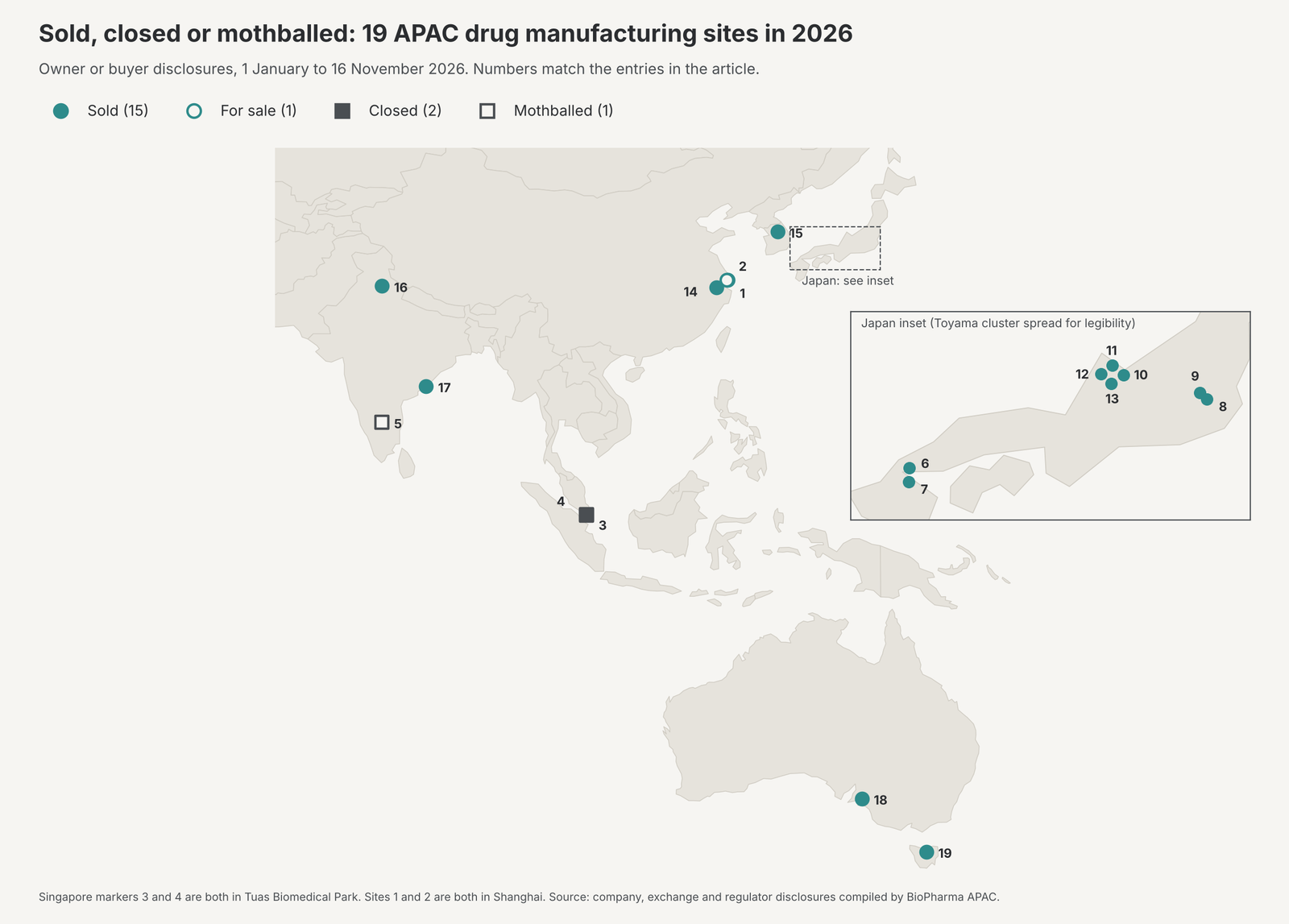
Figure: The 19 sites, coded by status. Numbers match the entries below. Japan's eight sites are shown in the inset
Openings in this region arrive with ceremony. There is a groundbreaking, a ribbon, a minister and a press release with a capacity figure in the headline. Exits arrive as a line in an exchange filing, a statement emailed to a local newspaper, or a short notice posted in Japanese on a weekday evening. That is why the capacity story Asia-Pacific tells itself is only ever half told.
So we went looking for the other half. Between 1 January and 16 November 2026, we found 19 GMP drug substance or drug product sites in APAC that their owners or buyers disclosed as sold, closed, mothballed or formally put up for sale. Fifteen were sold or placed under binding transfer agreements. Two are closing. One sits idle while its owner looks for a buyer. One is being auctioned on an exchange.
Three patterns stand out. The buyers are overwhelmingly local: of the 15 sites sold, 14 went to a buyer headquartered in the same country as the plant. The closures and the idle site all belong to Western companies, which also account for the one site on the open market and one of the outright sales. And Japan alone supplies eight of the 19 sites, every one of them passing from one Japanese company to another as the country's off-patent manufacturing base reorganises.
That shape answers the question this ledger was built to ask. The region is not losing manufacturing so much as reassigning it, from owners who no longer want plants to owners who need them.
How we counted
A site qualifies if it is a GMP drug substance or drug product facility in APAC, and if its owner or buyer disclosed in 2026 that it was sold, closed, mothballed or formally offered for sale. Small-molecule, biologics and fill-finish sites all count; API-only sites are flagged. Both the action and the reason come from the owner's or buyer's own disclosure, and where only the buyer explained itself, we say so. Signed transfers awaiting completion are counted as sold, with the expected completion date noted. Status is as of 16 November 2026. We excluded whole-company takeovers in which the plant was incidental to the deal, sales of brands or commercial units that carried no plant, and shutdowns forced by fire, flood or a regulator. Those last cases appear in a separate box below, because they matter, but they are not decisions to exit.
Part one: The leavers (sites 1 to 5)
Five sites belong to Western multinationals stepping back from Asian manufacturing. Their reasons differ, but none of them blames the host country.
1. Boehringer Ingelheim Biopharmaceuticals (China), Shanghai Zhangjiang
Owner before: Boehringer Ingelheim | Owner after: Shanghai RAAS Blood Products | Modality: biologics CDMO, mammalian cell culture | Disclosed value: up to RMB 20 million for 100% | Date: 23 September 2026 (buyer's filing) | Stated reason: buyer wants a self-controlled production base for its innovative drugs; target lost money in 2024, 2025 and Q1 2026
When Boehringer opened this Zhangjiang site in 2014, it was billed as the first international-standard biologics contract base a multinational had built in China, and it took part in the country's first pilots of biologics contract manufacturing. Twelve years on, it is changing hands for less than RMB 20 million. The buyer's filing, as reported by Yicai, shows why the price is so low: revenue fell from RMB 586 million in 2024 to RMB 232 million in 2025 and RMB 32.6 million in the first quarter of 2026, with losses in each period, including RMB 259 million last year.
RAAS, best known for blood products, has named innovative drugs as its second growth curve and wants control of the chain from target to commercial sale. Boehringer's own reasoning was not disclosed in anything we found. The buyer-side numbers are eloquent enough: a foreign-owned contract site without an anchor customer could not hold its ground as domestic CDMOs recovered. The Shortlist's CDMO profiles cover that competition; what matters here is that the plant keeps running under a Chinese owner.
2. Sino-American Shanghai Squibb (SASS), Shanghai
Owners before: BMS 60%, Shanghai Pharmaceuticals 30%, Sinopharm asset management 10% | Status: for sale; a buyer identified in Chinese press as Hillhouse has offered US$480 million for 100% | Modality: small-molecule finished dose, mature brands | Disclosed value: listing floor of RMB 1.023 billion for Shanghai Pharma's 30% | Date: Shanghai Pharma listing notice, 4 February 2026 | Stated reasons: BMS, to focus resources on core areas; Shanghai Pharma, to maximise asset value through a market exit
China's first Sino-US pharmaceutical joint venture, founded in 1982, is being dismantled in the open. BMS agreed in 2025 to sell its stake. In February, Shanghai Pharma said it would list its own 30% on an equity exchange, pricing the floor off a confirmed bid of US$480 million for the whole company, and the Securities Times identified the bidder as Hillhouse.
The disclosures make the economics plain. SASS booked revenue of RMB 1.795 billion and net profit of RMB 248 million in 2024, then just RMB 87 million of profit in the first nine months of 2025. Its portfolio of off-patent originals has been squeezed by volume-based procurement. We found no completion announcement by mid-November, so the site stays in the for-sale column for now.
3. MSD, one plant at its Tuas campus, Singapore
Owner: MSD (Merck & Co.) | Status: closed | Modality: not disclosed | Headcount affected: not disclosed | Date: 18 March 2026 (statement to Lianhe Zaobao) | Stated reason: none given beyond confirmation that other Tuas plants are unaffected
MSD's statement was brief: affected employees had been told, and the closure would not touch the rest of its Tuas operations. Sources quoted by Lianhe Zaobao linked the move to restructuring prompted by US tariff policy, but that is the paper's sourcing, not the company's explanation, and we record it as such.
The closure sits inside a campus that is still growing on paper. The Economic Development Board has publicised MSD's US$500 million Singapore investment plan, including a secondary packaging facility and a plant for new inhaled medicines. Asked about the spate of closures, Singapore's trade ministry said in a 7 May written reply that they reflected individual companies' commercial circumstances rather than any weakening of Singapore's value proposition. Whether the city-state is losing ground to rival hubs is a separate argument, made in the Shortlist's hub-competition piece; this ledger simply records the site.
4. BioNTech, Tuas Biomedical Park, Singapore
Owner: BioNTech (bought from Novartis in November 2022) | Status: closing by end-February 2027 | Modality: mRNA vaccines and therapeutics | Headcount: 85 employees | Date: 1 April 2026 | Stated reason: a comprehensive footprint review concluded the site no longer fits long-term strategy
This is the clearest case in the ledger of capacity built for a demand curve that did not arrive. BioNTech bought the former Novartis plant at the peak of its pandemic earnings, made it a regional headquarters and planned to produce several hundred million mRNA doses a year there. With its cancer vaccines still in development and Covid-19 vaccine revenue falling, the company now projects a sharp revenue decline in 2026 and said it has no plans for another Singapore office after the closure.
5. AstraZeneca Pharma India, north Bengaluru
Owner: AstraZeneca Pharma India | Status: mothballed; operations ceased, assets in the process of sale | Modality: oral solid dose | Headcount: the Bengaluru campus housed more than 900 staff when the exit was first flagged | Date: quarterly disclosure published 19 February 2026 | Stated reason: strategic review of AstraZeneca's global manufacturing and supply network
AstraZeneca first said in 2023 that it would exit the plant and tried to sell it as a running facility to a contract manufacturer that could keep making its products. No such buyer appeared. Production stopped in the quarter to June 2025, and the manufacturing licence was surrendered that September. The February 2026 disclosure confirms the site's current state: idle, and the subject of an asset sale. A property report in April put the asking figure for the 64-acre site at around INR 3,400 crore; that number has not been confirmed in a company filing.
What the five share is a story about portfolio and network design in Cambridge, Rahway, Mainz, Ingelheim and Princeton, not about Shanghai, Singapore or Bengaluru. None of the three China-adjacent exits cites US biosecurity legislation as its reason; the reading of that law's effect on Asian capacity sits with our BIOSECURE analysis in Story 21. The economics the owners did cite are older and duller: mature portfolios under price pressure, contract plants without customers, and pandemic capacity without products.
Part two: Japan's quiet reshuffle (sites 6 to 13)
Eight sites, five transactions, zero closures. Every Japanese plant in this ledger moved from a company that wanted out of manufacturing, or out of a dosage form, to one that wanted more of it. The trade press has described these deals as part of a broader reorganisation of the generics and long-listed product industry, which has spent years recovering from quality scandals and supply shortages.
6 and 7. Tanabe Pharma Factory, Onoda (Yamaguchi) and Yoshitomi (Fukuoka)
Owner before: Tanabe Pharma | Owner after: Towa Pharmaceutical | Modality: small-molecule finished dose, including long-listed brands such as Urso and Depas | Headcount: more than 500 (as of 1 April 2026) | Date: announced 3 July 2026; share transfer planned for end-November 2026, product rights from April 2027 | Stated reason: shifting to a business model that does not rely on owning primary manufacturing facilities
Tanabe, now owned by Bain Capital after its sale by Mitsubishi Chemical, is the purest example of an owner deciding it should not own factories at all. Towa, a generics maker, takes the manufacturing subsidiary, both plants and the approvals for 17 products across 35 specifications. The capacity does not move; the balance sheet it sits on does.
8 and 9. Nipro Pharma, Saitama No. 2 (Kasukabe) and Hanyu plants
Owner before: Nipro Pharma | Owner after: Mikasa Seiyaku | Modality: topicals (poultices, tapes, external liquids) | Disclosed value: not disclosed | Date: basic agreement 21 January; definitive agreement 18 September; completion planned 1 December 2026 | Stated reasons: Nipro, to concentrate on its core injectables and oral forms; Mikasa, to raise capacity and spread production geographically for business continuity
This is a dosage-form exit, not a manufacturing exit. Nipro remains Japan's largest contract manufacturer and keeps building injectable capacity elsewhere; it simply no longer wants to make patches. Mikasa, whose core business is topical anti-inflammatory analgesics, wants exactly that.
The deal carries one complication. In July, Nipro Pharma recalled products after finding that the Hanyu plant had been manufacturing with a process that differed from the approved one, and Nikkan Yakugyo reported that the deviation may date back to 2012. The same outlet reported that Saitama Prefecture was concerned about the plant changing owners while the issue remained open. The transfer went ahead regardless, which makes Hanyu one of the more interesting handovers to watch in 2027.
10. Fuji Yakuhin, Toyama No. 2 plant, Toyama City
Owner before: Fuji Yakuhin | Owner after: Nippon Kayaku | Modality: injectables, contract development and manufacturing | Disclosed scale: about JPY 3 billion in annual sales (forecast for the year to March 2026) | Date: announced 30 March; completed 1 October 2026 | Stated reason (buyer): strengthen supply and expand capacity for anticancer drugs and biosimilars
Nippon Kayaku, which is reshaping its pharmaceutical business around oncology and contract manufacturing, gets ready-made injectable capacity. The seller did not publish a separate reason in anything we found.
11. Kyowa Pharma Chemical, Takaoka (Toyama) [API]
Owner before: Kyowa Hakko Bio (Kirin group) | Owner after: Dai Nippon Printing (DNP), renamed DNP Pharma Chemical | Modality: API only | Disclosed value: not disclosed | Date: agreement 15 July; completed 1 October 2026 | Stated reason (buyer): build a one-stop CDMO spanning APIs, formulations and packaging, as demand for integrated contract manufacturing grows
A printing company buying a drug-substance plant sounds odd until you read DNP's explanation: its precision organic synthesis grew out of printing chemistry, and it already runs an API business. Kirin's exit from a 1946-vintage Takaoka chemistry site to a buyer that wants to integrate it is consolidation in its most literal form.
12 and 13. Kyorin group plants, Takaoka and Inami (Nanto), Toyama
Owner before: Kyorin Pharmaceutical group | Owner after: Iyakuhin Kyoso Kiko, a new joint venture of Daito (49.1%), Meiji Seika Pharma (36.0%) and the Development Bank of Japan (14.9%), together with Kyorin's generics unit Kyorin Remedio | Modality: generic small-molecule finished dose | Date: basic agreement 24 April; definitive agreements 30 September; JV to be set up in December 2026, operations from 1 April 2027 | Stated reasons: Kyorin, to concentrate on new drugs; the JV, to consolidate sites and products and stabilise generic supply
Kyorin Remedio booked JPY 34.3 billion in sales and an ordinary loss of JPY 784 million in the year to March 2025, and its parent has decided generics are no longer its business. The joint venture plans to merge manufacturing sites, unify product approvals and turn Takaoka into a model plant for producing fewer products in higher volumes. With a state bank on the cap table, this is industrial policy in the form of a share purchase.
Taken together, Japan's eight sites show what consolidation looks like when it is working. Innovators and diversified groups are handing plants to specialists, and the specialists are promising to make fewer things in larger runs. Nothing closed, and Toyama, the country's historic medicine prefecture, ended the year with four of the eight.
Part three: The consolidators elsewhere (sites 14 to 19)
Outside Japan, the pattern repeats in different accents: a cash-hungry owner sells to a capacity-hungry one, usually in the same country.
14. HJB (Hangzhou), Qiantang New District, Hangzhou
Owner before: Transcenta | Owner after: WuXi Biologics | Modality: biologics | Disclosed value: RMB 190 million, against an appraisal of RMB 198.8 million | Date: signed 6 August 2026; long-stop date 31 December 2026, subject to shareholder approval | Stated reason: near-term cash without equity dilution and a materially improved going-concern position; future manufacturing to be outsourced
Transcenta built this plant to make its own antibodies and to sell spare capacity. It is now selling the plant, keeping some in-house CMC capability and planning to rely on third-party manufacturers, having already cut labour and operating costs in the first half. The reason is candid: the company needs cash and does not want to raise it by issuing shares.
The buyer is the more telling half of the transaction. China's largest biologics CDMO is absorbing a biotech's idle-ish capacity at a small discount to appraisal. Whether that reflects too much biologics capacity in China is the argument Fault Lines makes about CDMO overcapacity; the ledger's narrower observation is that the market cleared at near book value, and the plant stays in use.
15. Korea Union Pharm, Wonju (Munmak), Gangwon
Owner before: Korea Union Pharm (in court rehabilitation) | Owner after: Bukwang Pharmaceutical | Modality: oral solids, liquid injectables and dedicated cephalosporin antibiotic lines | Disclosed value: KRW 30 billion | Date: confirmed as final bidder 5 January; acquisition completed June 2026 | Stated reason (buyer): Bukwang's Ansan plant has run above 100% utilisation for four years; the deal lifts its production capacity by about 30%
This is the cleanest capacity-for-distress swap in the ledger. Union's modern plant, GMP-licensed in 2020, was running its solid-dose lines at 29% to 35% utilisation amid a management dispute, while Bukwang's own factory was overbooked at 113%. Dailypharm described it as a factory-centred deal: Bukwang gained liquid injectable capacity more than double its own, plus cephalosporin lines that Korean rules require to be segregated. The company was bought for its building, and it said so.
16. Biological E, Paonta Sahib, Himachal Pradesh
Owner before: Biological E | Owner after: Biodeal Pharmaceuticals | Modality: sterile injectables, with a carbapenem line operational | Disclosed capacity: 135 million units a year | Date: 29 September 2026 | Stated reason: Biological E is concentrating investment on its new vaccine R&D and CDMO campus in Telangana
An Indian vaccine major selling one of Himachal Pradesh's largest manufacturing sites to a contract manufacturer is a portfolio decision dressed as a real estate one. Biological E keeps building where its strategy now lives, while Biodeal gets an established sterile platform and plans to add pre-filled syringe and lyophilised formats.
17. Raghava Life Sciences, Visakhapatnam, Andhra Pradesh [API]
Owner before: Raghava Life Sciences | Owner after: RPG Active Pharma (RPG Life Sciences) | Modality: API and intermediates | Disclosed value and capacity: up to INR 135 crore; about 300 KL installed reactor capacity; 22 commercial APIs and 7 in development | Date: agreement 2 September; completed 16 September 2026 | Stated reason (buyer): capture a larger share of the API market with an EU-GMP plant
Sold as a going concern through a slump sale, this is the standard instrument of India's mid-market roll-up. The seller did not publish a reason; the buyer, on its second acquisition, wants regulated-market API capacity without waiting years to build it.
18. Mayne Pharma International, Salisbury, South Australia
Owner before: Mayne Pharma | Owner after: Evaris Pharma (Perth) | Modality: small-molecule contract development and manufacturing, plus Australian commercial operations | Disclosed value: A$55.5 million, or 0.79 times FY26 revenue of A$70.7 million | Headcount: 240 at the Salisbury factory | Date: 6 November 2026; completion expected in early 2027, subject to ACCC clearance | Stated reason: to make Mayne a business 100% focused on the United States
The 40-year-old Salisbury plant has had an anxious two years. During the failed takeover by Cosette, the suitor reportedly warned it could close the Adelaide site, and Australia's Treasurer was given room to set conditions on the plant. Now an Australian owner takes it, keeps the workforce and talks of growing contract manufacturing using an A$18 million upgrade Mayne has just completed. For the region's ledger, it is a near miss turned transfer: a plant that might have been closed by a foreign buyer is instead consolidated by a domestic one.
19. Extractas Bioscience, Westbury, Tasmania [API]
Owner before: an affiliate of SK Capital Partners | Owner after: Siegfried | Modality: purified products and drug substance | Headcount: part of three sites with about 400 employees in total | Date: signed 27 January; completed 1 May 2026 | Stated reason (buyer): strengthen Siegfried's small-molecule drug substance network, with a focus on controlled substances
The ledger's only cross-border purchase came from Switzerland, and the Tasmanian site was the smallest piece of a deal built mainly around Noramco's US plants. Siegfried now says it runs the world's largest small-molecule drug substance CDMO network. When a foreign acquirer did want an APAC site this year, it came as part of a global package, not as a bet on the region.
Shut, but not by choice
Several significant 2026 shutdowns fail our test because no owner chose them. They still removed capacity, and readers should weigh them alongside the ledger.
- Zydus Hospira Oncology, Gujarat: Pfizer said monsoon floods on 23 July 2026 severely damaged the plant. According to US pharmacists' body ASHP, Pfizer expects supplies of some cytarabine and irinotecan presentations to run out between late 2026 and early 2027.
- Viatris, Nashik: a February fire shut a key plant, contributing to a lower 2026 profit outlook.
- Piramal Pharma, Dahej: the Gujarat Pollution Control Board issued a closure notice on 3 February 2026 alleging violations.
- Sun Pharma, Assam: Reuters reported on 30 October that regulators ordered a halt to eye-care drug production pending a satisfactory compliance report.
- 21 Tuas South Avenue 6, Singapore: a nine-hectare, ready-built pharmaceutical plant was listed in June at an indicative S$90 million. The agent did not name the owner, so it falls outside our owner-disclosure rule.
What the ledger says
Set the 19 entries side by side and the region's exits sort neatly. By country: Japan eight, China three, India three, Singapore two, Australia two, South Korea one. By modality: eight small-molecule finished-dose sites, three biologics or mRNA sites, three API sites, two sterile injectable sites, two topical sites, and one MSD plant whose product type was not disclosed. By buyer: every sold site except Westbury went to a buyer in the same country.
The reasons owners gave fall into four families. The largest is focus: Tanabe, Nipro, Kyorin, Mayne, Biological E and BMS all said, in different words, that a plant no longer matched what they want to be. The second is cash: Transcenta said so outright, and Boehringer's buyer showed the losses. The third is network design, the explanation behind AstraZeneca, BioNTech and, so far as it said anything, MSD. The fourth comes from the other side of the table: Bukwang, Nippon Kayaku, DNP, RPG and Siegfried all bought because building would take too long.
So, consolidating or retreating? The evidence points firmly to consolidation. Fifteen of 19 sites will keep making medicines under new owners, often owners with more volume and sharper specialisation than the sellers. Retreat is real, but it is concentrated in one class of owner: Western multinationals pruning mature portfolios, idle contract units and pandemic-era capacity. Even there, two of their five sites (Shanghai Zhangjiang and, if the auction completes, SASS) are being sold into continued operation rather than shut.
There is a final irony. In the same year these Western owners stepped back from Asian plants, Asian manufacturers bought plants in the United States. Samsung Biologics completed its purchase of GSK's Rockville site in the first quarter, Bora closed its US$122.5 million acquisition of MacroGenics' Rockville operations in July, and Celltrion closed on Eli Lilly's Branchburg plant at the turn of the year. Capital in this industry is not leaving Asia. It is being redeployed by Asian companies, at home through consolidation and abroad through tariff hedging.
What to watch next
- SASS, Shanghai: whether Hillhouse completes its US$480 million purchase of 100% once the equity listing closes.
- Transcenta's Hangzhou plant: shareholder approval and completion before the 31 December long-stop date.
- Nipro's Hanyu plant: how the unresolved manufacturing deviation is handled after the 1 December handover to Mikasa.
- BioNTech, Tuas: wind-down by end-February 2027, and whether the site re-enters the market.
- Mayne's Salisbury plant: ACCC clearance and completion in early 2027.
Next year's commissioning list will again be the louder of the two. This one is worth keeping too.
Most Read
- Can APAC Biomanufacturing Decarbonise Without Pricing Itself Out?
- The Algorithm on the GMP Floor: AI Promises a Smarter Plant. Regulators Demand the Audit Trail.
- APAC's Peptide-Capacity Gamble
- After the Rush: APAC's mRNA and Vaccine Capacity Hangover
- The Biosimilar Race: Factory to the World — or Stuck in the Copycat Economy?
- The Vein-to-Vein Problem: Can APAC's Cold Chain Carry Advanced Therapies?
- Vectors, Plasmids and the CGT Trap: APAC's Cell and Gene Therapy Ambitions Face an Upstream Bottleneck
- Can APAC Build Radioligand Therapy Before the Atoms Decay?
- The Great Biopharma Reset: 50 Developments That Changed Everything in H1 2026
- Beyond the Trial: Can Real-World Evidence Earn Regulatory Trust in APAC?
- Beyond the Obvious Giant: Where APAC's Clinical Trials Go Next
- The Frontier That Won’t Quite Arrive
Bio Jobs
- Sanofi Turns The Page As Belén Garijo Steps In And Paul Hudson Steps Out
- Global Survey Reveals Nearly 40% of Employees Facing Fertility Challenges Consider Leaving Their Jobs
- BioMed X and AbbVie Begin Global Search for Bold Neuroscience Talent To Decode the Biology of Anhedonia
- Thermo Fisher Expands Bengaluru R&D Centre to Advance Antibody Innovation and Strengthen India’s Life Sciences Ecosystem
- Accord Plasma (Intas Group) Acquires Prothya Biosolutions to Expand Global Plasma Capabilities
- ACG Announces $200 Million Investment to Establish First U.S. Capsule Manufacturing Facility in Atlanta
- AstraZeneca Invests $4.5 Billion to Build Advanced Manufacturing Facility in Virginia, Expanding U.S. Medicine Production
News


