27 Biopharma Trends to Watch in the United States in 2027
24 November 2026 | Tuesday | Analysis
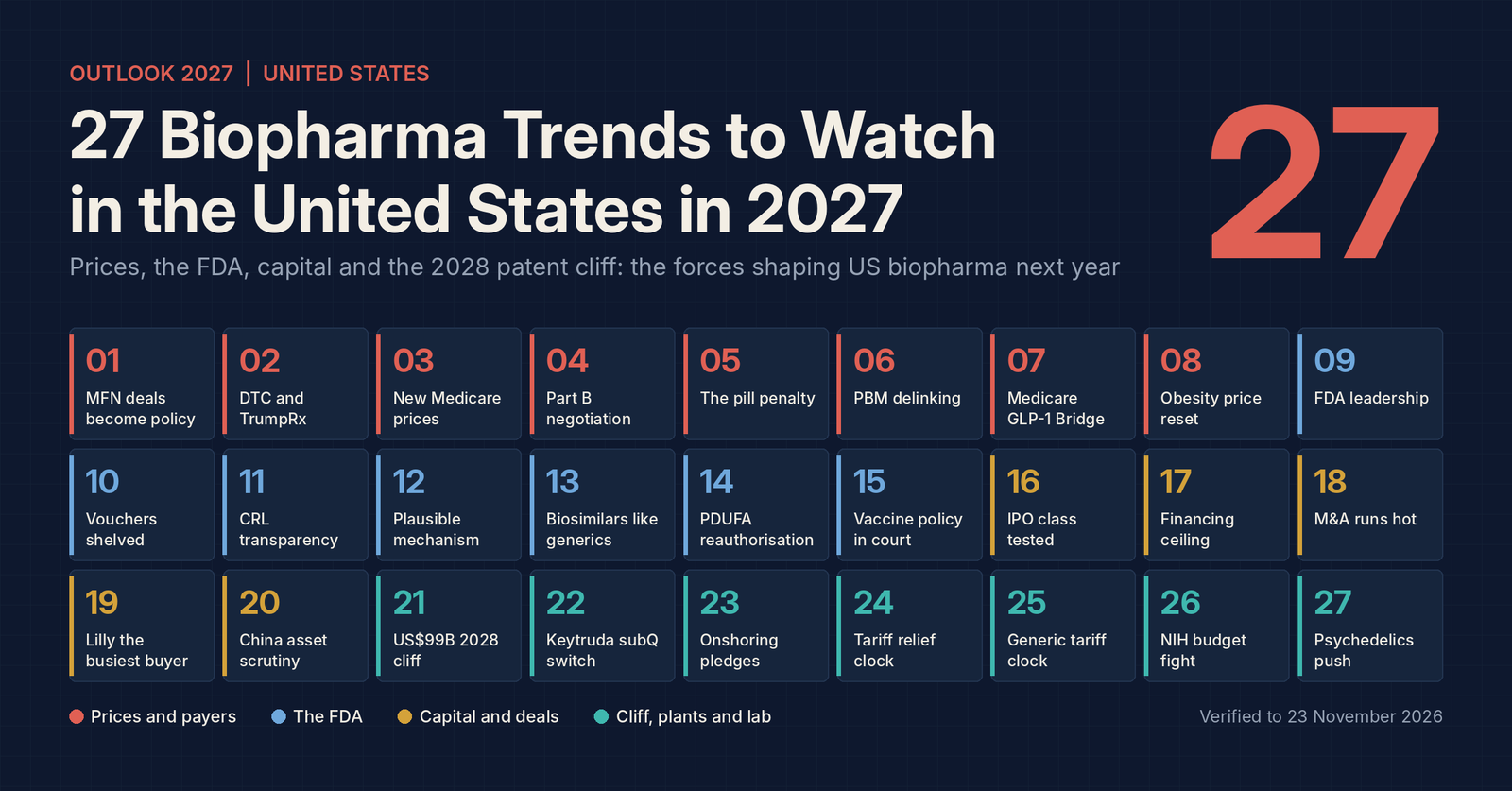
American biopharma ends 2026 in a strange position. Capital markets are the healthiest they have been in five years, with initial public offerings back, follow-ons flowing and mergers running at a post-pandemic high. At the same time, the industry has never been more exposed to Washington. Prices are now negotiated by Medicare, benchmarked to other countries through voluntary deals and sold directly to patients through a government website. Tariffs and onshoring pledges are reshaping where medicines are made. And the agency that approves them spent most of the year without a confirmed leader.
That mix makes 2027 a year of implementation. Many of the big decisions were taken in 2025 and 2026. Next year is when they land in contracts, formularies, plants and review queues. The 27 trends below are the ones we think will matter most. Each entry opens with the question it answers, sets out what we already know and names the signal to watch. Where a date is fixed, we give it.
A word on selection. We did not rank these trends. Each had to meet three tests: it moves money or policy at national scale, it can be tracked against a primary record or a named data source, and it will produce a visible answer within 2027. Several pull against each other. Washington wants lower prices and more domestic investment. Investors want growth and predictability. Patients want access. How those demands are reconciled is the story of the year ahead.
Movement one: prices and payers
1. Do most-favored-nation deals become permanent policy?
Will the White House's drug pricing deals outlast the headlines? That is the central pricing question for 2027. By the end of August 2026, the administration had signed most-favored-nation agreements with 26 manufacturers, which it says cover 89 percent of the branded drug market, with earlier signatories exempted from the 100 percent tariff on patented drugs. Analysts at Health Affairs have noted that many terms remain undisclosed. Watch whether the voluntary agreements are written into Medicaid and Medicare payment models. Codification would turn a negotiation into a rule, and rules are much harder to unwind. The other variable is behaviour: the companies that signed deals still raised list prices on hundreds of brands in January 2026, which shows how much room the agreements leave. Watch the January 2027 price increase season for the same signal.
2. Direct-to-patient sales become a real channel
Will patients actually buy medicines through TrumpRx and company websites? The infrastructure now exists. TrumpRx.gov launched on 5 February 2026, offering cash prices aligned with most-favored-nation levels, and companies including Eli Lilly now sell directly to patients. Lilly's oral obesity drug Foundayo launched at US$149 a month for self-pay patients. Watch volumes, not announcements. If cash-pay channels capture meaningful share in obesity and other consumer-facing categories, the role of insurers and pharmacy benefit managers in the US drug market will begin to shrink. That would be the most significant change in American drug distribution in a generation, and it would hand manufacturers a direct relationship with patients that they have never had at scale.
3. Medicare's second set of negotiated prices takes effect
What changes on 1 January 2027? Medicare starts paying negotiated prices for 15 more drugs. The second round of negotiation set prices that CMS says would have saved 44 percent on net spending, including US$274 a month for semaglutide, against a list price of US$959 for Ozempic. Watch the first quarterly results of affected companies. For several, 2027 will be the first year a top-selling product carries a government-set price in its largest payer channel. The first ten negotiated prices took effect in January 2026, so investors now have a year of data on how negotiated prices flow through to reported revenue. Expect that template to be applied quickly to the second cohort.
4. Physician-administered drugs enter negotiation
What is new about the third round of Medicare negotiation? It reaches Part B. CMS selected 15 drugs in January 2026 for prices effective in 2028, including physician-administered drugs for the first time, plus one drug for renegotiation. Five of them, including Orencia, Entyvio, Xolair, Botox and Cimzia, have most of their spending under Part B. The next selection list is due early in 2027. Watch which oncology and immunology biologics make it. Part B negotiation changes the economics of infused medicines in ways the oncology business has not yet fully priced in.
5. The fight over the "pill penalty" continues
Will Congress equalise negotiation timelines for small molecules? Not yet, but the pressure persists. Under the Inflation Reduction Act, small-molecule drugs face negotiation nine years after approval against 13 for biologics, and the bipartisan EPIC Act would extend small molecules to 13 years. The ORPHAN Cures Act, passed in 2025, already broadened the orphan drug exclusion. Watch any health package moving through the new Congress. Until the gap closes, expect capital to keep tilting toward biologics. That matters beyond finance: small molecules are typically cheaper to make, easier to take and simpler to distribute, so a structural bias against them shapes which medicines patients eventually get.
6. PBM delinking moves from law to contracts
How will the new PBM law change the market? Slowly, then suddenly. On 3 February 2026, President Trump signed the Consolidated Appropriations Act, which includes the first major federal reforms to pharmacy benefit managers in decades, centred on delinking PBM pay from list prices in Medicare Part D. Commercial plans face new transparency and rebate pass-through rules. Watch 2027 contract renewals and CMS implementing rules. Delinking removes one of the strongest incentives that has kept list prices high, which could also shift scrutiny back to manufacturers. Analysts have already noted that, once PBM compensation is decoupled from rebates, the public conversation about high list prices will have fewer intermediaries to blame.
7. Medicare's obesity coverage experiment runs through 2027
Will Medicare keep paying for obesity drugs? For now, yes. Medicare coverage of GLP-1s for obesity began in July 2026 through a temporary programme known as the GLP-1 Bridge, which was extended to the end of 2027 after the Medicare portion of the BALANCE model was delayed. Eligible patients pay a US$50 copay. Watch utilisation data and what CMS proposes for 2028. A financially sustainable long-term solution remains elusive, and whatever replaces the Bridge will define the largest drug class in American medicine. Part D plan bids for 2028 will be due in mid-2027, so CMS has limited time to decide.
8. Obesity prices keep falling
How low can US obesity drug prices go? Lower than anyone expected two years ago. Medicare's negotiated semaglutide price of US$274 sits above the US$245 the administration secured separately, and Lilly's Foundayo launched at US$149 a month for cash-pay patients. Watch how volume responds. If lower prices expand the patient pool enough, revenues can hold even as unit prices fall. If not, the obesity boom will show up in volumes but not in profits.
Movement two: the FDA
9. The FDA needs a permanent leader
Who will run the FDA in 2027? That remains unresolved. Marty Makary resigned in May 2026 after 13 turbulent months, and Kyle Diamantas, the agency's food chief, became acting commissioner. Reporting at the time noted that virtually all of the agency's senior career officials had resigned, retired or been forced out during the administration's first year. Watch for a nominee and Senate confirmation. Sponsors care less about any individual than about predictability, and predictability needs stable leadership in the review divisions. The drug center itself changed acting directors again in May, its latest turnover in a short period.
10. Fast-track experiments get paused
What happens to the national priority voucher? It has been shelved. The Commissioner's National Priority Voucher pilot, which promised reviews in as little as one to two months, produced its seventh approval by May 2026, but Reuters reported in November that the FDA had effectively shelved the programme, and that new complete response letter postings appeared to have stopped. HHS says work continues. Watch whether pending vouchers are honoured and whether any successor scheme emerges. Sponsors that planned around a one-month review need a fallback. Lawmakers had already questioned whether the pilot opened the door to political influence over reviews, so any replacement will face closer scrutiny from Congress.
11. Transparency on rejections stalls
Will the FDA keep publishing complete response letters? Possibly not. The agency's 2025 move to publish rejection letters was one of its most significant transparency changes, but November reports said new postings appeared to have halted. Watch the FDA website. Published letters let investors and competitors see exactly why applications fail, and their absence makes regulatory risk harder to price.
12. The plausible mechanism framework meets its first applications
Can bespoke gene editing therapies be approved without large trials? The FDA now says they can, in principle. Its February 2026 draft guidance set out a plausible mechanism framework under which sponsors of individualised genome and RNA therapies for ultra-rare diseases can generate substantial evidence without large randomised trials. A first-in-human study may serve as pivotal evidence. Watch for the first applications and for payer responses. Health Affairs analysts warn of a predictable gap between approval and reimbursement. If payers demand their own registries and endpoints on top of the FDA's, the ultra-rare populations the framework was designed for may not be able to support the evidence burden.
13. Biosimilars start to look like generics
Will biosimilar development get cheaper and faster? That is the intent. The FDA now generally does not recommend switching studies for interchangeable biosimilars, has proposed dropping most comparative efficacy studies and has eased pharmacokinetic requirements. As of August 2026, it had licensed 89 biosimilars, 42 of them interchangeable. Watch development timelines and launch counts. Cheaper biosimilars are the industry's fastest route to savings ahead of the 2028 patent cliff (entry 21). They are also the policy most likely to survive changes in leadership, because it has support from payers, manufacturers of biosimilars and both parties in Congress.
14. PDUFA reauthorisation becomes the year's regulatory negotiation
What is the biggest FDA decision Congress faces in 2027? Reauthorising the user-fee agreements. The current Prescription Drug User Fee Act authority runs to the end of fiscal 2027, on 30 September, and user fees fund a large share of drug review staff. Watch the commitment letter and the congressional hearings. Expect industry to push for staffing floors and review-time guarantees, and expect lawmakers to use the bill to settle questions about voucher programmes, advisory committees and transparency. In a year of leadership change and staff departures, PDUFA is where industry and Congress will try to lock in review timelines and staffing.
15. Vaccine policy stays in court and in flux
Where does US vaccine policy go next? Into continued uncertainty. In January 2026, federal officials replaced the childhood immunization schedule outside the usual ACIP process, moving several vaccines to shared clinical decision-making, but the revised schedule was removed in March after a Massachusetts district court stayed the changes. Insurers have committed to covering previously recommended vaccines through the end of 2026. Watch the court case and 2027 coverage commitments. Vaccine makers need to know who will pay, and at what scale. Lilly's decision to buy three vaccine companies in May (entry 19) is a bet that the market recovers. Few others have yet followed.
Movement three: capital and deals
16. The IPO class of 2026 faces its aftermarket test
Will the IPO window stay open in 2027? That depends on how this year's listings trade. By 10 November, 29 drug developers had priced US IPOs raising US$8.04 billion in base proceeds, against just eight in 2025, but only 12 were trading above their offer price. Kailera's US$625 million raise in April was the largest biotech IPO on record. Watch the first-year performance of this cohort. Investors forgive a slow start when the data come through, and they close the window quickly when they do not. The size of individual deals has also changed. Big-ticket offerings dominated 2026, which means the window has favoured well-financed companies with late-stage assets over early platforms.
17. Financing volumes test their ceiling
Is 2026's funding surge sustainable? The comparison base is now enormous. Biopharma companies raised US$98.5 billion across 898 financings in the first ten months of 2026, up 58.5 percent from the same period in 2025. Much of that was recycled from M&A proceeds. Watch the first quarter. If deal-driven cash keeps flowing back into new companies, 2027 can match 2026. If M&A slows, so will everything downstream.
18. M&A keeps running hot
Will pharma keep buying? The patent cliff says yes. Aggregate biopharma M&A reached US$130 billion in the first half of 2026, nearly matching all of 2025, and IQVIA says a best case of about US$250 billion for the year is in reach. Deals were bigger too, with three above US$10 billion in the first half alone, including AbbVie's acquisition of Apogee and GSK's of Nuvalent. Watch mid-sized commercial-stage targets. With revenue gaps opening in 2028, buyers need products that sell, not just promising science. Contingent value rights, used in roughly two-thirds of biotech acquisitions in 2025, will remain the tool of choice for bridging valuation gaps when data are still maturing.
19. Eli Lilly becomes the industry's busiest buyer
Who is setting the pace in dealmaking? Lilly. Beyond acquisitions including Centessa and Kelonia, Lilly signed 12 licensing deals with a combined value of US$28 billion in the first six months of 2026, and bought a trio of vaccine companies for US$3.8 billion in a contrarian bet on prevention. Its targets span gene therapy, in vivo CAR-T, multispecifics and ADCs. Watch what it buys next. Obesity profits are funding the broadest pipeline build in the industry, and rivals will have to respond. For smaller biotechs, Lilly has become the most important potential partner in the market, which gives its scientific priorities unusual influence over where venture money flows.
20. China-sourced assets face Washington's scrutiny
Can US companies keep licensing Chinese molecules? For now, but the perimeter is tightening. IQVIA notes that policymakers are raising concerns about the surge in licensing of Chinese-originated assets. The BIOSECURE Act's first list of biotechnology companies of concern is due by 18 December 2026, and Treasury has proposed rules that would bar covered US investments in Chinese biotech, with comments due 7 December. Watch the Biotech Investment National Security Act, which would extend coverage to licensing. If it moves, one of the industry's cheapest sources of pipeline gets more expensive. For now, the practical response from US buyers has been to structure deals carefully, often through US-domiciled NewCos, rather than to stop buying.
Movement four: the cliff, the plants and the lab
21. The 2028 patent cliff starts to bite in 2027
How big is the coming patent cliff? Evaluate forecasts US$99 billion of worldwide sales at risk from patent expiries in 2028 alone, led by Keytruda and Eliquis. Revenue does not vanish overnight, and lifecycle strategies blunt some of the fall. But 2027 is when guidance, budgets and deal plans have to reflect it. Watch 2027 company outlooks for the first explicit declines. The companies that have already bought replacements will be easy to identify. Bristol Myers Squibb, with both Eliquis and Opdivo approaching exclusivity loss, has one of the most concentrated exposures among large companies, and its 2027 guidance will be read closely.
22. Keytruda's subcutaneous switch becomes the test case
Can a reformulation protect a blockbuster? Merck is about to find out. Keytruda's core US compound patent expires in December 2028, and the subcutaneous version, Keytruda Qlex, reached US$830 million in third-quarter 2026 sales, or 9.7 percent of the franchise, with Merck hoping 30 to 40 percent of patients switch by 2028. Biosimilar developers are already filing. Watch the conversion rate each quarter. It will tell every company with a biologic patent cliff how much a delivery-device moat is worth.
23. Onshoring pledges meet construction schedules
How much of pharma's US investment is real? More than sceptics feared, less than headlines suggest. Commerce Secretary Howard Lutnick put the commitments secured by the administration at US$638 billion in September 2026, but CBRE found earlier in the year that only about US$60 billion of the announced capital spending had specific amounts and locations. Watch groundbreakings, permits and hiring. The gap between pledges and projects will narrow or widen visibly in 2027. Equipment suppliers are a useful early indicator: bioprocessing vendors only began to mention onshoring-driven orders in their third-quarter 2026 earnings calls.
24. Tariff exemptions start counting down
How long do pharma's tariff exemptions last? Not forever. Companies that signed most-favored-nation deals secured tariff exemptions for three years, and the zero rate for those with pricing and onshoring agreements runs through 20 January 2029. Watch for companies that slip on commitments, and for the next round of trade deals. In 2027, compliance with those agreements becomes a board-level risk.
25. Generic supply faces a tariff clock
Will the generic tariff disrupt American supply? It could. The administration has announced tariffs on imported generics of 100 percent from 1 August 2028, rising to 200 percent a year later, aimed largely at India and China. Most US prescriptions are generics, and margins are thin. Watch new US generic plant announcements and shortage data. If production does not move in time, the tariff could raise costs or worsen shortages rather than bring factories home. Generic makers operate on margins that rarely justify new American plants without long-term purchase commitments, which is why procurement policy may matter as much as the tariff itself.
26. The NIH budget fight returns
Will federal research funding shrink in 2027? The White House wants it to. The fiscal 2027 budget request seeks US$41.5 billion for NIH, a US$5 billion cut, and again proposes a 15 percent cap on indirect costs. Congress rejected deeper cuts last year and actually increased NIH funding for 2026. Watch the appropriations process. Academic research is the top of the biotech pipeline, and disruptions there show up in company formation years later. Funding grants upfront for several years has already meant thousands fewer awards, even where headline budgets held, because the same dollars are committed earlier to fewer projects.
27. Psychedelics get a federal push
Will the first psychedelic medicines reach patients? Washington wants them to. In April 2026, President Trump issued an executive order directing the FDA to grant national priority vouchers to appropriate psychedelic drugs with breakthrough designations, and the agency issued vouchers to three companies studying serotonin-2A agonists. With the voucher programme now shelved (entry 10), watch whether those reviews proceed on an accelerated timeline anyway. An approval would open an entirely new class in psychiatry. It would also be a test of whether politically prioritised reviews can still deliver decisions that the scientific community accepts.
The dates that will tell the story
Put the 27 together and three questions frame the year ahead. Will the administration's pricing deals become durable policy, or remain negotiable? Can the FDA provide the predictability that a booming capital market needs? And will the industry's acquisitions fill the revenue gap that opens in 2028?
The calendar will answer them in stages. On 7 December, comments close on Treasury's proposed biotech investment rule, and the first BIOSECURE list is due on 18 December. On 1 January 2027, Medicare's second round of negotiated prices takes effect. Early in the year, CMS names the next drugs for negotiation. Through the spring and summer, Congress works through appropriations and PDUFA reauthorisation, which must be complete by 30 September. Throughout, the Medicare GLP-1 Bridge, the first plausible-mechanism applications and Keytruda's subcutaneous conversion will show whether policy and science are moving in the same direction.
The United States remains the world's most valuable pharmaceutical market and its deepest pool of biotech capital. In 2027, it will also be the most regulated by politics rather than statute. Companies that treat Washington as a counterparty, not just a regulator, will be best placed to keep growing.
Most Read
- Can APAC Biomanufacturing Decarbonise Without Pricing Itself Out?
- The Algorithm on the GMP Floor: AI Promises a Smarter Plant. Regulators Demand the Audit Trail.
- APAC's Peptide-Capacity Gamble
- After the Rush: APAC's mRNA and Vaccine Capacity Hangover
- The Biosimilar Race: Factory to the World — or Stuck in the Copycat Economy?
- The Vein-to-Vein Problem: Can APAC's Cold Chain Carry Advanced Therapies?
- Vectors, Plasmids and the CGT Trap: APAC's Cell and Gene Therapy Ambitions Face an Upstream Bottleneck
- Can APAC Build Radioligand Therapy Before the Atoms Decay?
- The Great Biopharma Reset: 50 Developments That Changed Everything in H1 2026
- Beyond the Trial: Can Real-World Evidence Earn Regulatory Trust in APAC?
- Beyond the Obvious Giant: Where APAC's Clinical Trials Go Next
- The Frontier That Won’t Quite Arrive
Bio Jobs
- Sanofi Turns The Page As Belén Garijo Steps In And Paul Hudson Steps Out
- Global Survey Reveals Nearly 40% of Employees Facing Fertility Challenges Consider Leaving Their Jobs
- BioMed X and AbbVie Begin Global Search for Bold Neuroscience Talent To Decode the Biology of Anhedonia
- Thermo Fisher Expands Bengaluru R&D Centre to Advance Antibody Innovation and Strengthen India’s Life Sciences Ecosystem
- Accord Plasma (Intas Group) Acquires Prothya Biosolutions to Expand Global Plasma Capabilities
- ACG Announces $200 Million Investment to Establish First U.S. Capsule Manufacturing Facility in Atlanta
- AstraZeneca Invests $4.5 Billion to Build Advanced Manufacturing Facility in Virginia, Expanding U.S. Medicine Production
News