
The Batch Record Bottleneck in Life Sciences
22 October 2026 | Thursday | Analysis
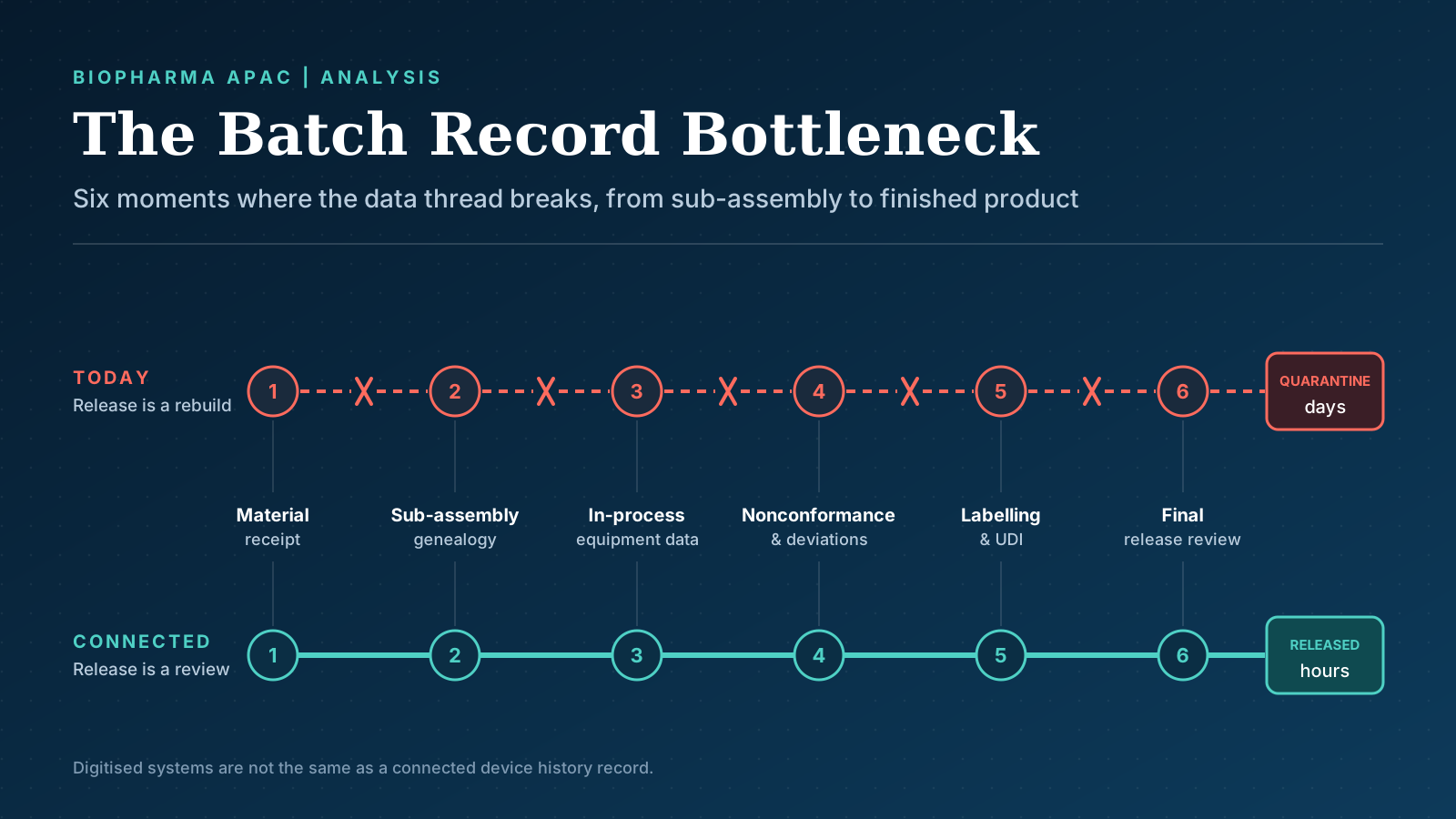
Walk into the finished goods area of almost any medical device plant at the end of a quarter and you will find the same quiet scene. Pallets of product sit behind a yellow line or inside a wire cage, labelled, sterilised, packed and ready to ship. Nothing is wrong with them. They are simply waiting for someone in quality to prove that nothing is wrong with them.
That proof is the device history record, and in 2026 assembling it remains one of the most stubborn bottlenecks in life sciences manufacturing. The irony is sharp. Over the past decade most device makers have spent heavily to digitise their operations. Paper travellers have been replaced by tablets at the workstation. Quality events live in an electronic QMS. Test stations write results to databases. ERP tracks every lot of resin, every reel of components, every sterilisation load.
The systems are digital. The data still is not flowing across them.
So when a batch finishes, a reviewer opens six or seven applications, exports reports, cross-checks lot numbers, chases a missing signature on a sub-assembly built three weeks earlier, and confirms that a nonconformance raised on the line was actually closed before the affected units moved on. Release becomes a rebuild of history rather than a review of it. This piece looks at why that happens, why it matters more this year than last, and how the vendor landscape is responding.
The digital paradox
The first wave of digitisation in device manufacturing was about replacing paper with screens. That was a necessary step, and it delivered real gains in legibility, data integrity and error-proofing at the point of work. But it was largely done system by system. Manufacturing execution went one way, quality management another, laboratory and test data a third, and supplier documentation often a fourth.
Each of those systems is now internally consistent and audit-ready. The problem lives in the gaps between them. A device history record, by definition, is a cross-functional object. It must show that every operation described in the master record was carried out, with the right materials, by trained people, on qualified equipment, with every deviation dispositioned and every label verified. No single application owns all of that.
Industry survey data cited widely by digital quality vendors puts the share of life sciences organisations reporting quarantine and release delays caused by data scattered across systems as high as 95 per cent. Whatever the precise number at any one company, quality leaders recognise the pattern immediately. Product sits while quality hunts across sub-assemblies and finished goods to reconstruct what happened on the floor.
The bottleneck is not a lack of effort. Release teams in most plants work extremely hard. The bottleneck is architecture. Digitising the steps did not connect the thread between them.
Why the pressure is rising in 2026
For years, slow release was treated as an operational irritant, a working capital problem for finance and a scheduling headache for supply chain. Three shifts in the regulatory environment have turned it into something more serious.
Inspections are up, and they are smarter
FDA's own compliance dashboard data shows the agency carried out roughly 2,330 device inspections in fiscal 2025, up from about 2,150 the previous year, an increase of around 8 per cent. Device warning letters edged up too, from 42 to 45. Across all product types the agency conducted close to 700 more inspections than in fiscal 2024.
The way inspections are targeted has also changed. FDA's internal AI system, Elsa, launched in June 2025, mines adverse event reports, Form 483 observations, open CAPAs and historical inspection outcomes to flag higher-risk facilities. Plants with unresolved inconsistencies in their quality data are, in effect, raising their own hand. The agency has also expanded unannounced inspections at foreign manufacturing sites, a development that matters directly to device makers and contract manufacturers across India, China and Southeast Asia.
QMSR has rewritten the rulebook
On 2 February 2026, FDA's Quality Management System Regulation replaced the decades-old Quality System Regulation and incorporated ISO 13485:2016 by reference. The familiar QSR labels of device master record, design history file and device history record no longer appear as defined terms. Their functions now sit within the ISO concepts of the medical device file and production records.
Practitioners stress that the substance of what a production record must prove has not softened. What has changed is the inspection model. On the same date FDA retired the Quality System Inspection Technique, which had guided investigators since 1999, and moved to a new compliance programme, 7382.850. Investigators can also now request records such as internal audit reports, supplier evaluations and management review minutes that were previously shielded. The practical effect is that the connections between production, supplier control and the wider quality system are more visible to inspectors than ever.
Validation is no longer the excuse
For a long time, the cost of validating integrations was the quiet reason connectivity projects stalled. Every interface between MES, QMS and ERP had to be scripted, tested and documented to exhaustion. In September 2025 FDA issued final guidance on Computer Software Assurance for production and quality system software, superseding the relevant section of its long-standing software validation guidance. The guidance takes a risk-based view, focusing rigour on functions that genuinely affect product quality and encouraging the use of system logs and audit trails as objective evidence.
In plain terms, the regulator has removed one of the main reasons manufacturers gave for keeping their systems apart.
What a release reviewer actually does
To understand the bottleneck, it helps to follow the reviewer. Consider a mid-sized manufacturer of a Class II single-use device with an electronic sub-assembly. A lot of finished devices completes final packaging on a Tuesday. Sterilisation is outsourced and the load returns the following week. Here is the reviewer's checklist, in practice.
First, pull the production record from MES and confirm every step was signed and every in-process check passed. Second, trace each sub-assembly lot back to its own record, which may have been built on a different line, in a different shift, sometimes at a sister site. Third, confirm the incoming components and raw materials were released, which means a trip into ERP and the supplier quality module. Fourth, check whether any nonconformances or deviations touched this lot or its sub-assemblies, and whether each one was closed with a disposition before the material moved on. Fifth, verify equipment calibration and maintenance status for every tool used. Sixth, reconcile labels and UDI data. Seventh, collect the sterilisation certificate and dosimetry results from the contract steriliser, often as a PDF in an email inbox.
Each check is reasonable. Done across disconnected systems, the sequence takes days. And every manual hop is an opportunity for the reviewer to miss something, which is exactly what an inspector is trained to look for.
Six moments where the thread breaks
When device makers map their release delays, the same six moments recur from sub-assembly through to finished product. These are the points at which data leaves one system and must be manually carried into another. Fix them and the record assembles itself. Leave them and every batch requires a reconstruction.
1. Material receipt and incoming inspection
The thread begins at the dock. Components arrive with certificates of conformance, incoming inspection results are recorded, and the lot status is set to released or held. Very often that status lives in ERP or a supplier quality module, while the operator on the line only sees a part number on a screen. If a lot is placed on hold after it has been issued to the floor, nothing in the MES necessarily knows. Connected, the line system checks material status at the moment of consumption and blocks a held lot from being used at all.
2. Sub-assembly build and genealogy
This is where many device records quietly fracture. Sub-assemblies are often built ahead of demand, stocked, and consumed later into different finished lots. Each has its own record. When the finished goods record simply references a sub-assembly serial or lot number without carrying its history, the reviewer must open each linked record separately. Connected genealogy means the finished device record inherits the full, reviewed history of everything inside it, so a sub-assembly that was already reviewed does not have to be reviewed again.
3. In-process inspection and equipment data
Test stations, vision systems, torque drivers, leak testers and weld controllers generate the most objective evidence in the whole process. Too often that data sits on the machine or in a local database, and the operator transcribes a pass result into the record. That is both a data integrity weakness and a review burden. Connected, the equipment writes directly to the record over standard industrial protocols, with values checked against limits automatically, and calibration status confirmed before the step can begin.
4. Nonconformance and deviation handling
The most time-consuming question in any release review is whether something went wrong and whether it was properly dealt with. When a nonconformance is raised in the QMS but the affected units continue through production in the MES, the two systems drift apart. Reviewers then spend hours cross-referencing NCR numbers against lots and serials. Connected, a nonconformance places an automatic hold on the affected material in production, and the hold can only be lifted by a dispositioned record. The deviation and the production record become the same story told once.
5. Final assembly, labelling and UDI
Labelling errors remain one of the most common causes of device recalls. The label content, the UDI, the lot and expiry, and the instructions for use must all match the approved specification for the market. When label printing, verification and the production record sit in separate tools, reconciliation becomes a manual count at the end. Connected, label issuance, print verification and UDI data are written into the record as they happen, and reconciliation is calculated, not counted.
6. Final acceptance and release review
The last moment is where all the others converge. Sterilisation certificates from external partners, final inspection results, open quality events, and market registration status must come together for a single disposition decision. If the first five moments are connected, this step becomes genuine review by exception: the reviewer sees only what deviated from expectation and signs off. If they are not, this is where the days are lost.
When the thread stays connected, release becomes a review, not a rebuild.
The real cost of a rebuild
The visible cost of slow release is inventory. Finished goods in quarantine tie up working capital, consume warehouse space and, for products with limited shelf life, burn through dating that customers will notice. For contract manufacturers, slow release can also delay invoicing and strain relationships with brand owners who are measured on their own on-time delivery.
The less visible costs are larger. Quality teams that spend their week assembling records are not analysing trends, improving processes or preparing for inspection. Reviewers under time pressure make mistakes, and a missed open deviation that surfaces later turns a release delay into a field action. And in an inspection environment increasingly shaped by data analytics, a pattern of late-closed CAPAs or inconsistencies between production and quality records is precisely the signal that draws attention.
There is also a strategic cost. Device makers are being asked to launch faster, manage more variants and personalise more products. A release model that scales linearly with headcount simply does not keep up.
The players: who is trying to fix it
The vendor landscape has converged on the bottleneck from different directions. Traditional MES providers are extending into quality and release. QMS and quality cloud providers are reaching down towards the shop floor. A newer generation of composable and no-code platforms is attacking the problem at the workstation and connecting upward. Here are the players device makers are most likely to meet.
Siemens: Opcenter Execution Medical Device and Diagnostics
Siemens is among the most established names in device MES, having absorbed the former Camstar medical device suite into its Opcenter Execution line. Opcenter Execution Medical Device and Diagnostics is built to generate electronic device history records and electronic batch records automatically as production runs, enforcing the process and capturing the as-built record in one place. Its strength is depth: forward and backward genealogy, enforced routing and support for discrete, batch and combination products, tied into the wider Siemens portfolio of Teamcenter PLM and Mendix low-code extensions. Siemens has highlighted Terumo Americas, a maker of Class III devices, as a customer that used Opcenter to cut material release from days to minutes. The trade-off, typical of enterprise MES, is implementation scale and the need for strong internal ownership.
MasterControl: Manufacturing Excellence
MasterControl comes at the problem from the quality side. Long known for its QMS, the company now offers Manufacturing Excellence, a cloud-based MES for life sciences that digitises production records for both batch records and device history records. Its pitch centres on in-line quality control, with checks and alerts built into operator workflows, and on real-time review by exception for faster release. The natural advantage is the connection to MasterControl's own quality suite, which keeps nonconformances, training and documents close to the production record. User reviews generally praise the review gains, while some note that validation and configuration can be demanding when workflows change often and that review by exception is harder to apply to very complex processes.
Tulip: the composable frontline platform
Tulip, a spin-out from MIT, represents the composable approach. Rather than a monolithic MES, it provides a no-code platform on which manufacturers build apps for workstations, inspections and device history records, with machines connected over industrial protocols such as OPC UA and MQTT. Tulip connects to ERP, QMS and PLM through prebuilt connectors and open APIs, pulling work orders and inspection plans down to the station and pushing completion data and deviations back up. It promotes review by exception as a way to shorten eDHR review cycles. The company raised a 120 million dollar Series D led by Mitsubishi Electric in January 2026, a signal of confidence in the model. Its appeal is speed and flexibility, particularly for new product introduction lines and greenfield sites. The governance question is how to keep dozens of locally built apps validated, consistent and controlled as a programme scales.
Veeva: Batch Release in the Quality Cloud
Veeva attacks the final moment of the thread directly. Veeva Batch Release, part of its Vault Quality suite, aggregates batch-related information from quality, regulatory and manufacturing systems into a single execution page to support the disposition decision. It is genealogy aware, and recent functionality automates market-specific release decisions by checking registration status from Veeva RIM. Veeva has been explicit that it relies on predictable, rule-based logic rather than AI for the disposition step itself, a choice many quality leaders will welcome. Today the product is positioned primarily for pharmaceutical and biopharma batch disposition, and it requires Veeva QMS, so device makers will want to assess fit carefully. But its architecture, a release cockpit that sits above execution systems, is a clear model for where the market is heading.
PTC: Connected Work Cell on ThingWorx
PTC brings an industrial IoT and digital thread angle. Its Connected Work Cell application, built on the ThingWorx platform, delivers digital work instructions and eDHR creation, connecting to upstream enterprise master data and downstream systems while capturing production data down to individual parts and tasks. For manufacturers already invested in PTC's Windchill PLM, the attraction is continuity from design through to the as-built record, which matters more under a regulation organised around the medical device file.
Critical Manufacturing
Critical Manufacturing, owned by ASMPT, offers a modern MES with specific capabilities for medical devices, including electronic device history records, exception management, non-conformance management, sampling and certification management. It tends to appeal to high-mix, highly automated device and electronics manufacturers that want a single, modern execution layer with strong automation integration.
ComplianceQuest and the quality-native challengers
ComplianceQuest, built on the Salesforce platform, has been vocal about the gap this article describes, arguing that traditional electronic batch record systems alone are not enough when manufacturing and quality continue to run independently. Its approach is to bring production and traceability record review into the same environment as quality events. It is representative of a group of quality-native vendors betting that the release decision belongs in the QMS rather than in the MES.
The established heavyweights
Device makers will also meet Rockwell Automation, whose portfolio spans plant-floor automation and cloud MES; Dassault Systèmes, whose DELMIA Apriso is deployed across complex discrete manufacturing; and Körber, whose PAS-X MES is a reference in pharma and increasingly relevant to combination products. Each brings scale and integration with its own automation or PLM ecosystem.
Platform or stack: the architecture choice
Behind the vendor names sits a more fundamental decision. Broadly, device makers are choosing between three architectures.
The first is the integrated suite: a single MES that owns execution, genealogy, nonconformance handling at the line and the electronic record, with tight integration to one QMS. This minimises the number of seams but concentrates risk and can be slower to change.
The second is the quality-led cockpit: execution systems remain as they are, and a release or quality platform aggregates their outputs for a rules-based disposition. This is faster to deploy over an existing estate, but only as good as the data feeding it. If moments one to five remain disconnected, the cockpit simply displays the gaps more clearly.
The third is the composable layer: flexible, workstation-level apps that connect machines and people and push structured data up to enterprise systems. This is quick to start and well suited to new lines, but needs disciplined governance to avoid creating a new generation of silos.
In practice, mature manufacturers increasingly combine these approaches. The point is not which vendor wins. The point is that every one of the six moments must have a defined system of record and an automated hand-off to the next. An architecture that cannot answer the question of which system owns the truth at each moment will keep producing rebuilds, however modern its screens.
The Asia-Pacific angle
For readers in Asia-Pacific, the bottleneck carries extra weight. The region is now a major source of devices and components for the US and European markets, whether through multinational plants in Singapore, Malaysia and Thailand, a rapidly growing domestic manufacturing base in India supported by government incentives, or the deep contract manufacturing ecosystem in China. FDA's expansion of unannounced foreign inspections means these sites can no longer count on weeks of notice to assemble records.
Contract manufacturers face a double challenge. Their brand-owner customers increasingly expect near real-time visibility into production and quality data, while FDA enforcement in 2025 repeatedly flagged weak sponsor oversight of contract manufacturing operations. A CMO that can hand over a connected, reviewable device history record in hours rather than days is offering a genuine competitive advantage, not a compliance chore.
There is an opportunity here too. Many of the region's newer facilities are greenfield. They have the chance to design connectivity in from day one rather than retrofit it, and to adopt risk-based software assurance from the outset rather than inherit a legacy of over-documented validation.
A practical roadmap for quality and operations leaders
Turning release from a rebuild into a review is not a single project. Manufacturers that have made progress tend to follow a similar sequence.
- Map the thread before buying anything. Take one representative product family and trace every data hand-off from incoming material to final release. Mark each of the six moments, the system that owns it and how data crosses to the next. Most teams are surprised by how many hops are manual.
- Measure release as a process. Track the time from end of production to disposition, and break it down by cause. If most of the delay sits in waiting for external certificates, the fix is different from one where reviewers are reconciling nonconformances.
- Fix the hold logic first. The single most valuable connection is between nonconformance management and production status, so that affected material is held automatically and cannot progress until dispositioned. It removes the hardest question from the release review.
- Connect equipment at source. Replace transcribed results with direct capture from test and inspection equipment. This strengthens data integrity at the same time as it cuts review time.
- Define review by exception rules explicitly. Agree with quality which conditions require human attention and which can be auto-verified. Document the rationale in line with risk-based software assurance so it stands up in inspection.
- Bring partners into the thread. Sterilisers, component suppliers and contract manufacturers are part of the device history. Structured data exchange with key partners, rather than emailed PDFs, often unlocks the final days of delay.
Release as a review, not a rebuild
The medical device industry did the hard work of the first digital transformation. Paper is largely gone, records are electronic, and audit trails are in place. The second transformation is less visible but more valuable: connecting the thread so that the history of a device writes itself as the device is made.
Regulators are pushing in the same direction. QMSR has aligned the US with the international framework built around the medical device file. FDA's risk-based approach to software assurance lowers the cost of building connected systems. And a more data-driven inspection model rewards manufacturers whose production and quality records tell one consistent story.
The vendors are ready, from enterprise MES suites to quality clouds to composable platforms. What remains is a management decision: to treat the device history record not as a document assembled at the end, but as a living thread that runs from the first component received to the last label applied. Plants that make that choice will find the pallets behind the yellow line moving a great deal faster.
Most Read
- Can APAC Biomanufacturing Decarbonise Without Pricing Itself Out?
- The Algorithm on the GMP Floor: AI Promises a Smarter Plant. Regulators Demand the Audit Trail.
- APAC's Peptide-Capacity Gamble
- After the Rush: APAC's mRNA and Vaccine Capacity Hangover
- The Biosimilar Race: Factory to the World — or Stuck in the Copycat Economy?
- The Vein-to-Vein Problem: Can APAC's Cold Chain Carry Advanced Therapies?
- Vectors, Plasmids and the CGT Trap: APAC's Cell and Gene Therapy Ambitions Face an Upstream Bottleneck
- Can APAC Build Radioligand Therapy Before the Atoms Decay?
- The Great Biopharma Reset: 50 Developments That Changed Everything in H1 2026
- Beyond the Trial: Can Real-World Evidence Earn Regulatory Trust in APAC?
- Beyond the Obvious Giant: Where APAC's Clinical Trials Go Next
- The Frontier That Won’t Quite Arrive
Bio Jobs
- Sanofi Turns The Page As Belén Garijo Steps In And Paul Hudson Steps Out
- Global Survey Reveals Nearly 40% of Employees Facing Fertility Challenges Consider Leaving Their Jobs
- BioMed X and AbbVie Begin Global Search for Bold Neuroscience Talent To Decode the Biology of Anhedonia
- Thermo Fisher Expands Bengaluru R&D Centre to Advance Antibody Innovation and Strengthen India’s Life Sciences Ecosystem
- Accord Plasma (Intas Group) Acquires Prothya Biosolutions to Expand Global Plasma Capabilities
- ACG Announces $200 Million Investment to Establish First U.S. Capsule Manufacturing Facility in Atlanta
- AstraZeneca Invests $4.5 Billion to Build Advanced Manufacturing Facility in Virginia, Expanding U.S. Medicine Production
News


