
Japan's FY2027 Off-Year Drug Price Revision: 8 Numbers That Decide Who Pays
28 October 2026 | Wednesday | Analysis
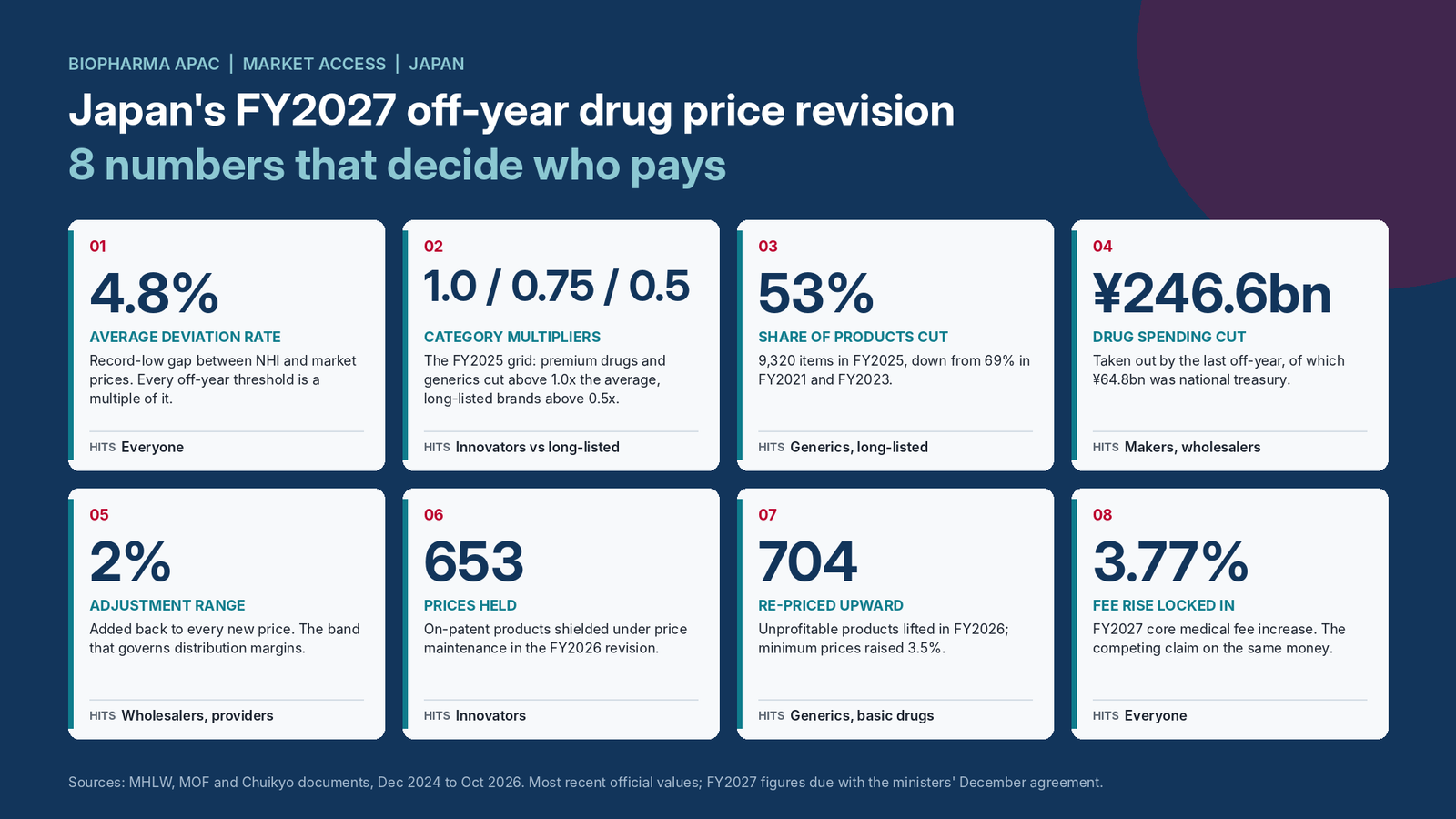
Japan's off-year drug price revision stopped being a question of whether some time ago. When the health and finance ministers closed the FY2026 budget round on 24 December 2025, their written agreement committed the government to carry out the FY2027 revision steadily. The honebuto economic and fiscal policy draft of 30 June 2026 repeated the commitment. Prime Minister Sanae Takaichi then defended it twice in October, on the 8th and the 14th, against opposition calls for outright abolition, promising to weigh innovation, stable supply and the public's financial burden together.
Inside the Central Social Insurance Medical Council (Chuikyo), nobody even argued the point. When its drug pricing subcommittee opened the FY2027 debate on 8 July, no member objected to holding the revision. The argument has moved on to two narrower questions that are worth far more money: which products are in scope, and which pricing rules are switched on.
The answer will arrive in two steps. In early December the Ministry of Health, Labour and Welfare (MHLW) reports the preliminary results of its September price survey to Chuikyo. Then, in the budget round in the second half of December, the ministers agree the revision, and Chuikyo turns that agreement into a formal outline (骨子) within days. New prices take effect on 1 April 2027.
For any company with a Japan P&L, that decision collapses into eight numbers. Each is set out below in the same four lines: the number, what it measures, the official document it comes from and its date, and who it hits. Where the FY2027 value is not yet published, we give the most recent official value and show where the debate is pushing it.
First, how the machine works
Every reimbursable drug in Japan carries a National Health Insurance (NHI) price. Hospitals and pharmacies buy below that price from wholesalers, then bill insurers at the full NHI price. The gap is the price margin (薬価差). A revision resets each price to the weighted average market price, plus consumption tax, plus an adjustment range. Until 2021 that happened every two years, alongside the medical fee revision. The four-minister basic policy of 20 December 2016 added a revision in the in-between years, aimed at products sold at large discounts. Japan has run three off-year revisions so far, in FY2021, FY2023 and FY2025. FY2027 is the fourth, and the first under an explicit political promise to balance innovation against premiums.
1. 4.8% the average deviation rate
|
Number |
4.8% (most recent official value). The FY2027 base will be the FY2026 survey figure, due early December 2026. |
|
What it measures |
The average gap between NHI prices and actual market prices across all listed drugs (平均乖離率), from September trades. |
|
Source and date |
MHLW preliminary results of the FY2025 drug price survey, Chuikyo general assembly, 3 December 2025. FY2026 survey design approved by Chuikyo, 8 July 2026. |
|
Who it hits |
Everyone. Every scope threshold in an off-year is a multiple of this number. |
This is the master number, because the off-year cut is built on it. The 4.8% reported in December 2025 was the lowest on record, down from 5.2% a year earlier, 6.0% in 2023 and 7.0% in 2022. But the pace of compression slowed: the 2025 drop was 0.4 points against 0.8 the year before. Underneath the average, the spread is wide. The 2025 survey put long-listed originators that face generic competition at 9.6% and generics at 8.7%, well above the market as a whole, while on-patent innovative products sit far lower.
The survey that will set the FY2027 base covered September 2026 trading and follows the off-year format Chuikyo approved on 8 July: two thirds of wholesaler sales offices, and a buyer sample half the size of a regular survey, meaning one in 40 hospitals, one in 400 clinics and one in 120 pharmacies. Physician members also asked MHLW to examine products distributed through a single wholesaler, which they suspect distort price formation.
Watch in December: Another record low would lower every threshold mechanically and, unless the multipliers in number 2 move, pull more products into the cut rather than fewer. That is the counterintuitive risk of a well-behaved market.
2. 1.0 / 0.75 / 0.5 the category multipliers
|
Number |
FY2025 multipliers of the average deviation: 1.0x for innovative-premium products and generics, 0.75x for other new drugs, 0.5x for long-listed products, 1.0x for other older drugs. |
|
What it measures |
The deviation threshold above which a product in each category is repriced in an off-year. |
|
Source and date |
“令和7年度薬価改定について”, agreement of the Chief Cabinet Secretary, Finance Minister and Health Minister, 20 December 2024. |
|
Who it hits |
Innovators with premium status (protected by a high multiplier) versus holders of long-listed brands (exposed by a low one). |
In FY2021 and FY2023, scope was set with a single flat multiplier of 0.625 for every product. FY2025 broke that habit. Against a 5.2% average, innovative-premium products and generics were cut only above 5.2%, other new drugs above 3.9%, and long-listed products above 2.6%. The design deliberately leaned on mature brands while shielding innovation and supply.
The FY2027 debate is about whether that grid survives, and at what levels. At the 7 October subcommittee meeting, the Japan Pharmaceutical Association's Daiki Watanabe argued that the original purpose of the off-year, catching products with large deviations, implies a multiplier above 1.0 now that the average has fallen to 4.8%. Payer members from Kenporen and Kyokai Kenpo argued the opposite: broad scope, with any narrowing done category by category as in 2025. Illustratively, if the 2025 grid were applied unchanged to a 4.8% base, long-listed products would be caught above 2.4%.
Watch in December: Whether the long-listed multiplier stays at 0.5x or below. That one coefficient decides most of the yen in number 4.
3. 53% the share of products cut
|
Number |
53% of listed products (9,320 items) in FY2025, against 69% in both FY2021 and FY2023. |
|
What it measures |
How many NHI-listed products receive a price cut in the off-year. |
|
Source and date |
MHLW estimate presented with the FY2025 outline draft, Chuikyo drug pricing subcommittee, 20 December 2024. |
|
Who it hits |
Generic makers and long-listed brand holders, whose portfolios are measured in thousands of items. |
Scope by share of items is the number that generic companies feel most, because they carry so many of them. The first off-year in FY2021, based on an 8.0% deviation, cut 69% of listed products, 12,180 items. FY2023 again reached 69%, around 13,400 items. The category design in FY2025 brought that down to roughly half the list.
The positions for FY2027 are clear. On 7 October the physician side and the industry's expert member both asked for fewer products in scope, the latter citing innovation and the international environment. The payer side asked for more. The share that emerges will be the most visible signal of which way the ministers leaned.
Watch in December: A share above 53% means the payer argument carried. A share well below it, combined with a higher multiplier, means the four-minister reading of the off-year as a narrow exercise won.
4. ¥246.6 billion the drug spending cut
|
Number |
¥246.6 billion reduction in drug spending from the FY2025 off-year revision, of which ¥64.8 billion was national treasury. |
|
What it measures |
The money the revision takes out of the system: what insurers stop paying and what the budget books as savings. |
|
Source and date |
Health Minister and Finance Minister budget agreement, 25 December 2024. Comparator: FY2026 regular revision, minus 0.86% of medical spending (minus 4.02% of drug spending, ¥105.2 billion treasury), agreed 24 December 2025. |
|
Who it hits |
Manufacturers lose the revenue; wholesalers revalue inventory on 1 April; payers and the treasury collect the saving. |
This is the figure the Ministry of Finance (MOF) negotiates for. The first off-year in FY2021 took roughly ¥430 billion out; the narrower FY2025 revision took about ¥247 billion. In its spring recommendation of 26 June 2026, MOF's Fiscal System Council said the FY2027 revision should be implemented in full, meaning broad scope and the full rule book.
The fiscal pressure is written into last December's agreement. The ministers committed to keeping the social insurance burden ratio in FY2027 from rising above its FY2025 level. With medical fees rising sharply (see number 8), drug prices are the most convenient place to find the offset.
Watch in December: The yen saving and its treasury share. A figure near or above the FY2025 level, on a smaller deviation, would mean the ministers widened scope or switched on more rules to get there.
5. 2% the adjustment range
|
Number |
2% of the current NHI price. |
|
What it measures |
The adjustment range (調整幅) added on top of the weighted average market price when a new price is calculated, intended to cover distribution costs and price variation. |
|
Source and date |
Standing MHLW pricing rule, applied in every revision. MOF’s Fiscal System Council asked in its autumn 2024 recommendation whether a uniform 2% regardless of price or drug type is justified; Chuikyo examined it again in the FY2026 reform debate. |
|
Who it hits |
Wholesalers, hospitals and pharmacies, whose purchase margins sit inside this band. |
The adjustment range rarely makes headlines, but it quietly governs how much of the market discount becomes a permanent price cut. A product sold at an average 5% below its NHI price does not lose 5%: it loses roughly 3%, because 2% of the old price is added back. Shrink the range and every cut deepens; widen it and every cut softens.
Nobody has formally proposed changing it for FY2027, and off-years have historically left it alone. But the wholesalers' federation used its 26 August hearing to press the cost side of distribution, and industry groups have asked that distribution costs assumed at listing actually be reflected in purchase prices. Any tinkering here would move margins across the whole chain at once.
Watch in December: Silence is the expected outcome. Any change to the 2% would be the single most consequential surprise in the decision.
6. 653 products whose price was held
|
Number |
653 products kept their price in the FY2026 revision under the innovative new drug price maintenance system (革新的新薬薬価維持制度, formerly the price maintenance premium). |
|
What it measures |
How many on-patent innovative products are shielded from market-price cuts while their deviation stays at or below the average. |
|
Source and date |
MHLW FY2026 drug price revision, gazetted 5 March 2026. The FY2027 treatment of the system was discussed at the Chuikyo drug pricing subcommittee, 7 October 2026. |
|
Who it hits |
Innovators, domestic and multinational, and their Japan launch decisions. |
For originator companies this is the number that matters most, because it measures the size of the safe harbour. In FY2025 the off-year honoured the maintenance premium and, for the first time in an off-year, deducted the accumulated premium from products that had lost eligibility. The open question for FY2027 is which other rules join it.
Payers argued on 7 October that every pricing rule should apply in the off-year, including market expansion re-pricing and the rules that push long-listed brands towards generics, not only the rules tied to market prices. Industry wants the opposite: a freeze on cuts to patent-period products, and no market expansion re-pricing or sustainability price adjustment in an off-year. Behind that sits the US most favoured nation pricing policy. Industry told Chuikyo on 26 August that companies are already reconsidering Japanese launches to protect US prices, and would think again if Japan priced more flexibly. Separately, last December's ministerial agreement set the FY2027 off-year as the point by which a conclusion on wider use of cost-effectiveness adjustments must be reached; that method is covered elsewhere in this series.
Watch in December: Whether price maintenance runs, and whether market expansion re-pricing is switched on. A yes to the second would be the clearest sign of a payer-leaning decision.
7. 704 products granted unprofitable re-pricing
|
Number |
704 products (232 ingredients) received unprofitable product re-pricing in the FY2026 revision; minimum prices were raised 3.5%. |
|
What it measures |
Price increases for essential products that lose money at their current NHI price (不採算品再算定), the main tool for propping up supply. |
|
Source and date |
MHLW FY2026 drug price revision, gazetted 5 March 2026; minimum price uplift agreed at Chuikyo, 16 January 2026. Industry data submitted to the Chuikyo drug pricing subcommittee, 26 August 2026. |
|
Who it hits |
Generic makers and producers of basic and supply-critical medicines. |
Off-years are not only about cuts. FY2025 ran unprofitable re-pricing as a temporary special measure and raised minimum prices for the first time since FY2000. FY2026 continued the support, lifting minimum prices by 3.5% and re-pricing 704 products upward.
Industry says it is not enough. In material submitted to Chuikyo on 26 August, generic makers reported that only 158 of their unprofitable items, roughly one in ten, won re-pricing in FY2026; that around 60% of those were still loss-making after it; and that 830 items classed as basic or supply-security medicines were left out. The ask for FY2027 is a wider, reliably applied floor, plus a general uplift reflecting inflation.
Watch in December: Whether unprofitable re-pricing runs again in an off-year, and on what scale. For generic makers this decides whether April 2027 is a net cut or roughly neutral.
8. 3.77% the fee rise already locked in
|
Number |
3.77% increase in the core medical fee (本体) for FY2027, following 2.41% in FY2026 (two-year average 3.09%). |
|
What it measures |
The rise in what hospitals, clinics and pharmacies are paid for services, already agreed for next year. |
|
Source and date |
Health Minister and Finance Minister budget agreement, 24 December 2025. |
|
Who it hits |
Indirectly, everyone in this list: it is the competing claim on the same money. |
This number is not part of the drug price decision, but it frames it. Last December the government pre-committed to a staged two-year fee increase that produced the first net revision above 2% in 32 years, and paired it with a FY2026 drug price cut that covered only one year. The FY2027 drug side was left to this December. The same agreement allows the wage and price components of the fee to be adjusted up or down in the FY2027 budget if the economy moves.
Providers have noticed. At Chuikyo on 7 October, the Japan Medical Association's Kazuhiko Ezawa said returning savings to the public should include investing them in quality of care, a clear request that part of the off-year saving flow back into fees. Payers want the saving to restrain premiums. The industry wants it to stay in the drug budget. The off-year is the pot all three are reaching into.
Watch in December: Whether the ministers' agreement earmarks any of the drug saving for fees, as FY2025's did for hospital meal charges and some dispensing and dental items.
So who pays?
Read together, the eight numbers sort the industry cleanly. Innovators live in numbers 2 and 6: their exposure depends on whether the premium multiplier holds at 1.0x and whether price maintenance survives an off-year that payers want to treat like a full revision. Long-listed brand holders live in number 2 as well, at the other end of the grid, and they are the most likely to pay for any widening. Generic makers live in numbers 3 and 7, where a wide scope can be partly offset by re-pricing support. Wholesalers live in numbers 4 and 5, absorbing the inventory hit on 1 April and depending on an adjustment range nobody wants to discuss.
The politics have rarely been less predictable. The Takaichi government has committed to the revision while promising balance. The Democratic Party for the People wants off-years abolished. MOF wants them complete. Chuikyo's own sides are split exactly as they were in 2024, with the physician and pharmacist members joining industry in asking for a small revision and payers asking for a large one. In that FY2025 round, the compromise was a category grid that cut half the list and ¥247 billion. The most likely FY2027 outcome is a variation on that template, with the multipliers and the rule book doing the real work.
The deviation rate arrives first, in early December. Read it against number 2, and you will know most of the answer before the ministers sign.
Most Read
- Can APAC Biomanufacturing Decarbonise Without Pricing Itself Out?
- The Algorithm on the GMP Floor: AI Promises a Smarter Plant. Regulators Demand the Audit Trail.
- APAC's Peptide-Capacity Gamble
- After the Rush: APAC's mRNA and Vaccine Capacity Hangover
- The Biosimilar Race: Factory to the World — or Stuck in the Copycat Economy?
- The Vein-to-Vein Problem: Can APAC's Cold Chain Carry Advanced Therapies?
- Vectors, Plasmids and the CGT Trap: APAC's Cell and Gene Therapy Ambitions Face an Upstream Bottleneck
- Can APAC Build Radioligand Therapy Before the Atoms Decay?
- The Great Biopharma Reset: 50 Developments That Changed Everything in H1 2026
- Beyond the Trial: Can Real-World Evidence Earn Regulatory Trust in APAC?
- Beyond the Obvious Giant: Where APAC's Clinical Trials Go Next
- The Frontier That Won’t Quite Arrive
Bio Jobs
- Sanofi Turns The Page As Belén Garijo Steps In And Paul Hudson Steps Out
- Global Survey Reveals Nearly 40% of Employees Facing Fertility Challenges Consider Leaving Their Jobs
- BioMed X and AbbVie Begin Global Search for Bold Neuroscience Talent To Decode the Biology of Anhedonia
- Thermo Fisher Expands Bengaluru R&D Centre to Advance Antibody Innovation and Strengthen India’s Life Sciences Ecosystem
- Accord Plasma (Intas Group) Acquires Prothya Biosolutions to Expand Global Plasma Capabilities
- ACG Announces $200 Million Investment to Establish First U.S. Capsule Manufacturing Facility in Atlanta
- AstraZeneca Invests $4.5 Billion to Build Advanced Manufacturing Facility in Virginia, Expanding U.S. Medicine Production
News


