27 Biopharma Trends to Watch in Europe in 2027
24 November 2026 | Tuesday | Analysis
Europe ends 2026 with a paradox at the centre of its biopharma industry. Its science is as strong as ever, its venture funds are raising record sums and several of the world's largest drugmakers are still headquartered on the continent. Yet the region is losing ground on almost every measure that decides where medicines are developed, made and launched first. Clinical trials have shifted to China and the United States. Capital and new factories are flowing across the Atlantic. And a US pricing policy designed to lower American drug costs has made European prices a liability for the companies that set them.
Brussels and national capitals spent 2026 responding. The EU's pharmaceutical package moved to the final stage of adoption, a Critical Medicines Act was agreed, a Biotech Act was proposed, and the UK raised the threshold its health system uses to judge value for money for the first time in more than two decades. 2027 is when those responses either start to work or start to look inadequate.
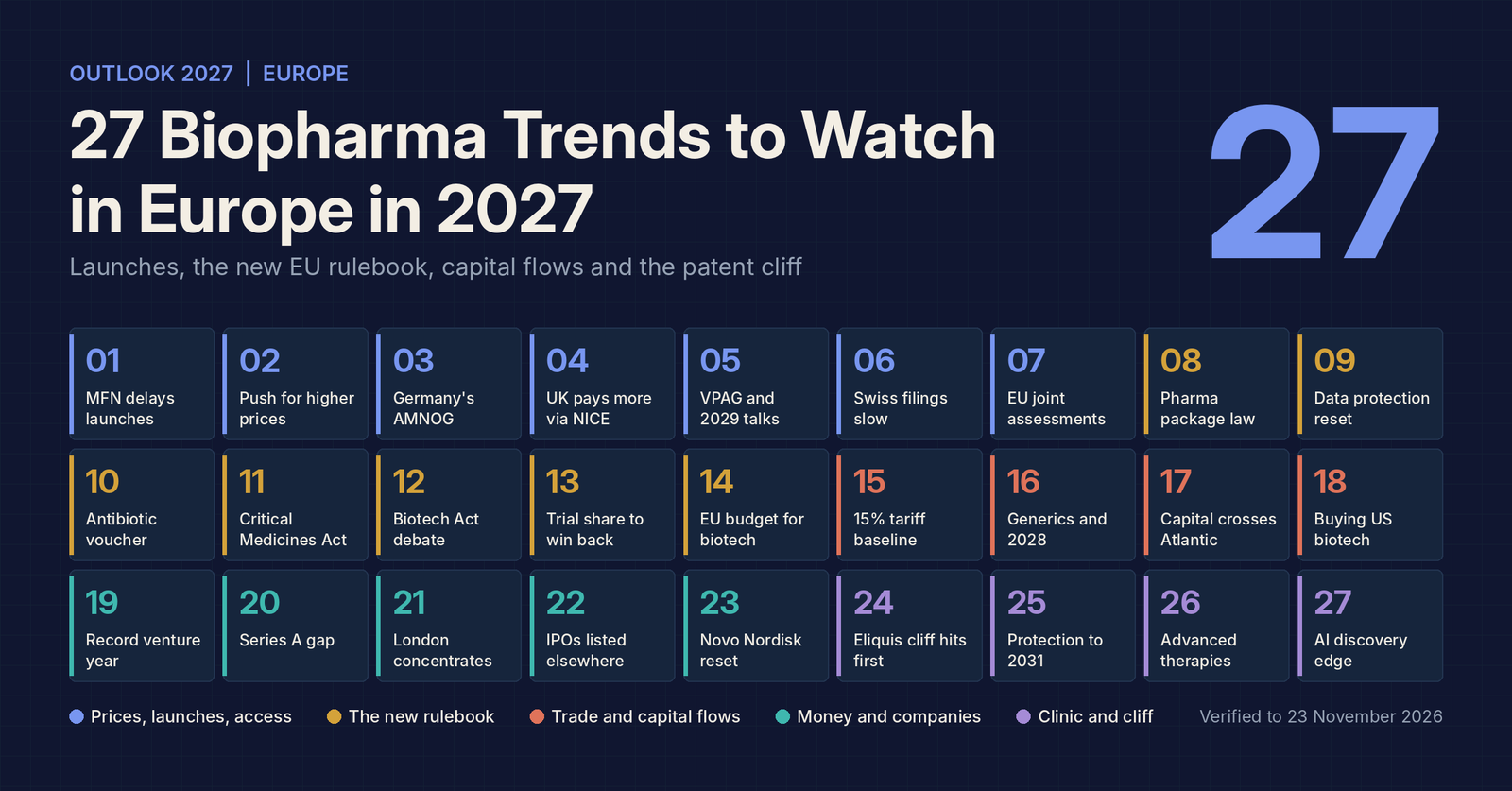
The 27 trends below are the ones we think will decide that. Each entry opens with the question it answers, sets out what we already know and names the signal to watch. We did not rank them. Each had to meet three tests: it moves money or policy at regional scale, it can be tracked against a primary record or named data source, and it will produce a visible answer within 2027.
Movement one: prices, launches and access
1. Will US price policy keep delaying European launches?
Are new medicines reaching Europe more slowly because of Washington? The data point that way. Roland Berger found that new drug launches in Europe fell by approximately 35 percent in the ten months after the May 2025 most-favored-nation executive order, as companies weighed whether a low European price would drag down their US price. Insmed postponed the European and Japanese launch of Brinsupri pending clarity. IQVIA notes the downturn may have begun earlier, so causality is still debated. Watch 2027 launch counts in the EU4 and the UK. A second year of decline would settle the argument. The practical response from companies is already visible: fewer simultaneous European rollouts, more careful sequencing and, in some cases, products withdrawn rather than priced low.
2. Drugmakers push for higher European prices
Will European governments pay more for new medicines? Industry is asking them to. Reuters reported in January that global drugmakers were bracing for a 2026 battle to secure higher prices in Europe, where countries pay around a third less than the US, after agreeing to cut American prices. Some governments have signalled resistance, including Italy as it tries to contain spending. Watch first-launch prices in Germany and France, which shape reference prices across the continent. Any upward movement would be the first since the system was built. More likely in 2027 is a quieter shift toward confidential discounts, which let headline prices rise while net prices stay contained.
3. Germany rethinks AMNOG under pressure
Will Germany reform its drug pricing system? It is actively considering it. A government-led pharma and medtech dialogue launched in 2026 is examining whether to streamline or redesign the AMNOG benefit assessment, and a senior health ministry official said that if the US breaks away on pricing, Germany cannot compensate for the loss. Germany is named as a reference country in every US most-favored-nation model. Confidential prices, introduced under the Medical Research Act, already give some companies an escape route. Watch the dialogue's recommendations. Germany's choices set the tone for Europe. Statutory insurers are pushing in the opposite direction, calling for limits on the six-month free pricing period that new medicines currently enjoy, so any reform will be a negotiation rather than a gift to industry.
4. The UK tests whether paying more buys access
Will a higher NICE threshold bring more medicines to NHS patients? London is betting that it will. Under the December 2025 UK-US pharmaceutical arrangement, NICE raised its baseline cost-effectiveness threshold from £20,000 to £30,000 per QALY to £25,000 to £35,000 from April 2026, the first increase in more than 20 years, and the UK committed to raise spending on new medicines from 0.3 to 0.6 percent of GDP over ten years. In return, UK pharmaceutical exports to the US face zero tariffs for at least three years. NICE expects three to five additional approvals a year. Watch 2027 appraisal outcomes and non-submissions. Critics, including the Nuffield Trust, argue that paying more per QALY will not automatically produce better population health, so the evidence from the first full year will shape the political case for the deal.
5. The UK rebate falls, and the 2029 scheme talks begin
What happens to the UK's branded medicines rebate? It has already fallen sharply. The VPAG headline rate for newer medicines was set at 14.5 percent for 2026, down from 22.9 percent in 2025, and the UK-US deal caps it at 15 percent through 2028. The current scheme ends after that. Watch the start of negotiations on a successor during 2027. Industry will want the lower rate locked in, while the NHS will want spending growth contained. The outcome will determine whether the UK's improved terms are permanent or temporary.
6. Switzerland becomes a launch-sequencing battleground
How is US pricing policy affecting Switzerland? Through reimbursement applications. Reuters reported in August 2026 that drugmakers were curbing Swiss reimbursement applications over US pricing concerns, a striking development in the home market of Roche and Novartis. Switzerland separately secured a 15 percent cap on US tariffs, down from 39 percent. Watch Swiss filings and federal pricing reform. If the country that hosts two of the world's largest drugmakers struggles to secure early launches, few others in Europe will do better.
7. EU joint clinical assessments scale up
Is Europe's new joint health technology assessment working? It is just getting started. The European Commission published the first joint clinical assessment report under the HTA Regulation on 9 June 2026, covering tovorafenib for paediatric low-grade glioma, and further reports followed in July. The regulation covers oncology medicines and advanced therapies now, with orphan drugs joining in 2028. Watch how national agencies use the joint reports and whether they reduce duplicate evidence demands. If they do not, companies face an extra layer of assessment rather than a simpler one.
Movement two: the new rulebook
8. The EU pharma package becomes law
When does the biggest EU pharmaceutical reform in two decades take effect? Formal adoption is nearly complete. The Council adopted the package on 28 September 2026, and the European Parliament must still give final approval before publication. The rules will generally apply 24 months after entry into force, which points to late 2028 or 2029. Watch the Parliament vote and Official Journal publication. Once the clock starts, every development plan in Europe will be measured against the new protection periods. The reform has been a decade in the making, with roots going back to 2016 and a formal Commission proposal in April 2023, so its arrival will close one of the longest policy debates in European health.
9. Data protection is restructured, not cut
How much regulatory protection will new medicines get? Slightly less market protection, the same data protection. The final text keeps eight years of regulatory data protection but cuts baseline market protection from two years to one, with conditional extensions and an overall cap of 11 years, or 12 with a transferable voucher. Products whose applications are submitted before 24 months after entry into force keep the old rules. Watch for a filing rush in 2028 and 2029. Planning for it starts in 2027.
10. Europe tries a new incentive for antibiotics
Will the transferable exclusivity voucher revive antibiotic development? That is the hope. Under the package, a company that develops a priority antimicrobial can obtain a voucher granting one additional year of regulatory data protection, which it can use on another product or sell. Watch voucher pricing and the first designations once the rules apply. If vouchers trade at meaningful values, Europe will have created the first pull incentive for antibiotics at continental scale.
11. The Critical Medicines Act targets supply security
How will Europe reduce its dependence on imported ingredients? Through the Critical Medicines Act. Parliament and Council reached a provisional agreement on 12 May 2026, and formal adoption could come by the end of 2026 or early 2027. The Council notes that 80 percent of imported pharmaceutical ingredients come from five countries, with China accounting for 45 percent, and the Union's 2026 critical medicines list includes around 300 products. Watch the first designated strategic projects. Money and procurement preferences, not legislation alone, will decide whether production comes back. Generic and API makers have long argued that European tender systems, which reward the lowest price, are what drove production to Asia in the first place.
12. The Biotech Act moves through Parliament and Council
Can the Biotech Act keep innovation in Europe? That is its stated purpose. Proposed on 16 December 2025, it amends the Clinical Trials Regulation and the advanced therapies framework to cut time to market, and adds a twelve-month extension to supplementary protection certificates for novel biotech medicines developed in the Union. A second Biotech Act was planned for late 2026. Watch co-legislators' positions through 2027. The SPC extension will be the most contested element, and its fate will signal how far the EU is willing to go on incentives. The Commission's May 2026 staff working document lists 17 separate interventions, from regulatory sandboxes to early scientific advice for smaller companies, so the final act could look quite different from the proposal.
13. Europe's clinical trial share becomes a political issue
Can Europe win back clinical trials? It needs to. The European Commission says the EEA's share of global clinical trials fell from 18 percent in 2013 to 9 percent in 2023, while China's rose to nearly 30 percent. EFPIA's analysis found that Europe's share of cell and gene therapy trials fell from 25 percent to 10 percent over the same decade. Watch whether the Biotech Act's clinical trial reforms move quickly and whether multinational trial starts in Europe stabilise. Trials are where launches, investment and expertise start. EFPIA has estimated that the decline translates into tens of thousands fewer trial places for European patients, which turns an industrial statistic into a patient access problem.
14. The next EU budget decides biotech funding
How much money will Brussels put behind biotech? The answer depends on the next multiannual budget. The Commission's proposal for a European Competitiveness Fund includes a health, biotechnology, agriculture and bioeconomy window with a total allocation of €20.4 billion, which the Biotech Act expects to draw on. Watch the 2028 to 2034 budget negotiations through 2027. Without real money behind them, the strategic project designations in both the Biotech Act and the Critical Medicines Act will be labels rather than levers.
Movement three: trade and capital flows
15. The 15 percent tariff becomes the baseline
How exposed is Europe to US pharmaceutical tariffs? Less than feared, more than before. The US-EU framework caps tariffs on EU branded pharmaceuticals at 15 percent and exempts European pharmaceuticals from additional Section 232 tariffs, while generics are treated separately. Medicines are the EU's largest export to the US by value, and analysts estimated the cost to the industry at US$13 billion to US$19 billion. Watch whether the cap holds through 2027. Any erosion would immediately change investment decisions across the continent. The EU accounts for about 60 percent of all US pharmaceutical imports, so even small changes in the tariff regime carry large sums. Ireland, Belgium, Denmark and Switzerland, whose economies rely heavily on pharmaceutical exports, have the most to lose.
16. Europe's generic makers watch the 2028 clock
Are European generics exposed to the planned US generic tariff? The framework suggests they are sheltered. Under the US-EU deal, generic pharmaceuticals, their ingredients and chemical precursors were placed under the lower standard tariff rate. The US has separately announced tariffs on imported generics of 100 percent from August 2028, aimed mainly at India and China. Watch how the two regimes interact. If Europe's carve-out holds, European generic and API makers could win share in the US as Indian and Chinese supply is penalised.
17. Capital and factories keep crossing the Atlantic
Where are Europe's pharma giants investing? Increasingly in America. Roche has committed US$50 billion to the US over five years, AstraZeneca US$50 billion in US manufacturing by 2030 and Novartis US$23 billion. Executives at Roche, Novartis and AstraZeneca have also publicly criticised European drug pricing and incentives for innovation. Watch the balance of new European versus US plant announcements in 2027. If Europe's own manufacturing investment does not keep pace, the Critical Medicines Act will be pushing against the current.
18. Europe's companies keep buying American biotech
Who are Europe's big pharma groups acquiring? Mostly US companies. GSK's US$10.6 billion acquisition of Nuvalent was among the three largest deals of the first half of 2026, following Novartis's US$12.7 billion purchase of Avidity and Sanofi's US$9.6 billion deal for Blueprint in 2025. Watch European buyers in 2027. Their acquisitions bring revenue but also move intellectual property and future R&D investment further toward the US.
Movement four: money and companies
19. European venture funding hits a record
Is Europe's biotech funding recovering? Strongly, at least in venture. PitchBook says European biotech is on track for a record venture year, with Europe claiming 20.5 percent of global biotech funding, its highest share since 2018. Paris-based Jeito Capital closed a US$1.2 billion second fund. Watch whether the momentum holds into 2027. Fundraising by specialist VCs is the leading indicator for company creation two to three years ahead. Smaller funds are also closing, including Kurma Partners' fourth biotech fund at €215 million, which suggests appetite is not limited to the largest managers.
20. Big rounds crowd out Series A
Is the money reaching early-stage companies? Less than it should. Speakers at BIO-Europe in November noted that European rounds above €100 million rose by 25 percent in 2026 while rounds below €15 million fell by 25 percent, leaving Series A as the gap. US investors are increasingly active in Europe but skew toward larger rounds. Watch Series A volumes. A healthy ecosystem needs a steady flow of new companies, not just bigger cheques for a few.
21. The UK concentrates Europe's biotech capital
Where is European biotech money going? Mostly to London. UK biotech raised £2.05 billion in venture capital in the second quarter of 2026, a five-year high, taking 61 percent of the £3.3 billion invested across Europe. Much of that came from Isomorphic Labs' record round. Watch breadth as well as totals. A single AI drug discovery megaround can flatter the numbers, and investors themselves have said that breadth matters more than the headline.
22. European biotechs keep listing elsewhere
Can Europe keep its winners? Not on current evidence. According to the European Commission's own Biotech Act analysis, 66 of the 67 EU biotech companies that went public over the past six years chose to list outside Europe. No UK biotech completed an IPO in the second quarter of 2026, even as the US window reopened. Watch for any European listing of scale in 2027, and for capital markets union measures aimed at life sciences. Without deeper local public markets, Europe will keep exporting its most valuable companies. A coalition of leading European venture investors has called for larger pension and institutional allocations to biotech funds and better capital markets, and 2027 will show whether policymakers respond.
23. Novo Nordisk's reset becomes Europe's bellwether
Can Europe's most valuable drugmaker regain momentum? That is one of the region's biggest corporate questions. Novo Nordisk cut its workforce by 13,000 over the past year as it lost ground to Eli Lilly, and chief executive Mike Doustdar set out plans in September to launch new multi-blockbusters and expand into new treatment areas. Watch obesity pipeline readouts and US pricing pressure. Novo's fortunes affect Denmark's economy, European equity indices and the continent's position in the largest drug class in the world. Its manufacturing footprint matters too: Novo is investing €432 million to upgrade its Athlone plant in Ireland to produce tablets, a sign of where it expects the obesity market to go.
Movement five: the clinic and the cliff
24. Europe feels the Eliquis cliff first
Where does the patent cliff hit first? In Europe. Eliquis lost exclusivity in Europe in May 2026, ahead of the US, and forecasts show Rest of World revenues falling by nearly 75 percent between 2025 and 2027 as tendering and formulary switching take hold. Watch European generic uptake and pricing. The speed of Eliquis erosion in Europe will be the industry's template for how fast big brands fall once generic competition arrives in tender-driven markets.
25. Europe keeps longer protection on two giants
Will Europe be the last major market for some blockbusters? For a while. Semaglutide's key patents run to 2031 in Europe, much later than in China, India or Canada, and pembrolizumab's European patent is expected to run to 2031, three years after the US. Watch biosimilar development and launch preparation for both. Europe may become the last premium market for these two products, which matters for how originators allocate supply and for how quickly European payers see savings.
26. Advanced therapies need a European home
Can Europe stay relevant in cell and gene therapy? Only if it acts quickly. Europe's share of cell and gene therapy trials fell from 25 percent in 2013 to 10 percent in 2023, while China's surged. The Biotech Act proposes changes to the advanced therapies regulation, and joint clinical assessments already cover advanced therapies. Watch EMA approvals of advanced therapies and where new trials start in 2027. Europe still has world-class academic centres in the field. Whether it keeps the companies they create is the open question. Manufacturing capacity for viral vectors and cell therapies is another constraint, and one where the Critical Medicines Act and the Biotech Act could combine to help.
27. AI drug discovery tests Europe's edge
Can AI give Europe a new advantage in drug discovery? It has a chance. Isomorphic Labs' record financing helped lift UK biotech venture investment to a five-year high in 2026, and the Biotech Act encourages trusted AI testing environments and data-driven approaches across the biotech value chain. Watch for the first AI-designed molecules from European companies entering the clinic, and for regulatory guidance on AI evidence. AI is one area where Europe starts the race close to the front.
The dates that will tell the story
Put the 27 together and three questions frame Europe's year. Will European governments pay more for new medicines, or accept fewer and later launches? Can the new rulebook (the pharma package, the Critical Medicines Act and the Biotech Act) be implemented quickly enough to matter? And will Europe's capital markets keep its best companies at home?
The calendar will answer them in stages. The European Parliament's final vote on the pharma package and its publication will start the 24-month clock. Formal adoption of the Critical Medicines Act is expected around the turn of the year. Through 2027, co-legislators will work on the Biotech Act and the next EU budget, Germany's pharma dialogue will report on AMNOG reform, and the UK will begin talks on a successor to VPAG. Throughout, launch counts, NICE decisions and European trial starts will show whether the response is working.
Europe still has the science, the talent and the companies to lead in biopharma. In 2027 it has to prove it also has the prices, the capital markets and the speed. The region has written its new rules. Next year will show whether it can compete under them.
Most Read
- Can APAC Biomanufacturing Decarbonise Without Pricing Itself Out?
- The Algorithm on the GMP Floor: AI Promises a Smarter Plant. Regulators Demand the Audit Trail.
- APAC's Peptide-Capacity Gamble
- After the Rush: APAC's mRNA and Vaccine Capacity Hangover
- The Biosimilar Race: Factory to the World — or Stuck in the Copycat Economy?
- The Vein-to-Vein Problem: Can APAC's Cold Chain Carry Advanced Therapies?
- Vectors, Plasmids and the CGT Trap: APAC's Cell and Gene Therapy Ambitions Face an Upstream Bottleneck
- Can APAC Build Radioligand Therapy Before the Atoms Decay?
- The Great Biopharma Reset: 50 Developments That Changed Everything in H1 2026
- Beyond the Trial: Can Real-World Evidence Earn Regulatory Trust in APAC?
- Beyond the Obvious Giant: Where APAC's Clinical Trials Go Next
- The Frontier That Won’t Quite Arrive
Bio Jobs
- Sanofi Turns The Page As Belén Garijo Steps In And Paul Hudson Steps Out
- Global Survey Reveals Nearly 40% of Employees Facing Fertility Challenges Consider Leaving Their Jobs
- BioMed X and AbbVie Begin Global Search for Bold Neuroscience Talent To Decode the Biology of Anhedonia
- Thermo Fisher Expands Bengaluru R&D Centre to Advance Antibody Innovation and Strengthen India’s Life Sciences Ecosystem
- Accord Plasma (Intas Group) Acquires Prothya Biosolutions to Expand Global Plasma Capabilities
- ACG Announces $200 Million Investment to Establish First U.S. Capsule Manufacturing Facility in Atlanta
- AstraZeneca Invests $4.5 Billion to Build Advanced Manufacturing Facility in Virginia, Expanding U.S. Medicine Production
News