China Plus One: Slogan, Strategy, or Capacity APAC Does Not Have?
16 July 2026 | Thursday | Analysis
THE RESHUFFLE · ANALYSIS
On a Monday in June 2026, one line in the United States Federal Register did what two years of lobbying had not. The Department of War added WuXi AppTec, the largest single name in pharmaceutical outsourcing, to its Section 1260H list of Chinese military companies. With that entry the company moved one procedural step away from being formally off limits to any drug program that touches United States federal money. WuXi AppTec called the finding mistaken and baseless and said it would pursue every remedy available. The rest of the industry quietly did the arithmetic.
That arithmetic is the real story. For most of a decade the phrase china plus one has circulated through biopharma boardrooms as if repeating it were the same as executing it. The idea is simple and seductive: keep China in the mix where you must, but stand up a second source somewhere else in Asia so that no policy shock in Washington can strand a pipeline. The Asia Pacific hubs, Korea, India, Japan and Singapore, have each spent the interval telling sponsors that they are that somewhere else. The question this analysis sets out to test is blunt. Is china plus one a working strategy, or a slogan that assumes a capacity nobody has actually built, on a timeline nobody can actually meet?
The stakes are not abstract. The volume of work potentially in motion is among the largest geographic rebalancing the industry has attempted since China first opened as a low cost hub in the 2000s. If the region can genuinely catch it, a generation of Asian CDMOs graduates from cost arbitrage to strategic anchor. If it cannot, sponsors are left holding validated processes they are contractually and scientifically bound to sites they are being told to leave.
// What Washington actually restricted
Start with what the law does and, just as important, what it does not do. The BIOSECURE Act became United States law on 18 December 2025, folded into the Fiscal Year 2026 National Defense Authorization Act as Section 851 and titled, plainly, a prohibition on contracting with certain biotechnology providers. It bars federal agencies from procuring biotechnology equipment or services from a biotechnology company of concern, and it bars contractors and grant recipients from using such equipment or services when they perform federally funded work. The trigger is a nexus to federal money: procurement, grants and loans. A purely private contract, funded entirely by a sponsor's own balance sheet, sits outside the four corners of the statute.
The enacted version dropped the feature that made earlier drafts so explosive. Previous iterations named five companies outright: WuXi AppTec, WuXi Biologics, BGI, MGI and Complete Genomics. The law as passed names none of them. Instead it defines a company of concern through two doors. The first is the Department of War's annual 1260H list of Chinese military companies, provided the listed firm is involved to any extent in biotechnology equipment or services. The second is a direct determination by the Office of Management and Budget. Landing on the 1260H list, in other words, is not the end of the process. It is the first prerequisite.
Which is exactly what happened in June. The updated 1260H list, running to 188 entities, added WuXi AppTec on the stated basis of indirect state ownership and affiliation with China's defence science apparatus and the People's Liberation Army. Notably, WuXi Biologics and the antibody drug conjugate specialist WuXi XDC were not added. BGI and MGI, the genomics names, were already there. So the single most consequential CDMO in the industry is now on the clock, while its biologics affiliate, for the moment, is not. That asymmetry is already shaping how sponsors triage their exposure.
The clock, however, is slow. Even now that WuXi AppTec is listed, the prohibitions do not bite immediately. OMB must publish its formal list of companies of concern by December 2026, then issue implementing guidance within 180 days, after which the Federal Acquisition Regulation Council has a year to rewrite procurement rules. For a 1260H company the ban takes effect 60 days after that rewrite. Run every clock to its statutory limit and the restrictions may not be enforceable until roughly mid to late 2028, with a five year grandfather protecting existing contracts out toward 2033. There is a waiver route as well, a single year with one six month extension, and an explicit carve out for medical countermeasures during a declared public health emergency.
Read one way, that timeline is comfort: years to plan. Read the way sponsors' risk committees are reading it, it is a countdown. A biologics tech transfer can consume most of it before a single commercial vial ships, which is why the counsel now landing on external manufacturing directors' desks says the same thing in different words. Do not wait for the OMB list. By the time it publishes, the queue for alternative capacity will already have formed.
// How deep the dependency actually runs
To grasp why a slow moving statute is causing fast moving anxiety, look at how thoroughly Chinese capacity is threaded through global pipelines. Industry surveys through 2025 put the share of United States biopharma companies that rely on a Chinese partner for at least part of a program at close to 79 percent. Estimates of the annual contract value exposed to BIOSECURE cluster in the range of 10 billion to 20 billion dollars. Outsourcing now accounts for roughly 40 percent of all pharmaceutical manufacturing, up from about 30 percent in 2018, and biologics, the modality where switching is hardest, make up close to 45 percent of the clinical pipeline.
WuXi's position was never built on price alone. The group's advantage is integration: discovery chemistry, biology, process development, analytical work and manufacturing under one roof, with a speed and continuity that fragmented Western supply chains struggle to match. That is precisely what makes it hard to replace. A sponsor does not merely move a manufacturing step; it unpicks a relationship that can span the molecule's entire life, from the first screen to the commercial batch, and rebuilding that continuity elsewhere is measured in years, not purchase orders.
Exposure is not evenly spread across modalities. Small molecule active ingredients and intermediates, the historical core of Chinese contract manufacturing, are the most broadly outsourced. Monoclonal antibodies run a close second, sitting on a large installed base of mammalian capacity. Antibody drug conjugates are a particular pressure point, because the bioconjugation and payload chemistry they demand is concentrated in relatively few hands, WuXi XDC prominent among them. Oligonucleotides and peptides, the fast growing chemistries behind much of today's metabolic and rare disease pipeline, lean on the same base. The rule of thumb is uncomfortable: the more novel and the more integrated the work, the tighter the tie to China, and the longer any unwind will take.
// Can APAC actually absorb the work?
Every hub in the region has an answer ready. The harder question is whether the answer is capacity that exists, capacity that is announced, or capacity that is merely hoped for. Those are three different things, and buyers are learning to tell them apart.
Korea is the clearest winner on paper, and the clearest test of whether paper converts to product. Samsung Biologics, now a pure play CDMO after spinning off its biosimilar arm, runs about 785,000 litres across its five Songdo plants and has added a 60,000 litre site in Rockville, Maryland, bought from GSK, taking global capacity to roughly 845,000 litres. Its order backlog stood near 21.4 billion dollars in the first quarter of 2026, and it counts 17 of the world's 20 largest drugmakers as clients. Management has guided to revenue growth of 15 to 20 percent for 2026, a step down from 30 percent the year before, a reminder that even the region's flagship is pacing itself. A third bio campus, earmarked for antibody drug conjugates, cell and gene therapy and antibody vaccines, extends the runway, but not this year's available slots.
Lotte Biologics tells the more honest story about timing. It owns a 40,000 litre site with an ADC line in Syracuse, New York, acquired from Bristol Myers Squibb, and is building a Songdo campus of three 120,000 litre plants that come online in sequence: the first in 2027, the remainder by 2030, for 400,000 litres eventually. Eventually is the operative word. A sponsor that needs a qualified line in 2027 cannot book one that commissions in 2029.
India is where the gap between narrative and near term capacity is widest, and also where the momentum is loudest. The country's contract manufacturing sector is projected to grow from roughly 8 to 9 billion dollars today toward 15 to 20 billion dollars by the end of the decade, outpacing the global average, and firms report a marked rise in inquiries from sponsors derisking away from China. But that base is overwhelmingly small molecule and generic active ingredient work, India's historic strength. In large molecule biologics the installed capacity is real yet modest against Korea's. Syngene, the Biocon subsidiary, operates a 20,000 litre single use site acquired from Stelis and a roughly 50,000 litre single use footprint once its Bayview, Maryland facility is counted. Aurigene, under Dr Reddy's, cites around 25,000 litres of available single use capacity. Aragen has brought GMP suites at 2,000 litre scale on stream. Sai Life Sciences reports unprecedented demand, and Anthem Biosciences pitches a gene to vial alternative. The direction is unambiguous. The current scale is not yet Korea's.
India also carries a specific reputational burden that BIOSECURE has sharpened. A clean regulatory record with the United States FDA has moved from a hygiene factor to the ticket to play, precisely because the work in question is diverting on security grounds. Every Form 483 observation, and Indian sites drew plenty through 2025, is now read by nervous sponsors as evidence for or against the country's readiness. The audit trail, not the sales pitch, has become the differentiator.
Japan competes on quality and, increasingly, on state support. Fujifilm Diosynth Biotechnologies has committed more than 4 billion dollars to global expansion, weighted toward the United States and Denmark rather than Japan itself, and AGC Biologics is expanding at home and in Seattle. Tokyo's economic security legislation is channelling subsidies into domestic CDMO buildout. Japan's constraint is less capacity than cost and, candidly, appetite: it has rarely chased volume outsourcing the way Korea has. Singapore plays a different game again. It cannot match Korean or Indian scale, and does not try to. Its pitch is regulatory credibility, intellectual property protection, a mature biologics workforce and the standing of the Health Sciences Authority, which makes it a natural home for high value, high trust programs rather than displaced volume in bulk. For a sponsor moving a sensitive process out of China, the qualities that matter are governance and predictability, and those are Singapore's inventory.
Aggregate the region and a pattern emerges. There is genuine free capacity in Korean mammalian antibody manufacturing today, thinner availability in ADCs and cell and gene therapy almost everywhere, and a wall of announced capacity whose commissioning dates cluster in 2027 to 2030, conveniently close to when the BIOSECURE prohibitions could bite, and inconveniently far from when sponsors want to start moving. The mismatch is not that APAC lacks ambition. It is that the ambition and the deadline are not synchronised.
“The inquiries are real and serious, not tyre kicking. What we cannot do is compress physics. We can win the program in 2026. We cannot make the plant appear in 2027.”
That was the commercial head of a large Indian CDMO, describing a doubling of qualified requests for proposal since the law passed. A greenfield biologics suite, the executive noted, is around three years from ground breaking to a validated batch. Winning the mandate is the easy part. Having somewhere to run it, on the buyer's schedule rather than the builder's, is the constraint that no amount of demand can relax.
// The switching cost nobody prices
The line item that rarely makes it into the strategy deck is the one that decides whether the reshuffle happens on schedule or not: the cost, in years and dollars, of actually moving a process. A biologics tech transfer, the disciplined recreation of a manufacturing process at a new site so that it yields an equivalent product, typically runs 12 to 24 months, and that is before regulators are satisfied. It is not a shipment. It is a re-engineering.
Walk the sequence. The receiving site must reproduce the cell line performance, media and feed strategy, bioreactor conditions, purification train and analytical methods of the original. Then comes comparability, the studies that demonstrate the product from the new site is the same molecule, with the same critical quality attributes, as the product patients already receive. Then process performance qualification batches, then stability data measured in real time, then regulatory filings and, often, pre approval inspection. Each stage has a floor set by biology and by the regulator's calendar, not by how urgently the sponsor wants to switch.
“People budget for the transfer and forget the comparability tail. Stability you cannot rush. If the filing needs twelve months of real time data, no amount of money buys month eleven.”
That was a tech transfer lead who has moved commercial monoclonal antibody processes between continents. Analytical methods, the lead cautioned, do not travel as cleanly as sponsors expect; a shift barely visible on a chromatogram can trigger a six month investigation. The bill scales with how far up the value chain the program sits. Moving an early clinical process is merely inconvenient. Moving a commercial product with an approved specification means comparability, requalification and, potentially, a variation in every market where it is registered, each with its own agency and its own clock. For a sponsor with a global franchise, a single molecule's move can run into the tens of millions of dollars and cross two or three years, with revenue at risk if supply is interrupted in between.
This is why the mood inside sponsors is less opportunistic land grab than defensive triage. One director of external manufacturing at a mid sized United States biotech described spending the first half of 2026 not switching suppliers but re-papering them: rewriting contracts to add BIOSECURE representations, right to audit provisions and clean exit ramps, while quietly rerunning comparability assessments to understand which products could realistically move and which are, for practical purposes, married to their current site.
“For our commercial products we are grandfathered and we will use every day of it. For anything still in development, yes, we are dual sourcing in Asia outside China from the start, because a transfer you design in is cheap and a transfer you retrofit is not.”
The director's warning was pointed: nobody should pretend a validated commercial process can be pulled out of China in eighteen months and landed clean somewhere else. Designed in from the first batch, a second Asian source is affordable and fast. Bolted on to an approved product, it is neither.
// The counter-case from China
There is a rebuttal, and it deserves to be heard on its merits rather than dismissed as special pleading. Chinese CDMOs, WuXi foremost, argue that the policy raises costs and delays patients without measurably improving security. WuXi AppTec's response to its 1260H listing was categorical: it described itself as an independent, publicly traded company, rejected any government or military affiliation, called the designation baseless and said it would exhaust its remedies. The commercial substance of the argument is straightforward. Redundant qualification, higher cost alternative sites and multi year transfers all feed into the price of medicines and the timelines for reaching patients, and none of that, the argument runs, closes a genuine security gap for a company that manufactures antibodies rather than munitions.
The point lands differently depending on where one sits, but two things are hard to dispute. First, the near term effect of the law is to raise the cost and lengthen the timeline of the affected work, whatever its long term security logic. Second, the restriction is narrower than the headlines suggest. WuXi and its peers retain their large domestic Chinese market and the whole of the non United States world, and the statute reaches only work with a federal nexus. A European sponsor selling into non United States markets, or a United States company's privately funded program, is not directly captured.
“My clients want a yes or no and the statute gives them a maybe, in stages, over years. The mistake is treating a 1260H listing as a switch that has flipped. The other mistake is treating it as a reason to do nothing.”
That nuance is exactly what the compliance bar spends its days explaining. Counsel advising on the list stress that BIOSECURE is a procurement rule, not an embargo, and that the grandfather clause and waiver process leave more room than the slogan implies. The prudent move, one life sciences compliance lawyer put it, is to price the option to leave, not to leave: assume WuXi Biologics could follow WuXi AppTec onto the list, map every program's federal exposure now, and build optionality rather than execute a panicked, expensive exit that the timeline does not yet require.
// Strategy, or slogan
So which is it? The evidence points to an uncomfortable middle. China plus one is a real strategy for programs that have not yet been built, where a second Asian source can be designed in from the first batch at modest incremental cost. For the installed base of commercial products, it is closer to a slogan: a description of where the industry would like to be rather than where it can get to on the regulator's clock and the CDMO's construction schedule. The displaced demand is enormous and the intent to catch it is sincere. The qualified, inspected, available capacity to absorb it at commercial scale in the window that matters, roughly 2026 to 2028, is not yet in the ground.
The reshuffle, then, is neither the clean opportunity APAC's marketing suggests nor the empty promise its sceptics claim. It is a real opportunity the region can service partially and progressively: Korea best placed on large molecule volume today, India rising fastest but from a smaller biologics base, Japan and Singapore serving the high trust end, and everyone constrained by the same immovable facts of comparability, requalification and time. Sponsors that internalised this early, and started designing transfers in rather than bolting them on, will find china plus one was a strategy. Those still treating it as a slogan may discover, somewhere around 2028, that the plant they were counting on is still pouring concrete.
|
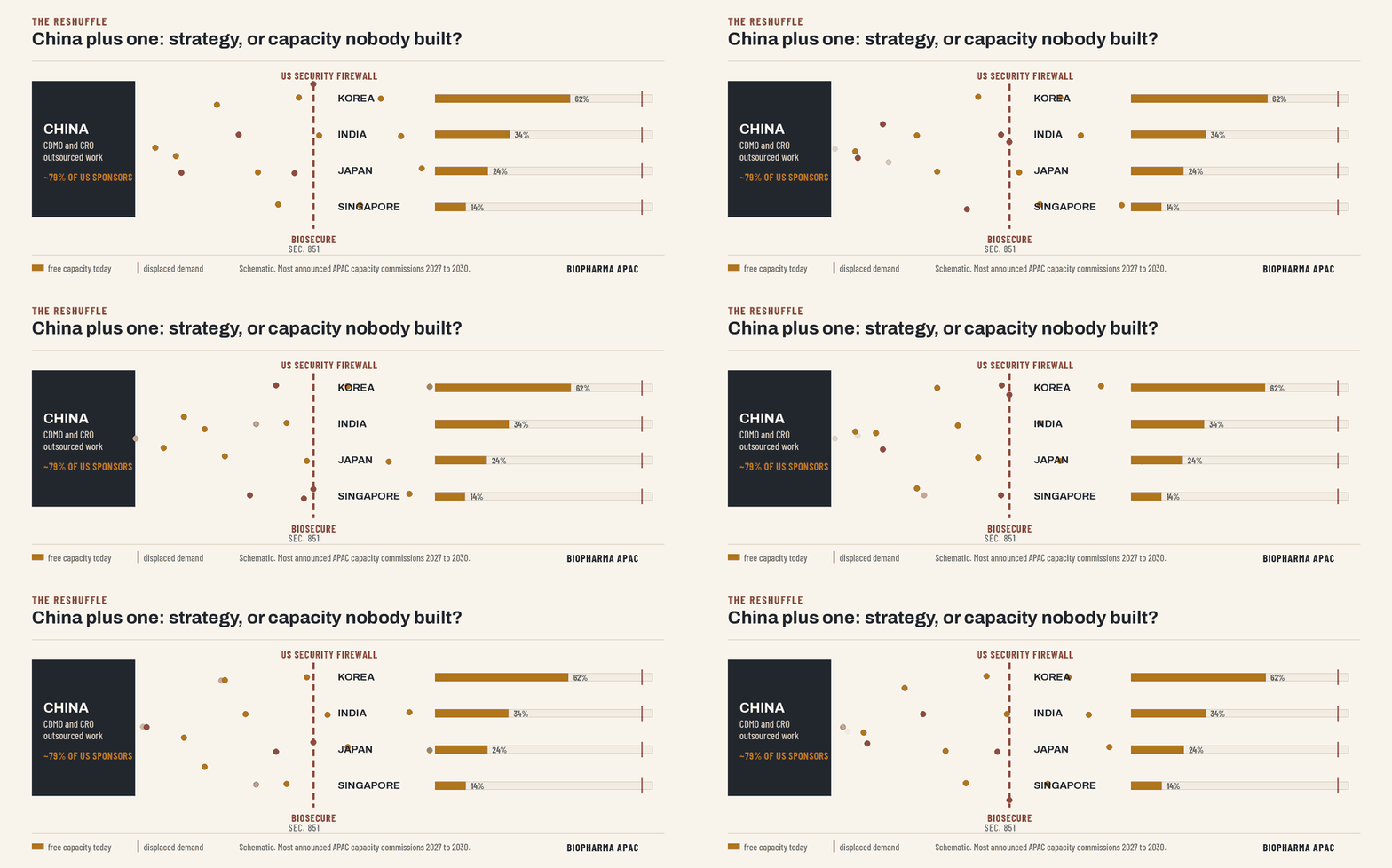
Capacity versus displaced demand: the arithmetic that decides it WHAT COULD MOVE Around 10 billion to 20 billion dollars a year of outsourced work carries a United States federal nexus. Close to 79 percent of United States biopharma companies use a Chinese partner for at least part of a program. Outsourcing is about 40 percent of all pharmaceutical manufacturing; biologics, the hardest to switch, are near 45 percent of the clinical pipeline. KOREA, AVAILABLE NOW Samsung Biologics: about 845,000 litres global (785,000 litres Songdo plus 60,000 litres Rockville); backlog near 21.4 billion dollars; 17 of the top 20 pharma as clients. Free slots are real in mammalian antibody work, tight in ADC and cell and gene therapy. KOREA, ANNOUNCED Lotte Biologics Songdo: three 120,000 litre plants; the first in 2027, the rest by 2030; 400,000 litres eventually, plus a 40,000 litre ADC-enabled site in Syracuse today. Samsung Bio Campus III (ADC, CGT, vaccines) lands beyond 2026. INDIA, AVAILABLE NOW Syngene about 50,000 litres single use including Bayview, Maryland; Aurigene around 25,000 litres single use; Aragen GMP at 2,000 litre scale. Sector roughly 8 to 9 billion dollars, dominated by small molecule and API. Clean FDA record is now the ticket to play. INDIA, ANNOUNCED Sector projected toward 15 to 20 billion dollars by 2029 to 2030; ADC and biologics suites in build. Momentum is fastest here; installed biologics scale still trails Korea. JAPAN AND SINGAPORE Japan: Fujifilm Diosynth more than 4 billion dollars of global expansion, AGC expanding, state economic security subsidies; low appetite for bulk volume. Singapore: limited scale, high regulatory credibility and IP protection for high value programs. THE SWITCHING CLOCK A biologics tech transfer runs 12 to 24 months, then comparability, PPQ, real time stability and filings. A commercial move can reach tens of millions of dollars and two to three years, with supply at risk in between. THE MISMATCH Most announced APAC capacity commissions between 2027 and 2030. BIOSECURE prohibitions could bite mid to late 2028; the grandfather runs to about 2033. The window to move and the window when capacity arrives only partly overlap. Bottom line: The region can absorb the reshuffle in time. The open question is whether in time means the buyer's timeline or the builder's. |
(arcilla.fran@biopharmaapac.com)
DISCLAIMER
Figures are drawn from company disclosures, regulatory filings and public industry analyses available to July 2026. Practitioner comments quoted here are representative composites, not attributed interviews. This article is analysis and does not constitute legal or investment advice. BioPharma APAC is an independent publication.
Most Read
- Can APAC Biomanufacturing Decarbonise Without Pricing Itself Out?
- The Algorithm on the GMP Floor: AI Promises a Smarter Plant. Regulators Demand the Audit Trail.
- APAC's Peptide-Capacity Gamble
- After the Rush: APAC's mRNA and Vaccine Capacity Hangover
- The Biosimilar Race: Factory to the World — or Stuck in the Copycat Economy?
- The Vein-to-Vein Problem: Can APAC's Cold Chain Carry Advanced Therapies?
- Vectors, Plasmids and the CGT Trap: APAC's Cell and Gene Therapy Ambitions Face an Upstream Bottleneck
- Can APAC Build Radioligand Therapy Before the Atoms Decay?
- The Great Biopharma Reset: 50 Developments That Changed Everything in H1 2026
- Beyond the Trial: Can Real-World Evidence Earn Regulatory Trust in APAC?
- Beyond the Obvious Giant: Where APAC's Clinical Trials Go Next
- The Frontier That Won’t Quite Arrive
Bio Jobs
- Sanofi Turns The Page As Belén Garijo Steps In And Paul Hudson Steps Out
- Global Survey Reveals Nearly 40% of Employees Facing Fertility Challenges Consider Leaving Their Jobs
- BioMed X and AbbVie Begin Global Search for Bold Neuroscience Talent To Decode the Biology of Anhedonia
- Thermo Fisher Expands Bengaluru R&D Centre to Advance Antibody Innovation and Strengthen India’s Life Sciences Ecosystem
- Accord Plasma (Intas Group) Acquires Prothya Biosolutions to Expand Global Plasma Capabilities
- ACG Announces $200 Million Investment to Establish First U.S. Capsule Manufacturing Facility in Atlanta
- AstraZeneca Invests $4.5 Billion to Build Advanced Manufacturing Facility in Virginia, Expanding U.S. Medicine Production
News