Semaglutide Generics, Six Months In: Every Launch in India, Every Price, and Where China Stands
08 October 2026 | Thursday | Analysis
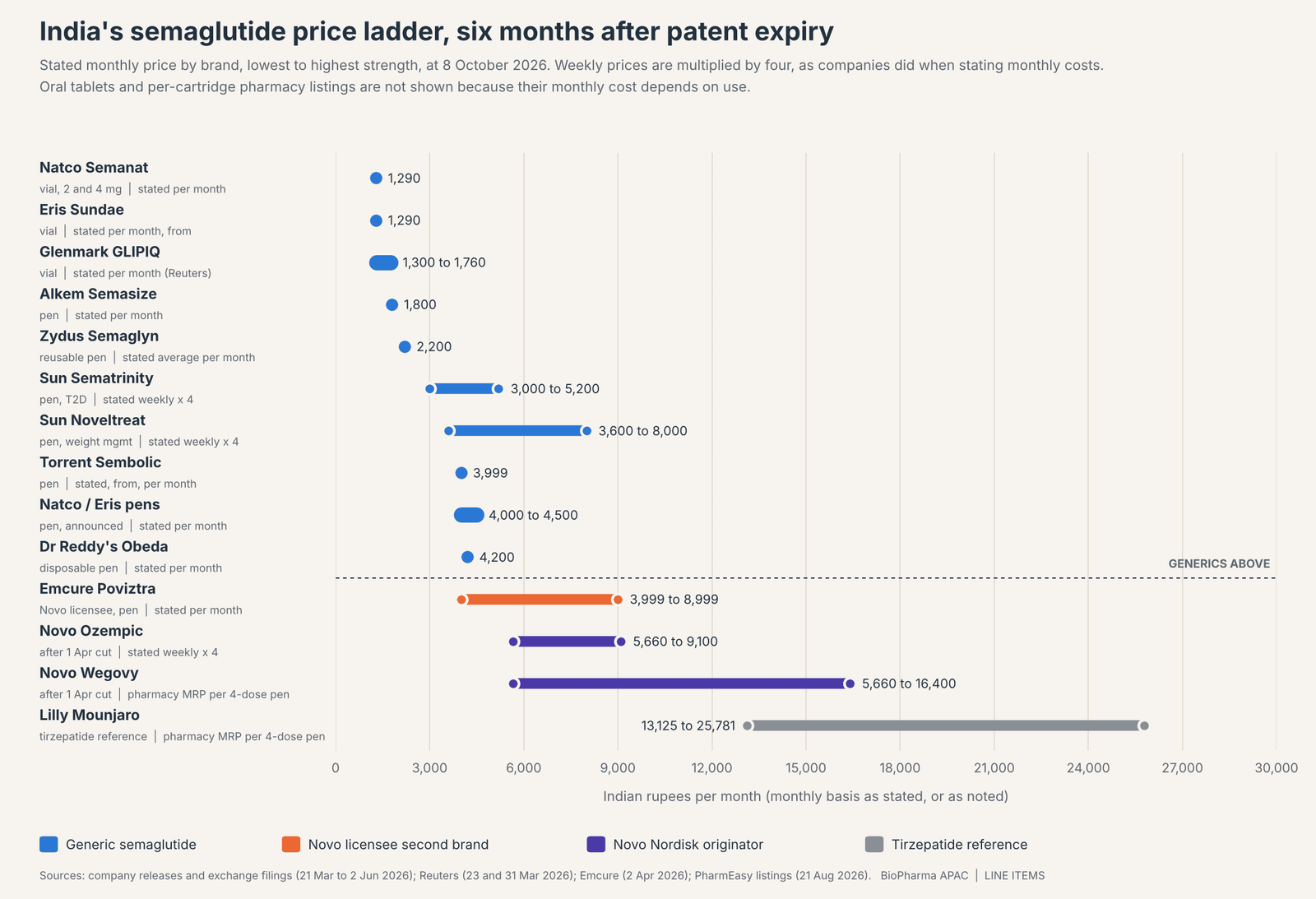
Figure 1. India's semaglutide price ladder at 8 October 2026: stated monthly prices by brand, with Novo Nordisk, its licensee and the tirzepatide reference below the line.
AT A GLANCE
|
12 generic makers with a public launch in India, selling 20 brands between them |
Rs 1,290 lowest stated monthly price, for vials from Natco and Eris |
3x the premium Natco and Eris put on a pen over a vial of the same molecule |
|
48% Novo Nordisk's cut to its Wegovy starting dose on 1 April |
50% generic share of India's semaglutide sales by value in April, two months in |
0 generic semaglutides approved in mainland China |
ONE
Day one: a patent ends, a market opens
Few patent expiries in Indian pharmaceutical history have been planned as carefully as this one. Novo Nordisk's compound patent on semaglutide lapsed on 20 March 2026, and by the morning of 21 March companies had filed launch notices with the stock exchanges, priced their packs and briefed their field forces. Dr Reddy's, Sun Pharma, Zydus Lifesciences, Torrent, Alkem, Glenmark, Natco, Eris and USV all announced launches that day or the day before.
The legal ground had been cleared months earlier. In December 2025 a single judge of the Delhi High Court refused Novo an injunction against Dr Reddy's, allowing it to make the drug for export to markets where the patent had lapsed. On 9 March 2026, eleven days before expiry, a division bench dismissed Novo's appeal. When the date arrived, there was no legal barrier left to test.
Novo had spent the preceding year preparing the ground on price. Wegovy launched in India in June 2025 at Rs 17,345 to 26,015 a month, and in November Novo cut it, by up to 37% according to Reuters, taking the starting pack from Rs 16,261 to Rs 10,850 and the highest strength from Rs 24,389 to Rs 16,400. Ozempic arrived only on 12 December 2025, at Rs 8,800, Rs 10,170 and Rs 11,175 a month across its three strengths. Eli Lilly had already launched Mounjaro in August 2025 at Rs 14,000 to Rs 27,500 for a month's supply. Novo also lined up partners: in November 2025 Emcure agreed to sell a second brand of Wegovy as Poviztra, and on 27 February 2026 Abbott announced Extensior, a second brand of Ozempic. When the generics arrived, they were pricing against an originator that had already moved twice.
The regulator moved too, though in a different direction. On 10 March the Drugs Controller General of India warned companies against direct or surrogate promotion of GLP-1 drugs and restated that they are for prescription by registered medical practitioners only. On 24 March CDSCO said it had inspected 49 entities and issued notices; Telangana's drug controller issued its own advisory on prescription and advertising the same week, and in May CDSCO's enforcement cell directed state regulators to tighten supply-chain and advertising checks. The market opened under the closest regulatory watch any Indian generic launch has seen in years.
Market data from Pharmarack counted 26 brands from 13 companies on sale in March. By April generic semaglutide accounted for Rs 44 crore of an Rs 88 crore semaglutide market, exactly half by value, and 137,000 of 170,000 injectable units sold, about four in five. Generics took half the money and most of the units because they cost so much less.
TWO
The price war, launch by launch
Every company below has a public launch and a stated price or a dated pharmacy listing. Prices are as the company stated them, in the unit it used. Where a company gave a weekly figure, we show it alongside the four-week equivalent that companies themselves used when quoting monthly costs.
|
Dr Reddy's Obeda Form Disposable pen, 2 mg and 4 mg; oral tablets 3, 7 and 14 mg from 20 May Launched 21 March 2026 Stated price Rs 4,200 per month for both pen strengths; tablets Rs 99, 135 and 225 each First Indian company to receive DCGI approval. Paused supply in July after an API batch issue; supply due to resume by November. |
|
Sun Pharma Sematrinity (diabetes); Noveltreat (weight management) Form Pens; Noveltreat in five strengths from 0.25 mg to 2.4 mg Launched 21 March 2026 Stated price Rs 750 to 1,300 a week (Sematrinity); Rs 900 to 2,000 a week (Noveltreat) The only launcher to split diabetes and weight management into separate brands. Patient support programme. |
|
|
|
|
|
Zydus Lifesciences Semaglyn, Mashema, Alterme Form Reusable multi-dose pen, 15 mg/3 mL cartridge Launched 21 March 2026 Stated price About Rs 2,200 average monthly treatment cost DCGI approved for diabetes and obesity. Also supplies Lupin and Torrent. |
|
Lupin Semanext, Livarise Form Injection; Livarise as a 15 mg/3 mL cartridge Launched March 2026 Stated price No company price; Livarise listed at MRP Rs 8,749 per cartridge (Apollo, September 2026) Co-markets the Zydus product through a dedicated semaglutide division. |
|
|
|
|
|
Torrent Sembolic, Semalix Form Injectable pens and oral tablets 3, 7 and 14 mg Launched 21 March 2026 Stated price Injectables from Rs 3,999 per month Sources from Zydus, Dr Reddy's and MSN. Recalled select Semalix pen batches in July. Generic value leader in April. |
|
Alkem Semasize, Obesema, Hepaglide Form Disposable pen and reusable cartridge pen; prefilled syringe from 2 June Launched 21 March 2026 Stated price Rs 450 a week, Rs 1,800 for a month (pen); syringe "starting Rs 350", unit not stated DCGI approved for diabetes and chronic weight management. |
|
|
|
|
|
Glenmark GLIPIQ Form Vial and prefilled pen, 2, 4 and 8 mg Launched 21 March 2026 Stated price Vial Rs 325 to 440 a week, about Rs 1,300 to 1,760 a month; pen price not disclosed CDSCO approved for diabetes. "Sankalp" patient programme. |
|
Natco Semanat, Semafull Form Multi-dose vials, 2, 4 and 8 mg; pen announced Launched 21 March 2026 Stated price Vials Rs 1,290 a month (2 and 4 mg), Rs 1,750 (8 mg); pen MRP Rs 4,000 to 4,500 a month CDSCO approval in February 2026. Manufactures for Eris. |
|
|
|
|
|
Eris Lifesciences Sundae Form Vials, 2 and 4 mg; pen announced Launched 20 to 21 March 2026 Stated price Vials from Rs 1,290 a month; pen MRP Rs 4,000 to 4,500 a month Made by Natco, sold through Eris's diabetes field force. Said in July it plans no price cut. |
|
USV Usema Form Pens, 2 mg and 4 mg Launched 21 March 2026 Stated price Not stated Launched with Dr Reddy's; described as among India's first DCGI-approved. |
|
|
|
|
|
MSN Laboratories Semabest Form Prefilled pen Launched 15 April 2026 Stated price "Nearly 50% lower than the innovator"; no rupee figure CDSCO approved. Also supplies Torrent's 8 mg presentation. |
|
Corona Remedies Wyntide Form Prefilled multi-dose pen Launched By April 2026 (Pharmarack) Stated price MRP Rs 4,999 per pen (Apollo, September 2026) No company launch statement found; included on market data and a dated pharmacy listing. |
|
|
|
|
Mankind Pharma told investors in July that it had launched after a deliberate delay, but has published no brand, date or price, so it is not in the ledger. Cipla, Biocon, Intas, Ajanta, Aurobindo and Hetero had not launched in India by the cut date; Biocon said in April that India was "not on the immediate list" and Hetero has launched only outside India.
|
How many players? It depends who is counting Estimates of the size of India's generic semaglutide field have varied by a factor of three. A list of 55 brand names circulated before expiry, but it recorded names companies had registered, not products on shelves. Pharmarack counted 26 brands from 13 companies in March and nearly 25 generic brands in April. Mankind's management told investors in July of "over 20 companies and 35+ brands". A review reported in September referred to nearly 40 Indian companies, while a market-intelligence firm counted only 13 verified active players in April. Our count of 12 is deliberately conservative: it requires a launch someone can point to. The gap between 12 and 40 is mostly companies that hold approval or have named a brand but have published no launch, no price and no sales. Some will launch; others have chosen to license their product to a larger seller, which is how Natco reaches Eris's field force and Zydus reaches Lupin's. In India's semaglutide market the number of brands overstates the number of manufacturers by a wide margin. |
Read as a ladder, the prices fall into three bands. At the bottom are vials: Natco and Eris at Rs 1,290 a month and Glenmark from about Rs 1,300. These are the cheapest presentations in the market because the patient or clinic supplies the syringe. In the middle are the pens priced for diabetes, between Alkem's Rs 1,800 and Torrent's Rs 3,999. At the top sit the branded pens aimed at weight management and the highest strengths, where Sun's Noveltreat reaches about Rs 8,000 a month.
The device decides the price. Every company with a vial undercut every company with only a pen, and Natco and Eris, the two companies that priced both, set the pen at more than three times the vial. That is the first lesson of India's generic GLP-1 market: once the molecule is generic, the margin moves into the delivery device and the brand built around it.
The second lesson is that strength matters more than the label. Several companies sell the same molecule under separate diabetes and weight-management brands, and Sun charges more for the weight-management one because it carries higher strengths. The split also follows the regulator: diabetes brands sit inside a familiar prescription channel, while weight-management brands sit under the promotion rules the DCGI restated in March.
The third lesson is about presentation. The market already holds disposable pens, reusable pens taking a 15 mg cartridge, multi-dose vials up to 8 mg, oral tablets and, since 2 June, Alkem's single-shot prefilled syringe. Reusable devices let a company price the cartridge rather than the pen, which is how Zydus reaches an average of about Rs 2,200 a month with a pen. Natco's 8 mg vial, at Rs 1,750, is the highest-strength vial with a stated price. Each format is a separate bet on what prescribers and patients will accept, and the spread of formats is wider than in any market where only the originator sells.
The fourth is how companies are reaching patients without consumer promotion. Sun and Glenmark run patient support programmes, the latter under the name Sankalp. Lupin set up a dedicated semaglutide division, Eris sells through its diabetes field force, and Abbott uses its own distribution network for Extensior. All of them sell on prescription through pharmacies; none is permitted to advertise to the public, and the DCGI's March advisory made clear that surrogate advertising counts.
THREE
Month six: what the originator did, and what broke
Novo Nordisk did not wait for the generics to set the price. On 31 March it announced cuts effective 1 April. The starting dose of both Ozempic and Wegovy fell to Rs 1,415 per weekly shot, Rs 5,660 for four weeks. For Ozempic that was a cut of about 36% from Rs 2,200 a shot, and for Wegovy about 48% from Rs 2,712. Reuters reported average cuts across doses of about 24% for Ozempic and 27% for Wegovy. A year earlier, in June 2025, Wegovy had launched in India at Rs 17,345 to 26,015 a month.
Novo also fought with second brands. Its licensee Emcure cut the price of Poviztra, its version of Wegovy, from 3 April, taking the starting strength from Rs 8,790 to Rs 3,999 a month and the highest from Rs 15,000 to Rs 8,999. Abbott sells Extensior, a second brand of Ozempic. Rybelsus, the oral form, saw no announced cut; pharmacy listings in August still showed Rs 2,972 to 3,628 for a strip of ten tablets.
Even after the cuts, Novo's cheapest pen costs more than four times the cheapest generic vial and about 35% more than Dr Reddy's generic pen. Eli Lilly's Mounjaro, the tirzepatide competitor, still sits above them all, listed in August at Rs 13,125 to 25,781 per four-dose KwikPen.
The first real test of the generic market was not price but supply. On 9 July Dr Reddy's told the exchanges that some batches had failed specification because of an issue with the active ingredient, and paused commercial supply in India and Canada. The same day Torrent voluntarily recalled select batches of its Semalix pens, which Dr Reddy's makes. On its July earnings call Dr Reddy's said it had sold about 180,000 pens before the pause, took a Rs 240 crore provision and expected to resume supply by November. Torrent said it had brought in an alternative supplier and expected its full range back by the end of August.
The incident exposed the market's shape. India has many more brands than manufacturers: Zydus supplies Lupin and Torrent, Natco supplies Eris, Dr Reddy's supplied Torrent and partnered with USV, and MSN supplies Torrent. A problem at one plant reaches several brands at once. It also showed who could absorb the shock. Torrent, which sources from three makers, told investors it held 36% of combined oral and injectable semaglutide sales in the April to June quarter, and Pharmarack data put it at about 38% of generic value in April.
The oral market is moving more slowly than the injectables. In June, generic tablets reached about half of oral units but under a third of oral value, Rs 8 crore of Rs 27 crore, which says the originator has kept most of the tablet revenue for now. In April alone, generic tablets sold 468,000 units, and Dr Reddy's added its own oral range on 20 May at Rs 99, Rs 135 and Rs 225 a tablet. Torrent, which launched tablets on day one, is the only other generic oral seller named in company statements. Among the injectables, Eris told investors in July that Sundae held 20% of volume and 14% of value, though it did not say of which segment, and that it planned no price cut.
Indian makers are also starting to export. Dr Reddy's launched in Canada on 15 May after Health Canada approval in April, at a list price it described as about half of Novo's. Sun Pharma received approval in South Africa in July and in Brazil, where it will sell through Hypera. Biocon has filed in Canada, Brazil, Saudi Arabia and Turkey. Hetero, which has not launched at home, began selling its brands in Africa, Asia and the Middle East within a week of India's expiry. Lupin plans South Africa later this year, Torrent expects approval in Brazil within months, and Ajanta holds a Biocon licence covering 26 countries outside India. Dr Reddy's Brazilian launch has been delayed. The Indian ledger is becoming the price reference for every market where the patent has gone.
FOUR
China: same patent, same day, no generic
Semaglutide's compound patent in China expired on 20 March 2026, the same day as India's. As of our cut date, the National Medical Products Administration has approved no generic or biosimilar. Novo Nordisk's Ozempic remains the only approved semaglutide for diabetes, and its Wegovy and Rybelsus the only ones for weight management and oral use. The record below explains why.
|
20 Mar 2006 |
Novo files Chinese patent ZL200680006674.6 on semaglutide. |
|
Apr 2021 |
NMPA approves Ozempic in China. The marketing authorisation holder is Novo Nordisk Pharma AG of Zurich. |
|
24 Aug 2022 |
China's patent office declares the patent invalid on a petition by Huadong Medicine's subsidiary. |
|
6 Nov 2023 |
Beijing Intellectual Property Court sets the invalidation aside. |
|
25 Sep 2025 |
Patent office rejects Novo's request for a patent term extension. |
|
26 Dec 2025 |
Supreme People's Court dismisses the appeal, upholding the patent to term. |
|
20 Mar 2026 |
Compound patent expires. Between 10 and 12 companies have marketing applications under review. |
|
6 May 2026 |
Novo says Ozempic holds data protection in China until April 2027 under the China-Switzerland free trade agreement, six years from approval. |
|
15 May 2026 |
NMPA's new rules on drug test-data protection take effect: six years for originators, with applications relying on protected data neither accepted nor approved. |
|
19 Aug 2026 |
Jiuyuan Gene, the first filer, reports its diabetes application review as suspended over data protection, and sets its next milestone for the second quarter of 2027. |
The applicant list reads like a roll call of China's peptide industry: Jiuyuan Gene, Livzon, Qilu, United Laboratories, Huadong, CSPC, Huisheng, Chengdu Beite, Fosun Wanbang and Chia Tai Tianqing, with Huadong filing for obesity in April and Hybio in July. Some applicants have argued that a treaty clause not written into domestic law should not block approval, and some believed that filings in a different registration class might proceed. Neither argument had produced an approval by our cut date, and NMPA has not commented publicly.
The queue is long because it formed early. Jiuyuan Gene filed for diabetes in April 2024 and for obesity in February 2026, and has already licensed its product to Fosun Pharma for the Middle East, Africa and parts of Southeast Asia. Livzon's diabetes application is under review and its weight application has been accepted. Qilu's was accepted in September 2024 and CSPC filed for diabetes in August 2025 and for weight in December. What they lack is a decision, and each month the reviews stay suspended is another month in which Novo sells semaglutide in China without generic competition.
Novo has used the window to cut prices ahead of competition. A Sichuan hospital listing notice in December 2025 cut Wegovy's prices by about 48%, a Qinghai notice in February 2026 cut Rybelsus by 20%, and e-commerce prices for an Ozempic pen fell to around RMB 600 by March. Ozempic is reimbursed for type 2 diabetes on the national list, and from 1 September on the Essential Medicines List; weight loss is not covered. Domestic rivals did not wait for semaglutide either: Innovent's mazdutide was approved for obesity in June 2025 and Sciwind's ecnoglutide in March 2026, and Novo's oral Wegovy application was accepted in August.
The comparison with India is stark. Two markets lost the same patent on the same day. One has a dozen generic makers, a price ladder that starts at Rs 1,290 and an originator that has cut its prices by up to half. The other has a queue of a dozen applicants, an originator that set its own price cuts, and a data-protection date that, on Novo's reading, falls in April 2027.
|
How to read these prices Every price here is a stated list price or maximum retail price, not what a patient pays after discounts, and none is a recommendation. Monthly figures are the company's own where it gave one; where it gave a weekly price, the four-week figure is ours, following the convention the companies themselves used. Prices differ by strength, so a range runs from the lowest to the highest strength the company priced. Oral tablets and single-cartridge listings are shown as stated, without a monthly figure, because their monthly cost depends on how they are prescribed. This article describes a market. It is not guidance on the use of any medicine. |
NEXT
What to watch
|
November |
Dr Reddy's planned return to supply in India and Canada, and whether pricing holds when it does. |
|
Quarterly results |
Whether Torrent's lead holds through the July to September quarter, and whether Mankind, Cipla or Biocon join the market. |
|
Regulation |
Any further CDSCO enforcement on promotion, and the reported draft pharmacopoeia standard for semaglutide. |
|
China, April 2027 |
The data-protection date Novo cites, and whether NMPA releases the suspended reviews then or earlier. |
Method. The ledger includes generic semaglutide products with a public launch in India between 21 March and 8 October 2026, evidenced by a company statement, an exchange filing or, where neither exists, market data plus a dated pharmacy listing. Prices are from company statements and exchange filings at launch, Reuters, and pharmacy listings with their dates. Market shares are from Pharmarack as reported, and from company earnings calls. China status rests on company disclosures, court and patent records as reported, and Chinese financial press to late September 2026; it is reported as status, not forecast. BioPharma APAC's longevity series reads this drug class separately; this is a market ledger only.
Most Read
- Can APAC Biomanufacturing Decarbonise Without Pricing Itself Out?
- The Algorithm on the GMP Floor: AI Promises a Smarter Plant. Regulators Demand the Audit Trail.
- APAC's Peptide-Capacity Gamble
- After the Rush: APAC's mRNA and Vaccine Capacity Hangover
- The Biosimilar Race: Factory to the World — or Stuck in the Copycat Economy?
- The Vein-to-Vein Problem: Can APAC's Cold Chain Carry Advanced Therapies?
- Vectors, Plasmids and the CGT Trap: APAC's Cell and Gene Therapy Ambitions Face an Upstream Bottleneck
- Can APAC Build Radioligand Therapy Before the Atoms Decay?
- The Great Biopharma Reset: 50 Developments That Changed Everything in H1 2026
- Beyond the Trial: Can Real-World Evidence Earn Regulatory Trust in APAC?
- Beyond the Obvious Giant: Where APAC's Clinical Trials Go Next
- The Frontier That Won’t Quite Arrive
Bio Jobs
- Sanofi Turns The Page As Belén Garijo Steps In And Paul Hudson Steps Out
- Global Survey Reveals Nearly 40% of Employees Facing Fertility Challenges Consider Leaving Their Jobs
- BioMed X and AbbVie Begin Global Search for Bold Neuroscience Talent To Decode the Biology of Anhedonia
- Thermo Fisher Expands Bengaluru R&D Centre to Advance Antibody Innovation and Strengthen India’s Life Sciences Ecosystem
- Accord Plasma (Intas Group) Acquires Prothya Biosolutions to Expand Global Plasma Capabilities
- ACG Announces $200 Million Investment to Establish First U.S. Capsule Manufacturing Facility in Atlanta
- AstraZeneca Invests $4.5 Billion to Build Advanced Manufacturing Facility in Virginia, Expanding U.S. Medicine Production
News