The Biosimilar Race: Factory to the World — or Stuck in the Copycat Economy?
07 July 2026 | Tuesday | Analysis
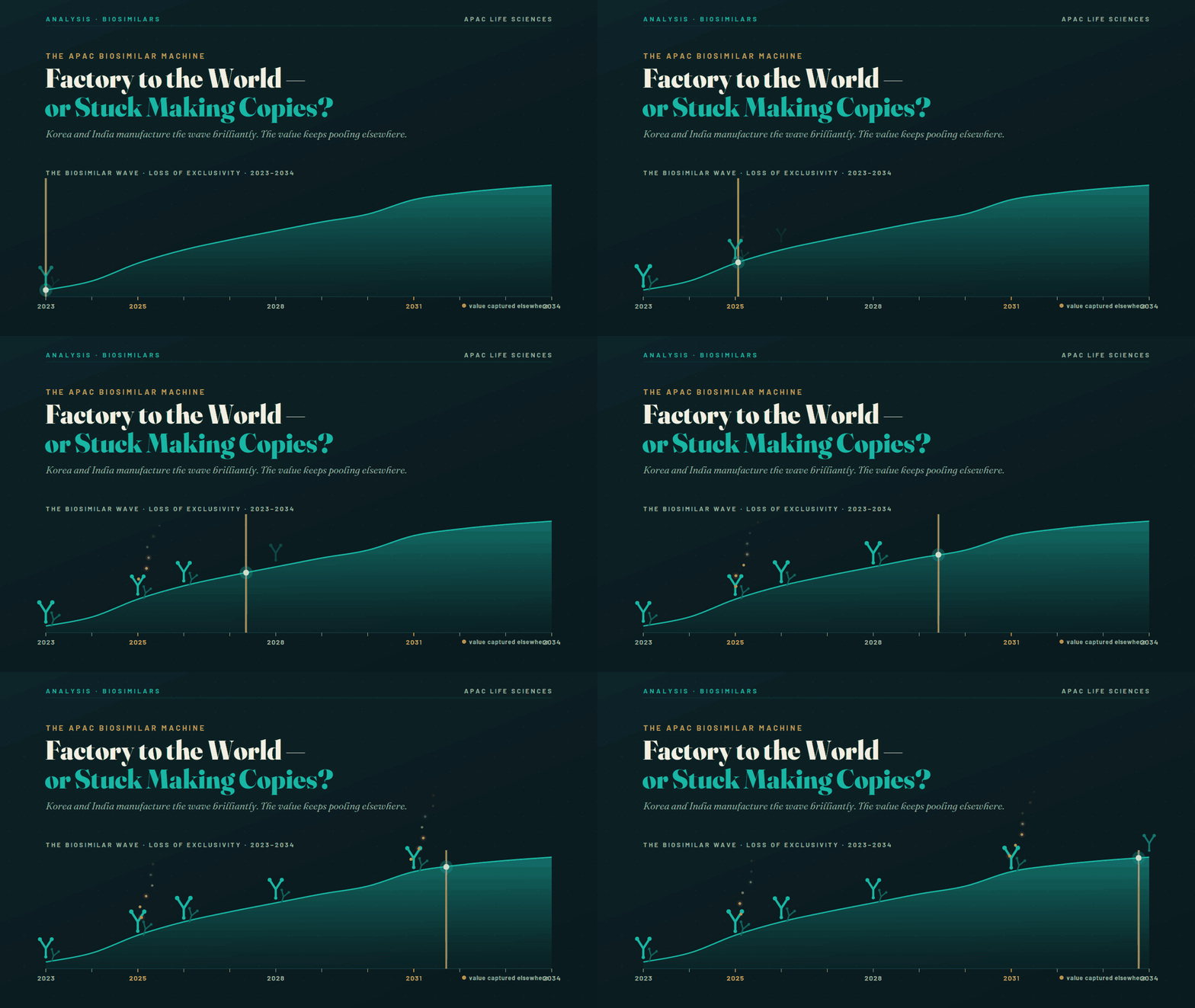
The biosimilar wave, 2023–2034: Korea and India supply the volume as blockbuster biologics lose exclusivity — while much of the value escapes at the Stelara (2025) and semaglutide (2031) inflection points.
In Songdo and Bengaluru, the numbers finally look like the ones the region was promised a decade ago. Celltrion closed 2025 with revenue above ₩4 trillion — roughly US$2.8 billion — and operating profit past the ₩1 trillion mark, and paid its staff bonuses worth close to half a year's salary. Samsung Bioepis booked a record first quarter, with operating profit up 236 percent year on year and an operating margin north of 30 percent. Biocon's biosimilars arm ran four separate products past US$200 million in annual sales inside a single fiscal year.
These are not the margins of a commodity business. They are, on paper, the vindication of a twenty-year bet: that Asia could take the most technically demanding class of medicines ever commercialised — large-molecule biologics, grown in living cells, impossible to copy atom-for-atom — and manufacture them at a quality and scale the West would have to buy from.
And yet the people running these companies are unusually anxious for an industry printing record profit. Because the same twelve months that produced those results also produced the clearest evidence yet of the trap the region has walked into. The biologics losing exclusivity between now and the mid-2030s represent one of the largest transfers of pharmaceutical value in history. APAC is positioned to manufacture an enormous share of the copies. It is positioned to capture very little of the value. The originator economics — the pricing power, the formulary leverage, the brand — mostly stay somewhere else.
This is the central tension of APAC's biosimilar moment. The region has become the factory to the world. The open question is whether that is a stepping stone to something higher up the value chain, or a permanent, low-margin role inside someone else's business model.
The scale: a workshop, fully built
Start with what has actually been achieved, because it is genuinely enormous and easy to undersell. The global biosimilar market grew from about US$2.2 billion in 2016 to roughly US$32.7 billion in 2024 — a fifteen-fold expansion in eight years, driven by patent expiries and relentless payer pressure to cut drug spending. Korea and India are not participants in that market so much as its engine room.
Celltrion won approval for the world's first monoclonal-antibody biosimilar, Remsima, back in 2013, and now runs an integrated model spanning development, manufacturing and direct global sales. Samsung Bioepis has launched eleven biosimilars since 2012 and, together with Celltrion, controls more than half of six major biosimilar categories in Europe. Samsung Biologics, the contract-manufacturing sibling, is building toward 1.32 million litres of bioreactor capacity by 2032 — a scale that would make it comfortably the largest biomanufacturer on earth.
India's contribution runs on a different but complementary logic. Biocon Biologics has commercialised ten biosimilars with a pipeline of more than twenty assets across diabetes, oncology, immunology, ophthalmology and bone health, and holds roughly a fifth of the US insulin glargine market. Where Korea tends to compete on antibody sophistication and integrated scale, India competes on cost base, process economics and a deep bench of exporters — Biocon, Dr Reddy's, Cipla, Zydus — that can flood price-sensitive markets fast.
Behind them sits the reason this all matters right now: the wave. Drugs set to lose patent protection between 2025 and 2030 carried combined 2024 sales of about US$127.6 billion. Samsung Bioepis's own tracking puts it more starkly still — some 118 biologics representing close to US$232 billion in US sales are due to lose exclusivity between 2025 and 2034. Ustekinumab (Stelara) has already gone. Aflibercept (Eylea), denosumab, golimumab and a long tail of oncology and immunology antibodies are going now. The GLP-1 franchises — the biggest prize in modern pharma — are beginning to crack open at the edges.
The capacity, in other words, was built for exactly this moment — and for the leading players the manufacturing question is essentially solved. The anxiety in Songdo and Bengaluru is no longer whether the molecule can be made to standard; it is how cheaply, and for whose ultimate benefit. That shift — from a technical contest the region has decisively won to a pricing contest it may not — is the whole of the story that follows.
The value trap: making everything, keeping little
Consider Stelara, the defining biosimilar launch of 2025 and a preview of every launch to come. Within months of exclusivity ending, the US market held nine biosimilar versions of ustekinumab plus an unbranded biologic sold by the originator itself — with list-price discounts running anywhere from 5 to 90 percent off a reference product that had carried a wholesale acquisition cost near US$30,000 per 90mg dose. Payers celebrated. One mid-sized pharmacy benefit manager projected US$120 million in annual savings from swapping Stelara for biosimilars, on top of the US$100 million-plus it had already banked by dropping Humira the year before.
But look at who captured the upside, and the picture darkens. The three PBMs that dominate US drug purchasing — Caremark, Express Scripts and Optum Rx — did not simply add the cheapest biosimilar to their formularies. They launched their own private-label versions through affiliated subsidiaries and gave those preferred placement, in several cases while keeping the expensive reference product on formulary too because the rebate maths favoured it. The company that spent five to seven years and US$100 million to US$300 million developing a Stelara biosimilar frequently found itself supplying a molecule that a PBM re-badged, priced and controlled.
That last figure deserves emphasis, because it dismantles the lazy assumption that biosimilars are “just generics.” A small-molecule generic can be reverse-engineered in a year for a few million dollars. A biosimilar takes the better part of a decade and a nine-figure budget — the risk profile of a mid-stage novel drug — and then lands into a market that pays it like a commodity. You carry the cost structure of an innovator and the pricing power of a contract manufacturer. That gap is the value trap in one sentence.
You are negotiating for shelf space with the landlord who also runs the shop next door.
Price erosion, on this reading, is merely the weather. The deeper problem for an Asian manufacturer is structural: in the US, the entity that controls the formulary increasingly owns a competing private label. A developer can field the better molecule and still lose the placement, because the decision was never really about the molecule at all — it was about who owned the shelf.
Layer on the policy machinery and the squeeze tightens further. Stelara was among the first drugs subject to US Medicare price negotiation under the Inflation Reduction Act, with a 2026 maximum fair price set roughly 66 percent below its 2023 list. Negotiated originator prices compress the ceiling that biosimilars price beneath, thinning already-thin margins from the top down even as private labels attack from below.
And then there is the cruel irony buried in the wave itself. Of those 118 biologics worth US$232 billion heading off-patent through 2034, only around 10 percent have a biosimilar in active development. The industry calls this the “biosimilar void” — and it is a direct consequence of the value trap. The workshop is fully capable of making these products. It is increasingly choosing not to, because it cannot see how to make money doing so. Nothing indicts the model more precisely than capable factories declining the work.
Interchangeability: the ground shifts under everyone
Into this pressure cooker, the US regulator has thrown a genuine wildcard — one that cuts in two directions at once. For a decade, the US operated a two-tier system found nowhere else: an ordinary “biosimilar,” and a more rigorously vetted “interchangeable” biosimilar that a pharmacist could substitute for the brand without calling the prescriber. Interchangeability required expensive clinical switching studies, and it functioned as a marketing moat.
That system is being dismantled in real time. A June 2024 draft guidance signalled that switching studies would generally no longer be needed. Then, in October 2025, the FDA went further, proposing that comparative clinical efficacy studies — long the single most expensive element of a biosimilar programme — may not be necessary at all, with high-quality analytical characterisation plus pharmacokinetic and immunogenicity data doing the work instead. The agency signalled it intends to finalise the framework in early 2026 and may begin approving all non-vaccine biosimilars as interchangeable by default. Approval timelines had already compressed sharply — from an average of around 798 days for applications filed in 2020 to roughly 364 days for those filed in 2024.
For a manufacturer, this is a double-edged blade, and which edge you feel depends entirely on where you sit in the value chain. The upside is real: eliminating comparative efficacy trials could strip US$100 million-plus and years out of a development programme. Korea's own regulator is moving in parallel, relaxing Phase 3 requirements, and Celltrion has been publicly revising trial plans to match — its chairman, Seo Jung-jin, welcomed the shift as “big news we have waited for over a long period of time.” The downside is just as real: every barrier the regulator removes is a barrier that protected incumbents' margins. If interchangeability becomes automatic and clinical trials become optional, the last few sources of differentiation between biosimilars evaporate — leaving price, supply reliability and payer relationships, exactly the axes on which vertically-integrated Western PBMs already hold the whip hand.
To read the FDA changes as unambiguously good news for Asian manufacturers is therefore only half right. Cheaper filings help the low-cost, high-volume model more than almost anyone's. But interchangeability had been one of the few levers that let a strong product command even a modest premium; remove it, and the molecule becomes a pure commodity that much faster. The winners will be whoever is genuinely lowest-cost — which is precisely the position India's exporters have spent two decades building toward, and the one Korea's integrated leaders must now defend.
The GLP-1 race: the whole thesis, compressed
Nowhere will the region's dilemma be tested more visibly than in GLP-1s — the obesity and diabetes franchises that have become the most valuable drugs on the planet. And the GLP-1 story is a near-perfect miniature of the larger one: extraordinary manufacturing opportunity, brutal value capture, and a fork between commodity supplier and originator.
The cliff is opening unevenly, which is the whole game. Liraglutide — the first-generation molecule — has already gone generic: Teva launched in the US in August 2025, and Biocon won FDA approval for its version in February 2026, covering both diabetes and weight management. But early savings are modest, because a first-generation drug competing against vastly more effective successors has limited pricing leverage.
Semaglutide — the Ozempic and Wegovy molecule where the real money sits — is where geography becomes destiny. In the US, the picture is a fortress: the core compound patent's nominal March 2026 expiry has been extended to December 2031, behind a thicket of 49 follow-on patents on formulation and delivery devices stretching toward 2042. In India, it is the opposite: the patent office rejected Novo Nordisk's semaglutide claim back in 2019 as an obvious modification of liraglutide, meaning Indian manufacturers can produce it now. The molecule loses protection across India and China in 2026.
This hands APAC a genuine first-mover window — but pointedly not in the market that pays the most. Indian firms including Biocon, Cipla and Dr Reddy's are targeting domestic launches in late 2026 and export markets in 2027–2028; Biocon has already partnered with Biomm to commercialise an off-patent candidate in Brazil, and Samsung Bioepis has a liraglutide biosimilar in Phase 3. The region will almost certainly supply enormous volumes of low-cost GLP-1 to the developing world, where analysts expect prices to fall by up to 70 percent. That is a profound public-health achievement. It is also, once again, high-volume manufacturing at commodity margins in the markets that pay least, while the originators keep the high-price US and European franchises walled off for years.
And the originators are not standing still. Novo Nordisk launched oral semaglutide in early 2026; Eli Lilly won approval for the oral GLP-1 orforglipron in April 2026; tirzepatide is locked up until 2036. The innovator playbook is textbook: as one molecule cracks open, move the franchise to the next patented formulation and let the copies fight over yesterday's product. It is precisely the move APAC has not yet learned to make in reverse.
The move upmarket: the only exit that matters
Which brings us to the question that will define the next decade: can the workshop become an originator? The most revealing corporate action of the past year was not a product launch but a restructuring. In November 2025, Samsung split its biosimilar arm into a new holding company, Samsung Epis Holdings, explicitly charged with developing platform technologies and novel drug candidates — while Samsung Biologics doubled down as a pure-play contract manufacturer. Read carefully, that is a company formally separating the low-margin factory from the aspiration to invent.
Celltrion is making the same bet through vertical integration — internalising R&D and manufacturing, moving to direct commercialisation to capture the margin that partners used to take, and expanding its US manufacturing footprint through acquisition. Biocon's version runs through insulins and increasingly complex biologics, funded by a January 2026 capital raise to buy out its former partner's minority stake. Every serious player has arrived, independently, at the same conclusion: biosimilars are the tuition, not the degree.
But the honest assessment is that none of them has yet made the leap, and the leap is genuinely hard. Novel biologics require discovery capability, clinical-development muscle, first-in-class regulatory experience, and — hardest of all — the appetite to absorb the failure rate of real innovation. It is a fundamentally different risk culture from the biosimilar model, which is engineered specifically to eliminate scientific uncertainty. The skills that make you a brilliant copyist are not obviously the skills that make you an inventor working without a reference molecule to aim at.
There is a hard irony in this. The biosimilar business builds excellence in precisely the capabilities that matter least for the leap ahead — manufacturing, quality systems, regulatory execution — while offering no training at all in the one that matters most: the willingness to take a scientific bet that may simply fail. Making that cultural jump is the whole ballgame. On current evidence, Korea's integrated leaders look better placed to attempt it than most of the Indian field, but the honest verdict is that none of them has yet done it. The answer will not be clear until the end of the decade.
A TIMELINE
|
THE BIOSIMILAR WAVE — 2023–2034 |
|
|
2023 |
Adalimumab (Humira) biosimilars launch in the US — the first cracks in the innovator wall, as Celltrion, Samsung Bioepis and Biocon enter in force. |
|
2024 |
Humira biosimilars trigger a PBM-driven price war; private labels emerge. Aflibercept (Eylea) exclusivity ends. FDA's June draft guidance signals switching studies will no longer be required for interchangeability. |
|
2025 |
The defining year. Nine Stelara (ustekinumab) biosimilars flood the US; PBM private labels capture the upside. Denosumab biosimilars launch and generic liraglutide arrives. In October the FDA proposes dropping comparative efficacy studies; in November Samsung spins out Samsung Epis Holdings to chase novel drugs. Korea and India post record biosimilar profits. |
|
2026 |
FDA moves to treat all non-vaccine biosimilars as interchangeable. Semaglutide patents lapse in India and China; Indian firms begin domestic GLP-1 launches. Biocon's aflibercept and generic liraglutide reach the US. |
|
2027–28 |
Indian GLP-1 exports scale into emerging markets at up to 70% below branded prices. The “biosimilar void” widens as mid-tier biologics go off-patent with no biosimilar in development. |
|
2029–31 |
US semaglutide compound protection finally lapses (December 2031) — into a market already defended by oral successors and device patents. APAC's originator ambitions either bear fruit or stall. |
|
2032–34 |
Samsung Biologics' capacity build completes at 1.32 million litres. The tail of the US$232 billion loss-of-exclusivity wave plays out; the verdict on whether the workshop became an originator is largely in. |
The reader's takeaway
Strip away the record quarters and the strategic optimism, and APAC's biosimilar dominance resolves into a single, unresolved question. The region has proven, beyond any doubt, that it can make the world's biologics better and cheaper than anyone. What it has not yet proven is that manufacturing excellence converts into economic power. The Stelara experience says it may not: a manufacturer can win on quality, cost and regulatory execution — and still hand the value to a PBM's private label.
There are only two ways this story ends. In the first, biosimilar scale is exactly what the optimists promised: a stepping stone. The cash, the manufacturing mastery and the regulatory fluency compound into genuine originator capability, and by the early 2030s a Korean or Indian company is defending its own blockbuster against someone else's copies. In the second, the region remains permanently what it is today: the indispensable, brilliant, low-margin factory inside a value chain whose economics are decided in Boston, Basel and the formulary committees of three American PBMs.
The machinery is built. The wave has arrived. What APAC does with the next five years — not the manufacturing, which is settled, but the climb toward invention, which is not — will decide which ending it gets. The factory to the world is running at full capacity. Whether it is also building its own escape is the only question that still matters.
(arcilla.fran@biopharmaapac.com )
DISCLAIMER
Figures are drawn from public company disclosures and industry reporting current to mid-2026 and are subject to change. This article is analysis, not investment advice.
Most Read
- Can APAC Biomanufacturing Decarbonise Without Pricing Itself Out?
- The Algorithm on the GMP Floor: AI Promises a Smarter Plant. Regulators Demand the Audit Trail.
- APAC's Peptide-Capacity Gamble
- After the Rush: APAC's mRNA and Vaccine Capacity Hangover
- The Biosimilar Race: Factory to the World — or Stuck in the Copycat Economy?
- The Vein-to-Vein Problem: Can APAC's Cold Chain Carry Advanced Therapies?
- Vectors, Plasmids and the CGT Trap: APAC's Cell and Gene Therapy Ambitions Face an Upstream Bottleneck
- Can APAC Build Radioligand Therapy Before the Atoms Decay?
- The Great Biopharma Reset: 50 Developments That Changed Everything in H1 2026
- Beyond the Trial: Can Real-World Evidence Earn Regulatory Trust in APAC?
- Beyond the Obvious Giant: Where APAC's Clinical Trials Go Next
- The Frontier That Won’t Quite Arrive
Bio Jobs
- Sanofi Turns The Page As Belén Garijo Steps In And Paul Hudson Steps Out
- Global Survey Reveals Nearly 40% of Employees Facing Fertility Challenges Consider Leaving Their Jobs
- BioMed X and AbbVie Begin Global Search for Bold Neuroscience Talent To Decode the Biology of Anhedonia
- Thermo Fisher Expands Bengaluru R&D Centre to Advance Antibody Innovation and Strengthen India’s Life Sciences Ecosystem
- Accord Plasma (Intas Group) Acquires Prothya Biosolutions to Expand Global Plasma Capabilities
- ACG Announces $200 Million Investment to Establish First U.S. Capsule Manufacturing Facility in Atlanta
- AstraZeneca Invests $4.5 Billion to Build Advanced Manufacturing Facility in Virginia, Expanding U.S. Medicine Production
News