
What Eight APAC Regulators Have Actually Published on AI in Drug Development
21 October 2026 | Wednesday | Analysis
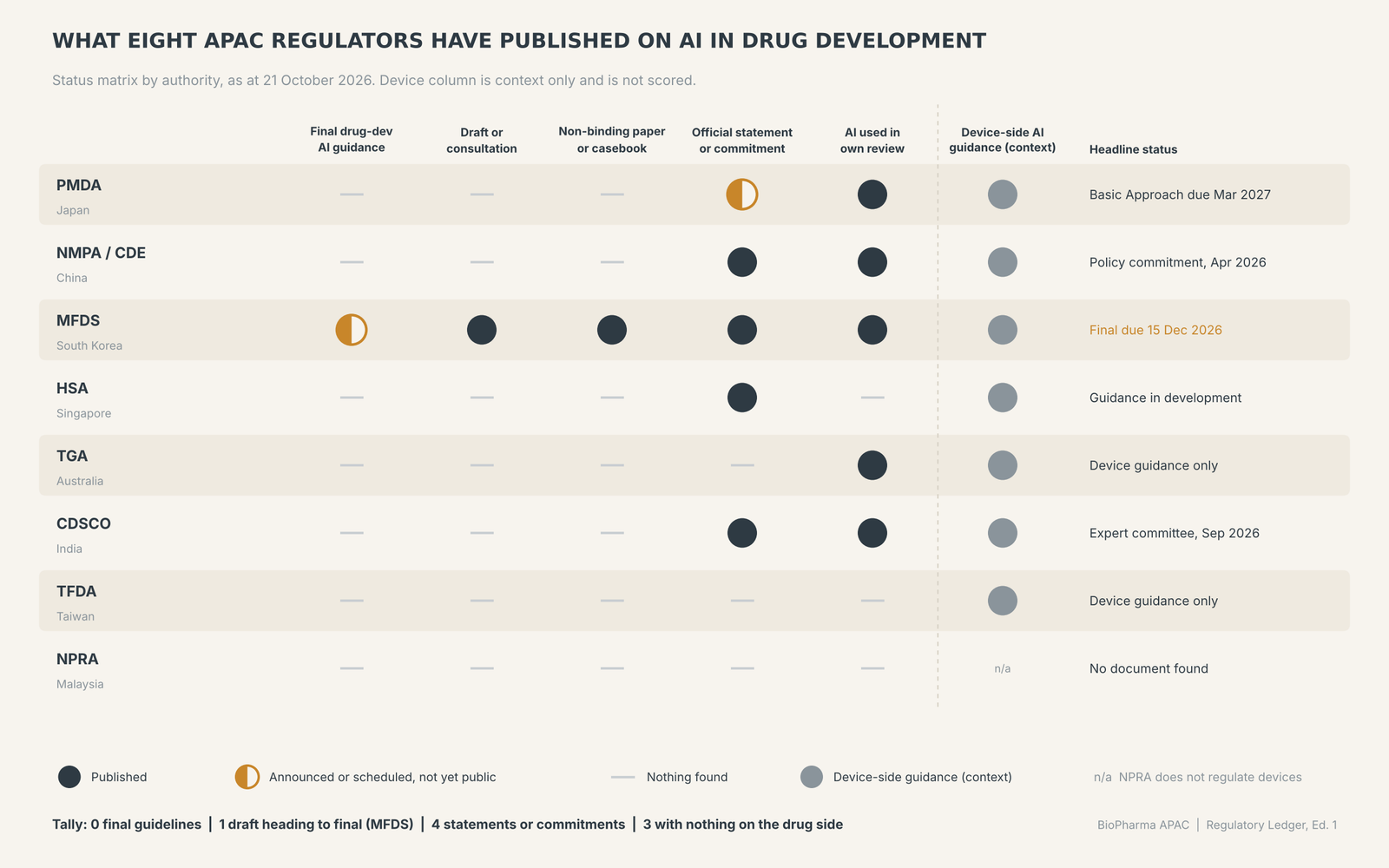
The ledger at a glance. Filled marks show published items; half marks show documents announced or scheduled but not yet public. The device column is context and is not scored.
Ask a regulatory affairs lead in Tokyo, Seoul or Singapore what the rules are for using a machine learning model in a drug submission, and the honest answer in October 2026 is a question back: which rules do you mean? The conference circuit suggests a region racing to write AI policy. The document record says something quieter, and more useful to know.
Outside the region, the paper trail has hardened fast. The US FDA's January 2025 draft guidance on using AI to support regulatory decision-making for drugs and biologics set out a seven-step, risk-based credibility framework anchored to a model's context of use, and it remains a draft. The EMA finalised its reflection paper on AI across the medicinal product lifecycle in September 2024. On 14 January 2026 the two agencies jointly issued ten guiding principles of good AI practice in drug development. Two weeks later, on 29 January, the ICH adopted M15, its general principles for model-informed drug development, which names AI and machine learning among the modelling approaches it covers.
So what have Asia-Pacific's regulators put on the record? We went through eight of them, authority by authority, and logged every document we could find that speaks to AI in drug development, along with its reference, status and date. The short version: as of 21 October 2026, not one of the eight has a final, sponsor-facing guideline on AI in drug development. One has a draft that has been through consultation and is scheduled to become final on 15 December. Four have statements, commitments or announced documents on the record. Three have nothing on the drug side at all.
That is not a criticism. It is a status report, and for anyone planning an AI-heavy submission in the region next year, the blanks matter as much as the entries.
How we built the ledger
The inclusion test was simple. A document counts if it was issued by the authority itself, or jointly with its parent ministry, and if it addresses the use of AI in drug development: nonclinical work, clinical trials, the evidence in a marketing application, or post-authorisation evidence generation. We graded each item on a five-step status scale: final guidance; draft or consultation text; non-binding paper (reflection papers, casebooks, compendia); official statement or commitment made on the record by the authority's head or its minister; and absent.
Three boundaries apply. AI as a medical device is recorded only as context, because every authority in this ledger with a device remit has published something there and it would drown the drug-side signal. AI in manufacturing and GMP belongs to our separate GMP AI story. And the platforms themselves, the companies building AI discovery engines in the region, are assessed in our evidence audit SL-06. This piece is about the rulebook, not the players.
Where an authority's own page could not be reached or a document sits behind a paywall, we say so and name the secondary source. Absences were confirmed by searching the authority's announcement and guidance listings, plus trade press in the local language. Eight authorities were in scope: the seven named in our brief and one further, Malaysia's NPRA, chosen because it is among the ASEAN regulators leaning hardest on reliance, which makes its silence on AI unusually consequential.
The ledger
Each entry follows the same template: the authority, the document, its status, its scope, what it requires, and what it leaves open. The narrative above each table explains why the status reads the way it does.
1. Japan: PMDA
STATUS: ANNOUNCED, NOT YET PUBLISHED
Japan is the most instructive absence in the ledger, because PMDA is anything but inactive on AI. On the device side it has a long record, from its Science Board report on AI-based software medical devices to a consultation, opened on 18 September 2026, on draft review points for medical device programs that use generative AI. On the drug side, though, the formal record so far concerns PMDA's own use of the technology.
PMDA published its Action Plan for AI Utilization in PMDA Operations on 10 October 2025 and switched on generative AI in its operations on 15 April 2026. On 2 June 2026 it set up a project team to draft a Basic Approach to AI Utilization. At PMDA's review and safety committee on 24 July, an industry representative asked the agency to set out its thinking on AI in GxP work, noting that companies still hesitate to use it there. PMDA said it was considering publication within the current fiscal year, which ends on 31 March 2027, according to Yakuji Nippo. Later trade reporting describes a document aimed first at PMDA's own processes, with generative AI for drafting review reports on the horizon.
|
Authority |
Japan: PMDA |
|
Document |
Action Plan for AI Utilization in PMDA Operations (10 October 2025); project team for a Basic Approach to AI Utilization (established 2 June 2026) |
|
Status |
Internal plan in effect. Basic Approach announced, publication targeted by 31 March 2027 |
|
Scope |
PMDA's own operations. Whether the Basic Approach will speak to sponsors' use of AI in GxP work is the question industry has put on the record |
|
What it requires |
Nothing of sponsors today. Where an AI or machine learning model generates model-informed drug development evidence, ICH M15, which PMDA has published, is the nearest applicable text |
|
What it leaves open |
Credibility expectations for AI used in nonclinical and clinical evidence; treatment of AI-drafted submission documents; change control for models that evolve during development |
2. China: NMPA and CDE
STATUS: POLICY COMMITMENT, NO TECHNICAL TEXT
China has the region's most explicit political commitment and, so far, no technical guideline to match it. On 2 April 2026 the NMPA issued its Implementation Opinions on "Artificial Intelligence + Drug Regulation" (Guo Yao Jian Zong [2026] No. 6), with an English version posted later. The bulk of the document is about the regulator's own use of AI: large models in review and approval, intelligent agents for classification and document checking, and a human-machine model built on manual review and full-process traceability.
One clause faces industry directly. Under the heading on collaborative digital development between regulation and industry, NMPA commits to accelerate research on and formulation of guiding principles for the standardised application of AI in the pharmaceutical industry. On the research side, it promises technical guides on electronic records in clinical trials and on computerised system validation. CDE's guideline on computerised systems and electronic data in drug clinical trials was reported as taking effect on 22 September 2026, and it governs the infrastructure AI tools run on, but it is not a guideline about models. We found no CDE guiding principle, final or draft, on AI in drug development as of our cut-off. The device side moved instead: NMPA released two draft AI medical device guidelines on 14 and 15 September.
|
Authority |
China: NMPA and CDE |
|
Document |
Implementation Opinions on "AI + Drug Regulation", Guo Yao Jian Zong [2026] No. 6 (2 April 2026) |
|
Status |
Policy document in force. The promised industry guiding principles are not yet published |
|
Scope |
The whole regulatory lifecycle, mainly NMPA's own use of AI, with one commitment aimed at industry |
|
What it requires |
Nothing of sponsors directly. It signals that regulator-side AI will run with human review and full traceability |
|
What it leaves open |
Everything a sponsor needs: which uses are in scope, credibility standards, documentation, and how AI-derived evidence will be assessed in IND and NDA review |
3. South Korea: MFDS
STATUS: DRAFT CONSULTED, FINAL SCHEDULED FOR 15 DECEMBER 2026
Korea is the only authority of the eight with a dedicated drug-development AI text that has been through consultation. In June 2024 MFDS circulated a draft Guide on the Use of AI in Drug Development for comment. It concentrated on the early lifecycle, from target discovery through nonclinical work to clinical trials, and set out technical and ethical considerations for data and AI use. MFDS was careful about its weight: the draft, it said, did not present settled principles and was meant as reference material. In December 2024 its National Institute of Food and Drug Safety Evaluation followed with a casebook of AI use in drug development, organised by stage from candidate discovery to ADMET prediction to trial design.
The 2026 picture is the most concrete in the region. AI-based drug development is one of ten clinical guideline projects MFDS is running this year. A compendium of how overseas regulators use AI was distributed in June, a survey of AI use among Korean pharma and biotech companies has been completed, and the final considerations document is being revised. Results are due for public release on 15 December 2026, according to a presentation at the KoNECT-MOHW-MFDS conference on 14 October reported by Medipana. Experts there noted strong demand to fold in a credibility framework now that the FDA and EMA have set out their positions.
|
Authority |
South Korea: MFDS |
|
Document |
Draft Guide on the Use of AI in Drug Development (consultation, June 2024); AI drug development casebook (December 2024); final considerations for AI use in drug development (scheduled) |
|
Status |
Draft consulted. Final scheduled for public release on 15 December 2026 |
|
Scope |
Early lifecycle: target identification, nonclinical prediction, clinical trial design |
|
What it requires |
As a guide for applicants, nothing binding. The draft recommends trustworthy-AI attributes (explainability, reliability, privacy, security, bias mitigation), impact analysis from the planning stage, and ethical and legal review |
|
What it leaves open |
Whether the final text adopts an FDA-style credibility framework; submission documentation format; manufacturing and post-market uses, outside the draft's focus |
4. Singapore: HSA
STATUS: OFFICIAL STATEMENTS, GUIDANCE IN DEVELOPMENT
Singapore's position is on the record at ministerial level, which is more than most can claim, but it is not yet written down as guidance. On 10 March 2026 Health Minister Ong Ye Kung said HSA would take a technology-neutral approach, applying the same rigour to AI-developed drugs as to conventional ones, and that HSA had not yet received a registration application for an AI-developed drug. The same day, the Ministry of Health and HSA launched AIHGle 2.0, the refreshed AI in Healthcare Guidelines. That document is aimed at developers, deployers and users of AI in care settings and complements HSA's software medical device rules; it is not a drug development text, and we do not score it as one.
The bigger move came on 12 October 2026. At the inaugural Health Regulatory Conference, HSA announced a Regulatory Innovation Corridor with the UK's MHRA covering regulatory considerations for breakthrough therapies that use AI in drug development and clinical trials, giving innovators a coordinated route to engage both regulators at once. In the same release HSA said it is strengthening its capabilities and developing regulatory guidance as AI spreads across the drug development lifecycle. No draft has been published.
|
Authority |
Singapore: HSA |
|
Document |
Ministerial statement (10 March 2026); HSA press release announcing the HSA and MHRA Regulatory Innovation Corridor (12 October 2026) |
|
Status |
Official statements. Guidance stated to be in development; no draft public |
|
Scope |
AI-developed drugs; AI in drug development and clinical trials for breakthrough therapies |
|
What it requires |
Nothing new. AI-developed products meet existing registration standards |
|
What it leaves open |
What evidence HSA expects about the model itself; how corridor engagement works procedurally; when guidance will appear |
5. Australia: TGA
STATUS: NO DRUG-DEVELOPMENT DOCUMENT; DEVICE GUIDANCE ONLY
Australia's AI output is substantial, and almost entirely device-shaped. The TGA's review of AI and medical device software produced 14 findings and concluded that the existing framework is broadly fit for purpose. On 5 February 2026 it published guidance on when and how AI that is, or is part of, a medical device is regulated, including the position that synthetic data may support training and validation but cannot replace clinical evidence. Its software reform project page was last updated on 30 September 2026, with 2026 consultations on transparency measures such as disclosure requirements for AI that is a medical device.
On prescription medicines, we found no published TGA guidance on how sponsors should use or document AI in a dossier. What we did find concerns the regulator's own practice: a 2025 industry briefing from the prescription medicines authorisation branch listed a feasibility analysis of AI in medicine evaluation, and federal budget papers cited the TGA's use of AI to assess medicines already approved overseas. Note the company Australia keeps: HSA and the MHRA, two of its partners in the Access Consortium, have just opened an AI-in-drug-development corridor without it.
|
Authority |
Australia: TGA |
|
Document |
None for drug development. Device-side: Artificial intelligence (AI) and medical device software regulation (5 February 2026) |
|
Status |
Absent for drug development; device guidance current |
|
Scope |
Not applicable. Device guidance is technology-agnostic and triggered by intended purpose |
|
What it requires |
Nothing specific of medicines sponsors |
|
What it leaves open |
Whether AI-derived evidence in a medicines dossier will meet any stated expectations; how Access Consortium work-sharing will treat AI-heavy submissions |
6. India: CDSCO
STATUS: EXPERT COMMITTEE ANNOUNCED, NOTHING PUBLISHED
India has spent 2026 regulating AI software as a device and saying very little in writing about AI in drugs. CDSCO finalised its Guidance Document on Medical Device Software (CDSCO/MD/GD/MDSW/01/2026), which formalises an algorithm change protocol for AI and machine learning tools. In August, the government told Parliament that CDSCO has not adopted AI for regulatory approvals, even as the Drugs Controller General described pilots using AI for reviewer allocation and pre-screening of applications.
The drug-side signal came orally. On 18 September 2026 DCGI Rajeev Singh Raghuvanshi said CDSCO had formed an expert committee, including AI specialists, to discuss how AI used in drug discovery should be evaluated, approved and regulated. As of our cut-off, the constituting order, membership and terms of reference had not been published. That framing is worth noticing: the FDA's draft guidance explicitly leaves drug discovery out of scope, while India's committee puts discovery at the centre. One caution for readers: web pages describing a CDSCO AI drug discovery validation framework in force from 1 April 2026 are circulating. We found no such document on CDSCO's site, and DCGI's own September remarks describe work only beginning.
|
Authority |
India: CDSCO |
|
Document |
None published. DCGI statement on the formation of an AI expert committee (18 September 2026) |
|
Status |
Committee announced; no order, terms of reference or draft public |
|
Scope |
AI in drug discovery and AI-enabled products, as described orally |
|
What it requires |
Nothing |
|
What it leaves open |
Everything, including whether discovery-stage AI will fall inside the regulatory perimeter at all |
7. Taiwan: TFDA
STATUS: NO DRUG-DEVELOPMENT DOCUMENT; DEVICE GUIDANCE ONLY
Taiwan has one of the deepest AI device libraries in the region and nothing on the drug side. On the device side, the TFDA revised its technical guidelines for AI and machine learning based computer-aided detection and diagnosis devices in August 2025, has published guidance on predetermined change control plans for AI/ML device software, and on 8 June 2026 announced Good Machine Learning Practice development and management principles for AI medical devices, based on the IMDRF principles.
Its drug announcements for 2026 tell a different story. The list covers simplified documents for first-in-human trial applications, adoption of ICH E9, E9(R1) and E19, guidance on exosome product trials and an accelerated domestic review pilot. None addresses AI. As an ICH regulatory member, TFDA is bound into M15, which is currently the only text that would touch an AI model generating modelling evidence in a Taiwanese submission.
|
Authority |
Taiwan: TFDA |
|
Document |
None for drug development. Device-side: GMLP development and management principles for AI medical devices (8 June 2026) |
|
Status |
Absent for drug development; device guidance current |
|
Scope |
Not applicable |
|
What it requires |
Nothing specific of medicines sponsors |
|
What it leaves open |
Whether TFDA will transpose the device-side lifecycle thinking, change control included, to drug development |
8. Malaysia: NPRA
STATUS: NO DOCUMENT FOUND
Our further authority is Malaysia's National Pharmaceutical Regulatory Agency, and it is here for what it represents. NPRA is one of the region's busiest adopters of reliance: a January 2026 directive introduced reliance and priority review routes for additional indications, and in May 2026 it began a one-year pilot of a recognition procedure for products already approved by the FDA or EMA. Its 2026 National Regulatory Conference ran under the theme of regtech.
We found no NPRA document on AI in drug development, and the July 2026 revision of the Drug Registration Guidance Document carries no AI-specific appendix. The national framework that does exist, the voluntary National Guidelines on AI Governance and Ethics issued by the science ministry in September 2024, is cross-sector. The practical consequence is that judgements on AI-derived evidence made by reference agencies may arrive in Malaysia by reliance, without a local text explaining how they are treated.
|
Authority |
Malaysia: NPRA |
|
Document |
None found |
|
Status |
Absent |
|
Scope |
Not applicable |
|
What it requires |
Nothing |
|
What it leaves open |
How reliance and recognition routes treat reference-agency conclusions on AI-derived evidence |
What the ledger shows
Lay the eight entries side by side and four patterns stand out.
First, the tally. Zero final guidelines. One draft that has been through consultation, Korea's, with a published date for the final. Four authorities with something formal on the record short of guidance: Japan's announced Basic Approach, China's policy commitment, Singapore's ministerial statements and corridor, and India's committee. Three with nothing on the drug side: Australia, Taiwan and Malaysia. For a technology that is already shaping candidate selection and trial design at scale, that is a thin rulebook.
Second, regulators are writing for themselves first. The most concrete AI documents from PMDA and NMPA are about their own operations, CDSCO is piloting AI in application screening, the TGA has used AI in evaluation, and MFDS has been building automated review support. Sponsors will meet reviewers who use AI before they meet written rules for their own use of it, and those reviewers are likely to ask sharper questions as a result.
Third, devices ran ahead, and they are probably the template. Every authority here with a device remit has AI device guidance, and several have the lifecycle machinery the drug side lacks: change control plans, good machine learning practice, post-market performance monitoring. When drug-side texts arrive, expect them to borrow from that architecture rather than start from nothing.
Fourth, the scope question is unresolved, and the region is pulling in different directions. The FDA draft excludes discovery. The EMA reflection paper takes in the whole lifecycle, discovery included. Korea's draft concentrates on the early lifecycle. India's committee was announced specifically around discovery. A sponsor that assumes discovery-stage AI is out of regulatory view everywhere is making an assumption the ledger does not support.
Underneath all of this sits one harmonised floor. ICH M15, adopted in January 2026, applies to AI and machine learning used to generate model-informed drug development evidence, and it reaches every ICH regulatory member in this ledger, including PMDA, NMPA, MFDS, HSA and TFDA. It is not an AI guideline, but for now it is the closest thing the region shares.
What a sponsor can do with a blank page
Absence of guidance is not absence of scrutiny. The practical move is to document as though the strictest text already applied. In practice that means writing a context-of-use statement for any model whose output could reach a submission, keeping data provenance, development and validation records detailed enough for an outside reviewer, and mapping that file against the FDA's credibility framework and the FDA-EMA principles, which are the most specific public texts available.
Use the consultation channels that already exist rather than waiting for new ones: PMDA's consultation system, MFDS pre-consultation, CDE communication meetings and, for breakthrough programmes, the new HSA and MHRA corridor. Then put three dates in the calendar: 15 December 2026 for MFDS, 31 March 2027 as PMDA's target for its Basic Approach, and the first publication from CDSCO's committee, whenever it lands.
Disclaimer
This article is an editorial status report for general information. It is not legal or regulatory advice, and it does not restate any regulatory requirement in full. Readers should consult the cited authority documents and qualified advisers before relying on any status described here. Document statuses can change without notice after the cut-off date. Product names and agency names are used for identification only.
Most Read
- Can APAC Biomanufacturing Decarbonise Without Pricing Itself Out?
- The Algorithm on the GMP Floor: AI Promises a Smarter Plant. Regulators Demand the Audit Trail.
- APAC's Peptide-Capacity Gamble
- After the Rush: APAC's mRNA and Vaccine Capacity Hangover
- The Biosimilar Race: Factory to the World — or Stuck in the Copycat Economy?
- The Vein-to-Vein Problem: Can APAC's Cold Chain Carry Advanced Therapies?
- Vectors, Plasmids and the CGT Trap: APAC's Cell and Gene Therapy Ambitions Face an Upstream Bottleneck
- Can APAC Build Radioligand Therapy Before the Atoms Decay?
- The Great Biopharma Reset: 50 Developments That Changed Everything in H1 2026
- Beyond the Trial: Can Real-World Evidence Earn Regulatory Trust in APAC?
- Beyond the Obvious Giant: Where APAC's Clinical Trials Go Next
- The Frontier That Won’t Quite Arrive
Bio Jobs
- Sanofi Turns The Page As Belén Garijo Steps In And Paul Hudson Steps Out
- Global Survey Reveals Nearly 40% of Employees Facing Fertility Challenges Consider Leaving Their Jobs
- BioMed X and AbbVie Begin Global Search for Bold Neuroscience Talent To Decode the Biology of Anhedonia
- Thermo Fisher Expands Bengaluru R&D Centre to Advance Antibody Innovation and Strengthen India’s Life Sciences Ecosystem
- Accord Plasma (Intas Group) Acquires Prothya Biosolutions to Expand Global Plasma Capabilities
- ACG Announces $200 Million Investment to Establish First U.S. Capsule Manufacturing Facility in Atlanta
- AstraZeneca Invests $4.5 Billion to Build Advanced Manufacturing Facility in Virginia, Expanding U.S. Medicine Production
News


