
APAC-Originated Obesity Drugs in the Clinic, Beyond Semaglutide
01 November 2026 | Sunday | Analysis
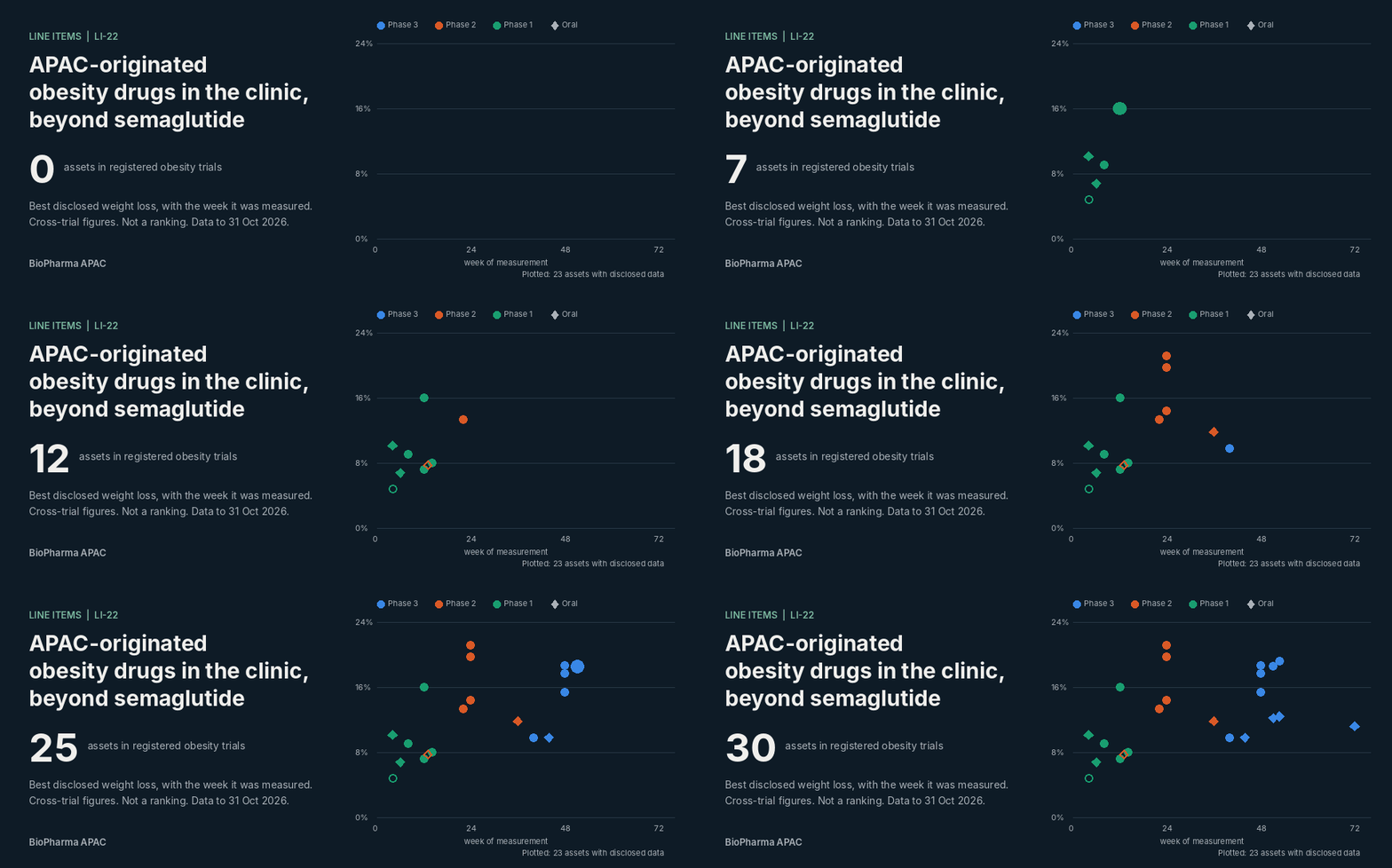
Obesity was the most searched therapeutic area of 2026, and for most readers the story still has two names in it. Semaglutide and tirzepatide set the benchmarks, the prices and the supply headlines. Yet the pipeline that will decide what comes after them looks increasingly Asian. By our count, 30 assets discovered by Asia-Pacific companies are in registered human trials for obesity or weight management as the year closes. Twenty-one of them originated in mainland China.
Several of those names are no longer pipeline at all. Orforglipron, the oral pill Chugai discovered and Eli Lilly took global, won US approval in April. Sciwind's ecnoglutide cleared China's National Medical Products Administration (NMPA) for weight management in March. Hanmi's efpeglenatide became Korea's first home-grown obesity drug in October. Behind them, three Chinese GLP-1/GIP dual agonists are waiting on the NMPA, and at least seven other assets have completed or are running Phase 3.
This year-end reckoning lists all 30. For each one we give the mechanism, whether it is swallowed or injected, its stage and a trial identifier, and the best weight change the sponsor has publicly disclosed, always with the week it was measured. Where no number has been released, we say so rather than estimate one.
-Inclusion had two tests. The originator, the company that discovered the molecule, had to be headquartered in Asia-Pacific. The asset had to have at least one registered human trial in obesity or weight management, on ClinicalTrials.gov, China's drug trial registry or an equivalent. Licensing a molecule out does not change its origin, so orforglipron counts as Japanese and olatorepatide as Chinese.
Efficacy appears only where it has been publicly disclosed, in a peer-reviewed paper, a congress presentation, an exchange filing or a company release. For each asset we report the figure from its most advanced completed trial at the longest disclosed timepoint, using the treatment-policy (or treatment-regimen) estimand where sponsors gave both. That estimand counts every randomised patient, including those who stopped the drug, and so runs lower than the efficacy estimand. Where only a placebo-adjusted figure exists, we label it. Figures are mean percentage change in body weight from baseline unless stated.
Excluded by design: semaglutide and other reformulations or generics of approved molecules, which belong to LI-03, and any discussion of these drugs as longevity agents, which LI-06 owns. Data are current to 31 October 2026.
|
Cross-trial comparison caveat Read before comparing. These figures come from different trials with different doses, durations, populations, baseline body-mass index, estimands and placebo responses. Many Chinese trials enrol people with a lower average BMI than Western trials. Several figures are Phase 1 or Phase 2 results from small cohorts over a few weeks. No two points on this chart come from a head-to-head trial, and the chart does not rank the drugs. |
Best disclosed mean weight change, by phase of the trial that produced it. Labels give the week of measurement. Hollow markers are placebo-adjusted figures; all others are unadjusted. Assets with no disclosed weight figure are not plotted. Sources: company releases, filings and publications listed below. Data to 31 October 2026.
Already through the door: approved in 2026
Three Asia-Pacific discovered molecules became medicines this year, each in a different market and each still running trials. Approval is not the end of their clinical story, which is why they open the list.
|
1 Orforglipron (Foundayo) |
|
|
Originator |
Chugai Pharmaceutical, Japan |
|
Mechanism |
Small-molecule GLP-1 receptor agonist |
|
Route |
Oral, once daily, no food or water restrictions |
|
Stage and trial ID |
Approved in the US, 1 April 2026; positive CHMP opinion in the EU, October 2026; filed in Japan, February 2026. ATTAIN-1, NCT05869903 |
|
Best disclosed weight change and week |
‑11.2% at week 72 (36 mg trial dose, treatment-regimen estimand; placebo ‑2.1%). Efficacy estimand: ‑12.4% |
|
Partner |
Eli Lilly, global licence from 2018 (USD 50 million upfront plus milestones and royalties) |
|
Note |
The only Asia-Pacific discovered oral obesity drug on sale anywhere. Chugai began booking royalty income in Q2 2026. |
|
2 Ecnoglutide (XW003) |
|
|
Originator |
Sciwind Biosciences, China |
|
Mechanism |
cAMP-biased GLP-1 receptor agonist |
|
Route |
Subcutaneous, once weekly |
|
Stage and trial ID |
Approved by the NMPA for chronic weight management, March 2026, after a type 2 diabetes approval in January. SLIMMER, NCT05813795 |
|
Best disclosed weight change and week |
‑15.4% at week 48 (2.4 mg; placebo ‑0.3%). Primary endpoint at week 40: ‑13.2% |
|
Partner |
Pfizer China, mainland commercialisation (deal valued at up to USD 495 million) |
|
Note |
SLIMMER is published in The Lancet Diabetes & Endocrinology. The oral version is entry 20. |
|
3 Efpeglenatide (HM11260C, Eppe) |
|
|
Originator |
Hanmi Pharmaceutical, Korea |
|
Mechanism |
Long-acting GLP-1 receptor agonist |
|
Route |
Subcutaneous, once weekly |
|
Stage and trial ID |
Approved by Korea's Ministry of Food and Drug Safety, October 2026. Korean Phase 3, NCT06174779 |
|
Best disclosed weight change and week |
‑9.75% at week 40 (placebo ‑0.95%; placebo-adjusted ‑8.13%), per Hanmi's October 2025 topline. Approval coverage cites ‑9.02%, which appears to be a different analysis set |
|
Partner |
None. Sanofi licensed it for diabetes in 2015 and returned the rights in 2020 |
|
Note |
Korea's first domestically developed obesity drug, positioned on tolerability; launch targeted by year end. |
Waiting on Beijing: filed in China
Three Chinese GLP-1/GIP dual agonists have completed Phase 3 and sit with the NMPA. Their headline figures land within a point and a half of one another, between roughly 18% and 19% at about a year.
|
4 HRS9531 (ribupatide, KAI-9531) |
|
|
Originator |
Jiangsu Hengrui Pharmaceuticals, China |
|
Mechanism |
GLP-1/GIP dual receptor agonist |
|
Route |
Subcutaneous, once weekly |
|
Stage and trial ID |
NDA under NMPA review since September 2025. China Phase 3, NCT06396429; Kailera's global KaiNETIC Phase 3 programme began in 2026 |
|
Best disclosed weight change and week |
‑17.7% at week 48 (6 mg, treatment policy); placebo-adjusted ‑16.3% |
|
Partner |
Kailera Therapeutics, ex-Greater China (three-asset package: USD 110 million upfront and near-term payments, up to USD 5.725 billion in sales milestones, 19.9% equity to Hengrui) |
|
Note |
Phase 2 at 8 mg reached ‑23.6% at week 36. A Phase 3 in obesity with knee osteoarthritis was cleared in July. |
|
5 Olatorepatide (HS-20094) |
|
|
Originator |
Hansoh Pharmaceutical, China |
|
Mechanism |
Biased GLP-1/GIP dual receptor agonist |
|
Route |
Subcutaneous, once weekly |
|
Stage and trial ID |
NDA accepted by the NMPA, June 2026. LIGHTEN Phase 3, NCT06839664 |
|
Best disclosed weight change and week |
‑18.7% at week 48 (15 mg, treatment-regimen; placebo ‑2.5%). Efficacy estimand: ‑19.3% |
|
Partner |
Regeneron, ex-mainland China, Hong Kong and Macau (USD 80 million upfront, up to USD 1.93 billion in milestones) |
|
Note |
An EASD 2026 late-breaker; Regeneron plans a global Phase 3. |
|
6 BGM0504 |
|
|
Originator |
BrightGene Bio-Medical Technology, China |
|
Mechanism |
GLP-1/GIP dual receptor agonist |
|
Route |
Subcutaneous injection |
|
Stage and trial ID |
NDA accepted by the NMPA, June 2026. Phase 3, NCT06704581 |
|
Best disclosed weight change and week |
‑19.2% at week 52 (15 mg, full analysis set); placebo arm not disclosed in the release |
|
Partner |
None disclosed |
|
Note |
The largest Phase 3 number in this list, though the missing placebo figure limits comparison. |
Phase 3 readouts in hand
Seven more assets have reported Phase 3 or have Phase 3 complete. This is where the oral class shows its shape: three Chinese pills, all once daily, landing between about 10% and 12.5% at 44 to 52 weeks.
|
7 Bofanglutide (GZR18) |
|
|
Originator |
Gan & Lee Pharmaceuticals, China |
|
Mechanism |
GLP-1 receptor agonist |
|
Route |
Subcutaneous, every two weeks; once monthly under test |
|
Stage and trial ID |
Phase 3: GRADUAL-1 complete; GRADUAL-2 head-to-head against semaglutide 2.4 mg; GRADUAL-3 monthly dosing, CTR20254659. US Phase 2, NCT06737042 |
|
Best disclosed weight change and week |
‑18.54% at week 52 (48 mg every two weeks; placebo ‑1.11%) |
|
Partner |
Menarini, 39 European countries (EUR 62 million upfront, up to about USD 849 million in total) |
|
Note |
In the US Phase 2, 48 mg gave ‑15.18% at week 36 against ‑16.93% for open-label tirzepatide 15 mg. |
|
8 HRS-7535 (KAI-7535) |
|
|
Originator |
Jiangsu Hengrui Pharmaceuticals, China |
|
Mechanism |
Small-molecule GLP-1 receptor agonist |
|
Route |
Oral, once daily |
|
Stage and trial ID |
China Phase 3 positive: HARBOR-1, NCT06904105. Kailera's global Phase 2 reads out in 2027 |
|
Best disclosed weight change and week |
‑9.8% at week 44 (180 mg, treatment policy; placebo ‑2.4%). Efficacy estimand: ‑10.9% |
|
Partner |
Kailera Therapeutics, ex-Greater China (part of the package in entry 4) |
|
Note |
A parallel China Phase 3 in type 2 diabetes, OUTSTAND-1, also met its endpoint. |
|
9 HDM1002 |
|
|
Originator |
Huadong Medicine, China |
|
Mechanism |
Small-molecule GLP-1 receptor agonist |
|
Route |
Oral, once daily |
|
Stage and trial ID |
Phase 3 complete and positive; pre-NDA meeting held. NCT06885021 |
|
Best disclosed weight change and week |
‑12.2% at week 52 (400 mg; placebo ‑1.2%). Primary endpoint at week 44: ‑10.7% |
|
Partner |
None |
|
Note |
The most advanced unpartnered oral in the region. |
|
10 VCT220 (CX11) |
|
|
Originator |
Vincentage Pharma, China |
|
Mechanism |
Small-molecule GLP-1 receptor agonist |
|
Route |
Oral, once daily |
|
Stage and trial ID |
China Phase 3 positive, NCT06939296; US Phase 2 positive, NCT07011797 |
|
Best disclosed weight change and week |
‑12.4% at week 52 (160 mg; placebo ‑1.3%) |
|
Partner |
Corxel Pharmaceuticals, ex-Greater China (terms undisclosed) |
|
Note |
The US Phase 2 reported up to ‑11.5% at week 36; Corxel plans a global Phase 3. |
|
11 RAY1225 |
|
|
Originator |
Raynovent (Guangdong Zhongsheng Pharmaceutical), China |
|
Mechanism |
GLP-1/GIP dual receptor agonist |
|
Route |
Subcutaneous, every two weeks |
|
Stage and trial ID |
Phase 3, NCT06893016: positive topline announced October 2026 without figures |
|
Best disclosed weight change and week |
‑21.18% at week 24, Phase 2 REBUILDING-1 (18 mg; placebo not disclosed for this cohort) |
|
Partner |
None |
|
Note |
The highest number on our chart, but from Phase 2 at 24 weeks with no placebo comparison. The Phase 3 figures matter more. |
|
12 HDM1005 (poterepatide) |
|
|
Originator |
Huadong Medicine, China |
|
Mechanism |
GLP-1/GIP dual receptor agonist |
|
Route |
Subcutaneous, once weekly |
|
Stage and trial ID |
Phase 3 met its primary endpoint at a week 40 interim (figures not disclosed). Phase 2 head-to-head against tirzepatide, NCT07521631, recruiting |
|
Best disclosed weight change and week |
‑13.31% at week 22, Phase 2 (2.0 mg; placebo ‑2.46%) |
|
Partner |
None |
|
Note |
Pre-NDA meeting expected in Q4 2026. |
|
13 TG103 (efsubaglutide alfa) |
|
|
Originator |
CSPC Pharmaceutical Group, China |
|
Mechanism |
GLP-1 Fc fusion protein |
|
Route |
Subcutaneous, once weekly |
|
Stage and trial ID |
Phase 3 in non-diabetic overweight or obesity completed, CTR20251416; obesity results not disclosed |
|
Best disclosed weight change and week |
‑7.24% at week 12, Phase 1b (15 mg; placebo ‑1.76%) |
|
Partner |
None |
|
Note |
CSPC's Phase 3 data at EASD 2026 were in type 2 diabetes only. |
Phase 3 under way
Three assets have started pivotal programmes but have only earlier data to show. Two are pills, and two of the three have global Phase 3 trials under way.
|
14 UBT251 |
|
|
Originator |
The United Laboratories, China |
|
Mechanism |
GLP-1/GIP/glucagon triple receptor agonist |
|
Route |
Subcutaneous, once weekly |
|
Stage and trial ID |
China Phase 3, NCT07648225; first participant dosed September 2026 |
|
Best disclosed weight change and week |
‑19.7% at week 24, Phase 2 (highest dose, efficacy estimand; placebo ‑2.0%) |
|
Partner |
Novo Nordisk, ex-Greater China (USD 200 million upfront, up to USD 1.8 billion in milestones) |
|
Note |
The doses tested in Phase 2 ranged from ‑13.6% to ‑19.7%. |
|
15 ASC30 |
|
|
Originator |
Ascletis Pharma, China |
|
Mechanism |
Small-molecule GLP-1 receptor agonist |
|
Route |
Oral, once daily (a once-monthly injectable depot of the same molecule is in Phase 2) |
|
Stage and trial ID |
Global Phase 3 AURORA-1, NCT07743463, and AURORA-2, NCT07743450; first patient dosed 30 August 2026, topline due Q3 2028 |
|
Best disclosed weight change and week |
‑7.7% placebo-adjusted at week 13, US Phase 2 (60 mg) |
|
Partner |
None; Ascletis holds global rights |
|
Note |
A Chinese-originated pill in global Phase 3 without a Western licensee. |
|
16 Elecoglipron (AZD5004, ECC5004) |
|
|
Originator |
Eccogene, China |
|
Mechanism |
Small-molecule GLP-1 receptor agonist |
|
Route |
Oral, once daily |
|
Stage and trial ID |
Global Phase 3 run by AstraZeneca (Embold in obesity). Phase 2b VISTA, NCT06579092 |
|
Best disclosed weight change and week |
‑11.8% at week 36 (75 mg, efficacy estimand; placebo ‑0.3%) |
|
Partner |
AstraZeneca, ex-Greater China (USD 185 million upfront; USD 50 million milestone on starting Phase 3, September 2026) |
|
Note |
VISTA is published in The Lancet. |
Phase 2 and earlier, with numbers
The early end of the list is where the mechanisms diversify: triple agonists, glucagon co-agonists, monthly dosing and an oral peptide. The figures here are small and short, and should be read as signals rather than results.
|
17 Zovaglutide (ZT002) |
|
|
Originator |
QL Biopharm, China |
|
Mechanism |
Ultra-long-acting GLP-1 receptor agonist |
|
Route |
Subcutaneous, every two weeks or once monthly |
|
Stage and trial ID |
HORIZON-1 registered, NCT07230119; Phase 2, NCT06371326 |
|
Best disclosed weight change and week |
‑14.4% at week 24, Phase 2 (160 mg every two weeks; placebo ‑2.4%). Monthly arm: ‑13.8% |
|
Partner |
None |
|
Note |
One of the clearest monthly-dosing signals in the region. |
|
18 HRS-4729 (KAI-4729) |
|
|
Originator |
Jiangsu Hengrui Pharmaceuticals, China |
|
Mechanism |
GLP-1/GIP/glucagon triple receptor agonist |
|
Route |
Subcutaneous, once weekly |
|
Stage and trial ID |
Phase 2, NCT07690826 |
|
Best disclosed weight change and week |
‑16.0% at week 12, Phase 1 (12 mg; placebo ‑5.4%) |
|
Partner |
Kailera Therapeutics (entry 4 package) |
|
Note |
Hengrui's third obesity asset, giving it a weekly dual, a weekly triple and a daily pill. |
|
19 HM15275 |
|
|
Originator |
Hanmi Pharmaceutical, Korea |
|
Mechanism |
GLP-1/GIP/glucagon triple receptor agonist |
|
Route |
Subcutaneous, once weekly |
|
Stage and trial ID |
US Phase 2, NCT07205900 (about 250 adults, 36 weeks; completion estimated January 2027) |
|
Best disclosed weight change and week |
‑4.81% placebo-adjusted at day 29 (about week 4), Phase 1, NCT06481098 |
|
Partner |
None |
|
Note |
Hanmi's stated goal of more than 25% loss is a target, not data. |
|
20 Oral ecnoglutide (XW004, VRB-101) |
|
|
Originator |
Sciwind Biosciences, China |
|
Mechanism |
cAMP-biased GLP-1 receptor agonist, oral peptide formulation |
|
Route |
Oral; once daily in Phase 1, once weekly in Phase 2b |
|
Stage and trial ID |
Phase 2b EVOLVE-2, NCT07281937, enrolment complete, topline due by end 2026 |
|
Best disclosed weight change and week |
‑6.76% at week 6, Phase 1 (30 mg daily; placebo ‑0.85%) |
|
Partner |
Verdiva Bio, ex-Greater China and Korea (about USD 70 million upfront, more than USD 2.4 billion in milestones) |
|
Note |
A weekly pill would be a genuine differentiator if EVOLVE-2 holds up. |
|
21 Utreglutide (GL0034) |
|
|
Originator |
Sun Pharmaceutical Industries, India |
|
Mechanism |
Long-acting GLP-1 receptor agonist |
|
Route |
Subcutaneous, once weekly |
|
Stage and trial ID |
Phase 2, NCT07282743, in overweight or obesity with type 2 diabetes (HbA1c primary endpoint; topline guided for H2 2027) |
|
Best disclosed weight change and week |
‑8.0% at week 14, Phase 1b/2a (postmenopausal women with obesity and MASLD; placebo ‑2.1%) |
|
Partner |
None |
|
Note |
The only Indian-originated novel obesity agent we found in a registered trial. |
|
22 DA-1726 |
|
|
Originator |
Dong-A ST, Korea |
|
Mechanism |
GLP-1/glucagon dual receptor agonist (oxyntomodulin analogue) |
|
Route |
Subcutaneous, once weekly |
|
Stage and trial ID |
Phase 1 Part 3, NCT06252220; topline due Q4 2026 |
|
Best disclosed weight change and week |
‑9.1% at week 8 (48 mg; not placebo-adjusted, placebo not reported) |
|
Partner |
MetaVia (formerly NeuroBo), a Dong-A ST affiliate, holds an exclusive licence |
|
Note |
Part 3 titrates to 48 mg or 64 mg over 16 weeks. |
|
23 IBI3032 |
|
|
Originator |
Innovent Biologics, China |
|
Mechanism |
Small-molecule GLP-1 receptor agonist |
|
Route |
Oral |
|
Stage and trial ID |
Phase 1 in adults with overweight or obesity, NCT07170319 |
|
Best disclosed weight change and week |
‑10.11% at week 4 (9 mg titrated cohort) |
|
Partner |
None |
|
Note |
Innovent's first self-originated obesity asset in the clinic; its marketed mazdutide is a Lilly molecule. |
In the clinic, no comparable number yet
Seven more assets meet the inclusion test but have no disclosed body-weight figure that can sit on the chart. Several are the most scientifically interesting names on the list.
|
# |
Asset |
Originator |
Mechanism and route |
Stage and trial ID |
What is disclosed |
|
24 |
MWN101 |
Shanghai Minwei (Lepu Medical), China |
GLP-1/GIP/glucagon triple, Fc fusion; injectable |
Phase 2, CTR20240802 |
No weight data disclosed |
|
25 |
PG-102 |
ProGen, Korea |
GLP-1/GLP-2 dual, Fc fusion; subcutaneous every two weeks or monthly |
Phase 2 in obesity with type 2 diabetes, NCT06712615 |
Weight change not quantified; Rani Therapeutics partners an oral version |
|
26 |
HM17321 |
Hanmi Pharmaceutical, Korea |
UCN2 analogue (CRF2 receptor), aimed at fat loss with lean-mass preservation; subcutaneous |
Phase 1, NCT07219589 |
Genentech: USD 190 million upfront, about USD 2.3 billion total (August 2026) |
|
27 |
LAE102 |
Laekna, China |
ActRIIA monoclonal antibody; subcutaneous |
Phase 1 |
Body composition only: lean mass +4.6%, fat mass ‑3.6% placebo-adjusted at week 5; clinical collaboration with Lilly |
|
28 |
HS-10535 (MK-4082) |
Hansoh Pharmaceutical, China |
Small-molecule GLP-1 receptor agonist; oral |
Phase 1, NCT07388667 |
Merck: USD 112 million upfront, up to USD 1.9 billion |
|
29 |
S-309309 |
Shionogi, Japan |
MGAT2 inhibitor; oral |
Phase 2, NCT05925114 |
Under 5% at week 24 as monotherapy; exact figure not disclosed |
|
30 |
Bivamelagon (LB54640) |
LG Chem, Korea |
MC4R agonist; oral, once daily |
Phase 2 in acquired hypothalamic obesity; Rhythm plans pivotal Phase 3 |
BMI, not weight: ‑9.3% at week 14 (600 mg; placebo +2.2%). Rhythm: USD 40 million upfront cash |
Held out, and why
Mazdutide, approved in China for weight management in June 2025, is Innovent's commercial lead but an Eli Lilly molecule, so it fails the originator test. Its GLORY-2 trial reported ‑18.55% at week 60 at 9 mg, which helps set the bar for the Chinese duals above.
Aleniglipron (Structure Therapeutics) and RGT-075 (Regor Therapeutics) both have Shanghai research roots but split or US headquarters, so we hold them out as borderline. Aleniglipron is in Phase 3 after ‑11.3% placebo-adjusted at week 36 in Phase 2b.
Ildong's ID110521156 has been tested only in healthy volunteers, and D&D Pharmatech's zabopegdutide (DD01) is in a fatty-liver trial rather than an obesity one. Neither yet meets the registered obesity trial test. Beinaglutide, approved in China in 2023, predates this year's reckoning.
What the list says
China is the volume, and the volume is dual agonists
Twenty-one of the 30 assets are Chinese, six are Korean, two Japanese and one Indian. We found no Australian, Taiwanese or Singaporean originated asset in a registered obesity trial. Within the Chinese group, the GLP-1/GIP dual agonist is now a crowded class: HRS9531, olatorepatide and BGM0504 report 17.7%, 18.7% and 19.2% at 48 to 52 weeks, a spread smaller than the difference between estimands within a single trial. RAY1225 and HDM1005 are behind them. When five companies converge on one mechanism, the next fight is about price, supply and dosing interval rather than the weight-loss number.
Oral is settling at 10% to 12%
Orforglipron's ‑11.2% at week 72 and the Chinese pills' ‑9.8% to ‑12.4% at 44 to 52 weeks describe a reasonably tight band for once-daily small molecules, below the leading injectables. The pills will compete on convenience, manufacturing cost and access rather than depth of loss. The open question is Verdiva's once-weekly oral ecnoglutide, which reads out by the end of this year.
Frequency is the new differentiator
Bofanglutide and RAY1225 dose every two weeks, zovaglutide and GRADUAL-3 test monthly injections, and ASC30 has a monthly depot. A mono-agonist given fortnightly, bofanglutide, reports a one-year figure in the same band as the weekly duals. If that holds in GRADUAL-2 against semaglutide, mechanism matters less than many assumed.
The rights have mostly been sold
Of the 30 assets, 13 have an ex-regional or global licensee or a European partner. Disclosed upfront payments across Lilly, Kailera, Regeneron, Novo Nordisk, AstraZeneca, Merck, Verdiva, Genentech and Rhythm come to roughly USD 1.04 billion, before Menarini's EUR 62 million. Hansoh alone has sold two obesity assets, to Regeneron and Merck. The notable unpartnered late-stage names are HDM1002, BGM0504, RAY1225 and HDM1005, plus ASC30, which Ascletis is taking through global Phase 3 itself.
Muscle is the next frontier
Two of the most valued early deals, Hanmi's HM17321 with Genentech and Laekna's clinical collaboration with Lilly, are not incretins at all. Both aim to protect lean mass while fat comes off. Neither has a weight figure yet, which is why they sit in the table rather than on the chart.
What to watch into 2027
- By end 2026: Verdiva's EVOLVE-2 topline for weekly oral ecnoglutide, and Dong-A ST's DA-1726 Phase 1 Part 3.
- NMPA decisions on HRS9531, olatorepatide and BGM0504, and the full Phase 3 figures behind the RAY1225 and HDM1005 announcements.
- January 2027: estimated completion of Hanmi's HM15275 Phase 2. During 2027: Kailera's global Phase 2 of HRS-7535, Sun Pharma's utreglutide Phase 2 (second half), and GRADUAL-2 against semaglutide.
- 2028: Kailera's KaiNETIC global Phase 3 for HRS9531 and Ascletis's AURORA topline for ASC30, the first pivotal tests of Chinese-originated obesity drugs in Western populations.
A year ago, an Asia-Pacific obesity pipeline was mostly a licensing story. At the end of 2026 it includes a US-approved pill, two Asian approvals, three Chinese filings and a deep bench of Phase 3 readouts. The figures are not yet comparable across trials, and the chart above should not be read as a league table. But the direction is clear enough: the next generation of weight-loss drugs will carry a lot of Asian intellectual property, whichever company's name ends up on the box.
Most Read
- Can APAC Biomanufacturing Decarbonise Without Pricing Itself Out?
- The Algorithm on the GMP Floor: AI Promises a Smarter Plant. Regulators Demand the Audit Trail.
- APAC's Peptide-Capacity Gamble
- After the Rush: APAC's mRNA and Vaccine Capacity Hangover
- The Biosimilar Race: Factory to the World — or Stuck in the Copycat Economy?
- The Vein-to-Vein Problem: Can APAC's Cold Chain Carry Advanced Therapies?
- Vectors, Plasmids and the CGT Trap: APAC's Cell and Gene Therapy Ambitions Face an Upstream Bottleneck
- Can APAC Build Radioligand Therapy Before the Atoms Decay?
- The Great Biopharma Reset: 50 Developments That Changed Everything in H1 2026
- Beyond the Trial: Can Real-World Evidence Earn Regulatory Trust in APAC?
- Beyond the Obvious Giant: Where APAC's Clinical Trials Go Next
- The Frontier That Won’t Quite Arrive
Bio Jobs
- Sanofi Turns The Page As Belén Garijo Steps In And Paul Hudson Steps Out
- Global Survey Reveals Nearly 40% of Employees Facing Fertility Challenges Consider Leaving Their Jobs
- BioMed X and AbbVie Begin Global Search for Bold Neuroscience Talent To Decode the Biology of Anhedonia
- Thermo Fisher Expands Bengaluru R&D Centre to Advance Antibody Innovation and Strengthen India’s Life Sciences Ecosystem
- Accord Plasma (Intas Group) Acquires Prothya Biosolutions to Expand Global Plasma Capabilities
- ACG Announces $200 Million Investment to Establish First U.S. Capsule Manufacturing Facility in Atlanta
- AstraZeneca Invests $4.5 Billion to Build Advanced Manufacturing Facility in Virginia, Expanding U.S. Medicine Production
News


