The Great Biopharma Reset: 50 Developments That Changed Everything in H1 2026
30 June 2026 | Tuesday | Analysis
For three years the biotechnology industry waited for a turn. The first half of 2026 delivered one — and then several more in quick succession. In six months the sector recorded its busiest dealmaking stretch since before the pandemic, watched the balance of the obesity market tip decisively, absorbed a regulatory and trade shock from Washington, and crossed a scientific threshold researchers had chased for over a decade. Beneath all of it ran a structural realignment that should command attention across this region: Asia, and China in particular, is no longer a supporting player in the global pipeline. It is increasingly the source.
None of these stories stands alone. The patent cliff driving the acquisition supercycle is the same force pulling Western buyers toward Chinese-discovered molecules. The pricing policy reshaping US launch strategy is the same policy handing leverage to manufacturers in Europe and Asia. The capital flooding back into public markets is the same capital chasing the gene-editing and AI platforms now reaching the clinic.
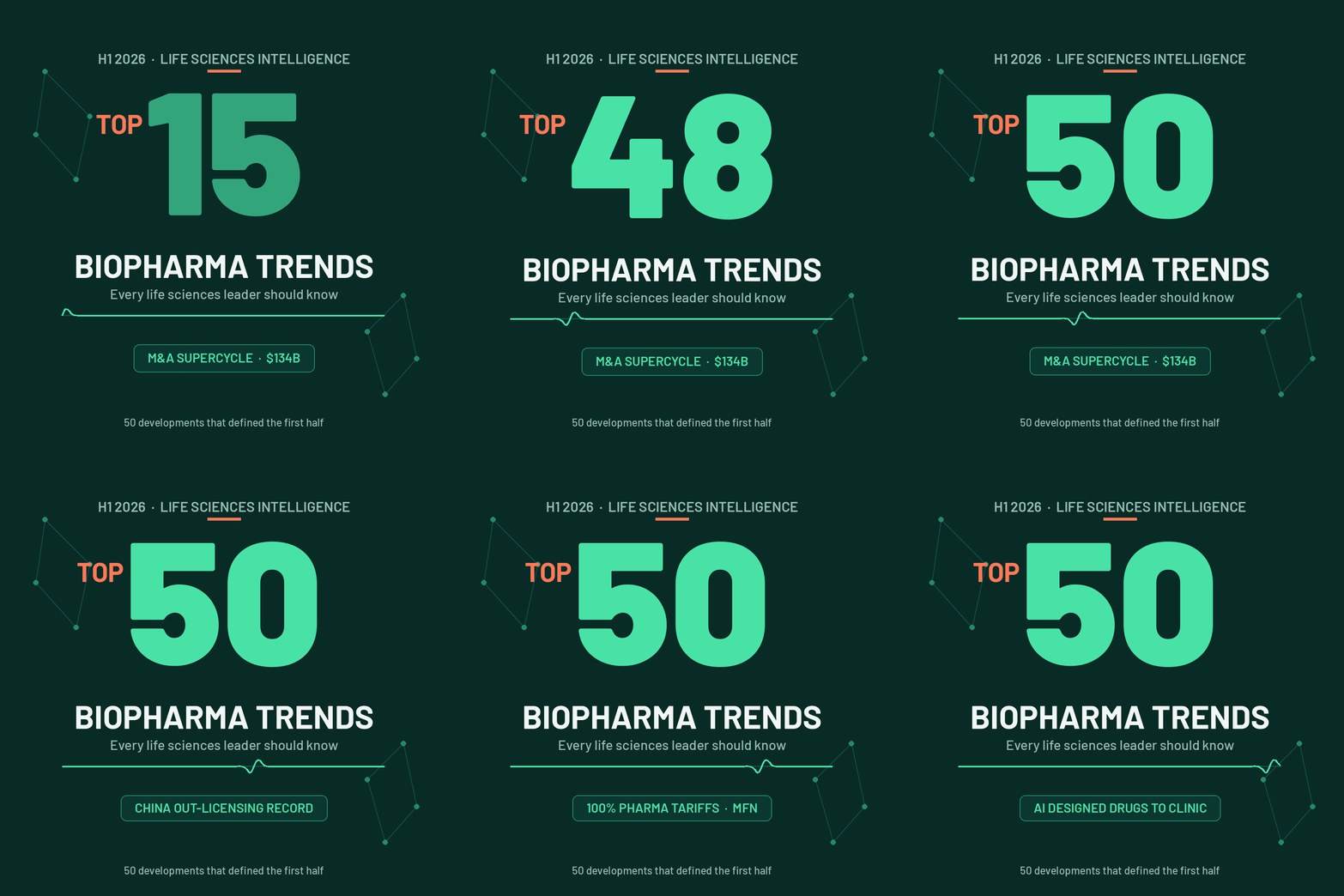
Here are the fifty developments from the first half that cannot be missed.
Dealmaking: the supercycle
1. M&A blew past all of 2025 in half the time. The first six months produced roughly $134 billion in deals and 33 acquisitions worth a billion dollars or more — already eclipsing the $112 billion spent across the whole of 2025. The driver everywhere is the patent cliff.
2. Sun Pharma / Organon — $11.75B, the year's largest. India's Sun Pharma agreed in late April to acquire New Jersey-based Organon for $11.75 billion in an all-cash transaction, a marquee piece of outbound Indian dealmaking that signals how far the country's leaders now reach.
3. AbbVie / Apogee — $10.9B. The year's second-largest biotech buyout and AbbVie's biggest since its 2019 Allergan takeover, adding an immunology franchise that includes a competitor to the blockbuster Dupixent.
4. GSK / Nuvalent and Recordati's take-private. GSK's roughly $10.6 billion move for Nuvalent and a private-capital consortium's takeover of Italy's Recordati at around $12.4 billion in equity value sat at the very top of the 2026 ledger.
5. Gilead / Arcellx — ~$7.8B. Gilead agreed to buy the cell-therapy developer for approximately $7.8 billion, paying $115 a share plus a contingent value right.
6. Eli Lilly's acquisition spree. Lilly strung together Centessa (~$7.8B, sleep disorders), Kelonia (~$7B, CAR-T) and Ajax (~$2.3B, blood cancer), plus tuck-ins in antibody-drug conjugates and genetic medicines — the half's most aggressive single buyer.
7. Merck / Terns — $6.7B. Acting under pressure from the looming Keytruda cliff in 2028, Merck paid $6.7 billion for Terns and its oral leukaemia candidate, and was reported to be weighing a far larger move for Revolution Medicines at $28–32 billion.
8. Pfizer / Metsera — $10B (GLP-1). Closed at the end of 2025, the deal anchors Pfizer's 2026 obesity push, with roughly $6 billion in additional firepower identified for further acquisitions.
9. Bolt-ons defined the sweet spot. GSK / RAPT ($2.2B, food allergy), Chiesi / KalVista ($1.9B, hereditary angioedema) and UCB / Neurona (up to $1.15B, cell therapy in epilepsy) typified the half's preference for differentiated, integrable assets over mega-mergers.
10. The macro backdrop. Loss of exclusivity is the engine — major pharma faces hundreds of billions in revenue erosion through 2030 — and IQVIA forecasts full-year M&A of $140–160 billion, with most of the industry's trillion-dollar firepower still undeployed.
The obesity war intensifies
11. Lilly seized the lead. A combination of superior efficacy and manufacturing scale put Lilly ahead, while Novo absorbed one structural blow after another; orforglipron, Lilly's oral GLP-1, was submitted or cleared across the US, Japan and the EU.
12. CagriSema's high-profile miss. In February, Novo's GLP-1/amylin combination failed to beat Lilly's tirzepatide in a head-to-head Phase 3 weight-loss study, sending Novo's shares down roughly 15 percent and reframing the competitive narrative.
13. The "year of the orals." 2026 marks a genuine inflection point as pill formulations begin to unlock adherence and long-term maintenance, led by oral semaglutide — Novo's "Wegovy in a pill" — and Lilly's orforglipron.
14. Novo's restructuring. The company posted a quarterly revenue decline, cut some 9,000 jobs and warned of 2026 pricing headwinds under a newly installed chief executive.
15. AstraZeneca–CSPC — up to $18.5B (China obesity). AstraZeneca went to China for its obesity ambitions, licensing weight-related candidates from CSPC in a deal worth up to $18.5 billion, including $1.2 billion upfront — proof that China is now an obesity-pipeline source, not merely a manufacturing base.
China and APAC move to the centre
16. Record out-licensing. Chinese cross-border out-licensing reached an unprecedented $137.7 billion in announced value in 2025, with 2026 on pace to break even that, as average deal sizes jumped about 76 percent year on year.
17. Q1 alone hit ~$60B. Chinese biotech out-licensing reached a record $60 billion in the first quarter, with the typical deal now running around $1.3 billion.
18. China overtook the US on launches. Per Citeline's Pharmaprojects, more drugs made their market debut in China than in any other country in 2025 — the first time any nation surpassed the US on that metric.
19. Marquee China deals. AbbVie licensed RemeGen's RC148 (up to $5.6B), Madrigal took rights to Suzhou Ribo's liver-disease programmes (up to $4.4B) and Sanofi licensed a Sino Biopharm candidate (up to $1.53B); antibody-drug conjugates remained the dominant currency, with China behind nearly 90 percent of global ADC licensing.
20. Everest / Hasten — Singapore, $250M. Shanghai-based Everest Medicines agreed to acquire Singapore's Hasten Biopharmaceutical, gaining rights to fourteen chronic-disease treatments across APAC and underscoring rising intra-regional consolidation.
21. India's Biopharma SHAKTI. India committed 100 billion rupees — about $1.1 billion — over five years through its 2026 budget, an explicitly export-oriented push to move from generics into biologics and biosimilars.
22. Singapore doubles down. AstraZeneca is building what it calls the world's first end-to-end ADC manufacturing facility in the city-state (~$1.5–1.9B, online 2029), AbbVie expanded local biologics capacity, and the forthcoming RIE2030 plan commits S$37 billion to science and biomedical research.
23. McKinsey's framing for the region. Asia, the firm argued, stands not at the edge of global innovation but at its centre — Japan in science, China in scaled clinical development, South Korea in advanced biologics, Singapore in early-stage innovation and regional deployment.
24. South Korea's momentum. The market is scaling fast, building FDA-approval momentum, striking out-licensing deals and advancing regulatory reforms — one to watch closely as the year progresses.
Policy upheaval
25. 100% pharma tariffs. On 2 April, the administration imposed 100 percent tariffs on patented pharmaceutical products and ingredients, with onshoring commitments cutting the rate to 20 percent and most-favoured-nation deals to zero through early 2029; generics were exempted.
26. MFN pricing scales up. The administration reached voluntary most-favoured-nation pricing agreements with seventeen of the largest manufacturers — roughly 86 percent of the branded market — alongside the direct-to-consumer channel TrumpRx.gov, launched in early February.
27. Makary out at FDA. Commissioner Marty Makary resigned after a turbulent thirteen-month tenure marked by organisational upheaval and White House friction; food regulator Kyle Diamantas stepped in as acting commissioner, leaving another Senate-confirmed health post to fill.
28. The National Priority Voucher programme. A new mechanism compressed review times from the usual ten months to as little as one or two, used for orforglipron, Regeneron's Otarmeni and a string of rare-disease decisions.
29. Regeneron's landmark MFN package. In exchange for portfolio-wide MFN pricing and a $27 billion US investment, Regeneron saw its rare-disease gene therapy for genetic deafness, Otarmeni, approved on a compressed timeline and made available to American families at no cost.
30. Launch-strategy fallout. Analysts warn MFN reference pricing may push companies to delay or bypass low-price markets to protect US benchmarks — meaning fewer future launches and real innovation headwinds, a structural story worth sustained coverage.
Notable FDA approvals
31. Baxfendy (baxdrostat). The first aldosterone synthase inhibitor approved for hypertension, targeting the hormonal driver of treatment-resistant disease — and an early real-world test of MFN pricing.
32. Beqalzi (sonrotoclax). Accelerated approval of a BCL-2 inhibitor for relapsed or refractory mantle cell lymphoma (BeOne Medicines).
33. Sacituzumab govitecan in first-line TNBC. Approved as monotherapy and with pembrolizumab for first-line triple-negative breast cancer, expanding a key franchise.
34. Relacorilant (Lifyorli). A first-in-class agent approved with chemotherapy for platinum-resistant ovarian, fallopian-tube or primary peritoneal cancer.
35. Optune Pax. The first FDA-approved therapy specific to locally advanced pancreatic cancer in nearly three decades, using tumour-treating fields.
36. Xocova (ensitrelvir). The first oral option for post-exposure prophylaxis of COVID-19 (Shionogi).
37. The rare-disease wave. Lumvoa (veligrotug, thyroid eye disease) joined Q1 approvals in achondroplasia, a cholestatic liver itch and hepatitis D, many accelerated through the priority-voucher pathway.
38. Q1 output. The FDA approved ten novel drugs in the first quarter, a modest rise over the seven a year earlier, though projected 2030 sales for the cohort run lower.
39. The watch-list builds. CagriSema and the oral GLP-1 decisions remain live FDA catalysts for late 2026 — the approvals most likely to reshape the obesity market further.
Gene editing crosses a threshold
40. First Phase 3 win for in vivo CRISPR. Intellia's lonvo-z cut hereditary angioedema attack rates by 87 percent versus placebo over six months — the first late-stage success for a therapy that edits a gene directly inside the body.
41. First in vivo CRISPR FDA filing. Intellia's nex-z for ATTR amyloidosis became the agency's first in vivo CRISPR submission, testing a gene-therapy framework not written with permanent edits in mind.
42. A historic personalised edit. A bespoke in vivo CRISPR therapy was developed, approved and delivered for an infant with a rare metabolic disorder — a landmark for individualised medicine.
43. A cautionary counterpoint. Verve's base-editing therapy targeting PCSK9 for cardiovascular disease hit a clinical hold after a serious adverse event, underscoring the irreversibility risk inherent to the modality.
44. Beam's AATD correction. The first clinical genetic correction of a disease-causing mutation in alpha-1 antitrypsin deficiency, with a broader program update in early 2026.
AI moves from hype to clinic
45. Isomorphic Labs' $2.1B Series B. Among the largest private rounds ever for an AI drug-discovery company; the DeepMind spinout expects to enter human trials with its first AI-designed cancer drug by the end of 2026.
46. Big Pharma's AI infrastructure bets. Eli Lilly partnered with NVIDIA on a roughly $1 billion co-innovation lab and expanded its Insilico Medicine alliance to as much as $2.75 billion — AI shifting from discovery engine to validated pipeline.
Capital markets reopen
47. The IPO comeback. In the first six months, biopharma companies raised more from initial public offerings than the sector managed across all of 2025, as the public window reopened after a multi-year drought.
48. Record-breaking debuts. Kailera Therapeutics raised $625 million to become the largest biotech IPO on record — its pipeline licensed from China's Hengrui — before Parabilis Medicines priced an upsized ~$670 million offering in June.
49. A venture funding surge. Capital concentrated in AI and immunology, from Isomorphic's mega-round to a $300 million Series A for the lupus-focused Beeline Medicines and a busy spring of $400-million-plus financings.
50. Layoffs easing, sentiment turning. Biotech layoffs moderated and generalist investors returned, with the XBI up sharply over the trailing year — the mood shift underlying everything above.
What to watch in the second half
The first half established the themes; the second will test how durable they are. Three questions stand out.
The first is whether the dealmaking supercycle broadens or narrows. The patent cliff is not going away and a trillion dollars of firepower remains largely undeployed, but a more uncertain rate environment could tighten the financing that has fuelled both M&A and the IPO window. If the recovery stays confined to a handful of large, de-risked names, the rebound will look very different from the broad revival the early data hinted at.
The second is policy. The most-favoured-nation framework and the tariff regime are still being implemented, with effective dates stretching into the autumn and final rules yet to clear. For manufacturers across Asia and Europe, the calculus of where to build and how to price American launches is now an open strategic question rather than a settled one.
The third, and for this region the most consequential, is the trajectory of Asian innovation. If China's out-licensing pace holds and South Korea, India and Singapore keep converting policy and capital into pipeline and infrastructure, the centre of gravity in drug development will continue shifting eastward. The first half of 2026 did not complete that transition. But it made the direction of travel unmistakable.
(arcilla.fran@biopharmaapac.com)
A first-half 2026 round-up. Figures and transactions are drawn from company disclosures and contemporaneous industry reporting through late June 2026; deal values reflect headline totals including milestones and contingent consideration unless otherwise noted.
Most Read
- Can APAC Biomanufacturing Decarbonise Without Pricing Itself Out?
- The Algorithm on the GMP Floor: AI Promises a Smarter Plant. Regulators Demand the Audit Trail.
- APAC's Peptide-Capacity Gamble
- After the Rush: APAC's mRNA and Vaccine Capacity Hangover
- The Biosimilar Race: Factory to the World — or Stuck in the Copycat Economy?
- The Vein-to-Vein Problem: Can APAC's Cold Chain Carry Advanced Therapies?
- Vectors, Plasmids and the CGT Trap: APAC's Cell and Gene Therapy Ambitions Face an Upstream Bottleneck
- Can APAC Build Radioligand Therapy Before the Atoms Decay?
- The Great Biopharma Reset: 50 Developments That Changed Everything in H1 2026
- Beyond the Trial: Can Real-World Evidence Earn Regulatory Trust in APAC?
- Beyond the Obvious Giant: Where APAC's Clinical Trials Go Next
- The Frontier That Won’t Quite Arrive
Bio Jobs
- Sanofi Turns The Page As Belén Garijo Steps In And Paul Hudson Steps Out
- Global Survey Reveals Nearly 40% of Employees Facing Fertility Challenges Consider Leaving Their Jobs
- BioMed X and AbbVie Begin Global Search for Bold Neuroscience Talent To Decode the Biology of Anhedonia
- Thermo Fisher Expands Bengaluru R&D Centre to Advance Antibody Innovation and Strengthen India’s Life Sciences Ecosystem
- Accord Plasma (Intas Group) Acquires Prothya Biosolutions to Expand Global Plasma Capabilities
- ACG Announces $200 Million Investment to Establish First U.S. Capsule Manufacturing Facility in Atlanta
- AstraZeneca Invests $4.5 Billion to Build Advanced Manufacturing Facility in Virginia, Expanding U.S. Medicine Production
News