
17 APAC-Made Biosimilars Approved in the US or EU in 2026
28 October 2026 | Wednesday | Analysis
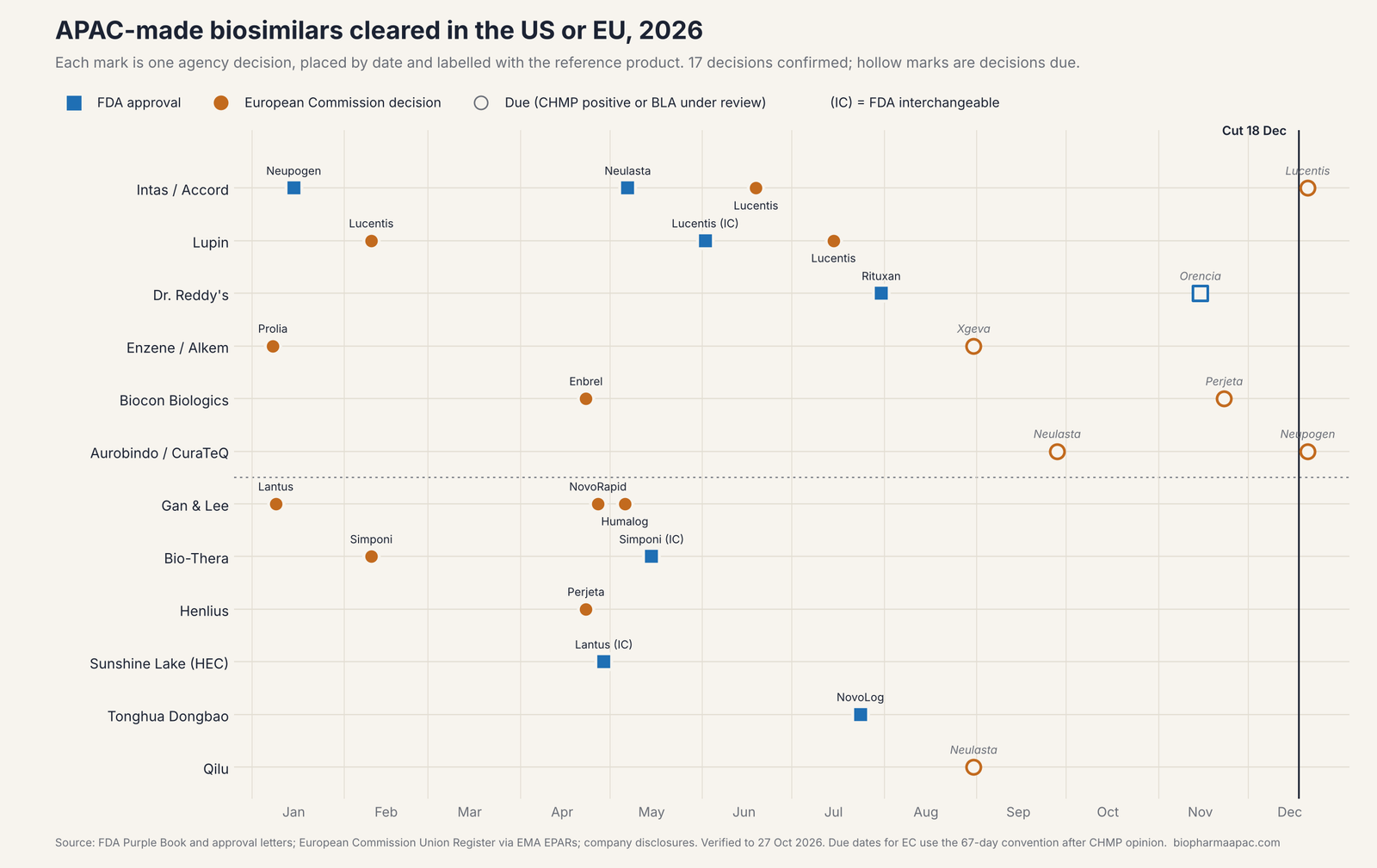
Figure 1. APAC-made biosimilars cleared in the US or EU in 2026, by developer and reference product. Hollow marks are decisions due before or at the 18 December cut.
Seventeen times in 2026, the US Food and Drug Administration or the European Commission cleared a biosimilar that was developed or made in Asia-Pacific. Nine of those decisions went to Indian developers and eight to Chinese ones. Seven came from the FDA and ten from Brussels, and three of the seven US approvals carry an interchangeability designation, which lets a pharmacist swap the biosimilar for the brand without calling the prescriber where state law allows.
Put those numbers against the rest of the market and the region's weight becomes plain. By this desk's count, seven of the nine new biosimilar licences the FDA issued from January to September went to APAC-made products, and the agency's running total of biosimilar approvals passed 100 in July on the back of two of them. In Europe, ten of the Commission's documented biosimilar authorisations to the end of July carry an APAC developer's name. For a category that Western generics houses once treated as their own, that is a quiet but decisive change of hands.
The more interesting number is zero. Samsung Bioepis and Celltrion built the template that every company on this list is now following: develop in Asia, manufacture at scale, license the commercial rights to a partner who already owns the Western pharmacy shelf. Neither added a new reference product in the US or the EU this year. Japan, home to a small biosimilar industry focused on its own market, also has no entry. The export record of 2026 is an Indian and Chinese record, and the reasons say a good deal about where the next three years of biosimilar competition will come from.
What follows is the full list, entry by entry, with the reference product, the developer, where the product is made, the agency and date, its interchangeability status and the company that will actually sell it. The method sits first, because a list is only as good as the rule that decides what goes on it.
|
HOW THIS LIST WAS BUILT What counts. One entry per agency decision per product family. A product cleared by both the FDA and the Commission appears twice, because the two decisions are separate events with separate commercial consequences. Paired brands approved together for the same molecule (for example a Prolia and an Xgeva version, or Immgolis and Immgolis Intri) count once. The test for APAC. The developer of record or the principal manufacturing site must sit in Asia-Pacific, defined as East, South and Southeast Asia and Oceania. A product developed in Europe and merely partnered with an Asian company for its home market does not qualify, and nor does West Asia: Gedeon Richter's tocilizumab Tuyory (Japanese partner Mochida) and CinnaGen's Iranian teriparatide Zandoriah, both authorised in Brussels in 2026, are excluded on that basis. What does not count. New presentations, new strengths, new formulations and interchangeability designations granted to products first approved before 2026. Those are listed in a sidebar, not the count. Dates. FDA entries carry the approval date on the licence, not the later press release. Commission entries carry the decision date on the Union Register. Where only a positive opinion from the EMA's human medicines committee (CHMP) exists, the product is listed as due, with the expected decision date under the 67-day convention. Sites. Where the FDA licence letter or the company names the manufacturing site, it is given. Otherwise the developer's home base is shown and marked as such. Revisions. This edition is verified to 27 October 2026. Decisions taken before the 18 December cut are added in place with a dated revision note. The list closes in the first week of January. |
The 17 at a glance
|
Biosimilar |
Reference |
Developer |
Agency, date |
FDA interchangeable |
|
Osqay (denosumab) |
Prolia |
Enzene / Alkem (IN) |
EC, 8 Jan |
n/a |
|
Ondibta (insulin glargine) |
Lantus |
Gan & Lee (CN) |
EC, 9 Jan |
n/a |
|
Filkri (filgrastim-laha) |
Neupogen |
Intas (IN) |
FDA, 15 Jan |
No |
|
Gotenfia (golimumab) |
Simponi |
Bio-Thera (CN) |
EC, 10 Feb |
n/a |
|
Ranluspec (ranibizumab) |
Lucentis |
Lupin (IN) |
EC, 10 Feb |
n/a |
|
Poherdy (pertuzumab) |
Perjeta |
Henlius (CN) |
EC, 23 Apr |
n/a |
|
Fubelv (etanercept) |
Enbrel |
Biocon Biologics (IN) |
EC, 23 Apr |
n/a |
|
Dazparda (insulin aspart) |
NovoRapid |
Gan & Lee (CN) |
EC, 27 Apr |
n/a |
|
Langlara (insulin glargine-aldy) |
Lantus |
Sunshine Lake (CN) |
FDA, 29 Apr |
Yes |
|
Bysumlog (insulin lispro) |
Humalog |
Gan & Lee (CN) |
EC, 6 May |
n/a |
|
Ennumo (pegfilgrastim-pccg) |
Neulasta |
Intas (IN) |
FDA, 7 May |
No |
|
Immgolis, Immgolis Intri (golimumab-sldi) |
Simponi, Simponi Aria |
Bio-Thera (CN) |
FDA, 15 May |
Yes |
|
Ranluspec (ranibizumab-hkdz) |
Lucentis |
Lupin (IN) |
FDA, 2 Jun |
Yes |
|
Rexatilux (ranibizumab) |
Lucentis |
Intas (IN) |
EC, 19 Jun |
n/a |
|
Vislyfa (ranibizumab) |
Lucentis |
Lupin (IN) |
EC, 15 Jul |
n/a |
|
Garzulys (insulin aspart-fsan) |
NovoLog |
Tonghua Dongbao (CN) |
FDA, 24 Jul |
No |
|
Zimrixby (rituximab-cdxx) |
Rituxan |
Dr. Reddy's (IN) |
FDA, 31 Jul |
No |
IN = India, CN = China. EU decisions carry no interchangeability designation; substitution is decided nationally.
India: nine decisions, five developers
India's nine entries come from five companies, and two of them, Intas and Lupin, account for six. The pattern is breadth inside familiar molecules: three ranibizumab decisions, two G-CSF products, a denosumab, an etanercept and a rituximab.
- Filkri (filgrastim-laha)
Intas's short-acting filgrastim became the first biosimilar licence the FDA issued in 2026.
Reference: Neupogen (Amgen)
Developer: Intas Pharmaceuticals, India
Site: Intas, Ahmedabad (developer base)
Agency and date: FDA, 15 January 2026 (announced 17 February)
Interchangeability: No
Commercial partner: Accord BioPharma, Intas's US arm
Filkri completes Accord's US G-CSF set, sitting beside the long-acting Udenyca it bought from Coherus. It is not a frontier molecule, and that is the point: Intas is filling every slot in supportive oncology where hospital buyers want one supplier for the whole class.
- Ennumo (pegfilgrastim-pccg)
Intas's own pegfilgrastim was approved by the FDA on 7 May, the eighth biosimilar to Neulasta in the US.
Reference: Neulasta (Amgen)
Developer: Intas Pharmaceuticals, India
Site: Intas, Ahmedabad (developer base)
Agency and date: FDA, 7 May 2026
Interchangeability: No
Commercial partner: Accord BioPharma
Accord now holds two pegfilgrastim biosimilars in one market, its in-house Ennumo and the acquired Udenyca. Owning both the leading brand and a self-made second source is a supply-security hedge more than a launch play, and it is a hedge only a vertically integrated Indian group can easily make.
- Rexatilux (ranibizumab)
The Commission authorised Intas's ranibizumab on 19 June, following a positive CHMP opinion on 23 April.
Reference: Lucentis (Genentech/Novartis)
Developer: Intas Pharmaceuticals, India
Site: Intas, Ahmedabad (developer base)
Agency and date: European Commission, 19 June 2026
Interchangeability: Not applicable in the EU
Commercial partner: Intas Third Party Sales (marketing authorisation holder); partners not disclosed
The holder name tells the strategy: a third-party sales entity, built to license the dossier to whoever wants a ranibizumab in a given country. A second Intas ranibizumab brand, Fovlussea under Accord, won a CHMP opinion in October and is listed below as due.
- Ranluspec (ranibizumab), EU
Lupin's ranibizumab was authorised in the EU on 10 February, two months after its CHMP opinion.
Reference: Lucentis
Developer: Lupin, India
Site: Lupin biotech, Pune (developer base)
Agency and date: European Commission, 10 February 2026
Interchangeability: Not applicable in the EU
Commercial partner: Sandoz across the EU except Germany; Sandoz and Biogaran in France
Lupin licensed Europe to the market's largest biosimilar seller rather than build a retina sales force. It is the clearest example on the list of the classic Asian export model: own the molecule and the plant, rent the shelf.
- Ranluspec (ranibizumab-hkdz), US
The FDA approved Ranluspec as an interchangeable biosimilar to Lucentis on 2 June.
Reference: Lucentis
Developer: Lupin, India
Site: Lupin biotech, Pune (developer base)
Agency and date: FDA, 2 June 2026 (announced 5 June)
Interchangeability: Yes, in vial and prefilled syringe
Commercial partner: Lupin (US partner not disclosed at approval)
This is Lupin's second US biosimilar and the fourth ranibizumab biosimilar cleared in America. Lupin stresses that it carries interchangeability in both vials and prefilled syringes, which matters in retina clinics where the syringe is the format of choice.
- Vislyfa (ranibizumab)
Lupin won a second EU ranibizumab authorisation, Vislyfa, on 15 July after a CHMP opinion on 21 May.
Reference: Lucentis
Developer: Lupin, India
Site: Lupin biotech, Pune (developer base)
Agency and date: European Commission, 15 July 2026 (register date to reconfirm)
Interchangeability: Not applicable in the EU
Commercial partner: Lupin Europe (holder)
Vislyfa is the same molecule under a second brand, which lets Lupin sell directly in markets it carved out of the Sandoz deal, Germany above all, without competing against its own partner's label. Duplicate brands look like padding on a count. In practice they are how a developer keeps optionality after licensing the main territory away.
- Zimrixby (rituximab-cdxx)
Dr. Reddy's rituximab was approved by the FDA on 31 July, on its goal date, after a complete response letter in October 2025.
Reference: Rituxan (Genentech)
Developer: Dr. Reddy's Laboratories, India
Site: Dr. Reddy's biologics plant, Bachupally, Hyderabad (named in the FDA licence)
Agency and date: FDA, 31 July 2026
Interchangeability: No
Commercial partner: Fresenius Kabi (exclusive US rights)
The approval followed a resubmission in February and a pre-licence inspection of the Hyderabad plant. Zimrixby is the fourth rituximab biosimilar in the US and the first new one since 2020, so it arrives into a mature, price-compressed class. Its significance is the plant licence, which opens the door for the abatacept dossier Dr. Reddy's has under FDA review.
- Osqay (denosumab)
Enzene's denosumab, sold in Europe by Theramex as Osqay, was authorised by the Commission on 8 January.
Reference: Prolia (Amgen)
Developer: Enzene Biosciences (Alkem group), India
Site: Enzene, Pune (developer base)
Agency and date: European Commission, 8 January 2026
Interchangeability: Not applicable in the EU
Commercial partner: Theramex, under a 2021 supply agreement covering Europe, the UK, Switzerland and Australia
Osqay was the year's first APAC-made authorisation in either market. Alkem's Xgeva version, Denosumab Ascend, followed with a CHMP opinion in June and is listed as due. In the US the same molecule is in litigation with Amgen, filed in November 2025.
- Fubelv (etanercept)
Biocon Biologics' etanercept was authorised in the EU on 23 April.
Reference: Enbrel (Amgen/Pfizer)
Developer: Biocon Biologics, India, via its Irish holder Biosimilar Collaborations Ireland
Site: Per EPAR annex IIA; to confirm in publication week
Agency and date: European Commission, 23 April 2026
Interchangeability: Not applicable in the EU
Commercial partner: Biocon Biologics (direct)
The approval rested on an equivalence study in 517 adults with rheumatoid arthritis. Biocon already sells Nepexto, the etanercept it inherited with the Viatris biosimilars business, so Fubelv gives it two etanercept brands in Europe. Its pertuzumab, Pebrilzo, became the first antibody biosimilar recommended under the EMA's tailored clinical approach in September and is listed as due.
China: eight decisions, five developers
China's entries are fewer per company but carry more firsts. A Chinese developer supplied the first golimumab biosimilars in the US, the first pertuzumab biosimilar in Europe and the first US insulin licence ever granted to a Chinese company.
- Ondibta (insulin glargine)
Gan & Lee's long-acting insulin was authorised in the EU on 9 January, the first of three Gan & Lee insulins cleared in Brussels this year.
Reference: Lantus (Sanofi)
Developer: Gan & Lee Pharmaceuticals, China
Site: Gan & Lee, Beijing (developer base)
Agency and date: European Commission, 9 January 2026
Interchangeability: Not applicable in the EU
Commercial partner: Sandoz
Ondibta is the basal half of a set. On its own it is a late entrant in a crowded class. Combined with the two mealtime insulins below, it becomes the backbone of a full tender offer.
- Dazparda (insulin aspart)
Gan & Lee's rapid-acting insulin aspart was authorised in the EU on 27 April.
Reference: NovoRapid (Novo Nordisk)
Developer: Gan & Lee Pharmaceuticals, China
Site: Gan & Lee, Beijing (developer base)
Agency and date: European Commission, 27 April 2026
Interchangeability: Not applicable in the EU
Commercial partner: Sandoz
Dazparda gives Sandoz a prandial partner for Ondibta from the same plant network, which simplifies supply, pharmacovigilance and device training across a hospital group.
- Bysumlog (insulin lispro)
Gan & Lee's insulin lispro was authorised in the EU on 6 May, completing a three-insulin portfolio for Sandoz in Europe.
Reference: Humalog (Eli Lilly)
Developer: Gan & Lee Pharmaceuticals, China
Site: Gan & Lee, Beijing (developer base)
Agency and date: European Commission, 6 May 2026
Interchangeability: Not applicable in the EU
Commercial partner: Sandoz
With basal glargine and two rapid-acting analogues, Sandoz can bid for several insulin lots in a national tender with one Chinese supplier behind all of them. Gan & Lee's US applications for the same three molecules remain pending.
- Gotenfia (golimumab)
Bio-Thera's golimumab was authorised in the EU on 10 February, partnered with STADA.
Reference: Simponi (Janssen)
Developer: Bio-Thera Solutions, China
Site: Bio-Thera, Guangzhou (developer base)
Agency and date: European Commission, 10 February 2026
Interchangeability: Not applicable in the EU
Commercial partner: STADA
Gotenfia arrived shortly after the first EU golimumab biosimilar, so in Europe Bio-Thera is a fast follower. In the US, as the next entry shows, it went first.
- Immgolis and Immgolis Intri (golimumab-sldi)
The FDA approved Bio-Thera's golimumab on 15 May as the first biosimilars to Simponi and Simponi Aria, with interchangeability.
Reference: Simponi and Simponi Aria (Janssen)
Developer: Bio-Thera Solutions, China
Site: Bio-Thera, Guangzhou (developer base)
Agency and date: FDA, 15 May 2026
Interchangeability: Yes
Commercial partner: Accord BioPharma (Intas)
This is the most consequential single entry on the list: a first-in-class US biosimilar, interchangeable from day one, developed in China and sold by the US arm of an Indian company. It is a useful corrective to the idea that India and China compete only against each other.
- Poherdy (pertuzumab)
Henlius's pertuzumab was authorised by the Commission on 23 April, the first pertuzumab biosimilar in Europe.
Reference: Perjeta (Roche)
Developer: Shanghai Henlius Biotech, China
Site: Henlius, Shanghai (developer base)
Agency and date: European Commission, 23 April 2026
Interchangeability: Not applicable in the EU; the US version was approved as interchangeable in November 2025
Commercial partner: Organon
Henlius and Organon now hold the first-mover position on pertuzumab on both sides of the Atlantic. In Europe that lead will be short: Biocon's Pebrilzo is due before the cut.
- Langlara (insulin glargine-aldy)
Sunshine Lake Pharma's insulin glargine was approved by the FDA on 29 April as an interchangeable biosimilar to Lantus, the first US insulin approval for a Chinese company.
Reference: Lantus (Sanofi)
Developer: Sunshine Lake Pharma (HEC Group), China
Site: YiChang HEC ChangJiang Pharmaceutical, Yidu, Hubei (named in the licence)
Agency and date: FDA, 29 April 2026 (announced 4 May)
Interchangeability: Yes
Commercial partner: Lanexa Biologics, a Lannett subsidiary
Sunshine Lake told the Hong Kong exchange it has a first order from Lannett of at least 18 million units over 18 months. That volume, not the approval itself, is the story: US insulin has had few suppliers because few can make it at scale, and a Chinese plant has now been licensed to try.
- Garzulys (insulin aspart-fsan)
Tonghua Dongbao's insulin aspart was approved by the FDA on 24 July, the third biosimilar to NovoLog.
Reference: NovoLog (Novo Nordisk)
Developer: Tonghua Dongbao (drug substance) and Nanjing King-Friend (drug product), China
Site: Tonghua, Jilin and Nanjing (developer bases)
Agency and date: FDA, 24 July 2026 (announced 30 July)
Interchangeability: No
Commercial partner: Meitheal Pharmaceuticals; licence held by Emerge Bioscience
Garzulys is the most layered structure on the list: Chinese drug substance and drug product, a US-run clinical programme, a separate licence holder and a US commercial partner. Meitheal holds rights to two further Tonghua Dongbao insulins, lispro and glargine, still in development.
What the record says
Read the list by developer and three patterns stand out.
The first is that India wins on count and China wins on firsts. Indian companies took nine decisions by going deep in established classes: three ranibizumab authorisations, two G-CSFs, a denosumab, an etanercept and a rituximab. Chinese companies took eight, but four of them opened something new: the first US golimumab biosimilars, the first European pertuzumab biosimilar, the first US insulin from a Chinese plant and a complete three-insulin European tender set. If India's year looks like a mature exporter widening its catalogue, China's looks like a challenger choosing its ground.
The second pattern is the partner. Four of the seven FDA approvals will be sold by a company unrelated to the one that made them: Lannett, Accord, Meitheal and Fresenius Kabi. Accord is the interesting case, because it is Intas's own US arm and will sell three of the seven, two Intas products and Bio-Thera's golimumab. In Europe, Sandoz will sell four of the ten. The region has built the molecules and the plants; the Western shelf is still rented. That is not a weakness so much as a choice, but it does mean the margins on most of these approvals will be split, and that the partner, not the developer, will decide launch timing and price.
The third pattern is interchangeability. Three of the seven US approvals carry it, and all three are APAC-made: Langlara, Immgolis and Ranluspec. The FDA's draft guidance of the past year has signalled that switching studies and comparative efficacy trials will matter less, so the designation may lose some of its scarcity value. For now it remains the cleanest commercial advantage a biosimilar can win in the US pharmacy channel, and Asian developers took all of it this year.
Why Korea is missing
Korea's absence is not a sign of retreat, and it should not be read as one. It reflects where Samsung Bioepis and Celltrion are in their cycle. Both companies cleared most of the current patent-cliff molecules, ustekinumab, denosumab, aflibercept, tocilizumab and omalizumab, in 2024 and 2025, and both spent 2026 on what comes next.
Samsung Bioepis used January to add six molecules to its pipeline, from dupilumab to trastuzumab deruxtecan, with a target of 20 biosimilars by 2030, and reported positive pembrolizumab data in May. Celltrion filed its secukinumab biosimilar with the EMA in July and its pembrolizumab with Korea's regulator in August, with Western filings to follow. Its 2026 US news was an interchangeability designation for Truxima on 1 July, a product first approved in 2018. In May it withdrew a European application for a new infliximab, citing business strategy.
The likely reading is a pause between waves, not a change in direction. The test is 2027 and 2028, when the Keytruda and next-generation immunology filings either land or slip. If they land, the Korean names will dominate the second edition of this list. If they slip while India and China keep adding one or two molecules a quarter, the regional balance in this category will have shifted for good.
Due before the cut
Five more APAC-made decisions are due before the cut and two more fall on its edge, so the count at 18 December is likely to land between 21 and 24. Each will be added in place with a dated note.
- Nylaspeg (pegfilgrastim) (Qilu Pharmaceutical, China). CHMP positive 25 June; Commission decision due about 31 August. Register date to confirm.
- Denosumab Ascend (Xgeva reference) (Alkem / Enzene, India). CHMP positive 25 June; decision due about 31 August. Register date to confirm.
- Cavoley (pegfilgrastim) (CuraTeQ (Aurobindo), India). CHMP positive 23 July; decision due about 28 September. Register date to confirm.
- Pebrilzo (pertuzumab) (Biocon Biologics, India). CHMP positive 17 September, the first antibody biosimilar under the EMA's tailored clinical approach; decision due about 23 November.
- Abatacept (DRL_AB, Orencia reference) (Dr. Reddy's, India). First abatacept biosimilar application filed with the FDA, accepted in February; decision expected in the fourth quarter.
- Fovlussea (ranibizumab) and Neuzafy (filgrastim) (Intas / Accord and CuraTeQ, India). CHMP positive in mid-October; under the 67-day convention both decisions fall around 21 December, just after the cut. If the Commission moves early they enter this edition; if not they open the next.
|
NOT COUNTED, BUT WORTH KNOWING ▪ Truxima (rituximab-abbs), Celltrion with Teva: FDA interchangeability designation, 1 July 2026, on a product approved in 2018. ▪ Byooviz prefilled syringe, Samsung Bioepis: European approval of a new presentation ahead of a 2026 launch. ▪ Avtozma subcutaneous, Celltrion: US approval of an added formulation in the first quarter. ▪ Tuyory (tocilizumab), Gedeon Richter with Japan partner Mochida: European authorisation 27 April; developer is European. ▪ Zandoriah (teriparatide), CinnaGen: European authorisation 27 April, the company's first in the EU; Iran falls outside this list's APAC definition. |
The question that is left
For a long time, the question about Asian biosimilars was whether Western regulators would trust them. That question was settled years ago, and 2026 confirms it in volume. The live question now is who in the region captures the value. On this year's evidence, the answer is still mostly the Western partner at the till, with the important exceptions of Intas, which now sells other people's biosimilars as well as its own, and Biocon, which sells its own in Europe.
Next year's edition will test three things: whether Korea returns with its next wave, whether Gan & Lee and the other Chinese insulin makers convert European authorisations into US licences, and whether any APAC developer other than Intas starts to own its Western shelf rather than rent it.
Boundaries. This list records export approvals only. How and where these products are manufactured, and what the plants behind them are investing in, belongs to the Next-Generation Manufacturing biosimilars story. Approvals granted by the region's own regulators, from the PMDA to the CDSCO, are consolidated in YE-02, Every First Approval in APAC 2026.
Revision notes. 27 October 2026: first build, 17 decisions verified. Open checks for publication week: Commission register dates for Vislyfa, Nylaspeg, Denosumab Ascend and Cavoley; Fubelv manufacturing site and development provenance against EPAR annex IIA; Filkri licence date against the Purple Book (company announcement dated 17 February).
Most Read
- Can APAC Biomanufacturing Decarbonise Without Pricing Itself Out?
- The Algorithm on the GMP Floor: AI Promises a Smarter Plant. Regulators Demand the Audit Trail.
- APAC's Peptide-Capacity Gamble
- After the Rush: APAC's mRNA and Vaccine Capacity Hangover
- The Biosimilar Race: Factory to the World — or Stuck in the Copycat Economy?
- The Vein-to-Vein Problem: Can APAC's Cold Chain Carry Advanced Therapies?
- Vectors, Plasmids and the CGT Trap: APAC's Cell and Gene Therapy Ambitions Face an Upstream Bottleneck
- Can APAC Build Radioligand Therapy Before the Atoms Decay?
- The Great Biopharma Reset: 50 Developments That Changed Everything in H1 2026
- Beyond the Trial: Can Real-World Evidence Earn Regulatory Trust in APAC?
- Beyond the Obvious Giant: Where APAC's Clinical Trials Go Next
- The Frontier That Won’t Quite Arrive
Bio Jobs
- Sanofi Turns The Page As Belén Garijo Steps In And Paul Hudson Steps Out
- Global Survey Reveals Nearly 40% of Employees Facing Fertility Challenges Consider Leaving Their Jobs
- BioMed X and AbbVie Begin Global Search for Bold Neuroscience Talent To Decode the Biology of Anhedonia
- Thermo Fisher Expands Bengaluru R&D Centre to Advance Antibody Innovation and Strengthen India’s Life Sciences Ecosystem
- Accord Plasma (Intas Group) Acquires Prothya Biosolutions to Expand Global Plasma Capabilities
- ACG Announces $200 Million Investment to Establish First U.S. Capsule Manufacturing Facility in Atlanta
- AstraZeneca Invests $4.5 Billion to Build Advanced Manufacturing Facility in Virginia, Expanding U.S. Medicine Production
News


