Gilead Reports Positive Phase 3 Data For Investigational Bictegravir And Lenacapavir Single Tablet Regimen
27 February 2026 | Friday | News
– Novel Investigational Combination Pairs Bictegravir, a Global Guideline-Recommended Integrase Strand Transfer Inhibitor with a High Barrier to Resistance with Lenacapavir, a First-in-Class Capsid Inhibitor –
– Phase 3 ARTISTRY-1 and ARTISTRY-2 Results will Inform Regulatory Filings –
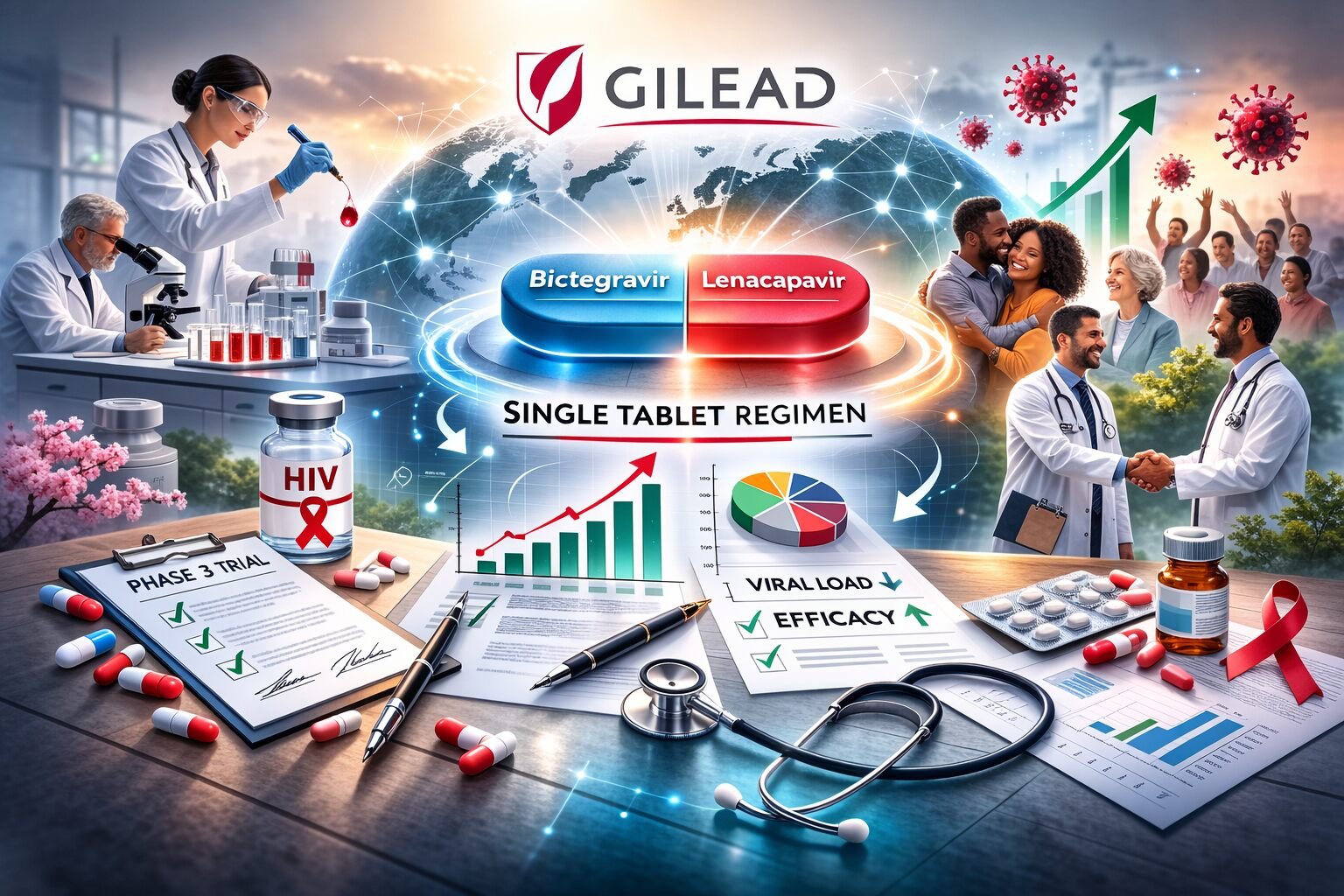
Gilead Sciences, Inc. (Nasdaq: GILD) announced the presentation of new Phase 3 ARTISTRY-1 and ARTISTRY-2 trial data at CROI 2026 showing a treatment switch to an investigational, single-tablet combination regimen of bictegravir 75 mg/lenacapavir 50 mg (BIC/LEN) was effective in people living with HIV with virological suppression, including those switching from complex multi-tablet regimens or a global guideline-recommended single-tablet regimen. The novel combination of BIC/LEN was generally well tolerated, with no significant or new safety concerns identified.
“The ARTISTRY trials represent the latest example of Gilead’s commitment to advancing HIV treatment through continuous scientific innovation,” said Jared Baeten, M.D., Ph.D., Senior Vice President, Clinical Development, Virology Therapeutic Area Head, Gilead Sciences. “This once-daily single-tablet regimen combines the durability of bictegravir with lenacapavir, a first‑in‑class capsid inhibitor. The novel treatment combination is designed to sustain virologic suppression for those seeking new options. We look forward to working with regulatory authorities to potentially bring this combination forward to people with HIV.”
The results demonstrate the potential of BIC/LEN to broaden HIV treatment options for adults with virological suppression, offering comparable efficacy to BIKTARVY® (bictegravir 50 mg/emtricitabine 200 mg/tenofovir alafenamide 25 mg tablets, B/F/TAF), as well as to treatment with complex multi-tablet regimens.
The new data, from the ARTISTRY-1 (NCT05502341) and ARTISTRY-2 (NCT06333808) trials, assessed the safety and efficacy of the once-daily single tablet regimen of BIC/LEN and were presented during late-breaker sessions at the 33rd Conference on Retroviruses and Opportunistic Infections in Denver, Colorado. The findings build on the positive topline results announced in November and December 2025.
Late-breaking results from ARTISTRY-1
Results presented at CROI 2026 demonstrate that a single-tablet regimen combining BIC/LEN could offer an important new option with optimized dosing for people living with HIV with virologic suppression on a complex multi-tablet regimen. Week 48 results showed that the single-tablet regimen of BIC/LEN was noninferior to complex multi-tablet regimens in maintaining virologic suppression, with 0.8% of participants receiving BIC/LEN having HIV-1 RNA ≥ 50 copies/mL (as determined by the US FDA-defined snapshot algorithm) compared to 1.1% who remained on their complex antiretroviral regimen. CD4 cell count remained stable in both treatment groups, and no participant had emergent resistance. At Week 48, the switch to BIC/LEN from complex multi-tablet regimens was also associated with an improvement from baseline in fasting lipid parameters, with a median change in total cholesterol, -15 mg/dL, versus +2 mg/dL. Additionally, patient-reported treatment satisfaction on the HIVTSQs score increased by a mean of 7 points from baseline, with those treated with complex multi-tablet regimens reporting no change.
“Pre-existing viral resistance, intolerance, contraindications, or drug-drug interactions, may prevent many people living with HIV from benefiting from guideline-recommended single-tablet antiretroviral regimens. Complex treatment regimens can pose a significant burden on people’s lives as can be seen in the ARTISTRY-1 trial where participants were taking between 2 and 11 pills per day at baseline, with ~40% taking antiretroviral therapy more than once a day,” said Chloe Orkin, MBE, Clinical Professor of Infection and Inequities at Queen Mary University of London. “Finding new effective and convenient dosing with single-tablet regimens is key to optimizing treatment, ensuring that more people can benefit from recent advances in medical research like bictegravir and lenacapavir.”
BIC/LEN was generally well tolerated, with drug-related adverse events reported in 14.3% of participants who switched to BIC/LEN and 1.6% of participants who remained on complex multi-tablet regimens. A similar incidence of serious drug-related adverse events was reported in both treatment groups (0.3% BIC/LEN; 0% complex multi-tablet regimen), with discontinuations due to adverse events rare (1.6% and 0.5%, respectively).
On February 25, 2026, The Lancet published the primary outcome results of the ARTISTRY-1 trial. The manuscript is titled Switch to single-tablet bictegravir/lenacapavir from a complex HIV regimen: results from ARTISTRY-1, a randomised, open-label phase 3 clinical trial.
Late-breaking results from ARTISTRY-2
Results from the ARTISTRY-2 trial presented at CROI 2026 further demonstrate the potential of BIC/LEN to broaden current HIV treatment options, offering comparable efficacy to BIKTARVY, a global guideline-recommended single-tablet treatment regimen. Through Week 48, BIC/LEN was non-inferior to standard of care treatment with BIKTARVY in maintaining virologic suppression, with 1.3% of participants receiving BIC/LEN having HIV-1 RNA ≥ 50 copies/mL (as determined by the US FDA-defined snapshot algorithm) compared to 1.0% who remained on BIKTARVY. CD4 cell count remained stable, and two participants in each treatment group met the criteria for resistance analysis.
Resistance analysis showed no treatment‑emergent resistance through Week 48 in three of the four participants (one BIC/LEN‑treated and both BIKTARVY‑treated participants). An isolated integrase substitution without phenotypic resistance was detected in one participant in the BIC/LEN treatment group at Week 36. No capsid mutations were detected. Switching to BIC/LEN was shown to have no significant impact on weight, with body-mass index remaining stable in both groups through 48 weeks of treatment.
BIC/LEN was generally well tolerated with similar rates of drug-related adverse events reported in the BIC/LEN and BIKTARVY treatment groups (10.4% and 12.0%, respectively). No serious drug-related adverse events were reported, and discontinuations due to adverse events were low (1.6%) in both treatment groups.
“The findings from ARTISTRY-2 support the potential of the bictegravir/lenacapavir regimen to expand the range of single-tablet antiretroviral treatments available to people living with HIV,” said Eric Meissner, MD, PhD, Associate Professor, Director of HIV and Hepatitis Patient Care and Research, Medical University of South Carolina. “With efficacy shown to be comparable to a guideline-recommended therapy, we look forward to the prospect of having another meaningful treatment option for adults with HIV who are virologically suppressed.”
Bictegravir and lenacapavir in combination are investigational and not approved anywhere globally. The safety and efficacy of this combination use has not been established.
There is currently no cure for HIV or AIDS.
Most Read
- Can APAC Biomanufacturing Decarbonise Without Pricing Itself Out?
- The Algorithm on the GMP Floor: AI Promises a Smarter Plant. Regulators Demand the Audit Trail.
- APAC's Peptide-Capacity Gamble
- After the Rush: APAC's mRNA and Vaccine Capacity Hangover
- The Biosimilar Race: Factory to the World — or Stuck in the Copycat Economy?
- The Vein-to-Vein Problem: Can APAC's Cold Chain Carry Advanced Therapies?
- Vectors, Plasmids and the CGT Trap: APAC's Cell and Gene Therapy Ambitions Face an Upstream Bottleneck
- Can APAC Build Radioligand Therapy Before the Atoms Decay?
- The Great Biopharma Reset: 50 Developments That Changed Everything in H1 2026
- Beyond the Trial: Can Real-World Evidence Earn Regulatory Trust in APAC?
- Beyond the Obvious Giant: Where APAC's Clinical Trials Go Next
- The Frontier That Won’t Quite Arrive
Bio Jobs
- Sanofi Turns The Page As Belén Garijo Steps In And Paul Hudson Steps Out
- Global Survey Reveals Nearly 40% of Employees Facing Fertility Challenges Consider Leaving Their Jobs
- BioMed X and AbbVie Begin Global Search for Bold Neuroscience Talent To Decode the Biology of Anhedonia
- Thermo Fisher Expands Bengaluru R&D Centre to Advance Antibody Innovation and Strengthen India’s Life Sciences Ecosystem
- Accord Plasma (Intas Group) Acquires Prothya Biosolutions to Expand Global Plasma Capabilities
- ACG Announces $200 Million Investment to Establish First U.S. Capsule Manufacturing Facility in Atlanta
- AstraZeneca Invests $4.5 Billion to Build Advanced Manufacturing Facility in Virginia, Expanding U.S. Medicine Production
News