
How Long It Takes to Start a Clinical Trial in 8 APAC Markets, Timed
19 October 2026 | Monday | News
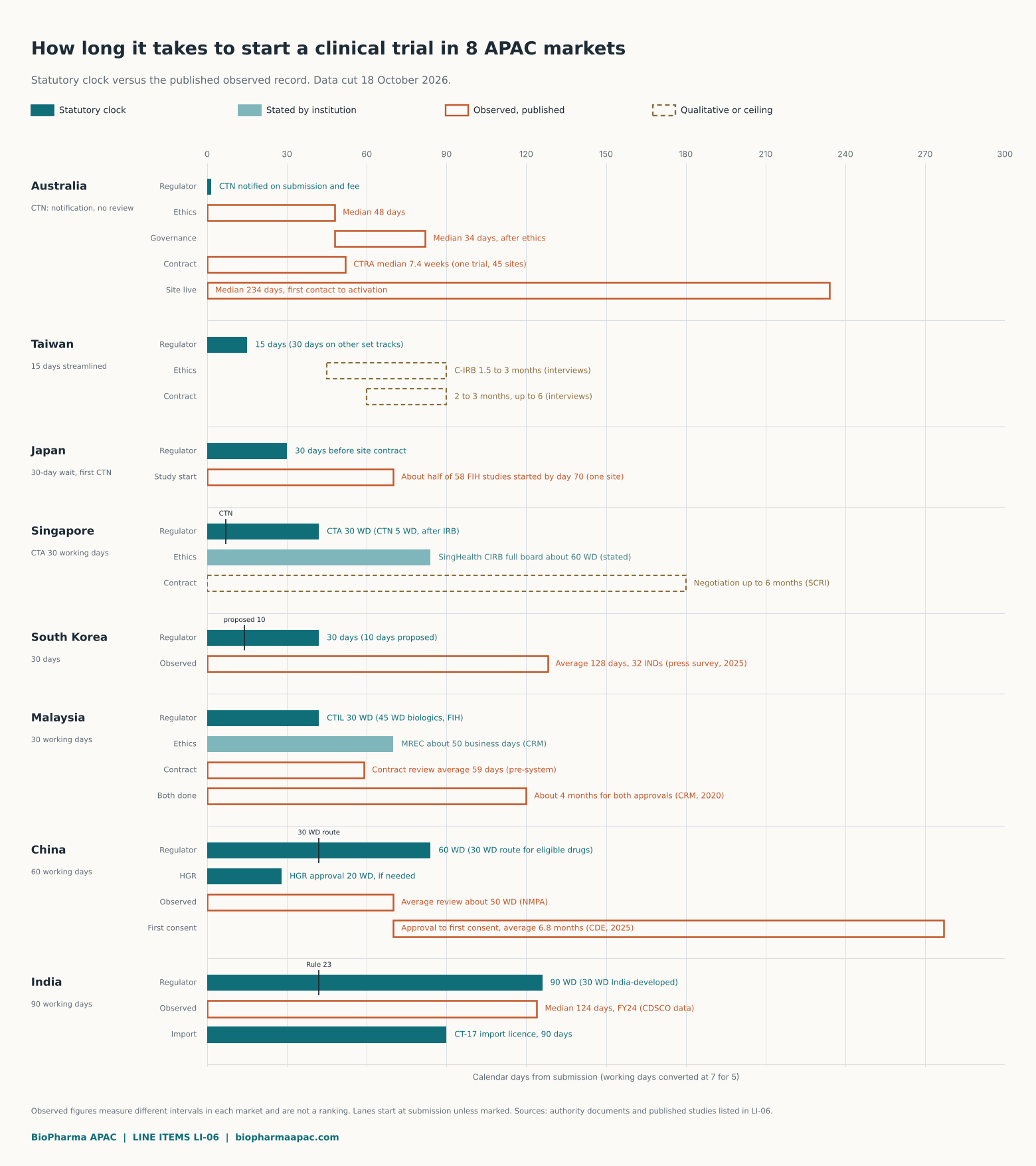
Figure 1. Statutory clocks against observed figures, eight APAC markets. Solid bars show statutory or stated clocks from day 0 of submission; outlined bars show published observed figures, each labelled with what it measures. Working days converted at 7 for 5. Observed intervals differ by market and are not directly comparable.
If you are building a 2027 trial budget this month, you are probably working from a spreadsheet with one row per country and a column headed "start-up". Most of the numbers in that column trace back to one of two places: the regulator's statutory clock, or a CRO's memory of the last study. Neither is the whole truth, and the difference between them is where timelines, and budgets, quietly slip.
The statutory clocks across Asia-Pacific are short, and several are getting shorter. Australia's notification scheme involves no regulatory evaluation at all. Taiwan will clear a multinational protocol already approved in a reference country in 15 days. China moved eligible innovative drugs onto a 30-working-day clock nationwide in September 2025. Korea has proposed cutting its 30-day review to 10 days for applications that pass pre-review.
Now set those against the handful of observed figures that have actually been published. China's drug evaluator reports that new-drug trials took an average of 6.8 months in 2025 to get from approval to first consent. A peer-reviewed study of 150 site activations, most of them in Australia, found a median of 234 days from first contact to activation, with ethics and governance accounting for well under half of it. A Korean press survey of 32 recent applications put average regulatory approval at 128 days against a 30-day rule. India's regulator reported a median of 124 days for global trial applications in FY24.
So this list does something simple. For each market it puts the statutory clock beside the best observed number we could find, says what that number measures, and names the one lever that most reliably closes the gap. It is a planning tool, not a league table: the observed figures measure different intervals in different places.
How we timed it
|
Statutory clocks |
Taken from the authority's own regulation, guideline or official notice, cited with its date in the source list. Working days stay working days in the text. In the graphic only, we convert them to calendar days at seven for every five, so 60 working days plots as about 84 days. |
|
Observed figures |
Only from peer-reviewed studies, authority performance reports, regulator presentations of their own data, or registry-derived analysis. Each is labelled with the interval it measures. CRO experience and vendor case studies are flagged as such and are not treated as observed data. |
|
The eighth market |
Malaysia rather than Thailand. Malaysia has a 2025 regulatory guideline with published clocks, a single licence that covers both review and import, and published contract data. We found no published review clock for Thailand's 2024 import rules. |
|
Out of scope |
Decentralised trials and site diversification belong to our Clinical Operations Series. Dated regulatory changes for 2027 belong to our 12 Regulatory Changes calendar. Where a pending change affects a lever, we mention it once and point there. |
|
Order |
Markets run from the shortest statutory regulatory clock to the longest. That is not a ranking of real-world speed. |
The eight markets at a glance
|
Market |
CTA clock (statutory) |
Ethics model |
Import |
Observed, sourced |
Fastest lever |
|
Australia |
CTN: notification, no evaluation |
Parallel; one HREC review under NMA |
Exempt; no permit before CTN |
Median 234 days to site activation (Trials, 2023) |
Governance and CTRA in parallel with HREC |
|
Taiwan |
15 days streamlined; 30 days for set tracks |
Parallel; C-IRB |
Separate TFDA permit, 2 years |
None quantitative published |
Reference-country approval, then streamlined filing |
|
Japan |
30 days after first CTN |
Site IRB; single IRB 9.4% |
No import confirmation needed |
About half of 58 FIH studies started within 70 days (one site) |
Single IRB review |
|
Singapore |
CTA 30 WD; CTN 5 WD |
CTA parallel; CTN after IRB; Single IRB Review |
CRM notification, immediate |
No published median; contracts up to 6 months (SCRI) |
Master Clinical Trial Agreement |
|
South Korea |
30 days; 10 days proposed |
Parallel; site IRBs |
Exempt from item approval |
Average 128 days, 32 cases (press survey, 2025) |
Pre-review to avoid clock stops |
|
Malaysia |
30 WD; 45 WD biologics, FIH |
Parallel; MREC |
CTIL is the import licence |
About 4 months for both approvals (CRM, 2020) |
CRM contract template, parallel filing |
|
China |
60 WD; 30 WD for eligible innovative drugs |
Parallel; site-by-site |
No separate approval; port clearance |
Average 6.8 months approval to first consent (CDE, 2025) |
The 30-working-day route |
|
India |
90 WD global; 30 WD India-developed |
Parallel; each site EC |
CT-16/CT-17, 90 days |
Median 124 days, FY24 (CDSCO data) |
SEC-ready dossier, filed with EC |
Order runs from shortest statutory regulatory clock to longest. WD: working days. Observed figures measure different intervals; see each entry.
1 Australia
The regulator is not the bottleneck
|
CTA review clock (statutory) |
Clinical Trial Notification (CTN) scheme: a notification, not a review. The TGA does not evaluate trial data at notification, and the trial is notified once the online form is submitted and the fee paid. The separate CTA scheme has a 50-day target that the TGA says is not legislated; it has evaluated fewer than 10 CTAs since the scheme began (TGA consultation paper, April 2024). |
|
Ethics model |
Parallel. The CTN is submitted alongside HREC and site approvals, all of which must be in place before product is supplied. National Mutual Acceptance lets one ethics review stand across participating states' public health services. |
|
Import permit |
None needed before the CTN. Trial goods are exempt for import and holding, but must stay under the sponsor's control until the CTN or CTA is in place. Controlled substances and biological material can need separate permits (Australian Clinical Trial Handbook, October 2024). |
|
Observed median, sourced |
Median 234 days from first CRO contact to site activation, range 74 to 657; median ethics approval 48 days, median governance approval 34 days (Crosby et al., Trials, 2023; 150 activations, 84% at Australian sites). |
|
Fastest lever |
Run site governance and the contract in parallel with HREC review, on the Medicines Australia standard CTRA, unamended. |
|
Note |
QASC Australasia stroke trial: median 7.4 weeks to CTRA execution across 45 sites, range 0.9 to 44.4 weeks. A national one-stop shop is still being built. |
Australia is the clearest demonstration in the region that a fast regulator does not make a fast start. The CTN route takes the TGA out of the critical path entirely, which is why it carries almost all trials: the TGA has evaluated fewer than 10 CTAs since that scheme began. Yet the best published dataset, from a CRO's own activation records, still lands at a median of 234 days.
The authors' point is the useful one for planners: ethics and governance together account for a median of about 82 days, so most of the delay sits elsewhere. They point to budget and contract negotiation, without having measured it. The single-trial QASC figures suggest why that matters. A median of seven weeks for a standard agreement sounds manageable until you notice the tail stretching past ten months at the slowest site.
Government data agrees. The national NAS-4 report for 2018-19 recorded a mean of 159 days from ethics submission to first site authorisation. New South Wales' metrics for early 2025 are better, at means of 66 days for ethics and 41 for site authorisation, which suggests benchmarks work where they are enforced.
2 Taiwan
Fifteen days on paper, months at the hospital
|
CTA review clock (statutory) |
15 days for multinational multicentre trials whose protocol is already approved in one of ten reference countries (including the US, Japan, Germany and Australia), excluding high-risk and regenerative medicine trials. 30 days for domestic-only trials holding a US IND, and for the regenerative medicine fast track. One deficiency round only, with 14 days to respond (TFDA drug clinical trial application notice, December 2025; consolidated procedure effective 1 September 2025). |
|
Ethics model |
Parallel. Sponsors may file with a statement that IRB review is running at the same time, but no site starts before its hospital IRB approves. A central model (C-IRB) pairs a main review with abbreviated review at other sites. |
|
Import permit |
A separate TFDA application for investigational product import, filed with the trial dossier. Permits run two years and cover multiple shipments. |
|
Observed median, sourced |
No quantitative published median found. An interview-based study (National Taiwan University thesis, 2018) reported the fastest C-IRB approvals at 1.5 to 3 months and contract signing at 2 to 3 months, sometimes 6. |
|
Fastest lever |
Secure the reference-country approval first, then file through the 15-day route with IRB review in parallel. |
|
Note |
The Taiwan Alliance of Clinical Trial Centers (32 hospitals, launched December 2025) plans unified IRB documents and standard contracts. National Taiwan University Hospital is piloting parallel contract pre-signing until June 2027. |
Taiwan has engineered one of the shortest regulatory clocks anywhere for the trials that matter most to global sponsors. If the protocol is already cleared by a reference regulator, the TFDA review is a 15-day check. The one-round deficiency rule also stops the slow back-and-forth that inflates clocks elsewhere.
What Taiwan lacks is published evidence of the rest of the timeline. We found no authority or registry dataset measuring start-up, and the only structured evidence is qualitative. It points squarely at the hospitals: IRB cycles measured in months, and contracts that can run for half a year.
The new alliance of trial centres and the NTUH contract pilot both target that hospital end. Neither has a published time target yet, which makes Taiwan a market to re-time next October.
3 Japan
A short clock and 1,303 ethics boards
|
CTA review clock (statutory) |
A 30-day waiting period for the first clinical trial notification of a new active ingredient: no site contract may be signed until 30 days after PMDA accepts the filing. Other notifications are filed about two weeks before contract (PMD Act Article 80-2; MHLW notice of 2020 as amended 31 August 2022). |
|
Ethics model |
Site IRB by default. Japan had 1,303 GCP IRBs as of January 2026. Single-IRB review covered 9.4% of domestic trials in an industry survey of 278 trials (February 2025). |
|
Import permit |
No import confirmation is needed once a trial notification has been filed; the importer presents a copy at customs (MHLW notice, 31 August 2020). |
|
Observed median, sourced |
No national median published. At one Phase 1 unit, 28 of 58 first-in-human or first-in-Japanese studies started within 70 days of notification, 2022 to mid-2025 (Kawakita et al., Clinical and Translational Science, January 2026). Single site; not representative. |
|
Fastest lever |
Single IRB review. MHLW's target is 80% of multicentre trials, with interim goals of 30% at three years and 50% at five, once the revised GCP Ordinance takes effect. The effective date has not been announced. |
|
Note |
A December 2023 MHLW notification says a Japanese Phase 1 is not required in principle before joining a multi-regional trial. In 2025, PMDA agreed in 13 of 17 consultations that sponsors could join without one (industry survey). |
Japan's regulatory clock is short and predictable. The 30-day wait applies only to a first notification for a new active ingredient, and import paperwork has largely been folded into the notification itself. On paper, Japan should be among the fastest starts in the region.
The friction is distributed across more than 1,300 institutional review boards and the site contracting that follows each one. Japan's own CRO association has said hospital IRBs can take several months, without publishing figures. The government's answer is structural: make single-IRB review the principle, and measure progress against an 80% target. Going from 9.4% to 80% is the largest single change any market on this list has in prospect.
There is a second, quieter lever. A domestic Phase 1 before joining a global trial long added months to Japan entry. The 2023 notification and PMDA's consultation record suggest that requirement is now usually negotiable. Ask early.
4 Singapore
Five working days, if you qualify
|
CTA review clock (statutory) |
CTA: 30 working days, or 15 for Phase 1 trials that solely test bioavailability, bioequivalence, food effect or drug interaction, and 60 for Class 2 cell, tissue and gene therapy products. CTN: 5 working days, for registered products used on label. Stop-clock time is excluded (HSA guidance GN-IOCTB-01, March 2021; HSA application page, September 2026). |
|
Ethics model |
CTA may run in parallel with IRB review; a CTN may only be filed after IRB approval. Since April 2025, Single IRB Review links five IRBs. SingHealth CIRB states about 60 working days for full-board review and about 30 for expedited review. |
|
Import permit |
A clinical research material notification is filed with the CTA or CTN; the acknowledgement is immediate. Genetically modified or cell and gene therapy products may also need committee review, which takes about three months. |
|
Observed median, sourced |
No peer-reviewed start-up median found. HSA publishes the share of trials approved within its timelines, 2019 to 2025, in chart form. SCRI states that agreement negotiation can run up to six months. |
|
Fastest lever |
The Master Clinical Trial Agreement, whose terms are pre-negotiated between the industry association and the public healthcare clusters, started at site selection. |
|
Note |
SingHealth CIRB full-board review meets monthly, with no December meeting. A November submission can lose a month. |
Singapore's regulator is fast and transparent, and the CTN route is the quickest formal approval on this list for trials that qualify. Most novel-drug trials do not qualify, so the working clock for them is 30 working days, run in parallel with ethics.
That parallelism leaves ethics and contracting as the real critical path. SingHealth's own published guide implies a full-board review of about three calendar months, and the national coordinating body's six-month ceiling for agreement negotiation is the longest stated contract figure in this list. That is why the lever here is the contract, not the regulator.
Two recent changes belong in 2027 plans: Single IRB Review across the five major boards, and SingHealth's Green Lane Review for industry studies. Neither has published performance data yet.
5 South Korea
Where the clock stops
|
CTA review clock (statutory) |
30 days, described as working days in KoNECT and cross-regulator comparisons. MFDS has proposed a 10-day clock for applications that come through its pre-review compliant (MFDS Notice 2026-412, 21 August 2026; comment closes 21 October 2026). |
|
Ethics model |
Parallel with MFDS review; each site's IRB must approve. A central IRB run by the Korean Academy of Medical Sciences has operated since 2021, with agreements covering 40 hospitals; usage is not published. |
|
Import permit |
Investigational drugs designated by ordinance are exempt from import item approval under the Pharmaceutical Affairs Act; importer registration still applies. We found no published clearance time. |
|
Observed median, sourced |
Average 128 days for MFDS approval of Phase 1 to 3 INDs, 32 cases, January 2023 to February 2025 (Korea Economic Daily survey, March 2025). Press survey; method not disclosed. |
|
Fastest lever |
Pre-review and pre-IND consultation, to cut the supplementary requests that stop the clock. |
|
Note |
The same survey found 15 of 16 IND amendments approved late. |
Korea is the market where the gap between statute and reported experience is widest. A 30-day clock and a 128-day average cannot both be right unless the clock is stopping, and in practice that means requests for supplementary data. Each request pauses the count while the sponsor answers.
The figure needs handling with care. It comes from a newspaper's survey of listed biotechs, not from MFDS, and the sample is small. But it is the only published number, and it matters for anyone budgeting Korea as a fast-start market on the strength of its site network.
The proposed 10-day clock targets exactly this: settle the hard questions in pre-review, then approve quickly. Its timing belongs to our regulatory calendar, but the lever works today. Pre-IND consultation reduces the chance of a stopped clock whether or not the new rule arrives.
6 Malaysia
One licence does two jobs
|
CTA review clock (statutory) |
30 working days for a Clinical Trial Import Licence (CTIL) or exemption (CTX). 45 working days for biologics, cell and gene therapy, herbal products and first-in-human trials, which also go to an expert panel. Clock stops are capped at two query rounds (NPRA guideline edition 8.1, effective 30 April 2025). |
|
Ethics model |
Parallel submission to NPRA and the ethics committee is allowed. First-in-human files are tabled only after a favourable ethics opinion. MREC issues decisions within 10 working days of its meeting but has no overall deadline. |
|
Import permit |
The CTIL is itself the import licence, at RM500 per product. |
|
Observed median, sourced |
About four months on average to obtain both approvals; contract review averaged 59 days before a national online system (Clinical Research Malaysia, December 2020, citing a 2016 study). NPRA met its 30-working-day target for all 129 standard applications in 2016, its latest published charter result. |
|
Fastest lever |
File NPRA and ethics in parallel and contract on the CRM national template. |
|
Note |
Fresher figures exist only as CRO experience, not observed data: IQVIA (May 2026) cites 40 business days for ethics and 45 to 60 for regulatory review. |
Malaysia's design is unusually tidy: the regulatory approval and the import licence are the same document, which removes a step that adds weeks elsewhere. The 2025 guideline also caps query rounds, so the clock cannot stop indefinitely.
The weakness is the age of the evidence. The best observed figures date from 2016 to 2020, before the latest guideline. They still point to the same pattern as everywhere else: about 30 business days on the regulator's side, about 50 for ethics, and contracts adding weeks unless a standard template is used. CRM's own target for contract review is 14 calendar days.
A note on Thailand, the market we did not pick: its 2016 manual set 20 working days for the import licence and CREC now issues a single central ethics certificate, but we found no published clock under the 2024 import rules and almost no observed data.
7 China
The only market that publishes its own start-up data
|
CTA review clock (statutory) |
60 working days, after which the trial is deemed approved (Drug Administration Law Article 19, 2019; Drug Registration Provisions, 2020). Since 9 September 2025, 30 working days nationwide for eligible innovative drugs (NMPA Announcement 2025 No. 86). |
|
Ethics model |
Parallel with NMPA review. Site-by-site review is the default; mutual recognition exists through voluntary consortia such as the Beijing alliance launched in 2020. |
|
Import permit |
No separate import approval for drugs listed in the trial approval (Implementing Regulations, in force 15 May 2026); a port customs clearance form is still required. Human genetic resources: a filing for international trials that export no samples, or approval within 20 working days for research cooperation, now handled by the National Health Commission. |
|
Observed median, sourced |
Average IND review about 50 working days under the 60-day clock (NMPA, October 2025). Average 6.8 months from approval to first consent for new-drug trials in 2025, about four months faster than 2024 (CDE clinical trial progress report, June 2026). |
|
Fastest lever |
The 30-working-day route, for drugs that qualify. |
|
Note |
No measured review times for the 30-day route have been published yet. Draft human genetic resources rules (May 2026) would confirm filings with no cross-border information transfer within a working day. |
China is the only market on this list where the regulator publishes what happens after its own approval, and the numbers deserve attention. In 2025, new-drug trials took an average of 6.8 months from approval to first consent. That is about four months faster than a year earlier, and 96.4% of trials approved and started in the same year reached first consent within six months.
The 30-day route is the lever because of how it is built. It halves the review clock, but eligible sponsors must also assess the lead site's ethics capability and start its project approval and ethics review before filing, and commit to consenting a first Chinese subject within 12 weeks. It is the only rule in the region that makes front-loading the site work a condition of the fast clock.
Eligibility is narrow: national-priority Class 1 innovative drugs, CDE-listed paediatric, rare disease or traditional Chinese medicine innovations, and globally synchronised programmes. For everyone else, 60 working days and the six-month post-approval average remain the planning numbers.
8 India
The regulator has caught up with its own clock
|
CTA review clock (statutory) |
90 working days for global trials (Rule 22, New Drugs and Clinical Trials Rules 2019). 30 working days, with deemed approval, for drugs discovered or developed in India (Rule 23). The January 2026 amendment cut test licences for trial material from 90 to 45 working days but left Rules 22 and 23 unchanged. |
|
Ethics model |
Each site's registered ethics committee must approve before that site starts (Rule 25); submission may run in parallel with CDSCO. |
|
Import permit |
Import licence on Form CT-17, applied for on Form CT-16, to be granted within 90 days. |
|
Observed median, sourced |
Median 124 days for global clinical trial applications in FY24 (n=125), down from 147 days in FY23 (n=151) (Drug Controller General of India, IPA presentation, June 2024). |
|
Fastest lever |
A dossier ready for Subject Expert Committee review on first pass, filed in parallel with ethics. |
|
Note |
Average time at the Subject Expert Committee fell from 98 days in 2022 to 29 in 2024. No peer-reviewed study of approval times under the 2019 Rules was found. |
India has the longest statutory clock on this list for global trials, and the most visible improvement against it. Ninety working days is roughly 126 calendar days. A median of 124 days in FY24, if counted in calendar days, puts the regulator at about its own limit, where a year earlier it ran over.
The regulator's own data identifies where that time went. Subject Expert Committee review, long the documented bottleneck, fell from an average of 98 days in 2022 to 29 in 2024. The DCGI said in April 2026 that approvals had been consistently within 150 days over the past year. That is a speech claim rather than published data, but it points the same way.
Two practical cautions for 2027 plans. Coverage of the 2026 amendment has sometimes implied that trial approval clocks were halved; they were not, only the test licence clock. And import is a separate licence with its own 90-day window, so file it early rather than treating it as paperwork that follows approval.
What the eight have in common
Three patterns hold across the list, and each changes how a start-up budget should be built.
First, the regulator is rarely the long pole any more. Where observed data exists for the full path, in Australia, Taiwan, Singapore and Malaysia, ethics, site governance and contracts take longer than regulatory review. Korea is the exception on current evidence, and India was the exception until recently. Budgets that pad the regulatory step and assume the rest will follow are padding the wrong line.
Second, parallel submission is universal on paper and optional in practice. Every market here allows ethics and regulatory review to run side by side, with Singapore's CTN route the one partial exception. Only China's 30-day route makes the site work a condition. Elsewhere, parallel is something the sponsor has to choose and resource.
Third, the data gap is itself a finding. China and India are the only regulators here that publish start-up performance from their own systems, and Singapore publishes its on-time rate. Japan has no national median at all, and Taiwan has nothing quantitative. When a CRO quotes a country start-up time, the useful follow-up is the denominator: how many sites, which years, and what interval was measured.
Using this list in a 2027 plan
Plan on observed figures, not statutory ones, and say which interval each covers. Where a market has no observed figure, as in Taiwan and Singapore, add the stated ethics and contract ranges to the regulatory clock rather than assuming they run inside it.
Start contracts at site selection, not after approval. In every market where contracting has been measured or estimated, it is the step most likely to set the first-patient date.
Watch four pending changes that would move this list: Korea's 10-day clock, Japan's single-IRB ordinance, China's final human genetic resources rules and Australia's national one-stop shop. Their dates sit in our 12 Regulatory Changes calendar. This list will be re-timed in October 2027 against whatever has been published by then.
Most Read
- Can APAC Biomanufacturing Decarbonise Without Pricing Itself Out?
- The Algorithm on the GMP Floor: AI Promises a Smarter Plant. Regulators Demand the Audit Trail.
- APAC's Peptide-Capacity Gamble
- After the Rush: APAC's mRNA and Vaccine Capacity Hangover
- The Biosimilar Race: Factory to the World — or Stuck in the Copycat Economy?
- The Vein-to-Vein Problem: Can APAC's Cold Chain Carry Advanced Therapies?
- Vectors, Plasmids and the CGT Trap: APAC's Cell and Gene Therapy Ambitions Face an Upstream Bottleneck
- Can APAC Build Radioligand Therapy Before the Atoms Decay?
- The Great Biopharma Reset: 50 Developments That Changed Everything in H1 2026
- Beyond the Trial: Can Real-World Evidence Earn Regulatory Trust in APAC?
- Beyond the Obvious Giant: Where APAC's Clinical Trials Go Next
- The Frontier That Won’t Quite Arrive
Bio Jobs
- Sanofi Turns The Page As Belén Garijo Steps In And Paul Hudson Steps Out
- Global Survey Reveals Nearly 40% of Employees Facing Fertility Challenges Consider Leaving Their Jobs
- BioMed X and AbbVie Begin Global Search for Bold Neuroscience Talent To Decode the Biology of Anhedonia
- Thermo Fisher Expands Bengaluru R&D Centre to Advance Antibody Innovation and Strengthen India’s Life Sciences Ecosystem
- Accord Plasma (Intas Group) Acquires Prothya Biosolutions to Expand Global Plasma Capabilities
- ACG Announces $200 Million Investment to Establish First U.S. Capsule Manufacturing Facility in Atlanta
- AstraZeneca Invests $4.5 Billion to Build Advanced Manufacturing Facility in Virginia, Expanding U.S. Medicine Production
News


