
10 APAC Biomanufacturing Plants Scheduled to Come Online Before End-2027, and How Many Have Already Slipped
09 November 2026 | Monday | News
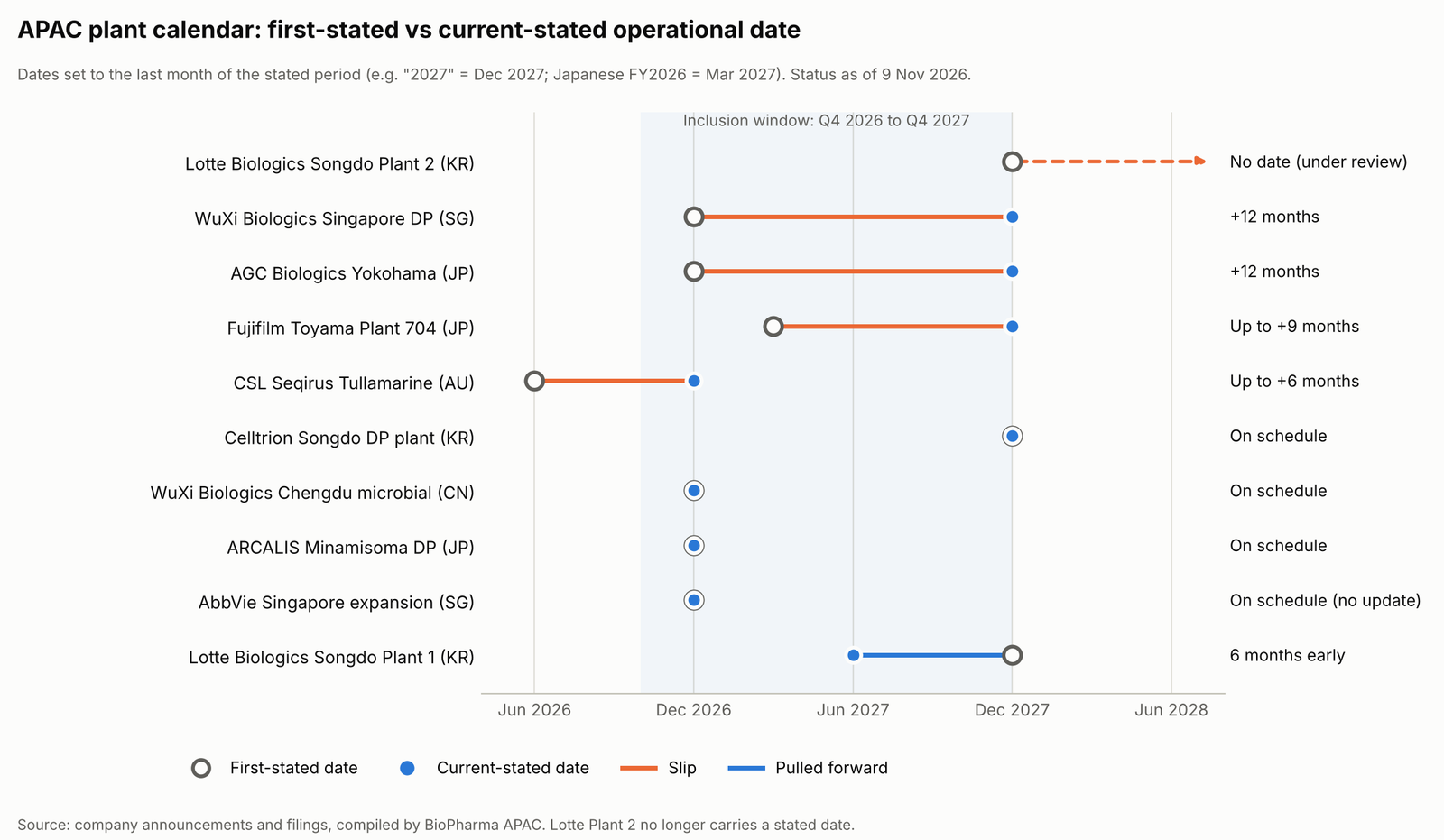
Figure 1. Slip chart. Hollow markers show the first-stated operational date, filled markers the current-stated date.
Every capacity plan written in an Asian biopharma company this quarter rests on a calendar it did not write. Somewhere in the spreadsheet is an assumption that a new plant in Songdo, Tuas, Yokohama or Toyama will be ready to take a tech transfer by a certain month in 2027. That assumption usually comes from a press release, and press releases have a habit of being quoted long after the date inside them has quietly changed.
So we did the unglamorous thing. We built a plant calendar for the commissioning wave that runs from the last quarter of 2026 to the end of 2027, and for each plant we wrote down two dates side by side: the operational date the owner first announced, and the operational date the owner states today. The gap between them is the slip. It is a number, not a mood, and it can be checked.
The short answer to the headline question: of the ten plants that qualify, five have slipped, four are holding their original date, and one has moved forward. Two of the slippers have lost a full year. One has dropped out of the window altogether and no longer carries a date at all.
How the calendar was built
The rules are deliberately narrow, because a loose list is just a collection of announcements.
- What counts. A GMP plant for biologics or an advanced modality, making drug substance or drug product, located in Asia-Pacific, with a company-stated operational date falling between Q4 2026 and Q4 2027.
- Two dates, both sourced. The first-stated date is the earliest operational date we could find attributed to the company. The current-stated date is the most recent one. Both are cited at the end of this piece.
- Like for like. Where a company gave a construction date and an operational date, we track the operational one (GMP release, commercial production or start of operations). Construction drift is noted separately.
- Converting words to months. Each stated period is set to its last month, so "2027" means December 2027, "H1 2027" means June 2027, "mid-2026" means June 2026 and a Japanese fiscal year 2026 means March 2027. Where the two statements differ in precision, we say "up to" rather than pretend to an accuracy the companies did not give.
- Disclosure only. A plant is on the list because its owner put a date in public, not because of who the owner is. Some of the companies listed are contract manufacturers that buy media in this sector, including on this title; that has no bearing on inclusion or on the numbers.
Two consequences of those rules matter. First, a plant with an impressive capacity number but no stated date cannot be on the list, however advanced it looks. Second, a plant that has already opened before Q4 2026 is out, even if it slipped on the way. Both groups are covered in a short section near the end.
The calendar
|
Site |
Owner |
Modality |
Disclosed capacity |
First-stated date |
Current-stated date |
Slip (months) |
Status |
|
Songdo Bio Campus Plant 1, Incheon, KR |
Lotte Biologics |
mAb drug substance (CDMO) |
120,000 L (8 x 15,000 L stainless) |
Commercial production 2027 (Feb 2023) |
Commercial production H1 2027; GMP-ready pulled forward six months (Jun 2026) |
-6 |
Built; occupancy approval Jun 2026 |
|
Songdo Bio Campus Plant 2, Incheon, KR |
Lotte Biologics |
mAb drug substance (CDMO) |
Same scale as Plant 1 |
Completion 2027 (Oct 2023) |
No date; build to be reviewed against demand (Jun 2026) |
Undated |
Fell out of window |
|
Songdo DP plant, Incheon, KR |
Celltrion |
Drug product (vials) |
c. 8 million vials a year |
Commercial operation 2027 (Sep 2023) |
Commercial operation 2027 (2026) |
0 |
Under construction, finish slated 2026 |
|
Singapore CRDMO Hub, DP facility, Tuas, SG |
WuXi Biologics |
Drug product (PFS, vials) |
c. 100 million units a year; hub 120,000 L DS |
Hub capacity by 2026 (Jul 2022) |
DP operations 2027; DS still in design (Jun 2026) |
+12 |
DP topped out Jun 2026 |
|
Yokohama site, JP |
AGC Biologics |
Mammalian, cell therapy, mRNA |
18,000 L single-use |
Operational 2026 (Dec 2023) |
Operational 2027 (Jul 2026) |
+12 |
Half of mammalian capacity contracted |
|
Plant 704, Toyama Second Factory, JP |
Fujifilm |
mAb and ADC drug substance (CDMO) |
2 x 5,000 L + 2 x 2,000 L single-use |
Operation FY2026 (Oct 2022) |
Operations 2027 (Dec 2025) |
Up to +9 |
Building completed Dec 2025 |
|
Tullamarine, Melbourne, AU |
CSL Seqirus |
Cell-based influenza vaccine, adjuvant, antivenoms |
Not disclosed in volume terms |
Operational by mid-2026 (Nov 2020) |
Fully operational in 2026 (Dec 2025) |
Up to +6 |
Opened late 2025, ramping |
|
Microbial site, Wenjiang, Chengdu, CN |
WuXi Biologics |
Microbial DS and DP |
15,000 L fermenter; 80 to 110 DS batches; 10m+ vials |
GMP release end-2026 (Jun 2025) |
GMP release end-2026 (Apr 2026) |
0 |
Structure complete, equipment in |
|
Minamisoma DP building, Fukushima, JP |
ARCALIS |
mRNA LNP fill-finish |
32 million doses a year |
DP plant by 2026 (Aug 2023) |
Building done Feb 2026; fill-finish from 2026 |
0 |
Building completed |
|
Singapore expansion, Tuas, SG |
AbbVie |
Biologics drug substance |
24,000 L |
Operational 2026 (Jan 2024) |
No public revision since groundbreaking |
0 |
Silent |
Table 1. Ten APAC biologics and advanced-modality plants with a stated operational date between Q4 2026 and Q4 2027, as of 9 November 2026. Dates in brackets show when each statement was made.
What the numbers say
Take the nine plants that still carry a date. Their average slip is about 3.7 months, but the average hides more than it shows. The median is zero, because four plants have not moved at all. The movement is concentrated: four plants account for 39 months of combined delay, and one plant has clawed six months back.
The more useful number is capacity. Add up the mammalian drug substance volume that is still due inside the window and has a disclosed size: Lotte Biologics' Plant 1 at 120,000 litres, AbbVie's 24,000-litre Singapore expansion, AGC Biologics' 18,000 litres in Yokohama and Fujifilm's 14,000 litres in Toyama. That is roughly 176,000 litres. Now add up what has left the window. WuXi Biologics' Singapore hub was announced in 2022 as adding 120,000 litres by 2026, and its drug substance facility is still in design. Lotte's Plant 2, planned at the same scale as Plant 1, has no date. Together that is around 240,000 litres. On disclosed numbers, more large-scale mammalian capacity has slipped out of the 2027 window than remains in it.
That does not mean Asia is short of capacity. Plenty of large plants opened in 2024 and 2025, and several are in this list because they are close to finished. It means that anyone counting on the regional build-out to absorb 2027 demand should be counting the plants that are physically built, not the plants that were announced.
Entry by entry
1. Lotte Biologics, Songdo Bio Campus Plant 1 (Incheon, Korea)
Modality: mAb drug substance | Capacity: 120,000 L | Slip: 6 months early
This is the outlier, and it is instructive. In early 2023 Lotte's plan was to finish Plant 1 in the second half of 2025, secure GMP certification and start commercial production in 2027. Construction then took longer than that first sketch: by mid-2024 completion had moved to the first quarter of 2026, with commercial operation pencilled for January 2027. The building itself received its occupancy approval in June 2026, two years after the formal groundbreaking.
Yet the operational date did not slip with it. Lotte now says it has pulled its GMP-ready timeline forward by six months in response to customer enquiries, plans a completion ceremony in November and targets commercial production in the first half of 2027. The plant runs eight 15,000-litre stainless steel bioreactors. The lesson is that a construction delay and an operational delay are not the same thing: a company can absorb a late building if it compresses qualification, which is exactly where a commercial customer's audit will look hardest.
2. Lotte Biologics, Songdo Bio Campus Plant 2 (Incheon, Korea)
Modality: mAb drug substance | Capacity: Same scale as Plant 1 | Slip: Undated
When Lotte signed for the Songdo land in October 2023, it said Plants 1, 2 and 3 would be completed in 2025, 2027 and 2030. A year later the second plant was still described as operational by 2027. In June 2026, as Plant 1 was handed over, the company said it would review the sequential construction of Plants 2 and 3 as market demand and contract momentum develop.
That is a reasonable commercial stance for a CDMO that has not yet filled its first Korean plant. It also means Plant 2 is no longer a 2027 event. We keep it on the calendar precisely because it was one: any planning model that still carries a second Lotte plant in 2027 is now out of date.
3. Celltrion, Songdo drug product plant (Incheon, Korea)
Modality: Drug product, vials | Capacity: c. 8 million vials a year | Slip: 0
Celltrion announced the plant in September 2023 with a budget of about KRW 126 billion and a capacity of around eight million liquid vials a year, saying construction would finish in 2026 and commercial operation would begin in 2027. That operational date has not moved in any subsequent statement.
The construction finish has wandered within 2026. In 2024 the company spoke of completion in early 2026; in February 2025, after receiving its building permit, it said the first half of 2026; in December 2025 it reported about 55 percent progress with completion expected in the first half; by 2026 it was citing more than 70 percent and completion within the year. That is a building finishing later in the year while the commercial start holds. The squeeze, if there is one, will land on validation in 2027 rather than on the headline date.
4. WuXi Biologics, Singapore CRDMO Hub drug product facility (Tuas, Singapore)
Modality: Drug product, PFS and vials | Capacity: c. 100 million units a year; hub 120,000 L DS | Slip: +12 months (DP); DS undated
In July 2022 WuXi Biologics announced a ten-year, S$2 billion plan for Singapore and said the site would add 120,000 litres of capacity to its network by 2026. Ground was broken at Tuas Biomedical Park in March 2024. The first building to rise was not the bioreactor hall but a modular drug product facility, fabricated in 470 modules in China and assembled on site, with construction starting in July 2025 and operations slated for 2027.
That building topped out in June 2026 and is designed for roughly 100 million pre-filled syringes and vials a year across three syringe lines and two vial lines. The drug substance facility that carries the 120,000-litre figure is, by the company's own account, still in the design phase. We score the drug product facility as a twelve-month slip against the hub's original 2026 date, and the drug substance capacity as having left the window with no date attached. A ten-year investment plan can legitimately phase its buildings; the point for planners is simply that the litres announced in 2022 are not a 2027 resource.
5. AGC Biologics, Yokohama (Japan)
Modality: Mammalian, cell therapy, mRNA | Capacity: 18,000 L single-use | Slip: +12 months
AGC Inc. decided on the roughly ¥50 billion Yokohama expansion in December 2023, with support under Japan's Ministry of Economy, Trade and Industry programme for dual-use biopharmaceutical sites. The plan gave 2026 as the start of mRNA, mammalian and additional cell and gene therapy services in the new facility, and AGC Biologics' January 2024 announcement said the site would be operational in 2026.
By June 2025 the company was describing the facility as on schedule to be operational in 2027, and that is the date it repeats today. In fairness to AGC, its own framing treats 2027 as the plan of record, and a cell therapy service did start early at the neighbouring technical centre in July 2025. Measured against the first public date, though, the main facility has moved a year. Demand does not seem to be the issue: in July 2026 AGC said one international customer had already contracted half of the site's mammalian capacity for five commercial programmes. The installed set is four 2,000-litre and two 5,000-litre single-use bioreactors.
6. Fujifilm, Plant 704 at the Toyama Second Factory (Japan)
Modality: mAb and ADC drug substance | Capacity: 2 x 5,000 L + 2 x 2,000 L single-use | Slip: Up to +9 months
Fujifilm announced its first Japanese bio CDMO base in October 2022, inside Fujifilm Toyama Chemical's existing site, also under the METI dual-use programme, and said operation was expected in fiscal 2026. Japan's fiscal year 2026 runs to March 2027, so the latest reading of that first date is March 2027.
The building, Plant 704, was completed with a ceremony in December 2025, and Fujifilm now says operations will start in 2027. Depending on where in 2027 that lands, the slip is anything from zero to nine months, which is why we record it as "up to". The plant uses the company's kojoX modular design, standardised with its UK site to ease technology transfer, and an adjacent plant for mRNA medicines and vaccines is still under construction. Fujifilm has said it wants the Toyama base to target ADC drug substance through to fill-finish for Japanese developers who currently send work abroad.
7. CSL Seqirus, Tullamarine (Melbourne, Australia)
Modality: Cell-based influenza vaccine, adjuvant, antivenoms | Capacity: Not disclosed in volume terms | Slip: Up to +6 months
The oldest promise on the list. In November 2020 CSL said it would invest more than A$800 million in a cell-based influenza vaccine plant in Melbourne, the only one of its kind in the Southern Hemisphere, and that it would be operational by mid-2026. It also makes the MF59 adjuvant, Australian antivenoms and a Q fever vaccine under a ten-year supply agreement with the Australian Government.
The plant opened in late 2025, now described as a roughly $1 billion facility, and the Victorian Government says it will be fully operational in 2026. Our method turns that into a slip of up to six months, but the honest reading is that this is the closest to on time a six-year greenfield vaccine project gets. The more striking drift here is cost rather than calendar.
8. WuXi Biologics, microbial commercial site (Chengdu, China)
Modality: Microbial drug substance and drug product | Capacity: 15,000 L fermenter; 80 to 110 DS batches; 10m+ vials | Slip: 0
The fastest-moving project on the calendar. WuXi Biologics broke ground in Chengdu's Wenjiang district in June 2025 and gave a target of GMP release by the end of 2026. In April 2026 it reported structural completion and the arrival of key equipment, with the same end-2026 target.
The 95,000-square-metre site starts with a 15,000-litre fermenter, which the company says can expand to 60,000 litres, plus a vial line and what it describes as China's first dual-chamber lyophilisation line. Its first named commercial programme is a technology transfer of lonapegsomatropin with VISEN Pharmaceuticals, with local production expected by 2028. Eighteen months from groundbreaking to GMP release would be quick for any modality. The next few weeks will show whether it holds.
9. ARCALIS, Minamisoma drug product building (Fukushima, Japan)
Modality: mRNA LNP fill-finish | Capacity: 32 million doses a year | Slip: 0
ARCALIS, the joint venture between Axcelead and Arcturus Therapeutics, finished its mRNA drug substance plant in Minamisoma in July 2023 and said then that it would complete the drug product plant by 2026, backed by grants worth about $115 million from the Japanese Government.
It did: the five-storey drug product building was completed on 27 February 2026, with capacity for about 32 million doses a year across LNP bulk, liquid vials and lyophilised vials, and the company lists fill-finish services as starting in 2026. That makes ARCALIS one of only two plants on this list to deliver a building on the date first stated. The open question is utilisation rather than timing, given how much mRNA demand has softened since the plant was conceived.
10. AbbVie, Singapore biologics expansion (Tuas, Singapore)
Modality: Biologics drug substance | Capacity: 24,000 L | Slip: 0 (unconfirmed)
AbbVie broke ground in January 2024 on a US$223 million expansion of its Tuas plant, its only manufacturing site in Asia, adding 24,000 litres of biologics drug substance capacity and more than 100 jobs, with operations expected to start in 2026.
We found no public revision of that date, and no public confirmation that it has been met. Under our rules it stays at zero slip. We flag it as silent rather than on time: with seven weeks of 2026 left, it is the entry most likely to change when this calendar is next updated.
What the slips have in common
Ten plants is a small sample, so treat these as patterns to test rather than laws. Still, three are hard to miss.
Construction is rarely the binding constraint. Lotte, Celltrion and Fujifilm all finished buildings later than their first sketches, yet only one of the three has moved its operational date by much. Where the operational date has slipped, the reason given is usually sequencing or phasing, not a crane that arrived late. For buyers, that shifts the diligence question from "is the building up?" to "what is the qualification plan, and who is first in line?"
The publicly backed Japanese cohort runs late, but not idle. AGC and Fujifilm both came out of the same METI programme for dual-use sites and both now say 2027, about a year after their first dates. Both buildings are physically well advanced, and AGC has booked a large commercial customer. Japan's slippage looks like the time it takes to stand up a first-of-its-kind domestic CDMO operation, not a lack of conviction.
Hub-level announcements age worst. The two largest blocks of lost capacity both came from campus-scale promises: a hub that would add 120,000 litres by 2026, and a three-plant campus with a 2027 second plant. Facility-level dates, tied to a named building, have held far better. If a plan cites a campus number, ask which building it is in and when that building is due.
Who is not on the list, and why
The rules exclude some large and important projects, and the reasons are informative in their own right.
- No stated date. Kashiv BioSciences secured ₹648 crore in December 2025 to build a single-use commercial facility at Pipan, near Ahmedabad, with up to 50,000 litres at full capacity. It would be one of the largest single-use plants in India, but no public operational date has been given, so it cannot be scored. That is also why India is absent from this year's calendar: its biggest disclosed biologics build carries no date.
- Only one date on record. Altruist Biologics, Innovent's CDMO, says a 2,000-litre antibody line at its Hangzhou site will be online by mid-2027 and that its bioconjugation capacity will be completed by 2027. We could find those dates only in 2026 statements, so there is no earlier date to compare against. It is a candidate for next year's edition.
- Dated outside the window. Samsung Biologics' remaining Bio Campus II plants are slated for completion by 2032. AstraZeneca's US$1.5 billion ADC plant in Singapore is due in 2029, and Sanofi's €1 billion insulin drug substance base in Beijing, which broke ground in October 2025, has been reported for 2029.
- Already landed. Sanofi's Modulus plant in Tuas, first described as operational by the end of 2025, targeted mid-2026 and is now producing its first product. WuXi XDC's Singapore bioconjugate facility received GMP clearance in August 2026, in line with its 2026 target. EirGenix opened its second microbial facility in Zhubei, Taiwan, on 16 September 2026. All three arrived before the window opened.
What to watch before the next update
Three dates will tell us whether this calendar is drifting further or tightening up.
- December 2026. WuXi Biologics' Chengdu GMP release and the AbbVie Singapore start are both due by year-end. Two confirmations would leave the on-time group intact; a quiet January would move one or both into the slip column.
- First half of 2027. Lotte's commercial start at Songdo Plant 1. Having pulled GMP readiness forward, the company has set itself a public test. The first customer batch is what counts, not the ceremony.
- Through 2027. AGC Yokohama, Fujifilm Toyama, Celltrion's DP plant and WuXi's Singapore DP facility all point at 2027 without naming a quarter. That is four plants sharing a single, unspecified year. When they convert "2027" into a month, we will know how much of the year's capacity is really early-2027 and how much is a December promise.
This calendar is built to be repeated. Next November the same method will run against the 2028 wave, and the plants on this list will either be off it, because they opened, or still on it, with their slip counted from the same first date. Either way, the number will be there to check.
Most Read
- Can APAC Biomanufacturing Decarbonise Without Pricing Itself Out?
- The Algorithm on the GMP Floor: AI Promises a Smarter Plant. Regulators Demand the Audit Trail.
- APAC's Peptide-Capacity Gamble
- After the Rush: APAC's mRNA and Vaccine Capacity Hangover
- The Biosimilar Race: Factory to the World — or Stuck in the Copycat Economy?
- The Vein-to-Vein Problem: Can APAC's Cold Chain Carry Advanced Therapies?
- Vectors, Plasmids and the CGT Trap: APAC's Cell and Gene Therapy Ambitions Face an Upstream Bottleneck
- Can APAC Build Radioligand Therapy Before the Atoms Decay?
- The Great Biopharma Reset: 50 Developments That Changed Everything in H1 2026
- Beyond the Trial: Can Real-World Evidence Earn Regulatory Trust in APAC?
- Beyond the Obvious Giant: Where APAC's Clinical Trials Go Next
- The Frontier That Won’t Quite Arrive
Bio Jobs
- Sanofi Turns The Page As Belén Garijo Steps In And Paul Hudson Steps Out
- Global Survey Reveals Nearly 40% of Employees Facing Fertility Challenges Consider Leaving Their Jobs
- BioMed X and AbbVie Begin Global Search for Bold Neuroscience Talent To Decode the Biology of Anhedonia
- Thermo Fisher Expands Bengaluru R&D Centre to Advance Antibody Innovation and Strengthen India’s Life Sciences Ecosystem
- Accord Plasma (Intas Group) Acquires Prothya Biosolutions to Expand Global Plasma Capabilities
- ACG Announces $200 Million Investment to Establish First U.S. Capsule Manufacturing Facility in Atlanta
- AstraZeneca Invests $4.5 Billion to Build Advanced Manufacturing Facility in Virginia, Expanding U.S. Medicine Production
News


