Kelun Biotech Wins China Approval For Sacituzumab Tirumotecan In Advanced Breast Cancer
09 February 2026 | Monday | News
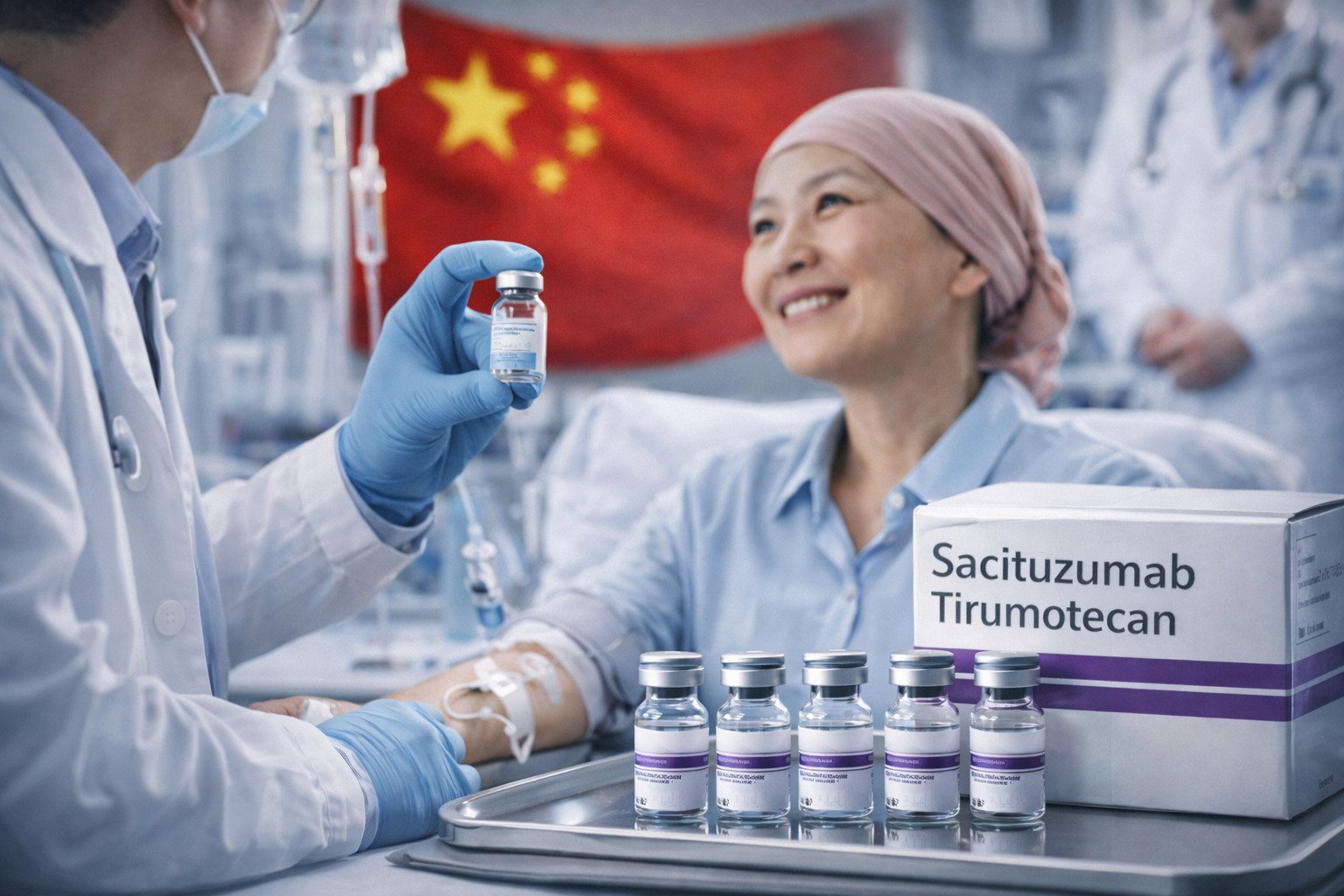
Sichuan Kelun-Biotech Biopharmaceutical Co., Ltd. ("Kelun-Biotech" or the "Company", 6990.HK) announced that a new indication application for its TROP2-directed ADC sacituzumab tirumotecan (sac-TMT, also known as SKB264/MK-2870) (佳泰莱®) has been approved by the National Medical Products Administration (NMPA) of China for treatment of adult patients with unresectable or metastatic HR+/HER2- (IHC 0, IHC 1+ or IHC 2+/ISH-) breast cancer (BC) who have received prior endocrine therapy (ET) and at least one line of chemotherapy in advanced setting. This approval for HR+/HER2- BC after at least one prior line of chemotherapy marks the fourth indication for sac-TMT approved for marketing in China.
The approval is based on the positive results from the Phase III OptiTROP-Breast02 study which was selected as a Late-Breaking Abstract (LBA) and presented as an oral report at the 2025 European Society for Medical Oncology (ESMO) Congress.
The OptiTROP-Breast02 study evaluated the efficacy and safety of sac-TMT monotherapy compared to investigator's choice of chemotherapy in patients with unresectable or metastatic HR+/HER2- BC. Of the patients enrolled in this Phase III study, 95.7% had visceral metastases, 75.9% had liver metastases; 52.9% were HER2-zero (IHC 0), while 47.1% were HER2-low (IHC 1+ or IHC 2+/ISH-). All patients had received prior CDK4/6 inhibitor and taxane therapy; 56.6% had received ≥2 lines of prior chemotherapy in the advanced or metastatic setting.
Results showed that sac-TMT demonstrated a statistically significant and clinically meaningful increase in progression-free survival (PFS) as assessed by the Blinded Independent Central Review (BICR) compared to chemotherapy (8.3 vs. 4.1 months; hazard ratios (HR), 0.35; 95% CI: 0.26-0.48; p<0.0001). Consistent PFS benefits were observed across all pre-specified subgroups, including HER2-zero and HER2-low, number of chemotherapy lines received in the advanced or metastatic setting, presence of baseline visceral and liver metastases and previous CDK4/6 inhibitor use. According to BICR-assessed PFS results, the hazard ratios in the HER2-zero and HER2-low (IHC 1+ or IHC 2+/ISH-) subgroups were 0.39 (95% CI: 0.26-0.57) and 0.31 (95% CI: 0.20-0.48), respectively. A trend towards overall survival (OS) benefit and a significantly higher objective response rate (ORR) (41.5% vs. 24.1%) were also observed compared with chemotherapy. [1]
Currently, Phase III clinical studies of sac-TMT with or without pembrolizumab (KEYTRUDA®[2]) for the treatment of chemotherapy-naïve HR+/HER2- BC who have received prior ET have been initiated globally (NCT06312176) and in China (NCT07071337).
About HR+/HER2- Breast Cancer
Breast cancer is one of the most common malignant tumors that seriously threaten women's health worldwide. In 2022, there were about 2,297,000 new cases of breast cancer and 666,000 deaths worldwide. Among them, HR+/HER2- breast cancer is the most common subtype, accounting for about 70% of all breast cancer cases, and advanced HR+/HER2- breast cancer has a poor prognosis. This subtype is typically sensitive to hormonal therapy, and therefore, endocrine therapy combined with a CDK4/6 inhibitor constitutes the standard treatment. However, for patients with HR+/HER2- advanced breast cancer whose disease progresses on endocrine therapy, chemotherapy is widely used in clinical while it is associated with low response rate (ORR approximately 14%-22.9%) and limited survival benefit (mPFS approximately 4.0-4.9 months).
Most Read
- Can APAC Biomanufacturing Decarbonise Without Pricing Itself Out?
- The Algorithm on the GMP Floor: AI Promises a Smarter Plant. Regulators Demand the Audit Trail.
- APAC's Peptide-Capacity Gamble
- After the Rush: APAC's mRNA and Vaccine Capacity Hangover
- The Biosimilar Race: Factory to the World — or Stuck in the Copycat Economy?
- The Vein-to-Vein Problem: Can APAC's Cold Chain Carry Advanced Therapies?
- Vectors, Plasmids and the CGT Trap: APAC's Cell and Gene Therapy Ambitions Face an Upstream Bottleneck
- Can APAC Build Radioligand Therapy Before the Atoms Decay?
- The Great Biopharma Reset: 50 Developments That Changed Everything in H1 2026
- Beyond the Trial: Can Real-World Evidence Earn Regulatory Trust in APAC?
- Beyond the Obvious Giant: Where APAC's Clinical Trials Go Next
- The Frontier That Won’t Quite Arrive
Bio Jobs
- Sanofi Turns The Page As Belén Garijo Steps In And Paul Hudson Steps Out
- Global Survey Reveals Nearly 40% of Employees Facing Fertility Challenges Consider Leaving Their Jobs
- BioMed X and AbbVie Begin Global Search for Bold Neuroscience Talent To Decode the Biology of Anhedonia
- Thermo Fisher Expands Bengaluru R&D Centre to Advance Antibody Innovation and Strengthen India’s Life Sciences Ecosystem
- Accord Plasma (Intas Group) Acquires Prothya Biosolutions to Expand Global Plasma Capabilities
- ACG Announces $200 Million Investment to Establish First U.S. Capsule Manufacturing Facility in Atlanta
- AstraZeneca Invests $4.5 Billion to Build Advanced Manufacturing Facility in Virginia, Expanding U.S. Medicine Production
News