PFAS Testing Enters A New Era As Solvent Purity And Analytical Discipline Redefine Data Integrity
21 April 2026 | Tuesday | News
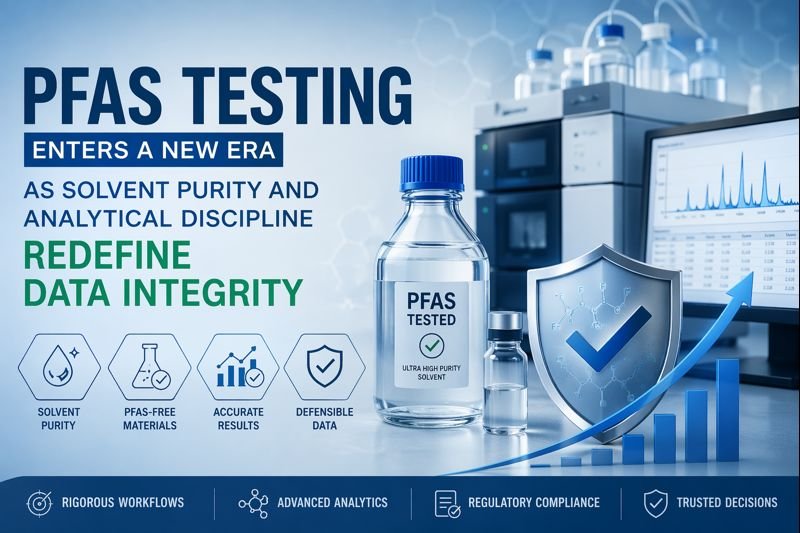
PFAS analysis has moved from a specialist capability to a core requirement for environmental control and testing laboratories because regulatory values are now at, or approaching, single-digit ng/L in some jurisdictions, while broader source-control policies are expanding the list of compounds, matrices and reporting obligations that laboratories must handle. At these concentrations, solvent and additive purity, packaging materials, blank control and chromatographic stability are no longer secondary laboratory issues: they directly determine whether a result is defensible, reproducible and procurement-ready.
Three conclusions matter most for lab managers, analysts and procurement teams. First, there is no globally harmonised regulatory grade called “PFAS-tested” solvent. In practice, the term is only meaningful if it is tied to documented lot testing or blank performance against the laboratory’s target list and action levels. Second, targeted LC‑MS/MS remains the regulatory backbone, but it must be supported by rigorous isotope dilution, matrix checks, field and laboratory blanks, delay-column/background control, and PFAS-safe consumables. Third, laboratories should prepare for a hybrid future in which targeted analysis is increasingly complemented by HRMS, total-fluorine approaches and better reference materials, especially for ultrashort-chain PFAS, neutral precursors and source fingerprinting.
Why PFAS matter to environmental labs
PFAS are a large family of synthetic fluorinated chemicals valued for oil, grease, stain, water and heat resistance. Official and scientific sources describe widespread use in firefighting foams, food-contact materials, textiles, cosmetics, electronics, metal finishing, paper coatings and many other industrial applications. Their persistence, mobility and tendency to accumulate in people, biota and environmental media explain why they have become a central analytical challenge rather than a niche contaminant class. Publicly used definitions also vary, so estimates of the “size” of the PFAS family differ, which is one reason regulatory scopes and target lists diverge across jurisdictions.
For laboratories, the significance is practical as much as toxicological. Current drinking-water values in the US and Europe sit close to the lower end of what well-controlled LC‑MS/MS systems can achieve. [4] That means a trace background contribution from a mobile-phase additive, a PTFE-lined cap, a contaminated SPE manifold, or an unstable buffer can create false positives, unstable retention times, elevated baselines, or non-comparable inter-laboratory data. EPA’s current PFAS methods make this explicit: solvents, reagents, labware and instrument components can themselves introduce PFAS, and each laboratory must establish its own real-world MDLs and LOQs rather than relying on published method examples alone.
Regulatory landscape and guidelines
For day-to-day laboratory decision-making, the most comparable cross-jurisdictional numeric values are in drinking water. Soil, sludge, biota, discharge and product restrictions are also important, but they are matrix-specific and not directly comparable, so the table below focuses on drinking-water limits or formal monitoring targets. Selected Asian entries are illustrative rather than exhaustive because publicly accessible English-language official documentation remains uneven across the region.
|
Jurisdiction |
Current drinking-water value most relevant to labs |
Regulatory character |
Notes and source |
|
United States |
PFOA 4 ng/L; PFOS 4 ng/L; PFHxS/PFNA/HFPO‑DA 10 ng/L each; Hazard Index 1.0 for mixtures of PFHxS, PFNA, HFPO‑DA and PFBS |
Federal enforceable rule still in force, but EPA announced in 2025 that it intends to keep PFOA/PFOS MCLs, extend their compliance deadline to 2031, and reconsider the other PFAS elements. Labs should therefore track both the rule text and implementation timing. |
|
|
European Union |
Sum of PFAS 0.1 µg/L; PFAS Total 0.5 µg/L |
Mandatory under the recast Drinking Water Directive since 12 January 2026 |
The European Commission has also issued technical guidelines for methods of analysis for both parameters, signalling a strong push towards harmonised monitoring. |
|
United Kingdom |
0.1 µg/L for the sum of 48 named PFAS |
Guidance, not a statutory drinking-water standard in England and Wales |
The updated 2025 guidance requires wider monitoring and risk-assessment updates; the UK’s 2026 PFAS Plan frames broader cross-government action on sources, pathways and exposure reduction. |
|
Japan |
PFOS + PFOA combined 50 ng/L |
Upgraded from provisional target to drinking-water quality standard in 2026 |
Japan’s Ministry of the Environment states that the 50 ng/L combined value is being elevated to a drinking-water standard, with additional PFAS kept under review; the same policy package also highlights PFAS reduction technologies and tighter AFFF management. |
|
South Korea |
Monitoring criteria reported as PFOA/PFOS 70 ng/L and PFHxS 480 ng/L |
Monitoring-based regime moving towards statutory standards |
A 2025 ministry press release confirms the present monitoring-based approach and a plan to formalise standards by 2028, expand monitoring and lower quantitation limits to 1 ng/L for key analytes. Published Korean literature summarises the present monitoring criteria above. |
|
China |
PFOA 80 ng/L; PFOS 40 ng/L |
Included in GB 5749‑2022 drinking-water hygiene standard |
Publicly accessible copies of the standard and recent peer-reviewed Chinese studies cite these values; English-language official access is limited, so labs should verify against the latest Chinese text used by the contracting authority. |
Beyond water limits, the broader policy direction is equally important for labs because it shapes future analyte lists and client demand. EPA has delayed and revised TSCA PFAS reporting implementation into 2026, the European Chemicals Agency[19] continues work on the broad EU PFAS restriction proposal under REACH with opinions progressing in 2026, and the UK has begun a formal cross-government PFAS Plan alongside UK REACH work on restrictions such as firefighting foams. In Asia, Japan is clearly tightening, while Korea and China show a more mixed pattern of monitoring programmes, selected standards and incremental source-control measures rather than a single comprehensive class-wide approach.
Analytical methods and instrumentation
Targeted LC‑MS/MS remains the workhorse for compliance and routine environmental PFAS testing because it combines selectivity, low ng/L sensitivity and manageable throughput across water and, increasingly, non-drinking-water matrices. EPA Method 537.1 covers drinking water using SPE-LC‑MS/MS with single-laboratory LCMRLs of 0.53–6.3 ng/L. EPA Method 533 broadened drinking-water coverage, especially for shorter-chain and newer analytes, using isotope dilution with anion-exchange SPE and LC‑MS/MS. EPA Method 1633A now provides the key multi-matrix framework for aqueous, solid, biosolids and tissue samples by LC‑MS/MS with isotopically labelled standards and matrix-specific extraction/cleanup steps.
Method 1633A’s validation data are a useful reality check for performance expectations. In aqueous matrices, pooled MDLs for PFOA and PFOS were about 0.54 and 0.63 ng/L respectively, with observed LOQs often in the 1–4 ng/L range for many common analytes, whilst the method also stresses that each laboratory’s own MDLs and LOQs must be used for reporting and data-quality assessment. The same method uses WAX SPE for aqueous matrices, basic methanol extraction plus carbon/SPE cleanup for solids, and potassium hydroxide/acetonitrile followed by basic methanol cleanup for tissues.
Matrix effects remain one of the principal analytical hazards. Method 533 reports that co-extracted organic matter appreciably enhanced ionisation for 4:2 FTS under the development conditions, while inorganic salts can depress recovery during anion-exchange SPE. Method 1633A relies on isotope dilution expressly to correct for losses and for signal suppression or enhancement that would otherwise bias results. Official QC frameworks therefore require not just calibration and internal standards, but also method blanks, ongoing precision and recovery checks, LOQ verification, calibration verification, retention-time windows, ion-abundance-ratio checks, and, where required, matrix spikes and duplicates.
GC‑MS and HRMS are best seen as complementary rather than competing platforms. GC‑MS, including GC‑Orbitrap and thermal-desorption GC‑MS approaches, adds value for neutral, volatile and semivolatile PFAS that are poorly covered by routine LC methods. HRMS is increasingly central for suspect and non-target screening, but it still depends on better reference data, better confidence frameworks and stronger harmonisation if it is to support regulatory-grade interpretation at scale. Aggregate approaches such as TOP assay, EOF, AOF and other total-fluorine methods are also gaining traction because targeted compound lists still capture only part of the PFAS burden.
|
Method family |
Where it fits best |
Strengths |
Main limitations |
Key sources |
|
Targeted LC‑MS/MS |
Compliance water testing; routine environmental programmes; most current accredited workflows |
Highest maturity; low ng/L performance; well-defined QC; isotope dilution widely available |
Limited to target list; matrix effects and background contamination remain significant; weaker coverage of neutrals and many unknowns |
EPA 533, 537.1 and 1633A. |
|
GC‑MS / GC‑Orbitrap / TD‑GC‑MS |
Neutral, volatile and semivolatile PFAS; complementary source profiling |
Extends coverage beyond ionic PFAS; useful complement to LC workflows |
Often requires specialised preparation or instrument configuration; not the default regulatory platform for most water methods |
Recent peer-reviewed studies describe GC‑Orbitrap and TD‑GC‑MS as complementary tools for neutral PFAS and broader PFAS “dark matter”. |
|
LC‑HRMS suspect/non-target |
Screening unknowns, transformation products, source characterisation, method development |
Broader discovery power; valuable for emerging PFAS and prioritisation |
Identification confidence, library gaps and harmonisation remain major constraints; not yet a routine substitute for targeted compliance data |
Recent reviews and NIST reference-data efforts highlight both the promise and the standardisation gap. |
|
TOP assay / EOF / AOF / total fluorine |
Closing mass-balance gaps; precursor assessment; forensic and research programmes |
Captures burden beyond target lists; useful for precursor transformation and source understanding |
Poor chemical specificity on their own; inter-method comparability and interpretation remain challenging |
Systematic reviews show these methods are increasingly used, but best deployed alongside targeted analysis. |
Solvents, additives and contamination control
There is no universally accepted regulatory specification for a “PFAS-tested” solvent or additive. For laboratories, the term only becomes meaningful when translated into a procurement specification: an LC‑MS/UPLC-grade reagent or consumable, tied to a specific lot, demonstrated by vendor or in-house data to contain no target PFAS above the laboratory’s action level for the method and matrix concerned. That interpretation is not a formal legal definition; it is an operational inference from the way EPA methods require analyte-free reagents, reagent blanks, lot verification and traceable standards.
The chemistry matters. Ammonium acetate remains the dominant additive in mainstream regulatory LC methods because it balances retention, ESI performance and robustness. EPA Method 537.1 explicitly notes that mobile phases with less than 20 mM ammonium acetate caused retention times to drift to shorter values over time during method development. Method 533, however, also warns that the relatively large quantities of ammonium acetate used for preservation can themselves introduce trace contaminants, so blank control is essential. In Method 1633A, methanol, acetonitrile, acetic acid, formic acid and ammonium hydroxide all appear in defined roles, with grade, storage and shelf-life expectations written into the method.
Methanol deserves particular attention because it is both indispensable and easy to misuse. Method 1633A states that some fluorinated carboxylic acids can esterify in anhydrous acidic methanol, so standards should be stored under basic conditions; it also warns that too much residual methanol before SPE cleanup harms recovery of longer-chain acids and sulfonates, whilst evaporating all methanol can hurt recovery of more neutral FOSE/FOSA species. That is a direct example of why “high purity” alone is not enough: the solvent composition and its control across extraction, evaporation and reconstitution determine data quality.
Container and packaging choices belong in the same discussion. Method 1633A forbids PTFE-lined caps for sample containers, requires each lot of containers to be shown PFAS-free at or below the laboratory MDLs, and specifies HDPE or polypropylene closures for liquid, solid and tissue samples. The USGS PFAS sampling guide similarly warns against PFAS-bearing field gear and materials such as waterproof papers, jacket finishes and Teflon-like liners. For a procurement function, that means that solvent quality, bottle/cap construction and packaging disclosures should be treated as a single control package, not as separate purchasing decisions.
|
Solvent or additive |
Typical role in PFAS workflow |
Recommended grade or control |
PFAS-specific risk |
Practical recommendation |
|
Reagent water |
Diluent, mobile phase, blanks, preservation solutions |
Ultrapure water demonstrated free of target analytes; flush system before use |
Water systems can accumulate PFAS in tubing and reservoirs |
Trend blank data by water source and purification train; never assume “18.2 MΩ” means PFAS-free. |
|
Methanol |
Extraction, elution, reconstitution, column flushing |
LC‑MS/HPLC grade or better, lot-verified |
Background contamination; esterification of some carboxylates in acidic anhydrous methanol; recovery loss if evaporation is mismanaged |
Use PFAS-screened lots, control residual methanol during evaporation, and keep standards under appropriate basic conditions. |
|
Acetonitrile |
Mobile phase organic, some clean-up and reconstitution steps |
UPLC/LC‑MS grade, lot-verified |
LC background and strong-solvent peak-shape effects if poorly matched to initial conditions |
Validate injection solvent effects for early-eluting PFAS, especially in broader methods and ultrashort-chain work. |
|
Ammonium acetate |
Mobile-phase buffer; sometimes preservative |
High-purity LC‑MS grade for chromatography; preservative lots also blank-checked |
Impure lots can contaminate blanks; low concentrations may destabilise retention |
Keep separate, qualified stocks for chromatography and preservation; monitor lot changes and retention drift. |
|
Acetic acid / formic acid |
pH adjustment, extract conditioning, calibration/reconstitution support |
ACS or high-purity grade, verified by lot |
Can alter PFAS chemistry and retention if composition is not tightly controlled |
Use method-matched recipes and expiry controls; do not improvise acid content across batches. |
|
Ammonium hydroxide / basic methanol |
SPE elution, standard stabilisation, dilution of high extracts |
Traceable high-purity reagent, prepared to method recipe |
Incorrect basicity changes recovery and can damage comparability |
Prepare fresh or within method shelf-life, document recipe, and verify response after lot changes. |
SOP design and data-quality lessons
An optimised PFAS workflow for environmental laboratories should look like an integrated contamination-control system rather than a conventional trace-organics SOP with a few extra exclusions. It should segregate PFAS work areas, restrict materials to approved HDPE, polypropylene, stainless steel and verified glass, qualify every lot of solvent, additive and container, and hard-code decision rules for blanks, isotope recoveries, retention-time windows and matrix-spike behaviour. EPA Methods 533, 537.1 and 1633A already provide the core of this discipline, and the best laboratories extend it into procurement, receipt inspection and long-term blank trending.
Three examples show the impact of solvent and additive choices on data quality. First, Method 537.1 observed retention-time drift when ammonium acetate concentration was reduced below 20 mM, demonstrating that a “cleaner” low-salt mobile phase can undermine chromatographic stability. Second, Method 1633A warns that both over-drying and under-removing methanol reduce recovery, but in opposite ways depending on PFAS class. Third, a 2024 peer-reviewed water workflow using inert hardware, a polar-embedded column, clean RO-water calibration and extensive isotope-labelled standards reported 70–130% recoveries and <20% RSD across tap water, bottled water and wastewater, showing how careful chemistry and hardware choices can expand scope without sacrificing robustness.
A practical SOP should, at minimum, include: controlled sample acceptance and storage times; lot qualification of solvents, additives and containers; sequence design with instrument blank, method blank and continuing calibration verification; matrix-spike and duplicate rules by matrix; defined responses to field-reagent-blank failure or blank contamination; and reporting templates that include LOQ, EIS/NIS recovery, qualifiers and any deviation from standard chemistry. These elements are not bureaucratic extras; they are the mechanism by which the lab demonstrates that a 1–10 ng/L result is analytical evidence rather than instrument background.
Gaps, recommendations and future direction
The biggest unresolved gap is not instrument sensitivity but comparability. Jurisdictions regulate different PFAS, use different summation rules, and distinguish unevenly between enforceable standards, guidance values and monitoring criteria. Analytical coverage is also incomplete: neutral PFAS, ultrashort-chain PFAS, precursors and unknowns remain difficult to capture in any single routine method, while English-language official guidance in parts of Asia is still patchy.
For laboratories, the clearest recommendation is to treat PFAS testing as a controlled production system. Lab managers should maintain a dedicated PFAS quality programme with blank trending, role-based change control and matrix-specific validation. Analysts should resist ad hoc chemistry changes, especially around buffer concentration, reconstitution solvent and extraction evaporation. Procurement teams should require lot-specific blank documentation, full bottle/cap material disclosure, packaging change notification and traceability for standards and additives. That last point is an operational recommendation rather than a formal rule, but it follows directly from the method requirements for lot verification, blank control and standard traceability.
For suppliers, the commercial opportunity is clear: the market increasingly needs reagents and consumables that are not merely high purity in generic LC-MS terms, but demonstrably fit for PFAS work. Useful supplier deliverables would include PFAS target-list blank certificates by lot, packaging declarations showing no PTFE liners or fluorinated components where relevant, and change-control notices when synthesis, packaging or distribution conditions change. In a market where only a limited number of laboratories currently have accredited capability at the required quality level, suppliers that can document PFAS suitability rather than merely claim it will have a meaningful competitive advantage.
The forward trajectory is towards method harmonisation, better reference materials and lower-solvent workflows. EU technical guidance for PFAS Total and Sum of PFAS is an important harmonisation step. [10] National Institute of Standards and Technology[45] has reported multiple PFAS reference materials already available, additional materials in development, and specific efforts to improve HRMS reference data and AFFF quality-control materials, all of which should improve inter-laboratory comparability. At the same time, peer-reviewed work is pushing lower-solvent and greener alternatives, such as dilute-and-shoot water methods, inert-hardware systems, and solvent-minimising GC or SPME-style approaches for neutral PFAS. For most environmental labs, the pragmatic near-term position is to adopt these greener approaches selectively and only after they have been validated against the lab’s target matrices, decision levels and blank-control expectations.
Disclaimer:
This article is intended for informational and industry awareness purposes only. While it reflects current analytical practices and regulatory perspectives, laboratories should validate all methods, materials, and workflows in accordance with their internal quality systems, accreditation requirements, and applicable regional regulations.
Most Read
- Can APAC Biomanufacturing Decarbonise Without Pricing Itself Out?
- The Algorithm on the GMP Floor: AI Promises a Smarter Plant. Regulators Demand the Audit Trail.
- APAC's Peptide-Capacity Gamble
- After the Rush: APAC's mRNA and Vaccine Capacity Hangover
- The Biosimilar Race: Factory to the World — or Stuck in the Copycat Economy?
- The Vein-to-Vein Problem: Can APAC's Cold Chain Carry Advanced Therapies?
- Vectors, Plasmids and the CGT Trap: APAC's Cell and Gene Therapy Ambitions Face an Upstream Bottleneck
- Can APAC Build Radioligand Therapy Before the Atoms Decay?
- The Great Biopharma Reset: 50 Developments That Changed Everything in H1 2026
- Beyond the Trial: Can Real-World Evidence Earn Regulatory Trust in APAC?
- Beyond the Obvious Giant: Where APAC's Clinical Trials Go Next
- The Frontier That Won’t Quite Arrive
Bio Jobs
- Sanofi Turns The Page As Belén Garijo Steps In And Paul Hudson Steps Out
- Global Survey Reveals Nearly 40% of Employees Facing Fertility Challenges Consider Leaving Their Jobs
- BioMed X and AbbVie Begin Global Search for Bold Neuroscience Talent To Decode the Biology of Anhedonia
- Thermo Fisher Expands Bengaluru R&D Centre to Advance Antibody Innovation and Strengthen India’s Life Sciences Ecosystem
- Accord Plasma (Intas Group) Acquires Prothya Biosolutions to Expand Global Plasma Capabilities
- ACG Announces $200 Million Investment to Establish First U.S. Capsule Manufacturing Facility in Atlanta
- AstraZeneca Invests $4.5 Billion to Build Advanced Manufacturing Facility in Virginia, Expanding U.S. Medicine Production
News