Australia and Taiwan Build a Faster Clinical Bridge for Global Biotech Development
20 July 2026 | Monday | News
As biotechnology companies face mounting pressure to move promising science into human studies faster, the relationship between Australia and Taiwan is emerging as a potentially powerful development corridor — combining Taiwan’s growing biotechnology innovation base with Australia’s globally recognised clinical trial ecosystem.
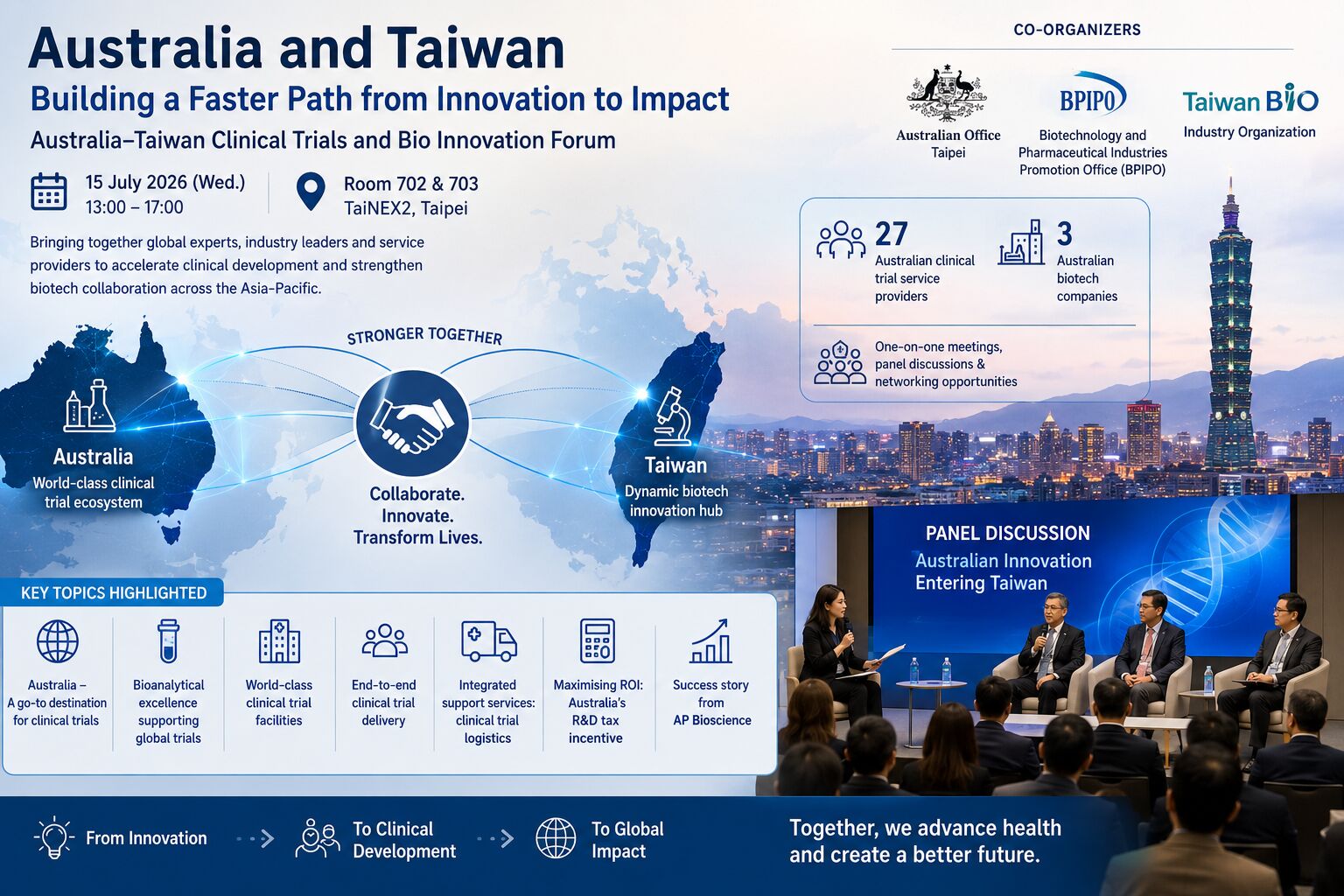
That opportunity took centre stage in Taipei on 15 July at the Australia–Taiwan Clinical Trials and Bio Innovation Forum, held alongside BIO Asia–Taiwan 2026 at the Taipei Nangang Exhibition Center.
Co-organised by the Australian Office Taipei, the Biotechnology and Pharmaceutical Industries Promotion Office (BPIPO) and Taiwan BIO Industry Organization, the forum brought together clinical development specialists, biotechnology companies and industry leaders from both markets to explore how closer collaboration could shorten development timelines and create new pathways for innovation to reach international markets.
Australia Makes Its Case as a Clinical Development Gateway
The scale of Australia’s participation demonstrated the strategic importance being placed on the relationship. The forum featured 27 Australian clinical trial service providers, spanning contract research organisations, specialist clinical trial sites, bioanalytical laboratories and clinical logistics providers.
Three biotechnology companies also presented emerging technologies across personalised hearing solutions, photodynamic therapy and AI-enabled patient recruitment.
Opening the forum, Christopher Lim, Deputy Representative of the Australian Office, set the stage for a discussion centred not simply on attracting more trials to Australia but on building stronger connections between the innovation ecosystems of the two countries.
For Taiwanese biotechnology companies seeking to advance assets internationally, Australia offers an increasingly compelling proposition: established early-stage clinical capabilities, sophisticated research infrastructure and a regulatory environment designed to facilitate efficient clinical development.
Daniela Caiazza, Vice President of Clinical Service ANZ at Novotech, highlighted Australia’s position as a preferred destination for global clinical trials, while subsequent presentations demonstrated the infrastructure supporting that proposition.
From the bioanalytical capabilities presented by Jason Wong, Site President of Resolian Bioanalytics, to the specialist clinical trial infrastructure outlined by Chris Hickey, Chief Business Development Officer at Nucleus Network, the session illustrated how Australia has built an interconnected ecosystem around clinical development.
Ben Edwards, Chief Operating Officer at Avance Clinical, addressed the importance of end-to-end trial execution, while Jon Fairweather, Business Development Manager at Cryosite, highlighted the increasingly critical role of specialised logistics in supporting complex clinical programmes.
The commercial equation was another important part of the discussion. Pavel Reddy, Founder and Director of Global R&D, examined how Australia’s R&D Tax Incentive can influence development economics — an increasingly important consideration for biotechnology companies navigating capital-intensive clinical programmes.
Taiwan Brings the Innovation Pipeline
If Australia’s strength lies in clinical execution, Taiwan is increasingly positioning itself as a source of technologies and therapeutic innovation capable of feeding that development ecosystem.
Dr Michael Huang, Director of BPIPO and Vice President of the Innovation and Entrepreneur Core at DCB, provided an overview of Taiwan’s biotechnology landscape, setting out the capabilities and ambitions of an industry increasingly looking beyond its domestic market.
The strategic opportunity is therefore complementary.
Taiwanese biotechnology companies need efficient routes to international clinical validation and global development. Australia, meanwhile, has built significant clinical infrastructure that depends on a continuous pipeline of innovative programmes.
Connecting the two ecosystems could create a more seamless pathway from Taiwanese innovation to Australian clinical development and ultimately to international markets.
A case study presented by Spike Lo, Vice President of Business Development at AP Bioscience, brought a practical industry perspective to this cross-border development model.
Innovation Must Travel in Both Directions
Importantly, the forum also looked beyond the movement of Taiwanese drug candidates into Australian clinical trials.
A panel moderated by Tam C. Nguyen, Director of Research & Innovation at Monash Health, examined how Australian innovation can enter and establish itself in Taiwan.
Featuring representatives from Audeara, Invion and TrialScreen, the discussion reflected the increasingly multidirectional nature of the Australia–Taiwan biotechnology relationship. The opportunity is no longer simply about choosing where to conduct a clinical trial. It is about connecting technologies, capital, clinical infrastructure, regulatory expertise and commercial markets across borders.
This is particularly relevant as biotechnology development becomes more specialised. Emerging modalities increasingly require sophisticated laboratories, experienced clinical sites, reliable biological sample logistics and technology-enabled patient recruitment — capabilities that few companies can efficiently build independently.
Cross-border ecosystems therefore have the potential to become a competitive advantage in their own right.
From Networking to a Development Corridor
The real measure of the Australia–Taiwan relationship will ultimately be the programmes that emerge from it.
The forum's combination of industry presentations, panel discussions, one-on-one meetings and networking was designed to move the conversation towards tangible partnerships between Australian and Taiwanese organisations.
For Australia, deeper engagement with Taiwan provides access to an expanding pipeline of biotechnology innovation and ambitious companies seeking international development pathways. For Taiwan, Australia offers established clinical capabilities that could help its biotechnology companies generate globally relevant evidence earlier in their development journey.
The proposition emerging from the forum was therefore larger than any individual clinical trial.
Australia and Taiwan have an opportunity to build a genuine cross-border biotechnology development corridor — one where innovation can originate in either market, clinical capabilities can be deployed where they offer the greatest advantage, and promising technologies can move towards global markets with greater speed.
As BIO Asia–Taiwan 2026 brings the international life sciences community together in Taipei, the Australia–Taiwan Clinical Trials and Bio Innovation Forum demonstrated how bilateral partnerships can translate the broader promise of regional collaboration into something considerably more practical: a faster route from biotechnology innovation to patients.
Most Read
- Can APAC Biomanufacturing Decarbonise Without Pricing Itself Out?
- The Algorithm on the GMP Floor: AI Promises a Smarter Plant. Regulators Demand the Audit Trail.
- APAC's Peptide-Capacity Gamble
- After the Rush: APAC's mRNA and Vaccine Capacity Hangover
- The Biosimilar Race: Factory to the World — or Stuck in the Copycat Economy?
- The Vein-to-Vein Problem: Can APAC's Cold Chain Carry Advanced Therapies?
- Vectors, Plasmids and the CGT Trap: APAC's Cell and Gene Therapy Ambitions Face an Upstream Bottleneck
- Can APAC Build Radioligand Therapy Before the Atoms Decay?
- The Great Biopharma Reset: 50 Developments That Changed Everything in H1 2026
- Beyond the Trial: Can Real-World Evidence Earn Regulatory Trust in APAC?
- Beyond the Obvious Giant: Where APAC's Clinical Trials Go Next
- The Frontier That Won’t Quite Arrive
Bio Jobs
- Sanofi Turns The Page As Belén Garijo Steps In And Paul Hudson Steps Out
- Global Survey Reveals Nearly 40% of Employees Facing Fertility Challenges Consider Leaving Their Jobs
- BioMed X and AbbVie Begin Global Search for Bold Neuroscience Talent To Decode the Biology of Anhedonia
- Thermo Fisher Expands Bengaluru R&D Centre to Advance Antibody Innovation and Strengthen India’s Life Sciences Ecosystem
- Accord Plasma (Intas Group) Acquires Prothya Biosolutions to Expand Global Plasma Capabilities
- ACG Announces $200 Million Investment to Establish First U.S. Capsule Manufacturing Facility in Atlanta
- AstraZeneca Invests $4.5 Billion to Build Advanced Manufacturing Facility in Virginia, Expanding U.S. Medicine Production
News