Hong Kong Makes Its Case as Asia’s Biotech Super-Connector: Capital, Regulation and Scale Converge
20 July 2026 | Monday | News
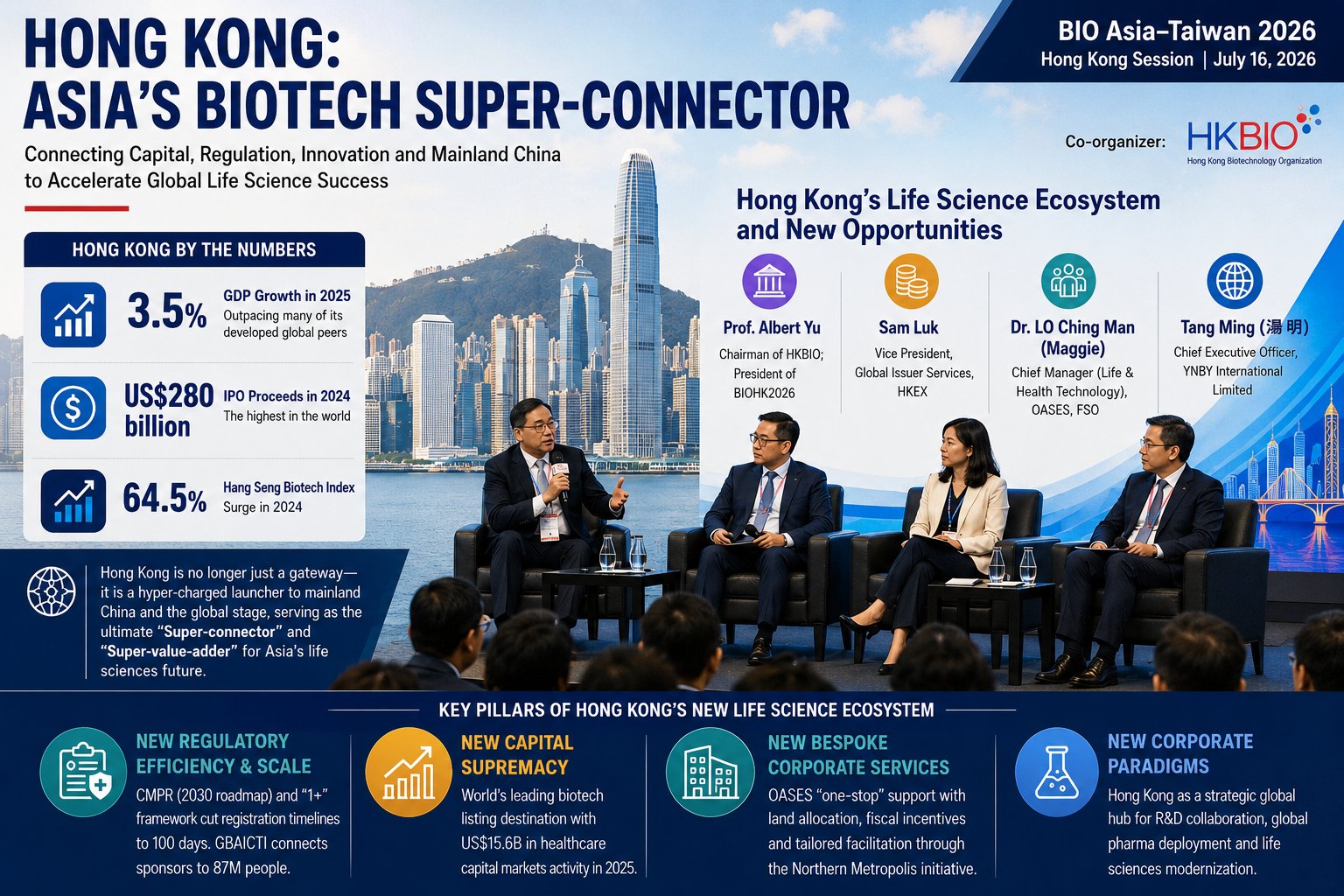
Hong Kong is seeking to redefine its place in the global life sciences economy. No longer content to be viewed primarily as a financial gateway into China, the city is building a broader proposition around capital, regulation, clinical development, innovation and cross-border commercialisation.
That proposition took centre stage during the “Hong Kong’s Life Science Ecosystem and New Opportunities” session held on July 16 at BIO Asia–Taiwan 2026, where representatives from the Hong Kong Biotechnology Organization, Hong Kong Exchanges and Clearing, the Office for Attracting Strategic Enterprises and YNBY International presented a picture of an ecosystem being deliberately redesigned for the next phase of biotechnology growth.
The message emerging from the session was clear: Hong Kong wants to become not merely a place where biotechnology companies raise money, but a platform from which they can build, finance and internationalise their businesses.
From Financial Gateway to Life Sciences Platform
Opening the session, Prof. Albert Yu, Chairman of the Hong Kong Biotechnology Organization and President of BIOHK2026, positioned Hong Kong’s evolving biotechnology ecosystem within a much larger transformation taking place across regulation, clinical research and regional integration.
One of the most consequential developments is the emergence of a more locally anchored regulatory infrastructure. Hong Kong's evolving medical product regulatory framework, alongside initiatives intended to streamline registration pathways, could significantly alter how international and regional biotechnology companies approach the market.
The implications extend beyond Hong Kong itself.
Through closer integration with the Greater Bay Area, life sciences companies operating from Hong Kong can potentially connect with an economic region encompassing a population of approximately 87 million people. The development of the Greater Bay Area International Clinical Trial Institute further strengthens the possibility of building larger and more connected clinical research capabilities across the region.
For Taiwan's biotechnology companies, this creates a potentially important strategic corridor. Hong Kong can offer access not only to international capital but also to clinical development networks, mainland China and global markets.
The opportunity, therefore, is increasingly about connectivity at scale.
Capital Remains Hong Kong’s Most Powerful Advantage
If Hong Kong is expanding its biotechnology proposition, capital remains one of its strongest foundations.
Sam Luk, Vice President, Global Issuer Services at Hong Kong Exchanges and Clearing Ltd., examined Hong Kong's position as a fundraising destination for biotechnology companies and the evolution of its capital markets infrastructure for innovative businesses.
The city's emergence as a major biotechnology listing centre has been accelerated by reforms that opened public markets to pre-revenue biotechnology companies, creating an important financing pathway for businesses whose scientific development timelines often extend well beyond conventional corporate investment cycles.
For biotech companies, the significance of a specialised capital ecosystem cannot be overstated. Drug development requires sustained investment through discovery, clinical development, regulatory approval and commercialisation. Access to investors who understand those timelines can determine whether promising science successfully reaches patients.
Hong Kong's increasingly active healthcare capital markets, combined with renewed investor interest in biotechnology, are strengthening its position as a potential financing centre for companies across Asia.
For Taiwanese and other APAC biotechnology companies evaluating international expansion, the proposition is particularly relevant: scientific innovation can originate anywhere, but scaling it increasingly requires access to sophisticated global capital.
Hong Kong wants to become the place where those two worlds meet.
A Government That Wants to Compete for Companies
Capital alone, however, is no longer sufficient to win the global competition for biotechnology investment.
Governments across Asia are competing aggressively for companies, laboratories, manufacturing facilities and scientific talent. Hong Kong is responding by attempting to make the process of establishing and expanding strategic enterprises significantly more coordinated.
Dr. LO Ching Man (Maggie), Chief Manager, Life & Health Technology at the Office for Attracting Strategic Enterprises (OASES), Financial Secretary’s Office, outlined the city's strategic approach to attracting life and health technology companies.
Central to that effort is the development of the Northern Metropolis, which is expected to play an increasingly important role in Hong Kong's innovation and technology ambitions.
But the emerging model goes beyond providing physical infrastructure.
Through its one-stop facilitation approach, Hong Kong is seeking to address many of the practical barriers companies encounter when entering a new market—from identifying suitable locations and navigating government processes to accessing incentives and building connections across the local ecosystem.
The shift reflects a broader reality in the global biotechnology economy: companies increasingly compare ecosystems, not simply tax rates.
The jurisdictions that succeed will be those capable of bringing together talent, capital, regulation, infrastructure, clinical development and government support within a coherent operating environment.
Hong Kong is attempting to build precisely that proposition.
Yunnan Baiyao Shows the Corporate Opportunity
The session also moved beyond policy and capital to examine how established companies can use Hong Kong as an internationalisation platform.
Tang Ming, Chief Executive Officer of YNBY International Limited, shared the company's journey and its role in advancing the global ambitions of Yunnan Baiyao.
The case illustrates another dimension of Hong Kong's potential role in the life sciences industry: serving as a corporate bridge between major Chinese healthcare businesses and international markets.
For companies with ambitions spanning global pharmaceutical deployment, cross-border R&D collaboration and the modernisation of traditional healthcare businesses, Hong Kong offers a combination that remains difficult to replicate elsewhere—proximity to mainland China alongside an internationally connected financial and business environment.
This positioning could become increasingly important as Chinese pharmaceutical and biotechnology companies accelerate their globalisation strategies.
Rather than functioning simply as an export gateway, Hong Kong has the opportunity to become an operational base where international partnerships are structured, capital is raised and global strategies are executed.
Asia’s Next Biotech Advantage May Be Connectivity
The concluding discussion, moderated by Prof. Albert Yu and featuring Dr. Maggie Lo, Sam Luk and Tang Ming, brought the session's different themes together around a larger question: what will define the next phase of biotechnology competitiveness in Asia?
The answer may increasingly be the ability to connect ecosystems.
Asia already possesses formidable scientific capabilities. Taiwan has established deep strengths in biotechnology, healthcare and advanced technology. Mainland China offers extraordinary market and clinical scale. Other markets across the region are building increasingly sophisticated research and manufacturing capabilities.
The opportunity for Hong Kong is to sit at the intersection of these strengths.
Its competitive proposition rests on a combination of international capital markets, evolving regulatory infrastructure, access to the Greater Bay Area, government-backed enterprise attraction and its longstanding position as a bridge between China and the world.
That combination could be particularly valuable at a moment when biotechnology companies are being forced to think more globally—and much earlier—about how they finance development, conduct clinical trials, establish partnerships and reach international markets.
For companies attending BIO Asia–Taiwan 2026, the Hong Kong session ultimately presented a proposition larger than any single incentive, regulatory reform or capital market statistic.
Hong Kong is betting that the next great biotechnology hubs will not necessarily be those that possess every capability within their own borders. They will be the ecosystems capable of connecting the best capabilities across borders—and turning those connections into commercial scale.
In that emerging map of Asian biotechnology, Hong Kong is positioning itself not simply as a gateway, but as a super-connector and super-value-adder between science, capital and markets.
Most Read
- Can APAC Biomanufacturing Decarbonise Without Pricing Itself Out?
- The Algorithm on the GMP Floor: AI Promises a Smarter Plant. Regulators Demand the Audit Trail.
- APAC's Peptide-Capacity Gamble
- After the Rush: APAC's mRNA and Vaccine Capacity Hangover
- The Biosimilar Race: Factory to the World — or Stuck in the Copycat Economy?
- The Vein-to-Vein Problem: Can APAC's Cold Chain Carry Advanced Therapies?
- Vectors, Plasmids and the CGT Trap: APAC's Cell and Gene Therapy Ambitions Face an Upstream Bottleneck
- Can APAC Build Radioligand Therapy Before the Atoms Decay?
- The Great Biopharma Reset: 50 Developments That Changed Everything in H1 2026
- Beyond the Trial: Can Real-World Evidence Earn Regulatory Trust in APAC?
- Beyond the Obvious Giant: Where APAC's Clinical Trials Go Next
- The Frontier That Won’t Quite Arrive
Bio Jobs
- Sanofi Turns The Page As Belén Garijo Steps In And Paul Hudson Steps Out
- Global Survey Reveals Nearly 40% of Employees Facing Fertility Challenges Consider Leaving Their Jobs
- BioMed X and AbbVie Begin Global Search for Bold Neuroscience Talent To Decode the Biology of Anhedonia
- Thermo Fisher Expands Bengaluru R&D Centre to Advance Antibody Innovation and Strengthen India’s Life Sciences Ecosystem
- Accord Plasma (Intas Group) Acquires Prothya Biosolutions to Expand Global Plasma Capabilities
- ACG Announces $200 Million Investment to Establish First U.S. Capsule Manufacturing Facility in Atlanta
- AstraZeneca Invests $4.5 Billion to Build Advanced Manufacturing Facility in Virginia, Expanding U.S. Medicine Production
News