
China's 2026 Reimbursement Lists: 10 Drugs That Will Show Where Beijing Is Paying, and the Commercial List's Second Year
02 November 2026 | Monday | Regulatory
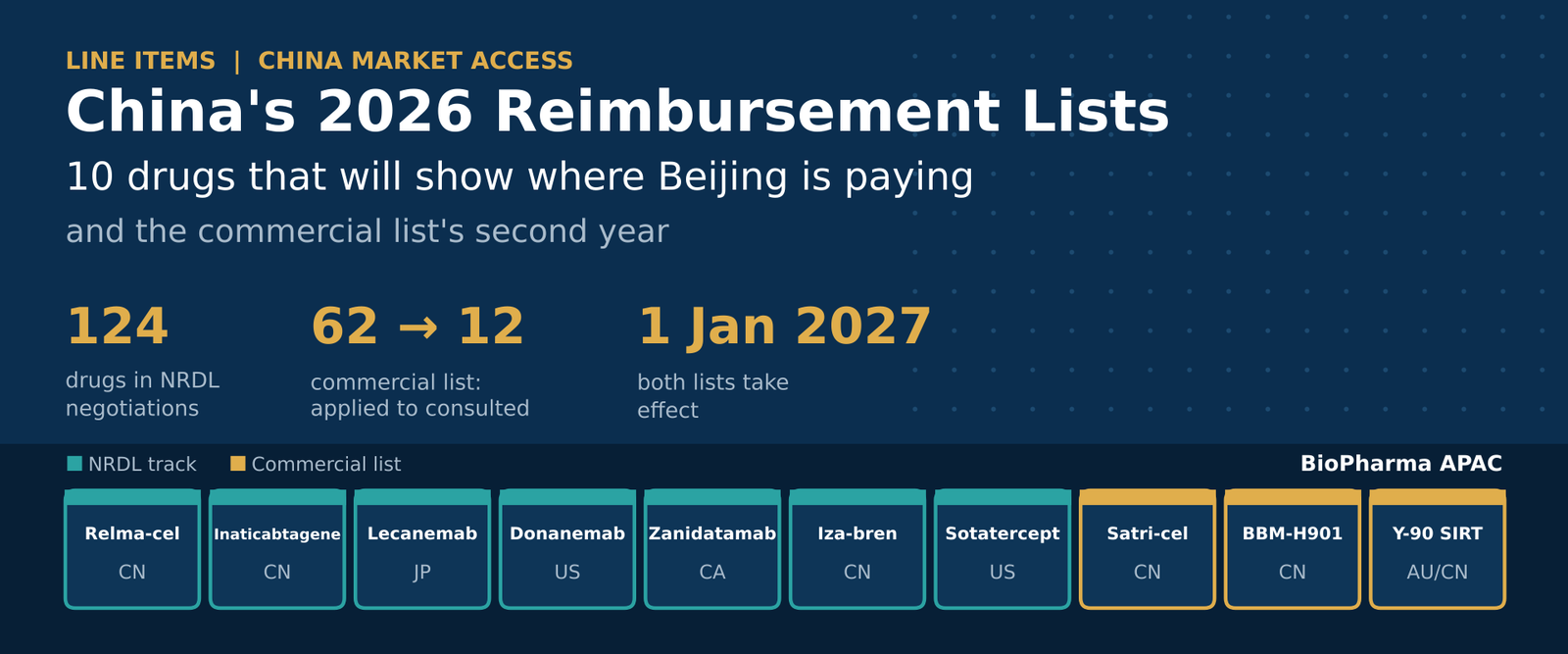
Where things stand. As of 2 November 2026, the National Healthcare Security Administration (NHSA) has not published the 2026 National Reimbursement Drug List (NRDL) or the 2026 Commercial Health Insurance Innovative Drug List. No drug named below is confirmed as an addition. Every fact here comes from NHSA notices, official briefings, company filings or named reporting, and no negotiated price has been disclosed for any candidate. Both lists are due to take effect on 1 January 2027.
Every December for the past few years, China's drug industry has gathered around a single document. Last year it arrived on 7 December 2025, when NHSA and the Ministry of Human Resources and Social Security released the updated NRDL alongside something new: the country's first Commercial Health Insurance Innovative Drug List, a catalogue of high-value drugs that sit outside basic insurance but are recommended for private and city-level cover. The NRDL added 114 drugs, 50 of them Class 1 innovative medicines, and removed 29. The commercial list named just 19.
This year the calendar moved. NHSA opened the application window a month early, ran the NRDL negotiation and bidding sessions from 5 to 8 September at the conference centre beside the Great Hall of the People, and finished the commercial list's price consultations on 9 September. In earlier cycles the talks had run into late October or early November. The regulator's stated reason was practical: more lead time for hospitals, provinces and insurers to implement the lists before they switch on in January. Officials have said the new lists will be out by the end of November.
That leaves a short, useful window. The applicant pools are public, the negotiation rosters are partly known, and a handful of drugs have already shown which route their makers chose. Whether those drugs make it through will say more about where Beijing is willing to spend than any headline count of additions. So rather than wait for the tally, this piece picks the ten candidates to watch, explains what each outcome would signal, and then turns to the bigger structural story: the commercial list's second year, where fewer companies applied and fewer still made it to the table.
The numbers so far
Start with the pipeline, because the shape of this year's funnel is already a finding. On 29 June NHSA reported 818 applications covering 674 generic names, up 100 applications and 41 names on 2025. After the preliminary check, 557 drugs cleared the basic-list screen and 54 cleared the commercial-list screen. Once the formal review closed, 601 drugs were in play for the NRDL: 368 seeking new listing and 233 seeking renewal or renegotiation, against 310 and 224 a year earlier.
The commercial list moved the other way. Sixty-two products applied and 58 passed formal review. In 2025 the same stage had produced 121 survivors from 141 applications. Only 12 drugs reached the commercial price consultations this September, half last year's 24, which ended with 19 agreements.
|
Metric |
2025 cycle |
2026 cycle |
Direction |
|
Applications received (all lists) |
718 (implied) |
818 |
Up 100 |
|
NRDL new-listing candidates after formal review |
310 |
368 |
Up |
|
NRDL renewal and renegotiation candidates |
224 |
233 |
Up |
|
Out-of-list drugs taken to negotiation |
Not comparable |
124 |
n/a |
|
Commercial list applications |
141 |
62 |
Down sharply |
|
Commercial list passing formal review |
121 |
58 |
Down by half |
|
Commercial list drugs in price consultation |
24 |
12 |
Down by half |
|
Commercial list final agreements |
19 |
Due by end Nov |
Pending |
|
Negotiation dates |
Late Oct to early Nov |
5 to 9 Sept |
About two months earlier |
Sources: NHSA notices of 29 June 2026; Xinhua; CCTV via Economic Observer; China Times; Simon-Kucher. The 2025 total is derived from NHSA's statement that 2026 applications rose by 100.
Two procedural changes explain much of the movement. First, a pre-submission route let drugs that had essentially finished technical review, but did not yet hold an approval letter, apply before the June deadline. Simon-Kucher counts 60 pre-submissions, of which 49 advanced. Second, a comparator pre-consultation let Class 1 drugs agree their benchmark with payer experts before filing. NHSA ran two rounds between April and June covering 59 drug instances. Both changes reward companies that plan early, and both pull more novel drugs into the same year as their approval.
How we chose the ten
We have not tried to predict winners. The ten below were selected because their outcomes, either way, carry information about NHSA's priorities. The rubric is published so readers can check the choices:
- Confirmed participation. Each drug is either confirmed in public reporting as having entered negotiation or consultation, or confirmed by NHSA or an independent tracker as having passed formal review for a named list.
- Origin spread. A mix of Chinese-originated and foreign-originated products, so that the result tests whether domestic innovation is treated differently from imported innovation.
- Therapy-area spread. Oncology dominates every year, so we capped it at six of ten and added neurology, rare haematology and rare cardiopulmonary disease.
- First-in-class or first-in-modality status. Preference for products that are the first of their kind globally or in China, because those are where a reimbursement decision sets precedent.
- Price-ceiling tests. At least four products priced near or above the level that has historically kept drugs out of basic insurance.
Price changes are reported only where NHSA or the company has disclosed them. At the time of writing, none has.
Graphic: the watch list by origin, therapy area and list applied for. Web version runs as an animated 960 x 400 hero.
The ten candidates to watch
The first seven are on the NRDL track. The last three applied to the commercial list.
1. Relmacabtagene autoleucel (relma-cel)
Company and origin: JW Therapeutics, China (built on a Juno Therapeutics CAR platform) | Indication: B-cell lymphomas | List: NRDL, moving up from the 2025 commercial list | Disclosed price change: None disclosed; list price RMB 1.29 million per dose | Stage confirmed: Negotiated 6 September
For years, CAR-T therapies never reached the negotiating room for basic insurance. Their roughly RMB 1 million price tags stopped them at formal review. That changed this year because of a rule NHSA added in May: any drug on the 2025 commercial list may apply to the NRDL, and is exempt from the usual requirement to have been approved within the past five years. JW Therapeutics used that door, and its delegation, led by the chief executive, negotiated on the morning of 6 September.
If relma-cel is listed, it will be the clearest evidence yet that the commercial list is a stepping stone rather than a parking lot, and that the informal ceiling which industry figures say capped basic-list prices around RMB 500,000 has moved. If it is not, the commercial list stays the realistic home for cell therapy in China, and companies will plan accordingly.
2. Inaticabtagene autoleucel
Company and origin: Juventas Cell Therapy, China | Indication: Adult relapsed or refractory B-cell acute lymphoblastic leukaemia | List: NRDL, moving up from the 2025 commercial list | Disclosed price change: None disclosed; list price RMB 999,000 per dose | Stage confirmed: Negotiated 6 September
Juventas negotiated on the same morning as JW, and its delegation was reported to be first out of the room. The two products make a natural pair: both domestic, both previously turned away at formal review, and both priced at or near seven figures. Watch whether NHSA treats them identically. A split decision would suggest the regulator is weighing indication and budget impact case by case. Two listings would suggest a deliberate policy to bring a whole modality into basic cover.
Either way, the pair answers a question multinationals have been asking since the commercial list launched: does starting on the commercial list help or hurt an eventual NRDL bid? A Juventas listing would be the second data point in one year.
3. Lecanemab (Leqembi)
Company and origin: Eisai with Biogen, Japan | Indication: Early Alzheimer's disease | List: NRDL, pivoting from the 2025 commercial list | Disclosed price change: None disclosed | Stage confirmed: Passed preliminary review for the NRDL
Alzheimer's treatment was one of the headline categories of the first commercial list, and lecanemab was part of it. This year Eisai has moved the product towards basic insurance, betting that wider reach outweighs the price concession. According to Simon-Kucher, its dossier leans on safety data in Asian patients.
The stakes are large because the eligible population is large. A listing would show NHSA is willing to commit basic funds to a chronic neurodegenerative indication with a big potential budget, provided usage can be managed. A rejection would underline that the basic fund still treats high-volume, high-cost chronic therapies with caution, whatever their novelty.
4. Donanemab (Kisunla)
Company and origin: Eli Lilly, United States | Indication: Early Alzheimer's disease | List: NRDL, pivoting from the 2025 commercial list | Disclosed price change: None disclosed | Stage confirmed: Passed preliminary review for the NRDL
Lilly is running the same play as Eisai, which makes this the cleanest head-to-head on the board. Simon-Kucher reports that Lilly updated its China label with a revised titration schedule aimed at the brain-swelling side effect known as ARIA, and added data on benefit beyond the 52-week treatment period.
There are three plausible outcomes, and each reads differently. Both listed would mean NHSA has accepted the anti-amyloid class into basic cover. One listed would mean the negotiation came down to price and risk-management terms rather than class. Neither listed would send both back to the commercial list, which would then carry more weight in neurology than anyone planned.
5. Zanidatamab
Company and origin: BeiGene (China rights); originated by Zymeworks, Canada | Indication: HER2-positive biliary tract cancer | List: NRDL, graduating from the 2025 commercial list | Disclosed price change: None disclosed | Stage confirmed: Passed formal review for the NRDL
Zanidatamab is the commercial list's best success story so far. Since its listing, it has been picked up by 22 city-level inclusive insurance (Huiminbao) plans, according to China Times, and Simon-Kucher counts listings in 31 provinces and 49 commercial health insurance formularies. It is also proof that the commercial list can deliver hospital access, which matters for the argument further down.
Now BeiGene wants the bigger prize. If zanidatamab graduates, it validates a two-stage strategy: launch on the commercial list, build coverage and evidence, then trade price for volume on the NRDL. That pathway would quickly become standard practice for oncology biologics with modest patient numbers.
6. Izalontamab brengitecan (iza-bren)
Company and origin: Sichuan Biokin and SystImmune, China; partnered with Bristol Myers Squibb outside China | Indication: Recurrent or metastatic nasopharyngeal carcinoma after chemotherapy and PD-1 or PD-L1 therapy; oesophageal squamous cell carcinoma added 17 July | List: NRDL, via the new pre-submission route | Disclosed price change: None disclosed | Stage confirmed: Passed formal review for the NRDL
China's regulator approved iza-bren on 22 June 2026, making it the first bispecific antibody-drug conjugate cleared anywhere in the world. The NRDL application deadline had been 10 June. Under the old rules it would have waited a year. Under the pre-submission rule it went straight into the 2026 cycle.
This is the single best test of whether the pre-submission reform does what NHSA says it does. A listing within months of approval, for a domestic first-in-class drug in a cancer that is far more common in southern China and Southeast Asia than in the West, would show the reform working as intended. It would also give Chinese originators a powerful sales argument: approval and reimbursement in the same calendar year.
7. Sotatercept (Winrevair)
Company and origin: MSD (Merck & Co.), United States | Indication: Pulmonary arterial hypertension | List: NRDL | Disclosed price change: None disclosed | Stage confirmed: Passed formal review for the NRDL
Sotatercept works differently from existing PAH drugs: rather than widening blood vessels, it targets the activin signalling pathway that drives the abnormal thickening of vessel walls. It sits in the rare-disease pool, which grew to 45 candidates this year from 37, according to Simon-Kucher.
It earns a place here because rare disease is where the 2025 NRDL was widely seen as disappointing. A foreign-originated, mechanism-first rare-disease drug getting through would suggest that the comparator pre-consultation and the larger rare-disease pool have translated into a friendlier outcome. A miss would suggest that, for rare conditions, the commercial list is being quietly positioned as the main route.
8. Satricabtagene autoleucel (satri-cel)
Company and origin: CARsgen Therapeutics, China | Indication: Claudin18.2-positive, HER2-negative advanced gastric or gastro-oesophageal junction adenocarcinoma after at least two prior lines | List: Commercial list | Disclosed price change: None disclosed | Stage confirmed: Entered commercial price consultation, 9 September
Satri-cel was approved on 22 June 2026 as the world's first CAR-T therapy for a solid tumour. Like iza-bren, it used pre-submission to enter this year's cycle, but CARsgen chose the commercial list. Gastric cancer carries a heavy burden in China, and late-line options are thin.
This is the commercial list's marquee test. If a domestic, global first-in-modality product cannot reach agreement on a list designed precisely for high-value innovation, the list's purpose is in doubt. If it does, CARsgen gets the hospital-access benefits the list carries and keeps open the route to the NRDL in a later year, exactly as relma-cel and inaticabtagene are attempting now.
9. BBM-H901 (Xinjiuning)
Company and origin: Belief BioMed, China; Takeda commercialises in mainland China, Hong Kong and Macau | Indication: Moderate to severe haemophilia B in adults | List: Commercial list, second attempt | Disclosed price change: None disclosed | Stage confirmed: Entered commercial price consultation
Approved in April 2025, BBM-H901 was China's first gene therapy for haemophilia B. It applied to the first commercial list and did not make it. Belief BioMed came back this year, and Simon-Kucher notes that returning commercial-list applicants generally arrived with more evidence and with prior city-insurance coverage to argue that budgets are manageable.
A one-time gene therapy is the hardest product type for any insurer to price, because the cost lands upfront while the benefit runs for years. If BBM-H901 gets in on the second try, it signals that commercial insurers and NHSA have found a workable approach to one-time payments. If it fails twice, Chinese gene-therapy developers will have to look harder at outcome-based or instalment deals outside the national lists.
10. Yttrium-90 resin microspheres
Company and origin: Grand Pharma, China; originated by Sirtex, Australia | Indication: Selective internal radiation therapy for liver tumours | List: Commercial list | Disclosed price change: None disclosed | Stage confirmed: Entered commercial price consultation
Radiopharmaceuticals are a growing category in China and a natural fit for a list built around high-value, procedure-linked treatments. Grand Pharma's Y-90 microspheres were among the products China Times reported at the consultation. Novartis's Pluvicto also passed formal review for the commercial list this year, according to Simon-Kucher, though its consultation status has not been reported.
The microspheres matter as a bellwether for a whole modality. A listing would tell radioligand and radioembolisation companies, local and foreign, that the commercial list is open to them, and would give hospitals a reimbursement anchor for nuclear-medicine capacity they are already building.
The commercial list's second year: smaller, sharper, under scrutiny
Now for the structural story. Applications to the commercial list fell from 141 to 62, and the field that passed formal review shrank from 121 to 58. Of those 58, 42 also applied to the NRDL, down from 77 last year. Rare disease, oncology and neurology make up about seven in ten of the remaining candidates, according to China Times. Read together, those numbers say the industry has recalibrated: fewer companies are using the commercial list as a free second ticket, and more are treating it as a deliberate destination for products that basic insurance will not absorb.
Why the pullback? The first year has been instructive. Through the end of March, the 19 listed drugs had been used 3,012 times nationwide, generating RMB 65.97 million in drug spending, an average of about RMB 21,900 per use, according to figures cited by China Times. By the end of April, 18 of the 19 were stocked in 1,440 designated institutions. The 19th, HUTCHMED's tazemetostat, had been withdrawn from the list. Coverage by inclusive city insurance is spreading but thin: only 16 of 169 basic Huiminbao products include list drugs, though Shanghai, Shandong, Shenzhen and Guangzhou have moved early, and Shenzhen committed to cover all 19.
The mechanics have been harder than the policy. Companies agree discounted prices with insurers during the consultation, but several told reporters that finding a compliant way to pay those discounts back to insurers has been a real obstacle. Industry participants also describe two informal guardrails: a de facto ceiling of around RMB 500,000 for basic insurance, and a floor of about RMB 300,000 below which a drug is unlikely to qualify for the commercial list. Neither threshold is published, so treat them as negotiators' rules of thumb rather than policy.
What keeps companies coming back is hospital access. Drugs on the commercial list benefit from three exclusions: they do not count against a hospital's basic-insurance out-of-pocket ratio, they are excluded from substitution monitoring under volume-based procurement, and eligible cases can be removed from diagnosis-related group payment calculations. Those exclusions address the long-running complaint that a drug could be listed yet absent from hospital pharmacies. By January, at least 28 provinces had said list drugs would be stocked on the same basis as NRDL-negotiated drugs. Gaps remain, notably for outpatient use and in competition for special-case inpatient approvals, but the access argument is what sustained this year's applications.
The biggest change, though, is the new connection between the two lists. Seven drugs from the 2025 commercial list cleared preliminary review for the NRDL this year, using the rule that lifts the five-year approval limit. NHSA's Huang Xinyu, head of the medical services management department, has said the agency encourages high-value drugs to apply to the commercial list early in their lives to leave room for a later NRDL application. In effect, Beijing is describing a ladder: launch on the commercial list, prove value and manage budget, then compete for basic cover.
Equally telling are the products that were left out. Three new insomnia drugs from the orexin-receptor class, approved in 2025 and 2026, passed formal review for the commercial list but did not reach the consultation. The signal is that the list is not for every new mechanism. It is for drugs that are expensive, clinically distinctive and difficult for basic insurance to carry.
Reading the result when it lands
When the lists are published, four questions will do most of the analytical work.
- Did the ladder work? Count how many of the seven commercial-list graduates made the NRDL. Relma-cel, inaticabtagene, lecanemab, donanemab and zanidatamab are the ones to check first. Three or more would make the two-stage route a mainstream strategy.
- Did pre-submission pay off? Look at iza-bren on the NRDL and satri-cel on the commercial list. Both were approved twelve days after the application deadline.
- Is domestic innovation favoured? Compare outcomes for the five Chinese-originated candidates with the five foreign-originated ones, and set that against the full addition list once it is out.
- How big is the second commercial list? With 12 drugs in consultation, the maximum is 12. A list of eight to ten would mean a higher success rate than last year's 19 out of 24, from a much more selective field.
There is a broader point too. NHSA has added 949 drugs to the NRDL over nine annual cycles, and the basic fund has paid more than RMB 460 billion for negotiated drugs during their agreement periods. Through the first five months of 2026, the fund covered 1.319 billion people, with RMB 1.61 trillion in income against RMB 1.21 trillion in spending. The fund is not short of money, but it is short of room for products costing a million yuan a patient. The two-list system is Beijing's answer to that tension, and this year's results will show whether it is a safety valve or a genuine second market.
Most Read
- Can APAC Biomanufacturing Decarbonise Without Pricing Itself Out?
- The Algorithm on the GMP Floor: AI Promises a Smarter Plant. Regulators Demand the Audit Trail.
- APAC's Peptide-Capacity Gamble
- After the Rush: APAC's mRNA and Vaccine Capacity Hangover
- The Biosimilar Race: Factory to the World — or Stuck in the Copycat Economy?
- The Vein-to-Vein Problem: Can APAC's Cold Chain Carry Advanced Therapies?
- Vectors, Plasmids and the CGT Trap: APAC's Cell and Gene Therapy Ambitions Face an Upstream Bottleneck
- Can APAC Build Radioligand Therapy Before the Atoms Decay?
- The Great Biopharma Reset: 50 Developments That Changed Everything in H1 2026
- Beyond the Trial: Can Real-World Evidence Earn Regulatory Trust in APAC?
- Beyond the Obvious Giant: Where APAC's Clinical Trials Go Next
- The Frontier That Won’t Quite Arrive
Bio Jobs
- Sanofi Turns The Page As Belén Garijo Steps In And Paul Hudson Steps Out
- Global Survey Reveals Nearly 40% of Employees Facing Fertility Challenges Consider Leaving Their Jobs
- BioMed X and AbbVie Begin Global Search for Bold Neuroscience Talent To Decode the Biology of Anhedonia
- Thermo Fisher Expands Bengaluru R&D Centre to Advance Antibody Innovation and Strengthen India’s Life Sciences Ecosystem
- Accord Plasma (Intas Group) Acquires Prothya Biosolutions to Expand Global Plasma Capabilities
- ACG Announces $200 Million Investment to Establish First U.S. Capsule Manufacturing Facility in Atlanta
- AstraZeneca Invests $4.5 Billion to Build Advanced Manufacturing Facility in Virginia, Expanding U.S. Medicine Production
News


