2026 in 26 Numbers: The APAC Biopharma Year, Counted
18 September 2026 | Friday | Analysis
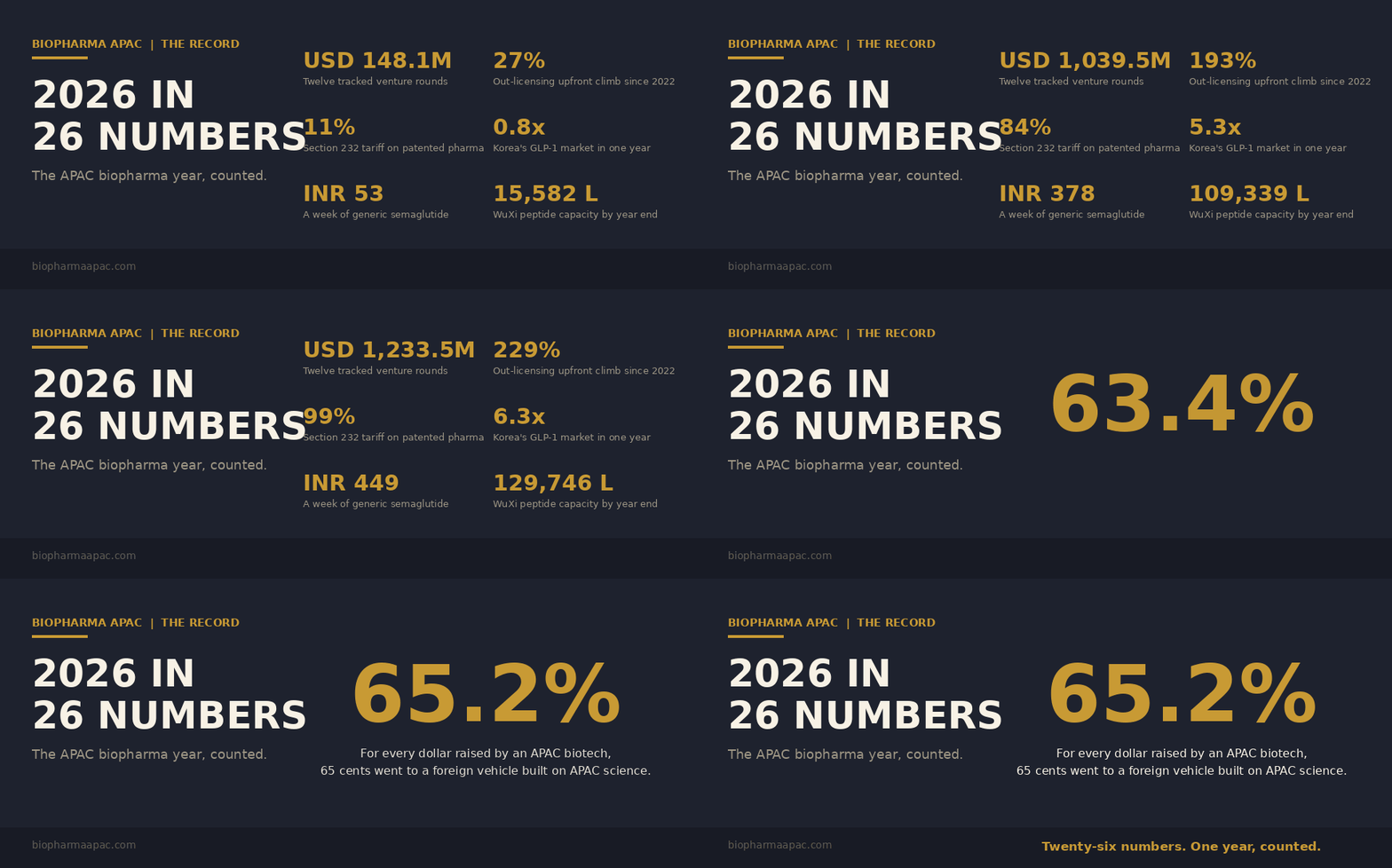
Figure 1. The year in twenty-six tiles. Sources and verification dates as stated per entry in the text.
METHOD IN BRIEF A number qualifies for this list only if it is sourced to a company disclosure, regulator publication, exchange filing or peer-reviewed paper, and only if it changed something. Market-research sizings are excluded by rule; where a category has nothing else behind it, that absence is itself one of the twenty-six. Figures are verified against the cited primary sources to the dates shown, and the article is updated in place with dated revision notes as year-end figures close, through a final revision at the 31 December cut. This piece is annual: next year the count becomes 27.
Years in this industry do not announce their shape while they are happening. They accumulate it, disclosure by disclosure, in filings and gazettes and registry entries that few people read twice. This article reads them twice. What follows is the Asia-Pacific biopharma year counted out in twenty-six numbers, one paragraph each, every figure traced to a primary source with the date it was disclosed.
The numbers were not chosen to flatter the region or to alarm it. They were chosen because each one changed something: a price, a precedent, a legal category, a capacity plan, or a belief the industry had been carrying without evidence. Several of them open questions that the remaining pieces in this series will answer in full between now and late January, from the complete approvals list to the deals ranking, the patent cliff and the 2027 preview. Taken together, they describe a year in which Asia-Pacific science was validated at prices nobody predicted, Asia-Pacific capital stayed narrower than the headlines suggested, and the rules governing both arrived on delay timers set years ago.
THE CAPITAL
Money returned to the region's biotechs in 2026. It did not return evenly, and a striking share of it went into vehicles the region does not own.
- USD 1,235.9 million
Twelve disclosed APAC biotech venture rounds, 1 January to 28 July 2026.
The twelve rounds in our funding tracker, selected for modality and stage spread rather than size and cited to company announcements and regulatory filings, totalled USD 1,235.9 million at the 28 July close of the tracking window. Mainland China took USD 914.9 million of it, 74.0 percent across eight rounds. South Korea took 16.2 percent, Japan 8.1. Singapore, India, Australia, Taiwan and Southeast Asia contributed nothing at disclosed value in the tracked set, and 68.0 percent of the money was late stage. The recovery is real. It is also narrow in geography and conservative in stage, which is not what the conference-panel version of the year sounded like. The full-year read, with a lower observation floor built to catch the Southeast Asian and Indian rounds the international trackers miss, closes this series in late January.
- 65.2 percent
The parallel channel, as a share of the regional total.
Over the same window, non-APAC vehicles raising capital specifically to develop APAC-originated molecules disclosed USD 805.5 million, equal to 65.2 percent of everything raised by APAC companies themselves. For every dollar that went into an Asia-Pacific biotech, sixty-five cents went into a foreign company built around Asia-Pacific science. Both figures are compiled from the same class of primary disclosures. The region's laboratories are funding two ecosystems, and only one of them pays taxes, salaries and exit proceeds at home. No single number in this list says more about who captures the value of the region's discovery engine.
- USD 21 million
CORE Biomedicine's Series A, closed 28 July 2026.
Small by the standards of this list and included for what it converted. The round was co-led by UTokyo Innovation Platform and Elikon Venture, with an exclusive global licence from Eisai announced the same day and a leadership team drawn from H3 Biomedicine, spanning Boston, Tokyo and Suzhou. Japan's new life-science fund layer had spent two years raising vehicles without producing company formation at scale; the standing critique was that the money was stuck at the fund layer. CORE is the first clean conversion of that capital into a company, with a marquee pharma licence attached on day one. One round does not make a pipeline, but it retires the claim that the conversion cannot happen.
- CHF 1.46 billion
Samsung Peptide's tender offer for PolyPeptide Group.
The tender offer prospectus published on 31 August 2026 offered CHF 44.31 per share, roughly CHF 1.46 billion and a 40 percent premium to the 10 April unaffected price. What makes the number regional rather than Swiss is the buyer: the Samsung group whose biologics arm discloses 845,000 litres of bioreactor capacity, the largest in the region, paying a control premium not for litres but for chemistry. Peptide synthesis is the supply chain of the GLP-1 era, and the region's biggest capacity owner just declared that the next phase of the capacity race is modality breadth. The economics of making medicines for well populations, where this decision ultimately points, ran as a full feature in this publication in August.
- 6.3 times
The one-year growth of Korea's GLP-1 market.
KRW 169.9 billion in 2024 to KRW 1.0709 trillion in 2025, a 6.3-fold rise in a single year, per the regulatory impact analysis Korea's MFDS published with its 2026 designation amendment. The figure is worth pausing on for its provenance as much as its size: the sharpest demand signal in the region's most closely watched drug category came not from an equity analyst but from a regulator's own cost-benefit paperwork, published in the course of restricting the category. It is also the arithmetic behind entry 24, where the same document counts what that demand did in the clinic.
THE DEALS
Western pharma kept buying Asia-Pacific science in 2026, and the price of it moved in one direction.
- USD 650 million
AbbVie's upfront to RemeGen for RC148.
Announced in January 2026 and confirmed as completed in AbbVie's Form 10-Q for the first quarter, the deal paid USD 650 million upfront for a PD-1 by VEGF bispecific at Phase 1/2. Eight months earlier, Pfizer had paid 3SBio USD 1.25 billion upfront for a Phase 2 asset in the same class. Two like-for-like deals, half a development phase and 1.9 times apart, form the cleanest available price series for Chinese-origin assets, and the series slopes toward the seller. The full ranking of the year's ten defining transactions, scored on a published rubric rather than headline value, runs in this series in December.
- 230 percent
The climb in average upfronts for China out-licensing, 2022 to 2026.
Our analysis of disclosed deal terms puts the average upfront payment for out-licensing by China-based biotechs at USD 52 million in 2022 and USD 172 million in 2026, a 230 percent climb in four years. The diligence discount, the idea that Chinese assets trade cheap because verifying them is expensive, was a defensible reading of the 2022 market. In 2026 it is a memory. Competition among Western buyers has priced the discount away faster than any policy or promotion campaign could have, which is the market's own answer to the question of whether the region's science is validated.
- 3 to 36 percent
The swing in upfront share of headline value across the out-licensing class.
Across the eight deals in our roster of the 2025 to 2026 out-licensing class, computed from company announcements and, where available, securities filings, the upfront payment ranged from 3 percent to 36 percent of the headline deal value. The same nine-figure press release can describe almost any underlying transaction. Where filings exist they tell a different story from the announcement, and the gap between the two is now wide enough that reporting headline values without decomposition is closer to stenography than journalism. Every deal figure in this series is decomposed where the filings allow, for exactly this reason.
THE TARIFF
The year's most consequential numbers for the region's exporters were written in Washington, and they came with dates attached.
- 100 percent
The Section 232 tariff on patented pharmaceuticals entering the United States.
The presidential proclamation of 2 April 2026 imposed a 100 percent tariff on imports of patented pharmaceuticals, biologics and their ingredients, effective 31 July 2026 for the companies listed in its Annex III and 29 September 2026 for everyone else, with products of Japan, EU member states, Korea, Switzerland and Liechtenstein capped at 15 percent under existing trade commitments. For a decade the question hanging over every APAC innovator's business plan was what access to the world's largest pharmaceutical market would cost. In 2026 the question got a number, a rate structure and a calendar, and every out-licensing negotiation, site-selection decision and onshoring announcement in the region now prices against it.
- 0 percent, for now
The tariff on generic pharmaceuticals under the same proclamation.
The proclamation's own text: generic pharmaceuticals and their associated ingredients "shall not be subject to tariffs pursuant to section 232 at this time." Four words, at this time, are carrying the export economics of the world's largest generics industry into 2027. The exclusion preserved India's US franchise on the day the patented trade was repriced, and it did so on explicitly provisional language. Whether that carve-out survives, and who has actually filed to exploit the patent expiries it makes valuable, is the subject of this series' patent cliff piece in January.
THE PLANTS
The region kept building in 2026. The honest numbers are about what got permitted to run, not what got bought.
- 196 and 160
Automated microbial QC systems placed versus validated, at 31 March 2026.
The vendor of the region's most widely adopted automated growth-based microbial QC platform disclosed 196 systems placed and 160 validated as of 31 March 2026. The 36-system gap is the most honest metric of Pharma 4.0 adoption anywhere in the public record, because it separates the two things the industry habitually conflates: buying automation and being allowed to run it. Procurement is a purchase order; validation is a regulatory relationship. Every technology assessed in our pilot-to-plant reporting this year crossed or failed to cross on the second measure, never the first.
- 130,000 litres
WuXi AppTec's solid-phase peptide synthesis capacity expected by end 2026.
By the company's own successive disclosures, its peptide synthesis reactor volume has grown from 32,000 litres in January 2024 to more than 100,000 litres at the end of 2025, with 130,000 litres expected by the end of 2026: roughly fourfold in two years. These are company statements rather than audited capacity, and this publication reports them as such. Even so, no single infrastructure number expresses more clearly where manufacturing demand actually sits. While the industry debated antibody overcapacity, the region's largest CRDMO quadrupled its chemistry.
THE PRICES
The reference prices for the biggest category in modern medicine were set this year, and they were set in Asia.
- INR 450
A week of generic semaglutide in India.
Semaglutide's Indian patent lapsed on 20 March 2026 and generics launched the next day, an authentic Day 1 launch. Among the disclosed prices, Alkem's works out to roughly INR 450 a week, with other manufacturers' stated ranges clustering between INR 750 and INR 1,300 a month at the low end. Whatever a future long-horizon preventive medicine hopes to charge, its reference price is no longer set in New Jersey or Copenhagen. It is set in India, by manufacturers whose cost curves the originators do not control, and it is set at a level that redefines what "affordable chronic therapy" means globally.
- 0
Generic semaglutide approvals in China, five months after the same expiry.
China's semaglutide patent expired the same day as India's. Five months later, at our 30 August verification, no generic approval had been publicly reported, with applicants citing test-data protection obligations under the China-Switzerland free trade agreement. One molecule, one expiry date, two legal systems, opposite outcomes. It is the cleanest demonstration on record that a patent expiry is not a market entry, and it is why January's patent cliff piece treats "what expires" and "what opens" as different questions with different dates.
- USD 149
Orforglipron's monthly starting price at US launch.
The first oral small-molecule GLP-1 agonist was approved by the FDA on 1 April 2026 and launched at USD 149 a month for its starting dose, USD 399 at the highest tier. The molecule was discovered at Chugai in Japan. An APAC-origin compound has set the oral price floor for the most commercially important drug category in the world, and it did so at a level that makes pill-versus-injection the defining formulation question of the category's next decade. Between this entry and the previous two, every pricing anchor in the GLP-1 era now traces to Asia.
THE CLINIC
The year's trial results ran in both directions, and the most valuable of them were the sobering ones.
- 320 patients, 47 centres
The Phase 3 trial of rentosertib, initiated 7 July 2026.
Insilico Medicine's TNIK inhibitor for idiopathic pulmonary fibrosis entered Phase 3 in China on 7 July 2026, registered as CTR20262475 with a parallel NCT07687459 listing: 320 patients across 47 centres over 52 weeks, on the strength of Phase 2a data published in Nature Medicine in June 2025 showing a 98.4 mL forced vital capacity gain at the top dose against decline on placebo. Whatever one believes about AI-discovered drugs, the question is no longer rhetorical. It is registrational, it has a protocol number, and it will be answered by a regulator rather than a keynote.
- 2,000
Adults aged 50 and above being enrolled with aging itself as the frame.
Recruitment began in June 2026, per Xinhua's report of 3 June, for a 2,000-participant study of amimestrocel run with the PLA General Hospital, enrolling adults over 50 with aging itself as the enrolment frame. The sponsor's mesenchymal stromal cell product became China's first approved stem cell drug via NMPA conditional approval in January 2025. Nothing else in the region approaches this scale with this framing, and how the enrolment frame survives contact with regulatory endpoint requirements will say more about the future of aging-targeted development in Asia than any amount of longevity conference programming.
- Minus 0.08
The CDR-SB treatment difference for oral semaglutide in evoke.
The evoke and evoke+ trials, published in The Lancet in 2026 across 3,808 patients, moved cerebrospinal and plasma biomarkers of Alzheimer's pathology by as much as 10 percent and moved the clinic not at all: a CDR-SB difference of minus 0.08 in one trial (p=0.57) and 0.10 in the other (p=0.46). It was the year's most expensive tutorial in the difference between biomarker movement and clinical benefit, delivered by the world's most closely watched molecule. Every biomarker-led development thesis in the region, and the region has many, now has to argue past this result.
- Five, not ten
APAC clinical assets with aging biology stated as rationale by their sponsors.
In August we commissioned a list of ten Asia-Pacific clinical-stage assets whose sponsors state aging biology as the development rationale, with a published inclusion threshold: a registered human trial and the sponsor's own framing, not ours. Five assets cleared it, and the shortfall ran as the finding rather than being padded away. The pattern beneath the number: where a sponsor protects a registrational filing it does not say aging, and where it says aging freely there is usually no filing to protect. The gap between the region's longevity rhetoric and its regulatory paperwork is, for now, the defining fact of the field.
THE RULES
Almost nothing that governed the region's year was newly decided in it. The rules arrived on delay timers, and 2026 was when several of them went off.
- 14 months
From Korea's regenerative medicine category entering force to its first approved treatment plan.
Korea's advanced regenerative medicine treatment category took legal effect on 21 February 2025. The first treatment plan under it was approved in late April 2026, at Yeouido St. Mary's Hospital, for autologous EBV-specific T cells in a rare lymphoma. Fourteen months from category to first case is not a failure; it is what conservative implementation of a permissive law looks like. But it is also the number that explains why the law has not yet changed patient behaviour, which is the subject of the next entry.
- 10,000 to 20,000
Koreans travelling abroad each year for stem cell treatment, on the ministry's own estimate.
Korea's health ministry published this estimate alongside its March 2026 warning that brokering treatment in Japan may be illegal. Read against the previous entry, the two numbers frame the region's medical-travel economics precisely: one approved domestic treatment plan, against five figures of annual outbound patients. The law changed what Korea permits. It has not yet changed what Koreans do, and the arbitrage between the two remains one of the region's most durable, least discussed markets.
- 31 July 2026
The day Japan wrote to its entire regenerative medicine industry.
On 31 July, MHLW issued a self-inspection request to every provider, certified committee and cell manufacturer operating under Japan's regenerative medicine framework, after an investigation found a Tokyo clinic delivering treatment following content prepared by a South Korean group, in what the ministry described as provision under the influence of a third party and in a form the Act does not contemplate. The letter is the year's plainest official admission that Japan's register is a filing record rather than an approval list, and that enforcement is now catching up with a market that grew inside that distinction.
- 1 September 2026
The date Japan's supplement industry came under mandatory GMP.
Products under Japan's revised Foods with Function Claims system must be manufactured under mandatory GMP if made on or after 1 September 2026. It is the sharpest edge of a tightening wave that ran across all five of the region's functional food and supplement frameworks between 2024 and 2026, converging on pharmaceutical-grade manufacturing, vigilance and even ingredient exclusivity. What none of the five added, anywhere, is a pre-market efficacy gate. The region decided supplements must be made like medicines. It declined to require that they work like them.
- 69 and 194
Prescriptions to children under 12, and to pregnant women, in Korea's GLP-1 record.
The regulatory impact analysis behind Korea's move to designate GLP-1 obesity drugs as medications of misuse concern, agreed unanimously by the ministry's advisory committee on 8 April 2026 and pre-announced as an amendment on 5 June, counted 69 prescriptions to children under 12 and 194 to pregnant women. The designation's most instructive feature is its boundary: it covers the obesity products but not semaglutide for type 2 diabetes. Same molecule, same plant, same receptor, two legal identities. What gets policed is the indication, not the biology, and no regulator in the region has stated that principle more clearly.
- Twelve
Regulatory changes APAC executives should carry into 2027. None of them is new.
Our forthcoming 2027 regulatory calendar, publishing in this series in December, identifies twelve changes with dates attached across the region's major authorities, and its spine finding is already worth stating: not one of the twelve is new law. Every 2027 date was set in statute or set in motion years earlier, some as far back as 2021. Regulation in this region now arrives by deferred commencement, which means the companies caught out by 2027 will have been caught by calendars, not surprises. The full list, with who each change hits and what should already have been done, follows next month.
THE ABSENCE
The twenty-sixth number of the year is the one this method would not let us print.
- The number we did not print
The size of the region's biological age testing market.
The category is routinely described as the region's fastest-growing diagnostics segment. When we mapped it for an August feature, verified to 17 August 2026, every market sizing in circulation traced to commissioned market research, and not one to a company disclosure, regulator publication, exchange filing or peer-reviewed paper. Under this article's stated method, that number does not exist. Its absence is a finding in its own right: an industry can grow to prominence, attract clinics, celebrities and consultation papers, and still have no independently verifiable size. Where that is true, we will say so rather than launder a vendor's number into a fact, this year and every year this count runs.
WHAT THE COUNT SAYS
Counted together, the twenty-six describe a year with a consistent grain. The capital was real but narrow, and a striking share of it financed foreign ownership of regional science. The validation was real and repriced: the discount for Asian assets was competed away in public, deal by deal. The trade environment stopped being a rumour and became a rate schedule with dates. The clinic delivered its most useful results in the negative, and the rules that shaped the year had almost all been written before it began.
None of those sentences was obvious in January. All of them are documentable in November, from primary sources, with dates. That is the purpose of this count, and of the series it opens: the pieces that follow between now and late January take each of these threads to full length, from every first approval granted in the region this year to the deals ranking, the IPO class, the failures, the patent cliff and the 2027 calendar. Next year the count becomes 27. The method will not change.
Sources and method. Figures in this article are cited in the text to their primary sources: company announcements and investor disclosures (entries 1 to 8, 12, 13, 15, 16), securities filings including AbbVie's Form 10-Q for Q1 2026 and tender offer documentation published 31 August 2026 (entries 4, 6, 8), the presidential proclamation of 2 April 2026 under Section 232 of the Trade Expansion Act (entries 9, 10), regulator publications and official communications of MFDS, MHLW, MOHW, NMPA and Japan's revised Foods with Function Claims system (entries 5, 14, 17, 20 to 25), state media reporting of trial recruitment (entry 17), clinical trial registry entries CTR20262475 and NCT07687459 (entry 16), and peer-reviewed publications in Nature Medicine (2025) and The Lancet (2026) (entries 16, 18). Entries 1, 2, 7, 8, 19 and 26 rest on this publication's own compilations, each built from the primary source classes above and described with its method in the relevant published or forthcoming piece in this series. Verification dates are stated in the text where a figure is time-sensitive; all other figures were verified to 15 September 2026. This article is updated in place with dated revision notes as year-end figures close, through a final revision at the 31 December cut.
THE RECORD is BioPharma APAC's year-end series, running weekly from18 September 2026 to late January 2027.
(c) 2026 BioPharma APAC. All rights reserved. Reproduction of the figure grid with attribution and a link is permitted; reproduction of the article text requires permission.
Most Read
- Can APAC Biomanufacturing Decarbonise Without Pricing Itself Out?
- The Algorithm on the GMP Floor: AI Promises a Smarter Plant. Regulators Demand the Audit Trail.
- APAC's Peptide-Capacity Gamble
- After the Rush: APAC's mRNA and Vaccine Capacity Hangover
- The Biosimilar Race: Factory to the World — or Stuck in the Copycat Economy?
- The Vein-to-Vein Problem: Can APAC's Cold Chain Carry Advanced Therapies?
- Vectors, Plasmids and the CGT Trap: APAC's Cell and Gene Therapy Ambitions Face an Upstream Bottleneck
- Can APAC Build Radioligand Therapy Before the Atoms Decay?
- The Great Biopharma Reset: 50 Developments That Changed Everything in H1 2026
- Beyond the Trial: Can Real-World Evidence Earn Regulatory Trust in APAC?
- Beyond the Obvious Giant: Where APAC's Clinical Trials Go Next
- The Frontier That Won’t Quite Arrive
Bio Jobs
- Sanofi Turns The Page As Belén Garijo Steps In And Paul Hudson Steps Out
- Global Survey Reveals Nearly 40% of Employees Facing Fertility Challenges Consider Leaving Their Jobs
- BioMed X and AbbVie Begin Global Search for Bold Neuroscience Talent To Decode the Biology of Anhedonia
- Thermo Fisher Expands Bengaluru R&D Centre to Advance Antibody Innovation and Strengthen India’s Life Sciences Ecosystem
- Accord Plasma (Intas Group) Acquires Prothya Biosolutions to Expand Global Plasma Capabilities
- ACG Announces $200 Million Investment to Establish First U.S. Capsule Manufacturing Facility in Atlanta
- AstraZeneca Invests $4.5 Billion to Build Advanced Manufacturing Facility in Virginia, Expanding U.S. Medicine Production
News