Beyond the Obvious Giant: Where APAC's Clinical Trials Go Next
29 June 2026 | Monday | Analysis
For most of the last decade, the strategic case for running Asia-Pacific clinical trials could be summarised in a single word: China.
A vast, treatment-naïve patient pool, aggressive regulatory reform and costs a fraction of Western levels turned the country into the default engine of regional recruitment. In 2024 that engine became impossible to ignore. WHO’s International Clinical Trials Registry Platform logged more than 7,100 new drug trials in China against roughly 6,000 in the United States, and Citeline’s annual roundup recorded a Chinese sponsor — Jiangsu Hengrui — displacing AstraZeneca as the world’s single largest trial sponsor for the first time.
Yet the same year exposed why “just run it in China” is no longer a strategy a global sponsor can rest on. A wall of policy — the BIOSECURE Act, tightened data-transfer rules, new tariffs and visible FDA scepticism toward China-only datasets — has converted a commercial decision into a risk-management one. The question reshaping APAC development today is not whether China works. It is how much of a programme any sponsor can afford to leave there, and which markets absorb the volume that moves.
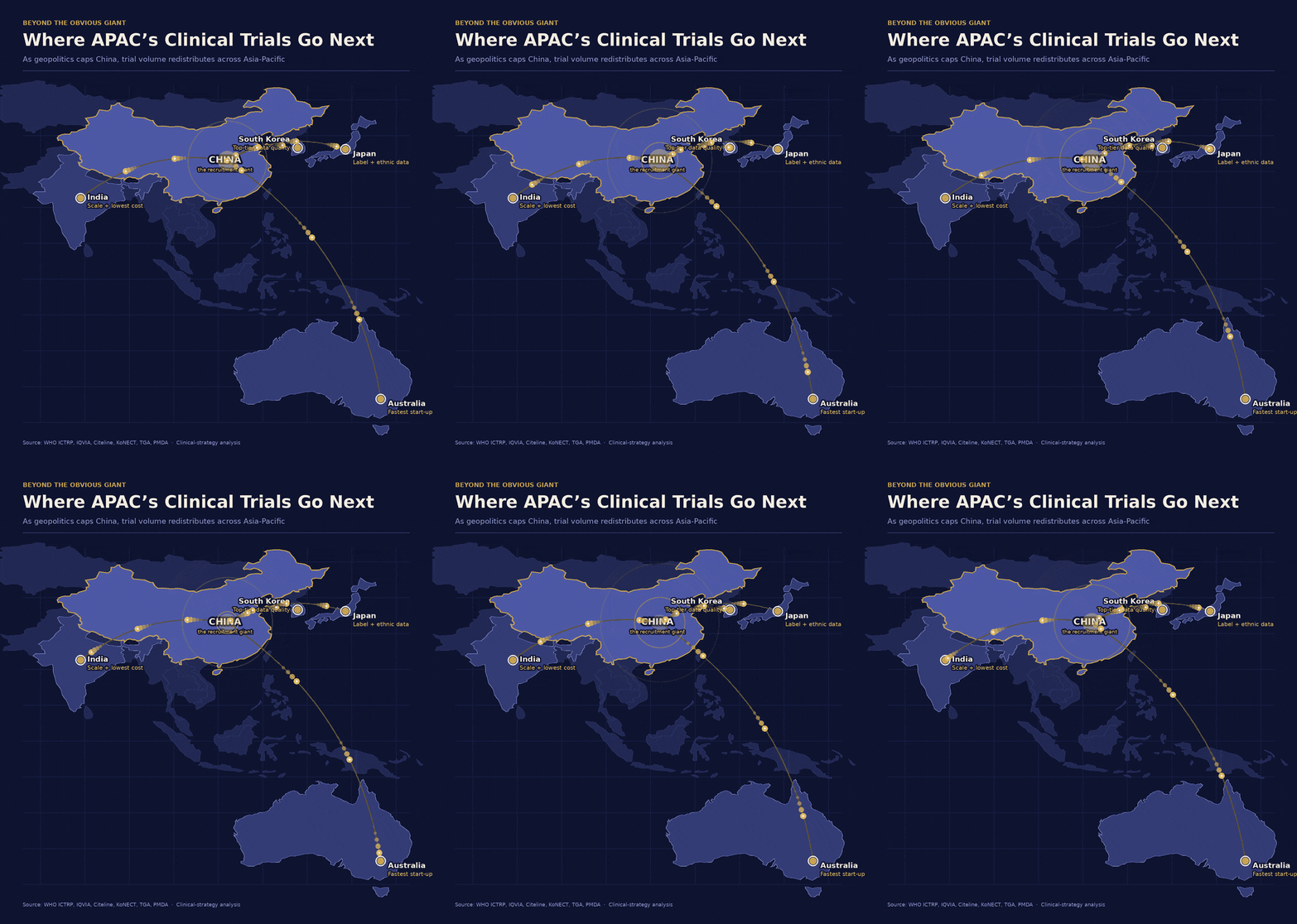
The honest answer is that no single country replaces China, and each credible alternative solves one problem while introducing another. India offers scale at the lowest cost but tests a sponsor’s patience on enrolment. South Korea delivers arguably the cleanest data in the region but on a small, congested patient base. Australia starts trials faster than almost anywhere on earth, yet its population ceiling makes it an early-phase specialist, not a volume play. And Japan — still a genuine innovation power — keeps losing ground in the one metric that matters to operations teams: trials actually initiated. What follows is a working map of the trade-offs.
THE GROWTH PICTURE
A region growing fastest — from a smaller base
Begin with proportion. North America still commands close to half of global clinical-trial spend — analysts put its 2025 share at roughly 49–51 percent. Asia-Pacific is materially smaller, but it is the fastest-growing region in every major forecast, and the gap is closing. Depending on how each house draws the boundaries of “the market,” APAC is sized somewhere between about US$12 billion and US$20 billion in 2025, compounding at 8–9.5 percent a year — comfortably ahead of North America’s low-single-digit growth and a flat-to-declining Europe. Precedence Research, for instance, projects the APAC trials market roughly doubling from about US$19.6 billion in 2025 to US$46.8 billion by 2035.
Those headline numbers matter less than what sits underneath them. The growth is not evenly spread; it is being redistributed. IQVIA Institute data show the share of companies running China-only trials climbed from 18 to 26 percent between 2019 and 2023, even as China’s overall share of world trials jumped by close to 60 percent over five years. That concentration is precisely what now worries development leaders — because the policy environment has turned against single-country dependence on exactly that market.
Why the volume is moving: the de-risking trigger
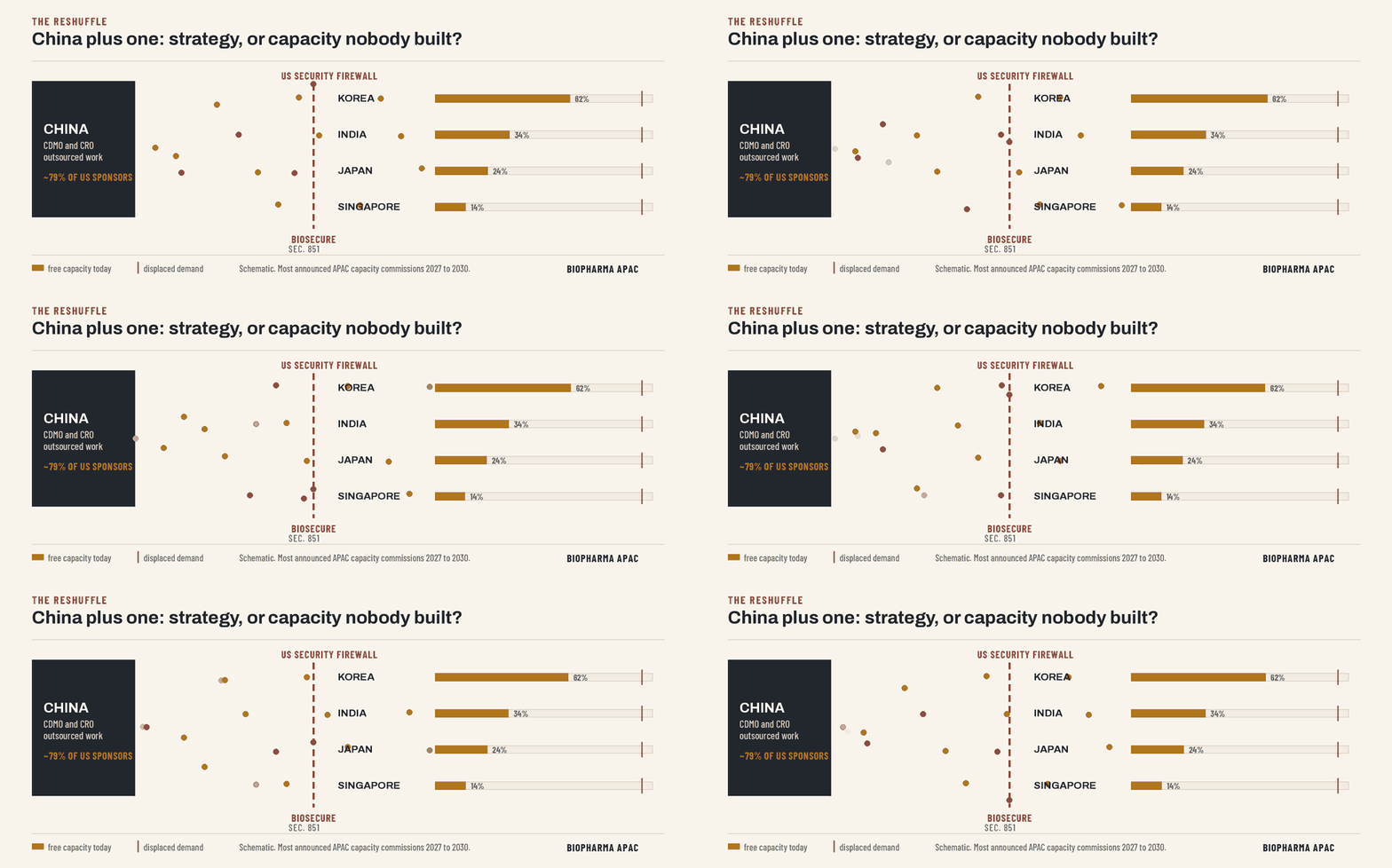
The catalyst is no longer hypothetical. The BIOSECURE Act was signed into law on 18 December 2025 as part of the FY2026 National Defense Authorization Act. It bars federal agencies, grantees and loan recipients from using equipment or services from designated “biotechnology companies of concern,” with the Office of Management and Budget required to publish a full list by the end of 2026 and a multi-year wind-down for existing contracts. WuXi AppTec and WuXi Biologics are not yet named but are widely expected to be designated — a prospect that touches the roughly four in five biopharma companies estimated to hold a contract with a Chinese CDMO.
BIOSECURE does not act alone. In April 2025 the U.S. Department of Justice tightened rules on transferring American clinical-trial and genomic data to China; in April 2026 Washington announced Section 232 tariffs of up to 100 percent on patented pharmaceuticals and their inputs. Separately, the FDA’s limited capacity to run bioresearch-monitoring inspections at Chinese sites — and its growing reluctance to accept China-only efficacy data — has already delayed multiple market-entry attempts. For a sponsor planning a pivotal programme today, the message is unambiguous: China can still generate data quickly and cheaply, but a registration dossier that leans on it alone carries regulatory and political tail-risk that did not exist five years ago. Diversification has become a hedge, not an optimisation.
The scale of the reversal is not lost on the industry. At Arena International’s Outsourcing in Clinical Trials West Coast conference in 2025, Revati Tatake, global head of pharma research and competitive intelligence at GlobalData, told delegates that the United States could no longer be assumed to be the default home of clinical research — an observation that would have sounded eccentric only a few years earlier. The strategic problem this creates is not where to add sites, but how to redistribute the weight a programme has come to place on a single country.
|
China can still generate data quickly and cheaply — but a dossier that leans on it alone now carries tail-risk that did not exist five years ago. |
COUNTRY-BY-COUNTRY TRADE-OFFS
India: scale and price, paid for in enrolment risk
India is the obvious destination for the recruitment volume leaving China, and on paper the fit is excellent. The market — valued at roughly US$1.4–2.0 billion in 2024 and growing 8–9 percent a year — offers a vast, genetically diverse population and trial costs 30–50 percent below U.S. and EU levels. The New Drugs and Clinical Trials Rules of 2019 rebuilt sponsor confidence after years of regulatory uncertainty, and the early-phase story is improving fast: roughly 60 percent of all first-in-human Phase I trials ever registered in India (about 1,641 studies) were initiated in the 2019–2024 window, with Phase I now the country’s fastest-growing segment. The 2026 amendment introducing a “prior intimation” pathway for low-risk bioavailability and bioequivalence studies signals a regulator still actively cutting friction.
The catch is delivery. Despite housing 18 percent of the world’s population, India still hosts only an estimated 5–6 percent of global trials, and capacity is thin where it matters. By industry estimates, 30–40 percent of Indian Phase I studies hit enrolment delays, as CROs compete for a limited pool of trial-ready participants concentrated in a handful of metro sites. Layered on top is data governance: the Digital Personal Data Protection Rules of 2025 introduce localisation expectations and a phased compliance clock that sponsors must now design around. India buys you scale and price — but it asks for time, and for operational maturity in site selection that not every programme has.
South Korea: the region’s quality benchmark
If India is the volume bet, South Korea is the quality one. Korea conducted about 3.46 percent of all global industry-sponsored trials in 2024, ranking sixth worldwide — ahead of the United Kingdom, Canada, Japan, Italy and France — from a population of just 51.7 million. Seoul, which held the title of the world’s single most active trial city from 2017 to 2023, remains second globally. The operational case is built on discipline rather than size: MFDS reviews of investigational new drug applications average around 30 working days, major academic ethics committees clear protocols in roughly three weeks, more than 200 institutions are designated trial sites, and the country has recorded zero FDA bioresearch-monitoring “official action indicated” findings for over fifteen years.
That last point is the whole argument. Korean data are accepted by the FDA and EMA because trials adhere to ICH-GCP, and the country sits inside both the ICH and the WHO Listed Authority framework. A near-universal national health-insurance system supplies consistent medical histories and reliable follow-up. The limitation is structural and unfixable: a small population means intense competition for patients and sites, particularly in the oncology programmes where Korea excels, and costs run above India’s. Korea is where you go when a regulator needs to trust the numbers — not where you go to enrol ten thousand patients in a hurry.
|
Korea is where you go when a regulator needs to trust the numbers — not where you go to enrol ten thousand patients in a hurry. |
Australia: the fastest start line in Asia-Pacific
Australia competes on a different axis entirely: speed at the front of a programme. Under the Clinical Trial Notification scheme, a sponsor does not seek regulatory approval to begin — the Therapeutic Goods Administration is simply notified once a human research ethics committee has cleared the protocol. There is no IND-style review and no clinical hold. In practice, ethics and governance run in parallel and a trial can move from protocol to first patient in roughly three months, against six to nine months in the U.S. or EU; private ethics committees can compress start-up to as little as four to eight weeks.
The constraints are equally clear-cut. Australia’s population of about 26 million caps how much enrolment it can absorb, which is why it functions as a first-in-human and early-phase specialist rather than a Phase III volume engine. Every trial requires a locally incorporated sponsor, adding a layer of structuring for overseas companies, and per-patient costs are high relative to South and Southeast Asia. Australia is the place to de-risk a molecule fast and generate clean, regulator-ready early data — then take the validated programme elsewhere to scale.
Japan: the innovation power that keeps shrinking on the operations dashboard
Japan is the region’s genuine puzzle. By any innovation measure it remains formidable — home to the anti-amyloid breakthroughs in Alzheimer’s disease (Eisai’s lecanemab, and Lilly’s donanemab, which Japan approved among the first countries globally) and historically a top-three source of new drug discovery. And yet, on the metric operations teams actually watch, Japan is sliding. By one widely cited estimate only about 4 percent of new global trials are now initiated by Japan-based companies, and domestic trial volume — which peaked artificially during the COVID surge of 2021 — has since drifted down, with a further slight dip in Phase I starts between 2024 and 2025.
The mechanism is the country’s long-running “drug lag” and “drug loss” problem: as innovation shifts to emerging biopharma companies based outside Japan, the historical expectation of Japanese clinical data became a reason to leave Japan out of early global development altogether. Regulators are responding. A December 2023 notification clarified that a separate Japanese Phase I is not automatically required before joining a multiregional trial, and an October 2024 guideline opened a path to orphan-drug approval without Japanese trial data. The reforms are real — Japanese participation in global Phase III oncology MRCTs actually rose from 34 percent to 60 percent across three five-year windows to 2022 — but the number of programmes that still skip Japan entirely has barely moved. For now, Japan is a market you include because you need its label and its ethnic-factor data, not because it accelerates your timeline.
|
For now, Japan is a market you include because you need its label and its ethnic-factor data — not because it accelerates your timeline. |
THE FACTOR BEHIND THE MAP
Representativeness: matching the study to the market you want to sell in
Underneath every placement decision sits a scientific constraint that geopolitics has only sharpened: a trial population must credibly represent the population a sponsor intends to treat. ICH E17, adopted as FDA guidance in 2018, set the principles for multiregional clinical trials — a single core protocol, statistically defensible allocation of patients across regions, and explicit treatment of ethnic factors so pooled data hold up. The FDA’s 2024 Diversity Action Plan expectations and its 2025 draft guidance on oncology MRCTs pushed in the same direction, flagging concern about the steadily falling proportion of U.S. participants in global cancer trials and whether such data remain applicable to American practice.
This is the deeper reason China-only data have become a registration liability rather than merely a political one, and it reframes the entire diversification exercise. The goal is not to scatter sites to look balanced; E17 explicitly discourages arbitrary quotas. It is to build a dataset a target regulator will accept. John Wu, who leads health-care work in BCG’s consulting practice, has framed the bind facing sponsors bluntly: a programme cannot satisfy modern U.S. expectations from American sites alone — too expensive, too slow, too competitive — yet arriving at an FDA filing short of the roughly one-in-five U.S. enrolment that reviewers increasingly look for, as he notes Roche found in 2025, is its own kind of failure. The way out runs through geography. For sponsors aiming at U.S. and EU approval, that argues for the regulator-trusted quality of Korea and the Western-representative populations of Australia inside the mix. For East Asian submissions, the emerging practice of pooling Japanese, Korean and Chinese patients into a single “East Asian” region — where ethnic factors are comparable — can turn four fragmented national efforts into one coherent evidence package.
|
Geography is no longer a sourcing decision. It is a regulatory-strategy decision made years before a filing. |
HOW IT PLAYS OUT
Three programmes, three patterns
The pivotal that spreads its bets. A global Phase III sponsor that once would have anchored enrolment in China now caps Chinese sites at a defined share and distributes the balance across an East-Asian spine — Korea for data quality and oncology depth, Japan for label and ethnic-factor coverage — with India absorbing volume and a Korean-led statistical pool designed to satisfy E17 consistency analysis. The programme is slower to design but far more defensible at filing.
The deliberate shift of volume. A mid-cap sponsor with BIOSECURE-exposed partners moves the recruitment weight of an ongoing programme out of China toward India and Korea — trading China’s speed for India’s scale-at-cost and Korea’s regulatory credibility, and accepting the enrolment-timeline penalty as the price of de-risking the dossier.
The Australian early-phase launchpad. An emerging biotech runs its first-in-human study in Australia to exploit notification-only start-up, the 43.5 percent rebate and FDA-ready data — generating a clean safety and PK package in months, then carrying the validated molecule into larger, cheaper Asian sites for later-phase scale.
The APAC trade-off map at a glance
|
Market |
Core strength |
Start-up speed |
Cost vs US |
Structural limit |
|
China |
Unmatched volume & enrolment; vast treatment-naïve pool |
NMPA review cut ~30% in 2025; very fast |
Lowest |
Geopolitical exposure (BIOSECURE, data rules); China-only data face FDA scrutiny |
|
India |
Large diverse population; lowest cost; maturing early phase |
Improving; prior-intimation path from 2026 |
30–50% lower |
Enrolment delays; thin Phase I capacity; data-localisation under DPDP |
|
South Korea |
Top-tier data quality; FDA/EMA-accepted; oncology depth |
MFDS IND ~30 working days; IRB ~3 wks |
Moderate |
Small population (51.7m); site congestion; higher cost than India |
|
Australia |
Notification-only start-up; FIH/early-phase; Western-like population |
First patient ~3 months; 4–8 wk ethics |
~28% lower pre-rebate; ~60% after |
Small population (~26m); local sponsor required; not a volume play |
|
Japan |
Innovation strength; required for Japanese label; orphan flexibility |
Faster post-2023 J-Ph1 reform; still deliberate |
Highest |
According to the Tokyo Foundation's analysis of Japan's drug-loss problem, only about 4 percent of new clinical trials globally originate from Japan-based biotech companies. |
Cost and timeline figures are indicative industry ranges; exact economics vary by indication, phase and site mix.
THE TAKEAWAY
There is no second China — only a portfolio
The strategic error would be to hunt for a single replacement market. None exists. China’s combination of scale, speed and price is genuinely unmatched, and most programmes will keep a measured presence there. What has changed is that the presence must now be measured — sized to the regulatory and political risk a sponsor can carry — with the remainder placed deliberately. India for cost-efficient scale where timelines allow it; South Korea for data a regulator will trust and for oncology depth; Australia to start fast and de-risk early; Japan when the label and the ethnic-factor data require it.
Read against the representativeness rules now hardening in Washington and beyond, the map resolves into a single discipline: decide the markets you intend to sell in, then build the trial geography — and the statistical pooling — that those regulators will accept. The sponsors who treat APAC diversification as a finance exercise will chase the lowest cost per patient and be surprised at filing. The ones who treat it as regulatory strategy will pay a little more, move a little slower, and arrive with a dossier that holds. In a post-BIOSECURE world, that is the only version of “where to run your trial” worth answering.
(arcilla.fran@biopharmaapac.com)
Sources: Trial-volume and market data drawn from the WHO International Clinical Trials Registry Platform, Citeline, the IQVIA Institute and GlobalData. Country figures from KoNECT, Korea’s MFDS, India’s CDSCO, Australia’s TGA and Austrade, and Japan’s PMDA and MHLW. Regulatory framing from the FDA’s ICH E17 guidance and its 2024–25 diversity and oncology multiregional-trial guidance. Market-sizing ranges reflect differing methodologies across Precedence Research, Grand View Research, Mordor Intelligence and Global Market Insights; figures are current to June 2026.
Disclaimer: This article is provided for general information and editorial analysis only. It does not constitute legal, regulatory, financial, or investment advice, and should not be relied upon as such. Market-size and timeline figures are indicative estimates compiled from third-party sources and may vary by methodology; regulatory positions and policies cited here can change without notice. Views attributed to named individuals reflect their publicly reported statements. Readers should verify current information and consult qualified professionals before making development, commercial, or regulatory decisions.
Most Read
- Can APAC Biomanufacturing Decarbonise Without Pricing Itself Out?
- The Algorithm on the GMP Floor: AI Promises a Smarter Plant. Regulators Demand the Audit Trail.
- APAC's Peptide-Capacity Gamble
- After the Rush: APAC's mRNA and Vaccine Capacity Hangover
- The Biosimilar Race: Factory to the World — or Stuck in the Copycat Economy?
- The Vein-to-Vein Problem: Can APAC's Cold Chain Carry Advanced Therapies?
- Vectors, Plasmids and the CGT Trap: APAC's Cell and Gene Therapy Ambitions Face an Upstream Bottleneck
- Can APAC Build Radioligand Therapy Before the Atoms Decay?
- The Great Biopharma Reset: 50 Developments That Changed Everything in H1 2026
- Beyond the Trial: Can Real-World Evidence Earn Regulatory Trust in APAC?
- Beyond the Obvious Giant: Where APAC's Clinical Trials Go Next
- The Frontier That Won’t Quite Arrive
Bio Jobs
- Sanofi Turns The Page As Belén Garijo Steps In And Paul Hudson Steps Out
- Global Survey Reveals Nearly 40% of Employees Facing Fertility Challenges Consider Leaving Their Jobs
- BioMed X and AbbVie Begin Global Search for Bold Neuroscience Talent To Decode the Biology of Anhedonia
- Thermo Fisher Expands Bengaluru R&D Centre to Advance Antibody Innovation and Strengthen India’s Life Sciences Ecosystem
- Accord Plasma (Intas Group) Acquires Prothya Biosolutions to Expand Global Plasma Capabilities
- ACG Announces $200 Million Investment to Establish First U.S. Capsule Manufacturing Facility in Atlanta
- AstraZeneca Invests $4.5 Billion to Build Advanced Manufacturing Facility in Virginia, Expanding U.S. Medicine Production
News