Security at What Cost? APAC and the Great Supply-Chain Reordering
24 June 2026 | Wednesday | Analysis
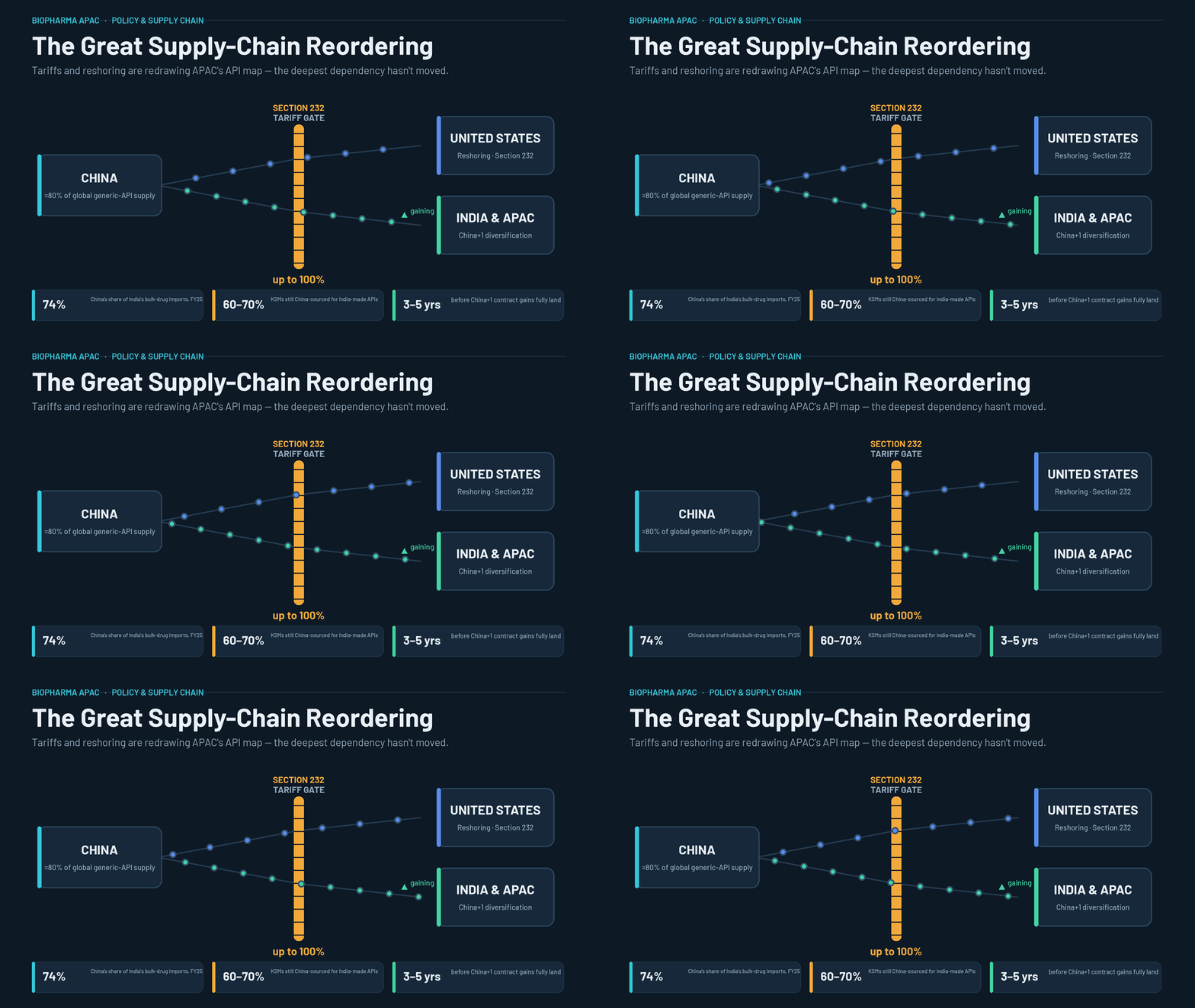
For the better part of two decades, the global pharmaceutical supply chain ran on a simple, unsentimental bargain: make the chemistry where it is cheapest, and worry about the consequences later. Later has arrived. Over eighteen months, a US national-security investigation has hardened into one of the most consequential trade actions the industry has faced — and it has forced every procurement desk, board and finance committee from Hyderabad to Singapore to ask a question they had managed to defer since the pandemic. Not "where is this cheapest?" but "what happens if we cannot get it at all?"
The answer is turning out to be expensive, slow, and politically fragile. It is also reshaping APAC's role in ways that will outlast any single proclamation.
The trigger: from a social-media post to a tariff schedule
The mechanism is Section 232 of the Trade Expansion Act of 1962 — the same national-security provision used for steel and aluminium. The US Department of Commerce opened its investigation into pharmaceutical and pharmaceutical-ingredient imports in April 2025, asking whether dependence on foreign supply threatened national security. In late September 2025, President Trump pre-empted the formal finding with a social-media post announcing a 100 percent tariff on branded and patented pharmaceutical products, sparing only companies that were "breaking ground" or "under construction" on US plants.
What was rhetoric in September became a schedule in April 2026. The presidential proclamation of 2 April imposes a headline 100 percent ad-valorem duty on patented pharmaceuticals and their associated ingredients — and, critically for APAC, on the active pharmaceutical ingredients (APIs) and key starting materials (KSMs) that feed them. The duty operates as a ceiling rather than an additive charge: where a most-favoured-nation rate already applies, the Section 232 rate is reduced so the combined burden tops out at 100 percent.
The structure is a tiered instrument of industrial policy, not a flat wall. Companies with a Commerce-approved onshoring plan pay 20 percent, a rate scheduled to climb back to 100 percent four years on. Those that have signed most-favoured-nation pricing agreements with the US — the pathway Pfizer and a cluster of large manufacturers executed across 2025 and early 2026 — pay zero through January 2029. Origin matters too: products from the European Union, Japan, South Korea, Switzerland and Liechtenstein face 15 percent under existing trade frameworks; the United Kingdom secured 10 percent, reducible to zero under its pharmaceutical-pricing arrangement. Seventeen named companies face the duty from 31 July 2026; everyone else from 29 September.
The exemptions are where APAC catches its breath — for now. Generic pharmaceuticals and biosimilars are explicitly carved out, alongside orphan drugs, cell and gene therapies, antibody-drug conjugates, plasma-derived therapies, nuclear medicines and a short list of specialty categories. Since generics make up roughly 90 percent of US prescription volume — and close to 90 percent of India's pharmaceutical exports to the US, a trade worth over USD 10 billion in the last fiscal year — the carve-out shields the bulk of Asia's existing US business from immediate damage.
But the proclamation also tasks Commerce with reviewing that generics exemption within a year, explicitly tying its survival to how quickly domestic US manufacturing scales up. The relief, in other words, is conditional and time-boxed. And it sits atop a reshoring wave the tariff was designed to accelerate. Industry analysts have tallied somewhere between USD 370 billion and USD 480 billion in announced US pharmaceutical manufacturing investment for 2025 through 2030 — Eli Lilly's USD 27 billion build-out, Merck's USD 70 billion US manufacturing commitment, Regeneron's New York conversion, AbbVie's expansion of API capacity in North Chicago, and a long tail of fill-finish and drug-substance projects. The capital is concentrated precisely in the capital-intensive tiers — API, finished-dose, fill-finish — that Section 232 was written to repatriate.
"The shift from rhetoric to schedule is the whole story. A deadline does what a warning never could."
The dependency map: where APAC actually sits
To understand why a tariff aimed at patented drugs reverberates through Asia's generics-and-ingredients economy, look at the chemistry rather than the labels.
The global API market is worth roughly USD 240–250 billion, and China sits at its structural foundation. By most estimates China supplies around 80 percent of the world's generic-API volume and accounts for something close to 40 percent of global API requirements, built on a cost advantage of 35–40 percent over Western producers and an integrated cluster model — shared utilities, effluent treatment, logistics — that delivers a further 15–20 percent in efficiencies that are difficult to replicate quickly. China's penetration of the US market is more nuanced: it supplies an estimated 17 percent of US API imports but only around 6 percent of overall US pharmaceutical imports — a reminder that its dominance is concentrated in specific generic and intermediate segments rather than spread evenly across the board. Within the Asia-Pacific API contract-manufacturing market, China commands roughly 38 percent.
India is the world's third-largest API producer, and the supplier the West reaches for when it talks about diversification — yet India's own prowess rests on a Chinese foundation. The country imports close to 35 percent of its total API requirement, and China accounted for an estimated 74 percent of India's bulk-drug imports in 2024–25. The dependence is not uniform; it is acute. In March 2026 the Department of Pharmaceuticals placed before Parliament a list of APIs for which China supplied 70 percent or more of India's imports across two consecutive fiscal years, with little reduction between them — concentrated in antibiotics, fermentation-based products, certain vitamins and chemical intermediates. For a basket of essential molecules the reliance runs to 80–100 percent. And even where APIs are now made in India, the KSMs feeding them are still 60–70 percent Chinese-sourced. India can manufacture the active ingredient and remain externally dependent for the building blocks that determine both its cost and its continuity.
That is the trap the reordering must reckon with. The patented-drug tariff lands hardest on high-value exporters — Ireland, Switzerland, Germany, Belgium, Denmark, Japan. But the same policy machinery that produced it is now pointed at the upstream layer where APAC, and China within it, is most concentrated. The covered-products list explicitly names APIs and key starting materials for patented medicines, and the one-year generics review hangs over everything downstream.
BY THE NUMBERS
- ~USD 240–250bn — estimated value of the global API market, 2025
- ~80% — China's share of global generic-API volume
- ~74% — China's share of India's bulk-drug imports, FY2024–25
- ~35% — share of its total API requirement India still imports
- 60–70% — share of KSMs still sourced from China even for India-made APIs
- USD 370–480bn — announced US pharma manufacturing investment, 2025–2030
- 100% / 20% / 15% / 0% — the Section 232 tariff tiers, by company status and origin
Friend-shoring and "China+1": who gains, and on what clock
If there is a winner in the reordering, the consensus answer is India — but the consensus also agrees the winnings arrive slowly.
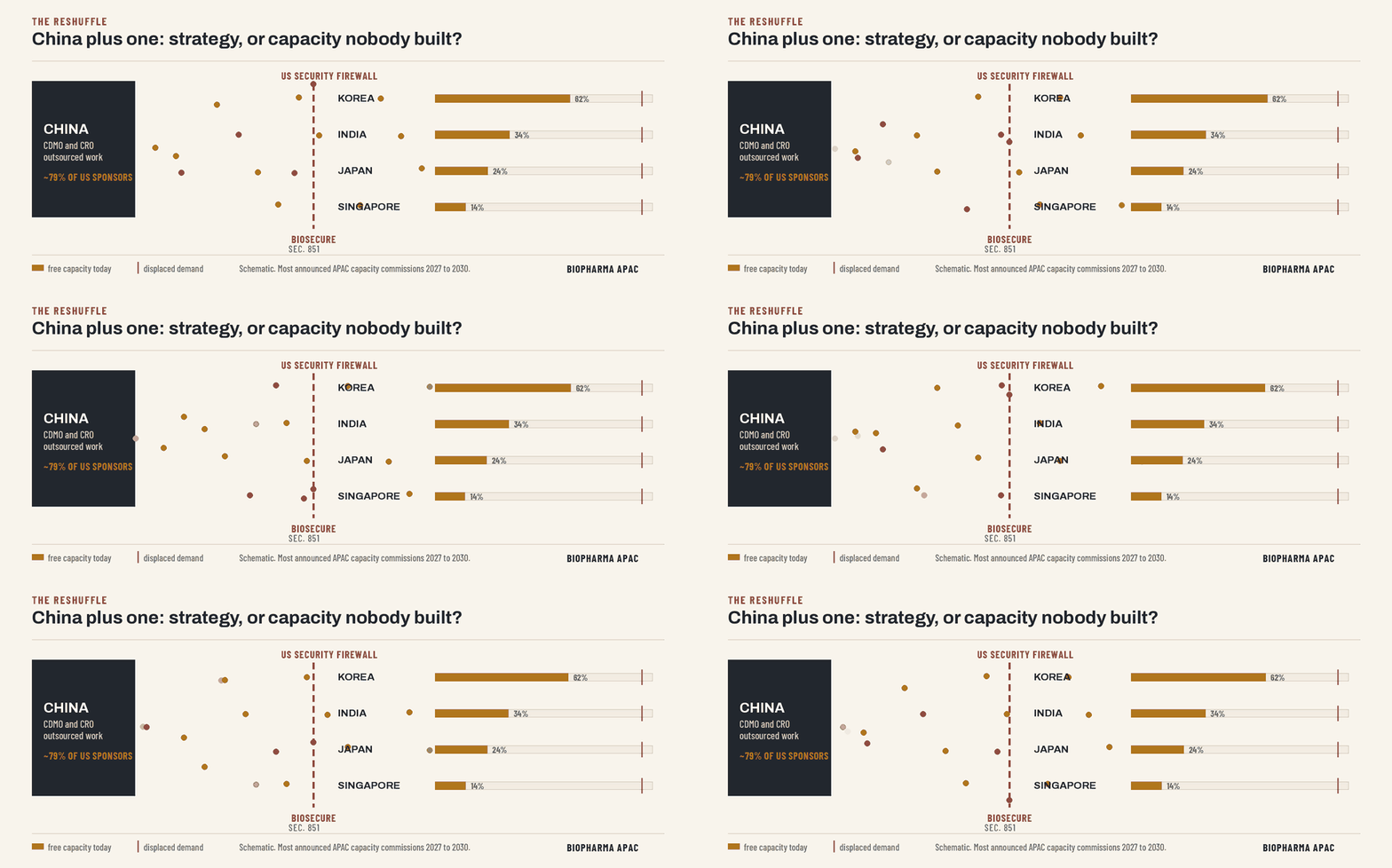
The "China+1" strategy — keep China, add at least one alternative geography — has moved from strategy decks into signed contracts. Goldman Sachs, after meeting a clutch of Indian contract-development-and-manufacturing firms in 2025, reported early conversion of requests-for-quotation into pilots and initial orders, while cautioning that the financial impact would materialise over a three-to-five-year horizon rather than the next quarter. The texture of that shift is visible across the sector. Syngene, Biocon's contract research-and-manufacturing arm, has turned diversification pilots into binding commercial agreements and says inbound inquiries rose materially once the proposed US BIOSECURE Act — which would restrict federal dealings with named Chinese providers such as WuXi — became a live boardroom concern. Neuland Laboratories secured three development-stage projects from a single large innovator explicitly shifting work out of China. Aurobindo's subsidiary signed a decade-long commercial-manufacturing deal with a US multinational. The BIOSECURE bill had not passed in final form as of mid-2026, but its mere prospect was already doing the work: a forced manufacturing-site change mid-trial requires FDA prior approval and can take 12–18 months, so multinationals are pre-qualifying backup suppliers now rather than risk that delay later.
This is the most useful way to read the moment — as a pre-emption, not a migration. The multinational re-papering its sourcing is rarely abandoning China; it is buying an option on an alternative, qualifying a second site so that if the politics turn, it is not caught flat. That distinction matters for how durable the gains are.
The Indian API maker positioned for that demand is, increasingly, building ahead of it. Divi's Laboratories — the country's foremost pure-play API and custom-synthesis house, serving originators and generics across 95-plus countries — commissioned its Kakinada complex in January 2025 with a roughly USD 144 million outlay and is progressively adding capacity for complex APIs; its most recent quarter showed revenue up about a quarter year-on-year. Laurus Labs, whose antiretroviral-API cluster and new oncology-injectables capacity made it one of 2025's standout pharma stocks, is widely grouped with Divi's and Piramal Pharma as best-placed to capture incremental outsourcing. Behind the marquee names sits a broad capacity wave: commissioned Indian pharmaceutical projects ran to roughly INR 60–68 billion a year across 2023–25, against a ten-year average closer to INR 21 billion, and the great majority of the 2025–26 projects are API-focused — weighted toward fermentation-based antibiotics and high-volume chronic-therapy molecules, exactly the segments where Chinese dependence is most acute.
Government policy is leaning the same way. India's Production-Linked Incentive (PLI) scheme for bulk drugs — a roughly INR 6,940 crore programme covering 41 critical products — had by December 2025 commissioned 38 greenfield projects across 28 products, established some 56,800 tonnes a year of capacity, generated cumulative sales of INR 2,720 crore and averted imports worth INR 2,192 crore. The 2026–27 Budget added a INR 10,000 crore Biopharma Shakti programme. Beyond India, South Korea, Japan, Singapore and Vietnam are positioning for the higher-value and biologics end of the same diversification mandate.
The timeline, though, is where ambition meets friction. The Indian Pharmaceutical Alliance's own framing is that it will take five to seven years to meaningfully reduce overall dependence. The PLI has commissioned 28 of 41 targeted products, not all of them — and total Indian API, KSM and intermediate imports still rose about 32 percent over five years, from INR 27,361 crore in 2020–21 to INR 36,124 crore in 2024–25, because demand grew faster than substitution. Self-sufficiency is not the same as capacity. China remains the cheapest producer of the building blocks even where India now makes the API.
PULL QUOTE: "China+1 has moved from procurement decks to signed contracts — but the money lands three to five years after the meeting."
The cost reckoning: who pays, and does it survive the budget cycle?
Resilience has a price, and the reordering is making it visible for the first time.
For the Indian manufacturer, the price is upfront and uncomfortable. Companies are deploying capital into fermentation, APIs and complex intermediates where the returns look unattractive for the first two to three years — margins under pressure, asset turns down, reported returns on capital temporarily disappointing. That is not a failure of execution; it is the cost of buying optionality and stabilising input costs against the next shock. The wager is that control over chemistry compounds quietly over time, even when it punishes the quarterly numbers. Whether listed companies and their shareholders hold their nerve through several lean years is the open question — and it is the same question, in a different currency, that the whole resilience project faces.
For the multinational, the price is a backup supplier it may never fully use and a qualification process measured in years. For the US patient and payer, the price is the one most likely to break the political consensus: tariffs on patented drugs, and any future extension to generics, ultimately flow toward the end of the chain. The generics exemption exists precisely because Washington fears shortages and price spikes if it does not — which is also why its one-year review is the single most important variable in the whole picture. Remove the carve-out before domestic capacity is ready, and the policy meant to secure supply could instead constrict it.
This is the structural tension the reordering cannot resolve by rhetoric. Security and cost discipline are pulling in opposite directions, and the concentration of API and KSM supply means the cheapest source and the most secure source are, for now, different places. Friend-shoring narrows that gap slowly and expensively; it does not close it on the timeline politics demands.
THE COMPETING VOICES
A supply-chain strategy head at a multinational frames the tariff less as a cost shock than as a forcing function: "We were always going to dual-source eventually. The proclamation just moved the deadline from someday to the next FDA filing."
An India-based API-manufacturing executive is blunter about the economics: "Everyone wants a China alternative. Almost no one wants to pay the premium it costs to be one. We build anyway, because the contract that justifies it usually arrives a year after the capacity does."
A trade economist cautions against reading the schedule as destiny: "Tariff tiers are negotiating instruments. A generics review can extend an exemption as easily as end it. Sourcing decisions made on today's rate card may be obsolete by the next trade deal."
A procurement director at a generics manufacturer keeps the focus on the layer no one tariffs: "I can re-paper my API contracts in a quarter. I cannot re-paper where the key starting material is made. That is still China, and it will be China for years."
The takeaway
Strip away the language of sovereignty and the picture is grounded and unsentimental. Real sourcing is shifting — pilots are converting, capacity is being commissioned across India and the wider region, and multinationals are genuinely qualifying alternatives they did not have eighteen months ago. But the shift is incremental, expensive and concentrated in the layers easiest to move, while the deepest dependency — the key starting materials at the very base of the chain — remains stubbornly where it has always been.
APAC is both the supplier under pressure and the beneficiary of the diversification, and which role dominates will be decided less by tariff schedules than by two slower variables: whether the generics exemption survives its review, and whether the manufacturers betting capital on resilience can outlast the years before it pays. Resilience, it turns out, is not a switch. It is a budget line — and budget lines are the first thing reviewed when the next cycle turns.
(arcilla.fran@biopharmaapac.com )
Disclaimer: The four practitioner perspectives in this analysis are composite voices, synthesised from positions BioPharma APAC has encountered across its reporting on supply-chain strategy, API manufacturing, trade policy and pharmaceutical procurement. They do not represent statements by any single identified individual.
Figures are drawn from public sources, including the 2 April 2026 US presidential proclamation and accompanying White House and Department of Commerce materials; India's Department of Pharmaceuticals and Press Information Bureau submissions to Parliament; Pharmexcil trade data; Production-Linked Incentive scheme disclosures; and published market and sell-side research. Market-sizing estimates vary by methodology and are presented as directional. Tariff tiers, exemptions and the generics-review timeline were accurate as described at the time of writing and remain subject to further Federal Register guidance.
Most Read
- Can APAC Biomanufacturing Decarbonise Without Pricing Itself Out?
- The Algorithm on the GMP Floor: AI Promises a Smarter Plant. Regulators Demand the Audit Trail.
- APAC's Peptide-Capacity Gamble
- After the Rush: APAC's mRNA and Vaccine Capacity Hangover
- The Biosimilar Race: Factory to the World — or Stuck in the Copycat Economy?
- The Vein-to-Vein Problem: Can APAC's Cold Chain Carry Advanced Therapies?
- Vectors, Plasmids and the CGT Trap: APAC's Cell and Gene Therapy Ambitions Face an Upstream Bottleneck
- Can APAC Build Radioligand Therapy Before the Atoms Decay?
- The Great Biopharma Reset: 50 Developments That Changed Everything in H1 2026
- Beyond the Trial: Can Real-World Evidence Earn Regulatory Trust in APAC?
- Beyond the Obvious Giant: Where APAC's Clinical Trials Go Next
- The Frontier That Won’t Quite Arrive
Bio Jobs
- Sanofi Turns The Page As Belén Garijo Steps In And Paul Hudson Steps Out
- Global Survey Reveals Nearly 40% of Employees Facing Fertility Challenges Consider Leaving Their Jobs
- BioMed X and AbbVie Begin Global Search for Bold Neuroscience Talent To Decode the Biology of Anhedonia
- Thermo Fisher Expands Bengaluru R&D Centre to Advance Antibody Innovation and Strengthen India’s Life Sciences Ecosystem
- Accord Plasma (Intas Group) Acquires Prothya Biosolutions to Expand Global Plasma Capabilities
- ACG Announces $200 Million Investment to Establish First U.S. Capsule Manufacturing Facility in Atlanta
- AstraZeneca Invests $4.5 Billion to Build Advanced Manufacturing Facility in Virginia, Expanding U.S. Medicine Production
News