The APAC CDMO Shortlist: 10 CDMOs to Watch Through 2028
24 July 2026 | Friday | Analysis
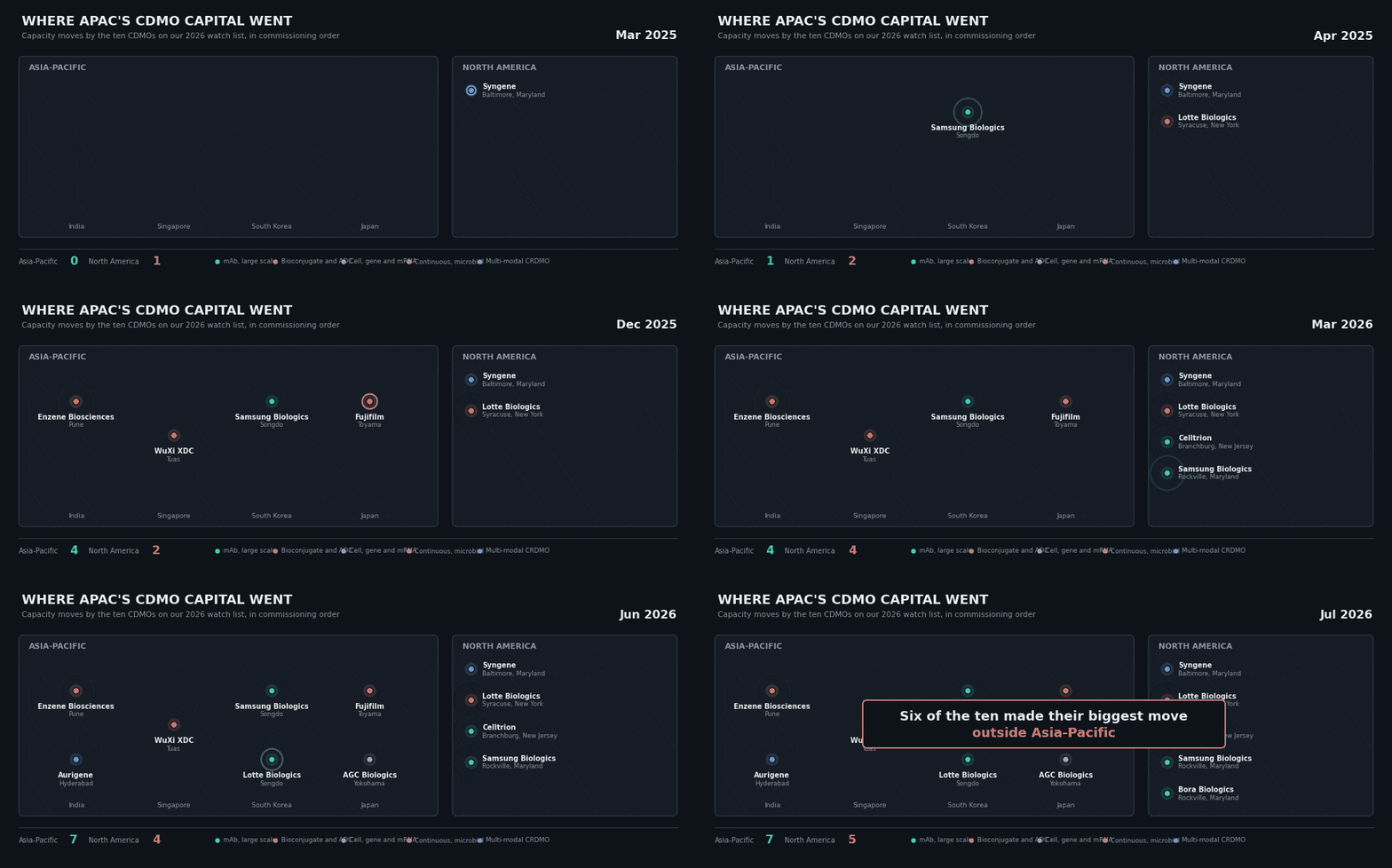
There is a version of this list that writes itself. Rank the region’s contract manufacturers by installed litres, put Samsung Biologics at the top, and publish. It would be accurate, it would be useless, and it would tell a reader nothing they could act on, because that ordering has barely moved in five years and will not move next year either.
So this is a different exercise. These are ten organisations whose next eighteen months carry genuine information. Each of them has done something since January 2025 that changes what they can offer, where they can offer it, or who they answer to, and each of them now faces a specific, dated test of whether that decision was sound. Some will pass it publicly. Some will pass it quietly. At least one on this list will not pass it at all, and the interesting part of a watch list is that we do not yet know which.
One pattern emerged early in the reporting and it reframed the whole piece. Of the ten organisations here, six made their single most consequential capacity move of the period outside Asia-Pacific. Samsung Biologics bought in Maryland. Celltrion bought in New Jersey. Syngene bought in Baltimore. Bora bought in Maryland and California. Lotte built its antibody-drug conjugate line in upstate New York. Enzene put its continuous manufacturing platform into New Jersey. The APAC biomanufacturing story of 2026, in other words, is being partly written on the American eastern seaboard, financed from Incheon, Taipei, Bengaluru and Pune.
That is either demand-following or risk-hedging, and honest people disagree about which. What it is not is a rounding error. Read the list with it in mind.
Sources and method
What this set out to identify: ten organisations whose capability or competitive position changed materially between January 2025 and July 2026, and whose next eighteen months will show whether the change worked.
Inclusion criteria, all four required: an announced or completed capacity or capability addition dated since January 2025; a modality, geography or capability that is new to that organisation; a disclosed customer, approval or transaction milestone; and material relevance to buyers of manufacturing services in Asia-Pacific.
Ordering: thematic and geographic, not ranked. Nothing in the sequence below implies a hierarchy, and no scoring model was applied because none was warranted.
Evidence: every entry rests on at least two independently verifiable public data points. Capacity figures are company-disclosed nameplate numbers and carry the date of disclosure, because a litre figure from 2023 and a litre figure from this March are not the same claim. Financial terms are cited to company releases or regulatory filings. Nothing here is estimated or reconstructed.
Deliberately excluded: organisations whose only qualifying activity was a memorandum of understanding, a letter of intent, or a strategy announcement without a dated commitment behind it. Also excluded, and this is a finding rather than an oversight, several mainland Chinese contract manufacturers with real expansion under way whose disclosure did not allow a capacity figure to be cited with a date.
Corrections: this list will be updated as a versioned revision with changes acknowledged. If a company meets these criteria and is not here, that is a correction and we would like to hear about it.
1. Samsung Biologics
Incheon, South Korea
Why watch. It is the only contract manufacturer in the region large enough that its utilisation rate functions as an industry indicator rather than a company metric.
Plant 5 came online in April 2025, adding 180,000 litres and opening Bio Campus II. In November 2025 the group completed a spin-off that refocused Samsung Biologics as a pure-play contract manufacturer, removing the awkwardness of selling capacity while a sister business developed biosimilars. Then on 31 March 2026 it closed the acquisition of GSK’s Rockville, Maryland site for 280 million US dollars, taking on two cGMP plants, roughly 60,000 litres of drug substance capacity and more than 500 retained employees. Total global capacity now stands at 845,000 litres by the company’s own March 2026 disclosure, with land already secured for a third Bio Campus.
The test. Rockville arrives with a captive customer, because Samsung will keep supplying GSK from the site. The question is whether it converts into a genuine third-party facility. Watch for the first disclosed non-GSK programme placed there. Without one, this is a supply agreement with a building attached.
The risk. A very large share of that 845,000 litres is stainless steel built for large-volume monoclonal antibodies. The pipeline is drifting toward bispecifics, conjugates and smaller commercial batches. Scale is an advantage right up until it is the wrong shape, and turning a 15,000 litre train into a flexible asset is expensive.
2. Lotte Biologics
Incheon, South Korea, and Syracuse, New York
Why watch. It is the purest execution test in the region: a brand new large-scale plant with, as of publication, no announced commercial contract running on it.
Songdo Plant 1 received approval for use in late June 2026, roughly two years after groundbreaking in July 2024, against an industry norm closer to three and a half to four years. The facility is a 120,000 litre antibody plant built around eight 15,000 litre stainless bioreactors, with higher-titre cell culture and perfusion capability, and it entered full commissioning and validation in the second half of 2026. Combined with the 40,000 litres at the Syracuse Bio Campus, the former Bristol Myers Squibb site where Lotte completed an antibody-drug conjugate line in March 2025 at a cost of around 100 million US dollars, total capacity reaches 160,000 litres on the company’s September 2025 disclosure.
The test. This is the rare case where the company has set its own falsifiable target in public. At BIO 2026 in San Diego, chief executive James Park said Lotte was targeting both GMP-ready status and a first commercial manufacturing contract by the end of the year. That is a date and a deliverable. It either lands or it does not, and either outcome is informative.
The risk. Depreciation on 120,000 litres begins whether or not there is a customer, and the two-year build that looks like an achievement today becomes a two-year head start on fixed costs if the order book lags. Speed to completion and speed to revenue are different races.
3. Celltrion and Celltrion BioSolutions
Incheon, South Korea, and Branchburg, New Jersey
Why watch. It is the region’s live experiment in whether a company built to manufacture for itself can credibly sell capacity to the companies it competes with.
Celltrion completed the transfer of Eli Lilly’s Branchburg facility on 31 December 2025 and opened it days later, launching its contract manufacturing business on the back of a three-year supply agreement with Lilly worth 678.7 billion Korean won. In March 2026 chairman Seo Jung-jin told shareholders the company would invest more than 1.22 trillion won to expand Plants 4 and 5 at Songdo, lifting drug substance capacity from 316,000 litres to 571,000 litres in phases through 2030, with Branchburg expanding toward 141,000 litres. Roughly 80 per cent of the new capacity is earmarked for Celltrion’s own products and about 20 per cent for contract work.
The test. In March 2026 Celltrion disclosed a drug substance supply agreement with an unnamed global pharmaceutical company, worth around 294.9 billion won and expandable to 375.4 billion won, running from 2027 to 2029. Watch whether further contracts follow and, more tellingly, whether any counterparty is eventually willing to be named. Anonymity in a contract manufacturing announcement is normal. Sustained anonymity across a portfolio is a signal.
The risk. That 80 to 20 split is the whole problem in one ratio. Contract customers are being asked to place programmes with a manufacturer whose parent develops biosimilars in adjacent therapeutic areas and whose own products have first call on the plant. Firewalls can be built. Whether procurement teams believe in them is a separate question.
4. WuXi XDC
Wuxi, China, and Tuas, Singapore
Why watch. It is the clearest test in the region of whether a Singapore address genuinely changes how Western buyers assess a China-headquartered manufacturer.
WuXi XDC announced mechanical completion of its Tuas Biomedical Park site at the end of June 2025, roughly sixteen months after groundbreaking, across about 25,000 square metres. The site moved into commissioning and qualification with operations from late 2025 and GMP manufacturing from early 2026. It is built as a one-stop bioconjugate facility: a dual-function line producing antibody intermediates and conjugate drug substance at up to 2,000 litres each, plus a conjugation drug product line with one 10 square metre and two 30 square metre lyophilisers and annual capacity above eight million vials. In January 2026 the company launched a cash tender offer for Dong Yao Pharmaceutical at 3.091 billion Hong Kong dollars, buying established Chinese conjugate capacity to relieve its own constraint, and at the 2026 J.P. Morgan conference it signalled more than seven billion renminbi of investment across 2026 to 2029. First-half 2025 revenue reached 2.701 billion renminbi, up 62.6 per cent year on year, against a backlog of 1.329 billion US dollars.
The test. The proof point is not the ribbon-cutting. It is the first Western-headquartered commercial conjugate programme placed at Tuas rather than at Wuxi, disclosed and dated. Until that happens, Singapore is a hedge on paper.
The risk. Procurement and legal functions at large sponsors are increasingly looking at ownership rather than geography. A Singapore site with a Chinese parent may be read as a Chinese site with a different postcode, in which case a very large capital programme has bought less protection than it appears to.
5. Bora Pharmaceuticals and Bora Biologics
Taipei, Taiwan
Why watch. It is actually executing the roll-up strategy that half the region describes in investor decks.
Bora completed its 122.5 million US dollar acquisition of MacroGenics’ GMP manufacturing operations in July 2026, having announced it on 12 May, with up to five million more contingent on future orders. The deal brought a biologics drug substance plant in Rockville, Maryland and a warehousing centre in Frederick. Bora Biologics, the group’s biologics franchise operated with Tanvex, now runs 20,000 litres of single-use drug substance capacity across Rockville and San Diego plus a development site in Zhubei, Taiwan. Rockville has completed more than 120 GMP batches, and across the US network Bora reports five FDA inspections and one PMDA review in 2025 with clean outcomes. Earlier in 2026 the group renewed a five-year, 250 million dollar manufacturing agreement with GSK covering more than twenty commercial product lines, and in May 2026 signed a ten-plus-two year agreement with a top-twenty global pharmaceutical company, led from its Maple Grove site in Minnesota, expected to lift consolidated output by around 20 per cent. The network now spans eleven sites across Taiwan, Canada and the United States.
The test. Bora has said it will integrate in-house drug substance and drug product capabilities over twelve to eighteen months. The thesis stands or falls on whether a single client can genuinely run one programme across two Bora sites without paying a tech-transfer penalty. That is an operational claim, and it is measurable.
The risk. Serial acquisition produces quality-system heterogeneity, and the market does not price it site by site. One bad inspection at one acquired facility gets applied to the whole network by every procurement committee that reads about it.
6. Fujifilm Toyama Chemical
Toyama Prefecture, Japan
Why watch. Japan has long been a large pharmaceutical market with a small merchant biologics contract manufacturing sector. This is the most serious attempt to change that.
Fujifilm completed construction of the plant at its Toyama Second Factory in December 2025 and marked it with a completion ceremony. It is the company’s first antibody manufacturing plant in Japan, fitted with two 5,000 litre and two 2,000 litre single-use mammalian bioreactors and designed for antibodies and antibody-drug conjugates. An adjacent plant under construction will extend the site from drug substance through finished goods and packaging, making Toyama the group’s bio contract manufacturing hub in Asia. The site is scheduled to be operational in 2027, and at the 2026 J.P. Morgan conference Fujifilm framed Toyama alongside Billingham as part of a deliberate small-to-mid tank strategy sitting beneath its very large facilities in Denmark and North Carolina.
The test. Whether Toyama books work from outside Japan. A Japanese facility serving only Japanese sponsors is a domestic supplier with a regional label on it, and the difference matters to anyone in Seoul, Singapore or Hyderabad trying to work out whether Japan has entered the competitive set.
The risk. Operational in 2027 means meaningful revenue in 2028. In a market repricing as quickly as this one, that is a long time to hold a finished asset, and Fujifilm is simultaneously equipping very large capacity in North Carolina that competes for the same commercial attention.
7. AGC Biologics, Yokohama
Yokohama, Japan
Why watch. It is the region’s largest single bet that Japan’s contract manufacturing advantage lies in advanced therapies rather than antibodies.
AGC is investing approximately 50 billion Japanese yen, around 350 million US dollars, in a four-storey facility of roughly 20,000 square metres at its Yokohama Technical Center, selected under Japan’s Ministry of Economy, Trade and Industry programme to strengthen domestic vaccine manufacturing capacity. The site carries two 5,000 litre and additional 2,000 litre single-use mammalian bioreactors, and is expected to employ around 400 people. What distinguishes it from Toyama, which sits about 300 kilometres away and has broadly comparable mammalian capability, is the deliberate decision to point Yokohama at cell and gene therapy and messenger RNA rather than at conjugates. GMP operations are expected from 2027.
The test. Cell and gene therapy demand in Japan is real but small. The question is whether Yokohama attracts allogeneic or autologous programmes from outside Japan, and whether the country’s regenerative medicine pathway delivers the volume the business case assumes rather than the volume the policy assumes.
The risk. A facility built partly with public money for pandemic preparedness has two masters. Standby capacity and commercial utilisation are not the same objective, and the tension usually shows up in scheduling.
8. Syngene International
Bengaluru, India
Why watch. It is the most instructive utilisation story in Indian biologics, because it has both the capacity and the disclosure to let you see what is actually happening.
Syngene closed its acquisition of the Baltimore-Bayview drug substance site from Emergent BioSolutions on 19 March 2025 at a gross value of 36.5 million US dollars, with total investment projected at roughly 50 million once the site was made operational. That took total single-use bioreactor capacity to 50,000 litres across four development and manufacturing sites in India and North America, and Emergent retained an option on future capacity there. It followed the December 2023 purchase of Stelis Biopharma’s multi-modal facility in Bengaluru, which added 20,000 litres of installed drug substance capacity and a commercial-scale fill-finish unit. The company said Baltimore would be available for client projects from the second half of 2025.
The test. Whether Baltimore fills. That was the promise attached to the purchase, it came with a date, and eighteen months of disclosed client wins or their absence will settle whether the deal was strategy or opportunism. Note the honest complication: Syngene reported a 37 per cent year-on-year fall in second-quarter FY26 profit on a biologics inventory correction, with revenue up 2 per cent to 926 crore rupees. Corrections hit utilisation before they hit order books.
The risk. Four sites across two continents is a lot of fixed cost for a business whose biologics demand is currently normalising rather than growing. Buying capacity is the easy half.
9. Aurigene Pharmaceutical Services
Hyderabad, India
Why watch. It is building in four modality lanes simultaneously, which is either exactly the right diversification or a focus problem, and the next eighteen months will say which.
Aurigene has committed roughly 100 million US dollars to expanding its contract research, development and manufacturing capability across small molecules, peptides, nutraceuticals and biologics. The first tranche of 40 million went into the Genome Valley site in Hyderabad, built for cell line development, clinical development and small-scale biologics manufacturing for innovator clients. In 2026 the company outlined a second phase of approximately 60 million, of which 20 million has been deployed into an active ingredient and intermediates block at a US FDA-approved facility in Telangana. Aurigene says it has grown more than threefold since 2022 across discovery, contract manufacturing, biologics and computational drug discovery.
The test. Peptides. The demand created by incretin therapies has made peptide capacity the single most contested capability in the Indian sector, and Aurigene has committed to it publicly. Watch for a disclosed commercial peptide supply agreement with a named counterparty. A capability announcement is a plan; a supply agreement is a business.
The risk. Four lanes and one balance sheet. Diversification protects against a single-modality downturn, and it also dilutes exactly the specialisation that the 2026 buyer says they are shopping for. The sector consensus this year is that specialists win. Aurigene is betting against it.
10. Enzene Biosciences
Pune, India
Why watch. It is the region’s most committed bet on continuous manufacturing, and continuous manufacturing is the technology most likely to change contract manufacturing unit economics this decade.
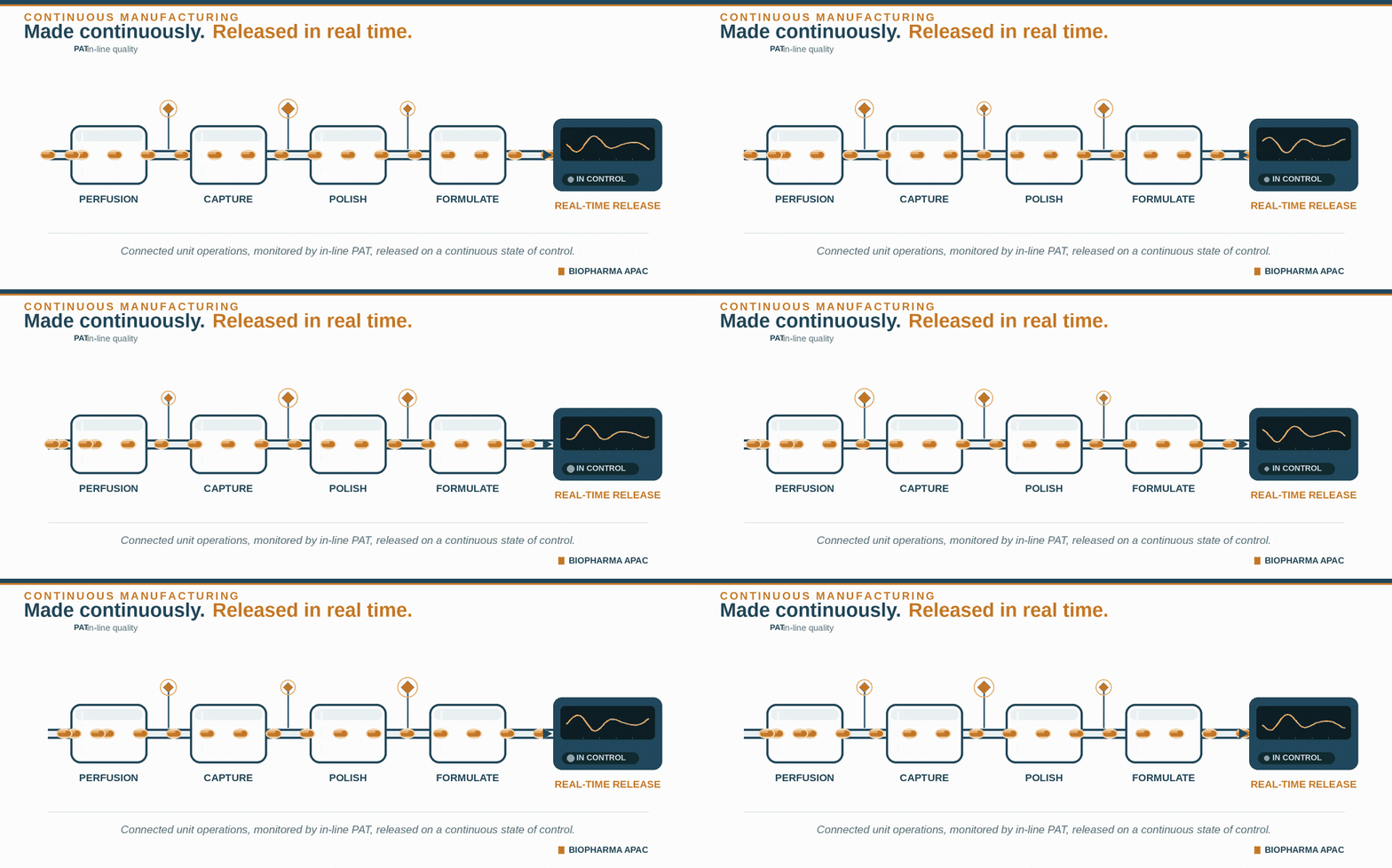
Both of Enzene’s Pune facilities hold European Union GMP certification covering commercial-scale microbial and mammalian drug substance supply and sterile fill-finish and packaging. Its EnzeneX platform, a fully connected continuous manufacturing system combining intensified perfusion using alternating tangential flow with automated multi-column chromatography, is validated for commercial biologics supply and operates from a minimum of 30 to 50 litres, which is a fundamentally different capital proposition from a stainless train. A US site at the Princeton West Innovation Campus in New Jersey, around 54,000 square feet, extends the platform to the American east coast, and a 75,000 square foot research facility opened in Pune.
The test. An innovator, rather than a biosimilar developer, committing a commercial programme to EnzeneX. Continuous has been proven at Enzene’s own scale and for its own molecules. Whether a Western sponsor will accept the regulatory and comparability work is the open question, and it is the one that decides whether this is a platform or a house technology.
The risk. Enzene publishes a target of bringing monoclonal antibody production below 40 US dollars per gram, a figure it set for 2025 and continues to cite. We could not independently verify that the threshold has been met, and we are recording that rather than repeating the number as achieved. Separately, regulatory familiarity with continuous processing varies sharply across APAC authorities, and Enzene bears the cost of educating every reviewer it meets.
What the ten have in common
Go back to the pattern. Six of these ten organisations made their most consequential move of the period in the United States. Only WuXi XDC’s largest single build sits inside Asia-Pacific, and Singapore is arguably itself a de-risking address rather than a demand-following one. Fujifilm and AGC are the genuine exceptions, and both are building from a domestic Japanese base with regional ambition attached rather than the other way round.
There are two readings and they are not mutually exclusive. The first is straightforward commercial logic: the United States is the largest biologics market on earth, sponsors increasingly want onshore supply, and a manufacturer that cannot offer it loses the conversation early. The second is defensive: proximity to the American regulatory and political environment is worth paying for when tariffs, procurement preferences and legislative attention to supply-chain origin are all moving in the same direction. Companies will tell you the first. The timing of the purchases suggests both.
What follows from that is a question worth putting to any of these ten in the next eighteen months. If the capital is going west, what happens to the regional capacity that Asia-Pacific governments have spent a decade subsidising into existence? Korea, Singapore, Japan and India have all built industrial policy around biomanufacturing as a strategic sector. If the sector’s leading firms are increasingly manufacturing elsewhere for their most valuable customers, the policy and the industry are quietly diverging.
One thing this list could not do. No Australian or Southeast Asian contract manufacturer outside Singapore cleared the two-data-point threshold for a dated capacity addition in the window. That is a finding rather than an oversight, and it is worth stating plainly: the region’s contract manufacturing capacity is concentrating in five markets, and the others are further behind than the conference programmes suggest.
We will revisit these ten in August 2027 and mark our own homework in public, entry by entry, against the tests set out above.
(arcilla.fran@biopharmaapac.com)
Most Read
- Can APAC Biomanufacturing Decarbonise Without Pricing Itself Out?
- The Algorithm on the GMP Floor: AI Promises a Smarter Plant. Regulators Demand the Audit Trail.
- APAC's Peptide-Capacity Gamble
- After the Rush: APAC's mRNA and Vaccine Capacity Hangover
- The Biosimilar Race: Factory to the World — or Stuck in the Copycat Economy?
- The Vein-to-Vein Problem: Can APAC's Cold Chain Carry Advanced Therapies?
- Vectors, Plasmids and the CGT Trap: APAC's Cell and Gene Therapy Ambitions Face an Upstream Bottleneck
- Can APAC Build Radioligand Therapy Before the Atoms Decay?
- The Great Biopharma Reset: 50 Developments That Changed Everything in H1 2026
- Beyond the Trial: Can Real-World Evidence Earn Regulatory Trust in APAC?
- Beyond the Obvious Giant: Where APAC's Clinical Trials Go Next
- The Frontier That Won’t Quite Arrive
Bio Jobs
- Sanofi Turns The Page As Belén Garijo Steps In And Paul Hudson Steps Out
- Global Survey Reveals Nearly 40% of Employees Facing Fertility Challenges Consider Leaving Their Jobs
- BioMed X and AbbVie Begin Global Search for Bold Neuroscience Talent To Decode the Biology of Anhedonia
- Thermo Fisher Expands Bengaluru R&D Centre to Advance Antibody Innovation and Strengthen India’s Life Sciences Ecosystem
- Accord Plasma (Intas Group) Acquires Prothya Biosolutions to Expand Global Plasma Capabilities
- ACG Announces $200 Million Investment to Establish First U.S. Capsule Manufacturing Facility in Atlanta
- AstraZeneca Invests $4.5 Billion to Build Advanced Manufacturing Facility in Virginia, Expanding U.S. Medicine Production
News