Asia-Pacific’s Geroscience Paradox: Plenty of Ageing Research, Just Five Clinical Assets
13 August 2026 | Thursday | Analysis
It is not a settled matter. It is a claim that has been made continuously for four years without anyone publishing the test they applied. So we wrote a test, published it before we started counting, and went looking for ten assets.
We found five.
That number needs qualifying in both directions, and we will do the qualifying in a moment. But the headline of this audit is not that Asia-Pacific has a thin geroscience pipeline. It is something more specific and more useful to anyone building a commercial case in this category. The region has a great deal of clinical activity that touches aging biology. Almost none of it does two things at once: state aging biology as the development rationale, and sit inside a registrational drug programme. Those two properties travel separately across our whole sample. Where a sponsor is protecting a filing, it does not say the word aging. Where a sponsor says the word aging freely, there is usually no filing to protect.
That separation, not the shortfall, is what a strategist should take from this list.
How we counted
Three conditions, all of which had to hold.
First, the sponsor is headquartered or principally operating in Asia-Pacific. Trial sites in the region were not enough, which is why several large multinational programmes running Australian and Korean sites do not appear.
Second, the asset is in human clinical trials with a registered trial identifier we could retrieve. Preclinical programmes were excluded no matter how strong the publication record, and an intervention offered to patients without a registration was excluded no matter how many patients received it.
Third, and this is the condition that did nearly all the work, aging biology is stated as the development rationale by the sponsor, in sponsor-controlled material. Not inferred by us from the indication. Not supplied by a reviewer or a trade publication. If we had to reason our way from the premise that this is an age-related disease to the conclusion that aging biology is therefore the rationale, the asset failed.
That third condition is deliberately harsh and it is worth being explicit about what it costs. Loosen it to the weaker test that aging biology plausibly underlies the indication, and this list runs past thirty without effort. Every Alzheimer's programme, every sarcopenia programme, every osteoarthritis and macular degeneration and fibrosis programme in the region qualifies. That is precisely why the category is claimed to exist. The claim is made under the loose test and defended under the strict one, and the two are never run in the same room.
Two limitations belong here rather than buried in the apparatus. This audit rests on English-language public sources, sponsor disclosure, and registry records retrievable in English. We did not complete a native-language sweep of ChiCTR, jRCT or CRIS. That is the single largest constraint on the count, and it is the first thing the second edition fixes. Readers should treat five as a floor rather than a total.
Second, the number is sensitive to what counts as an asset. Two of the five entries are nutritional interventions run by an academic sponsor. A reader who declines to count a multivitamin as a clinical asset lands on four. We have kept them in because the published method admits them and quietly dropping them would be exactly the kind of unexamined judgement this format exists to avoid. But the disagreement is legitimate and we would rather show it than settle it.
The five
1. Rentosertib, Insilico Medicine, Hong Kong
Mechanism. Oral small-molecule inhibitor of TNIK, a serine threonine kinase sitting across Wnt, TGF-beta, Hippo, JNK and NF-kB signalling. The target was not selected from the existing IPF literature. It came out of a computational pass over fibrosis datasets annotated by age, which is the detail that matters for our purposes.
Filed indication. Idiopathic pulmonary fibrosis, which the sponsor consistently describes as an age-related fibrotic disease.
Stage and registration. Phase 3, initiated 7 July 2026, registered as CTR20262475 and NCT07687459. Prospective, randomised, double-blind, placebo-controlled, 320 patients across 47 centres in China, dosed once daily over 52 weeks.
Funding. Public markets. Insilico is listed in Hong Kong under 3696.
Strongest external validation. The Phase 2a GENESIS-IPF result, published in Nature Medicine on 3 June 2025: 71 patients, 22 Chinese sites, 12 weeks, with the 60 mg once-daily arm showing mean forced vital capacity improvement of 98.4 mL against a 20.3 mL decline on placebo. The discovery-to-clinic path was separately published in Nature Biotechnology. Peer review at that level, twice, is more external validation than any other asset on this list carries.
Weakest link. The aging rationale is real but it is upstream. It describes how the target was found, not what the trial measures. Insilico's own framing is careful about this, and the company describes the origin as a biology-first, aging-informed AI workflow. Nothing in the Phase 3 protocol converts aging biology into a registrational endpoint. If rentosertib is approved, it will be approved as an antifibrotic, and the aging provenance will be a discovery anecdote rather than a label claim.
Near-term proof point. Phase 3 enrolment completion and any interim safety disclosure. Beyond that, whether Insilico applies the same aging-annotated target selection to a second indication and says so publicly. One asset is a case. Two is a platform claim with evidence behind it.
This title's evidence audit of nine Asia-Pacific AI discovery platforms owns the question of what those platforms have shipped, and rentosertib is assessed there on that basis. Here it is counted only as a clinical asset.
2. Amimestrocel, Platinum Life Excellence Biotech with the PLA General Hospital, China
Mechanism. Allogeneic mesenchymal stem cells derived from human umbilical cord tissue, marketed as Ruibosheng. The proposed activity is immunomodulatory and anti-inflammatory rather than targeted at a single hallmark.
Filed indication. This is the only entry on the list where the enrolment frame is aging itself. The study recruits adults aged 50 and over who have experienced, or are at risk of, age-related decline in physical function. Everything else here borrows a disease.
Stage and registration. Recruitment opened in June 2026 through the Second Medical Center of the PLA General Hospital in Beijing, widely known as 301 Hospital, as a multicentre randomised controlled trial targeting 2,000 participants. Reported by Xinhua on 3 June 2026. We could not retrieve a public registry identifier in English, which under a strict reading puts this entry at risk, and we flag it rather than resolve it.
Funding. Commercial developer plus a military hospital system. The product already generates revenue in its approved indication.
Strongest external validation. The product is not speculative. It received conditional NMPA approval in January 2025 as China's first approved stem cell drug, for acute graft-versus-host disease, and has reportedly been used in more than 70 transplant centres since the middle of that year. A safety and manufacturing base of that size is a genuinely different starting position from a first-in-human programme.
Weakest link. Scale is not design. Two thousand participants tells you nothing about what the primary endpoint is, how function is measured, or how long follow-up runs, and none of that was public at the time of writing. An anti-aging trial with an underspecified functional endpoint is the exact failure mode this series has documented elsewhere. The mechanism is also the loosest on the list: it is a plausible story about inflammation, not a defined target.
Near-term proof point. Publication of the protocol with the primary endpoint stated. If that endpoint is a validated functional measure rather than a biomarker panel, this becomes the most consequential geroscience trial in the region by a distance. If it is a biomarker panel, it is a very large marketing study.
3. GV1001, GemVax and KAEL with Samsung Pharmaceutical, South Korea
Mechanism. A 16-amino-acid peptide taken from the sequence of human telomerase reverse transcriptase. It was built as a cancer vaccine on the assumption that immunising against TERT would flag tumour cells. The neurological programme rests on something different: extra-telomeric activity, with the peptide protecting neural cells from amyloid-beta toxicity and other stressors.
Filed indication. Moderate to severe Alzheimer's disease, with progressive supranuclear palsy behind it.
Stage and registration. Phase 3 in Korea as NCT05303701, 936 patients with moderate to severe Alzheimer's, lead sponsor Samsung Pharmaceutical, first posted 31 March 2022 and scheduled to complete in April 2026. A US Phase 2 in mild to moderate disease, NCT05189210, closed in April 2025 with 199 participants. A Phase 2 in progressive supranuclear palsy runs as NCT06235775, and a Phase 1 in 56 healthy subjects as NCT06625710.
Funding. Listed Korean sponsors, with US regulatory support in the form of orphan drug and fast track designations granted in May 2025.
Strongest external validation. The Korean Phase 3 is the highest-enrolment study running anywhere in the moderate to severe Alzheimer's population, a group the anti-amyloid antibody trials excluded almost entirely. Whatever the result, it will be the best-powered dataset in that population.
Weakest link. The aging rationale is stated in sponsor-affiliated literature rather than in the trial documentation. A 2024 paper in Aging, with GemVax's chairman as a corresponding author, attributes the survival benefit in a triple transgenic mouse model to reduced neurodegeneration and senescence. That is the sponsor stating aging biology, so it clears our test, but it clears it in a company-linked journal paper about mice rather than in the registrational programme. Meanwhile the asset's own history is a caution: it was approved in Korea for pancreatic cancer and then failed to show efficacy in two international trials in the same disease.
Near-term proof point. The April 2026 Phase 3 completion and the readout that follows it. This is the nearest thing on the list to a binary event.
4. Alpha-ketoglutarate, National University of Singapore
Mechanism. An endogenous Krebs cycle metabolite, given as 1 g sustained-release calcium alpha-ketoglutarate, hypothesised to act on DNA methylation and downstream physiological function.
Filed indication. None. The stated aim is to evaluate whether the compound modulates biological pathways of aging in middle-aged adults, which is about as unambiguous a statement of aging rationale as this audit encountered anywhere.
Stage and registration. The ABLE trial, NCT05706389. Double-blind and placebo-controlled, 120 generally healthy adults aged 40 to 60 in Singapore, selected on the basis that their methylation-derived biological age exceeds their chronological age. Six months of intervention with three months of follow-up.
Funding. Academic and institutional, run through the Healthy Longevity Translational Research Programme at NUS.
Strongest external validation. A published recruitment evaluation, which is rarer and more valuable than it sounds. It records 467 expressions of interest against 120 enrolments, a 223 working-day recruitment period, eligibility rates of 80.3 per cent at pre-screening and 67.3 per cent at screening, and a consent rate of 66.1 per cent. Anyone modelling recruitment economics for a well population in this region now has a real number to work from instead of an assumption.
Weakest link. This is a supplement trial with a biological age endpoint, and no epigenetic clock is a qualified surrogate for any regulator anywhere. A positive result changes what is known and changes nothing about what can be filed. There is also no commercial sponsor carrying the asset forward, so the pathway from result to product does not exist yet.
Near-term proof point. Primary readout, and specifically whether methylation change tracks the physiological measures rather than moving on its own.
5. Multivitamin and mineral supplementation, National University of Singapore
Mechanism. Broad micronutrient repletion, with no single-hallmark mechanism claimed.
Filed indication. None. The endpoint is biological age in relatively healthy middle-aged individuals.
Stage and registration. NCT06666660, recruiting through the NUS Healthy Longevity Translational Research Programme and the Center for Healthy Longevity at Alexandra Hospital.
Funding. Academic and institutional.
Strongest external validation. It sits inside a programme with real infrastructure behind it. NUS Medicine opened a dedicated 350 square metre clinical trial centre under its Academy for Healthy Longevity in October 2025, with the multimodal PROMETHEUS feasibility study running alongside. Very few groups anywhere are building purpose-made capacity for gerotherapeutic trials.
Weakest link. Everything that applies to entry four, more so. Counting this as an asset in a pipeline audit is the point at which a published method starts producing results a sensible person would question, and we would rather show that seam than hide it. Include it and the region has five. Exclude it and the region has four.
Near-term proof point. Whether any commercial sponsor licenses or co-funds an intervention coming out of this programme. That transition, from academic gerotherapeutic result to industry asset, has not yet happened once in Asia-Pacific.
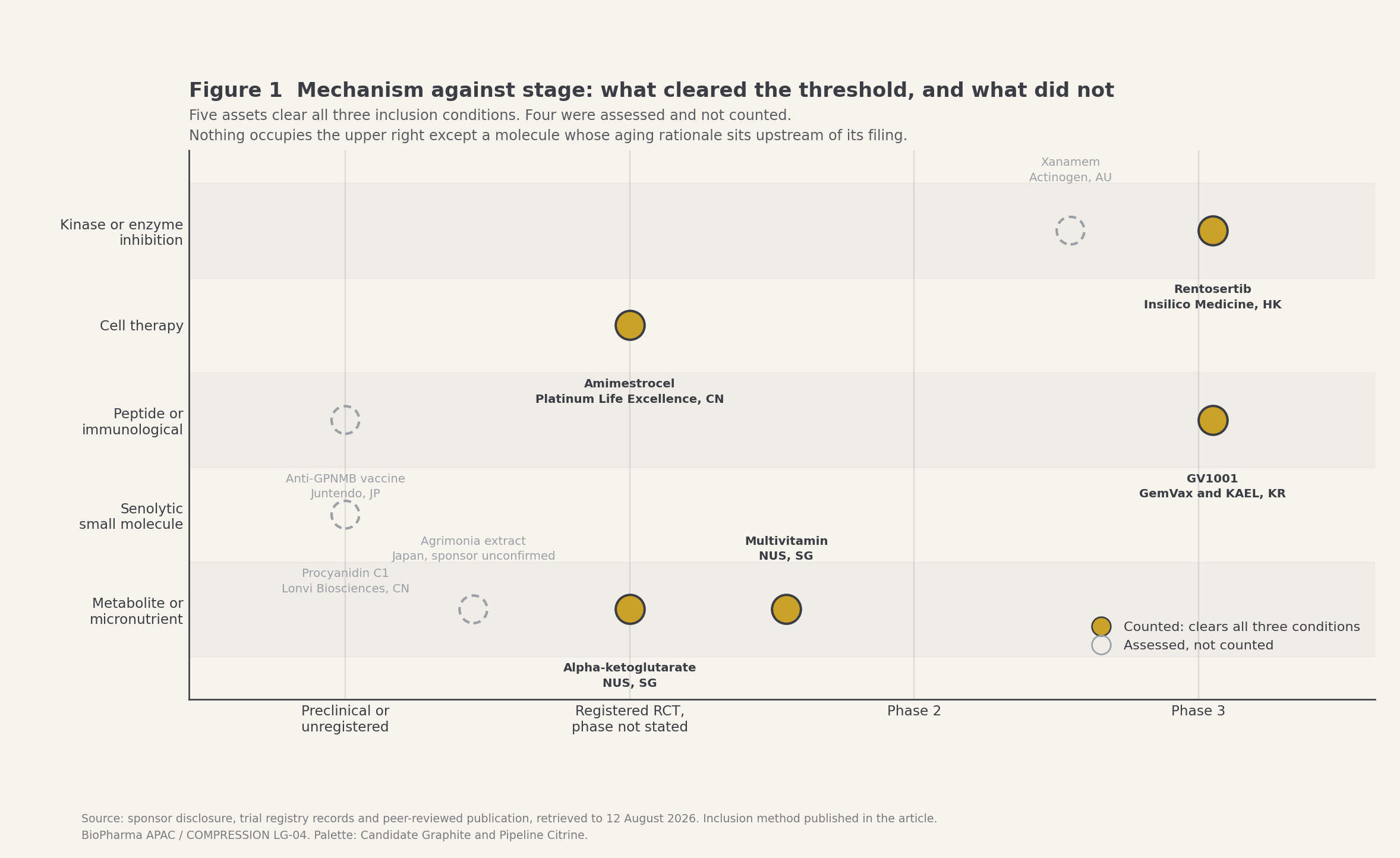
Figure 1. Mechanism against stage. Five counted assets in Pipeline Citrine, four assessed and not counted in outline. An interactive version with full hover detail per asset accompanies this article as a self-contained HTML embed.
What the five have in common, and what they do not
Read the entries together and the structural point becomes hard to miss.
Only one of the five is a novel chemical entity inside a registrational programme, and it is the one whose aging rationale sits furthest upstream. Rentosertib reaches Phase 3 precisely because it is filed as an antifibrotic. The aging biology explains how the molecule was found and plays no part in how it will be approved.
At the other end, the two Singapore trials say aging plainly, measure aging directly, and have no filing, no commercial sponsor, and no regulatory pathway. They are free to be explicit because nothing is at stake in a submission.
The remaining two sit in between and both borrow. GV1001 borrows Alzheimer's disease. Amimestrocel borrows an approval it earned in graft-versus-host disease and extends it toward a population defined by age. Neither built its regulatory position on aging biology. Both are using positions built elsewhere.
So the region's aging-adjacent clinical activity separates into two populations that do not meet. There are drug assets whose sponsors are disciplined about never saying aging, because there is no indication to say it into. And there are aging-labelled studies whose interventions are supplements or already-approved cell products, because there is no filing to endanger. The commercial consequence is straightforward: anyone marketing into this category is choosing between assets with regulatory substance and no aging claim, or aging claims with no regulatory substance. In Asia-Pacific in 2026, you cannot yet buy both in the same programme.
Assessed and not counted
The exclusions carry as much information as the list.
Xanamem, Actinogen Medical, Australia
The closest miss by some margin. An 11-beta-HSD1 inhibitor controlling cortisol in brain regions where the enzyme is highly expressed, in the XanaMIA Phase 2b/3 trial with 247 patients randomised across Australian and US sites, 36 weeks of treatment, CDR-SB as primary, topline expected November 2026. A separate Phase 2a in depression with 165 participants reported a 2.7-point MADRS benefit at week 10, rising to 4.2 points in the 46 per cent on background SSRI treatment. Glucocorticoid dysregulation is a recognised aging pathway, and the trial is the most advanced Australian-sponsored asset touching it. It fails our third condition and only our third condition: the sponsor frames the programme around cortisol and neurodegeneration, not around aging biology. Had Actinogen chosen the geroscience framing, this audit would report six.
The anti-GPNMB senolytic vaccine, Juntendo University, Japan
Scientifically the most striking aging-biology asset the region has produced, published in Nature Aging and supported by AMED-CREST. Excluded because it is preclinical. Japan's most-cited geroscience programme has no registered human trial, which is a sharper fact about the region than any of the entries above.
Procyanidin C1, Lonvi Biosciences, Shenzhen
Aging is stated as the rationale about as loudly as it can be stated, resting on a 2021 Nature Metabolism paper showing senolytic activity and lifespan extension in mice. Excluded because we could find no registered human trial and no published human data, while the compound is already sold as a capsule. That combination, aggressive aging claims plus a commercial product plus an absent trial registration, is the single most common pattern we encountered in this sweep and the reason the registration condition exists.
A Japanese immunosenescence RCT of Agrimonia pilosa extract
A randomised, double-blind, placebo-controlled study run in Japan between June 2023 and April 2024, screening 635 people to enrol 110 aged 40 to 59 on the basis of senescence-associated beta-galactosidase expression in CD8-positive T cells. Senescence is unambiguously the stated rationale. Excluded because we could not confirm a trial registration identifier or a commercial sponsor from available sources. This is a verification failure on our side, not a judgement about the study.
Clinic-channel provision in Japan and Korea
Thousands of patients receive cell products under lawful provision frameworks with anti-aging purposes recorded. That is provision, not clinical development, and this series has covered the distinction at length. Lawful provision is not approval and a provision plan is not a trial.
Incretins and sarcopenia programmes
Excluded by series boundary rather than by method. The incretin question belongs to the accidental gerotherapeutic entry in this series, and the endpoint question to the entry on endpoint ownership.
A reported Sumitomo Pharma longevity initiative
A figure in the region of USD 420 million appears in secondary market-research material. We could not corroborate it against company disclosure or primary reporting and therefore do not use it.
Where nothing cleared at all
India produced no qualifying asset. Neither did Taiwan, New Zealand, or Southeast Asia outside Singapore. Australia produced one near miss and no entry. Japan, the jurisdiction with the most developed regulatory architecture for cell-based aging interventions and the strongest academic senescence research in the region, produced no counted clinical asset at all.
That last absence deserves emphasis rather than a footnote. Japan has the framework, the science, and the patient volume. What it does not have, on this evidence, is a company taking a geroscience asset through a registrational programme.
For scale, the assets that most visibly define the category globally in 2026 are all outside this region: a partial epigenetic reprogramming gene therapy cleared for first-in-human study in January 2026, an alpha klotho mRNA therapeutic in Phase 1b, and a GPX4-modulating precision senolytic with dermatology proof-of-concept data. Asia-Pacific has demographics, manufacturing and cohorts. On present evidence it does not have the assets.
What would falsify each rationale
The entry template asks this of every asset, and the answers are short.
For rentosertib, the aging rationale fails if TNIK inhibition delivers antifibrotic benefit with no relationship to any senescence or aging-associated readout, which would make the discovery route incidental. For amimestrocel, it fails if benefit appears only in the inflammatory subgroups already served by the graft-versus-host indication, with no signal in the broader age-defined population. For GV1001, it fails if the Alzheimer's effect tracks conventional neuroprotection and shows no relationship to telomerase-associated or senescence readouts. For both Singapore trials, it fails if methylation-derived biological age shifts without any corresponding change in physiological function, which would confirm the clock as an artefact rather than a measure.
Every one of those is answerable within roughly eighteen months. That is unusual for this category and it is the reason this entry is built as an annual franchise.
Building for the second edition
This list is designed to be re-run rather than re-researched. The threshold is fixed and published. The entry template is fixed. What changes year to year is which assets cross which conditions, and that is a tracking exercise rather than an investigation.
Four things go into the 2027 pass. A native-language registry sweep of ChiCTR, jRCT and CRIS, which is the largest single gap in this edition. A resolved registration identifier for the amimestrocel trial. A standing check on whether any near-miss sponsor, Actinogen first among them, adopts an explicit aging framing. And a first-transition watch on whether an academic gerotherapeutic result in the region acquires a commercial sponsor.
If the answer next year is still five, that will be a finding. If it is fifteen, the movement will be visible entry by entry against a threshold that did not move to accommodate it. Either way the number will mean something, which is more than the claim we started with could say.
Most Read
- Can APAC Biomanufacturing Decarbonise Without Pricing Itself Out?
- The Algorithm on the GMP Floor: AI Promises a Smarter Plant. Regulators Demand the Audit Trail.
- APAC's Peptide-Capacity Gamble
- After the Rush: APAC's mRNA and Vaccine Capacity Hangover
- The Biosimilar Race: Factory to the World — or Stuck in the Copycat Economy?
- The Vein-to-Vein Problem: Can APAC's Cold Chain Carry Advanced Therapies?
- Vectors, Plasmids and the CGT Trap: APAC's Cell and Gene Therapy Ambitions Face an Upstream Bottleneck
- Can APAC Build Radioligand Therapy Before the Atoms Decay?
- The Great Biopharma Reset: 50 Developments That Changed Everything in H1 2026
- Beyond the Trial: Can Real-World Evidence Earn Regulatory Trust in APAC?
- Beyond the Obvious Giant: Where APAC's Clinical Trials Go Next
- The Frontier That Won’t Quite Arrive
Bio Jobs
- Sanofi Turns The Page As Belén Garijo Steps In And Paul Hudson Steps Out
- Global Survey Reveals Nearly 40% of Employees Facing Fertility Challenges Consider Leaving Their Jobs
- BioMed X and AbbVie Begin Global Search for Bold Neuroscience Talent To Decode the Biology of Anhedonia
- Thermo Fisher Expands Bengaluru R&D Centre to Advance Antibody Innovation and Strengthen India’s Life Sciences Ecosystem
- Accord Plasma (Intas Group) Acquires Prothya Biosolutions to Expand Global Plasma Capabilities
- ACG Announces $200 Million Investment to Establish First U.S. Capsule Manufacturing Facility in Atlanta
- AstraZeneca Invests $4.5 Billion to Build Advanced Manufacturing Facility in Virginia, Expanding U.S. Medicine Production
News