9 AI Drug Discovery Platforms Built in Asia-Pacific, and What They Have Actually Shipped
04 August 2026 | Tuesday | Analysis
For most of the past decade, the only honest answer to the question of whether AI drug discovery works in Asia-Pacific was that nobody could yet know. The molecules were too young. A platform could announce a target in January, a development candidate in June and a partnership in November, and none of it could be checked against the only test that finally matters, which is what happens when the compound meets a patient.
That has changed. The first regional cohort of AI-originated candidates is now old enough to carry clinical data, disclosed deal economics and, in a few cases, a peer-reviewed publication with a named principal investigator attached to it. Rentosertib moved into a Phase III registrational study in July 2026. An AI-designed formulation cleared Phase III in China in October 2025. A muscarinic agonist designed on a Tokyo-based structural platform is running two registrational studies with readouts scheduled for 2027 and 2028. There is now enough on the public record to stop grading platforms on their narrative and start grading them on their output.
This audit does that for nine platforms headquartered or principally operating in the region. It is deliberately not an argument about whether the sector is overvalued, and readers looking for that argument will find it in the Fault Lines series. What follows is the ledger the argument should be built on.
The method, published in full
Nine platforms were selected on disclosed pipeline or partnership activity, drawn from a longer screen of regional companies describing themselves as AI-driven discovery businesses. Each was then scored on two four-point scales, both built only from material the companies or their partners have put on the public record.
The claim score awards one point for each of the following public assertions: that the platform performs end-to-end AI discovery, covering target and molecule or full de novo design; that it has originated a proprietary clinical pipeline; that it outperforms an external benchmark or industry norm on speed, cost, accuracy or success rate; and that it has signed a collaboration with a headline value of USD 1 billion or more.
The shipped score awards one point for each of the following, with half points where the evidence is partial: at least one platform-originated molecule dosed in humans; at least one partnership with a disclosed cash figure that has been contracted or paid, as distinct from a milestone ceiling; platform output in a peer-reviewed journal; and independent replication, meaning a third party has generated data on the platform's output without the platform running the experiment.
Companies scoring zero across all four shipped tests were excluded, and that criterion is published here so it can be argued with. Exclusion is not a judgement on the science. It means only that, on the date of the check, nothing the company had shipped could be verified from outside the company. Several regional businesses that appear regularly on global AI discovery lists fell out on that basis, most of them selling computational services, data infrastructure or model access rather than originating molecules.
Every negative assessment below rests on a documented absence rather than on our inability to find something. Where the two could not be separated, the entry says we could not verify, and that phrasing is deliberate.
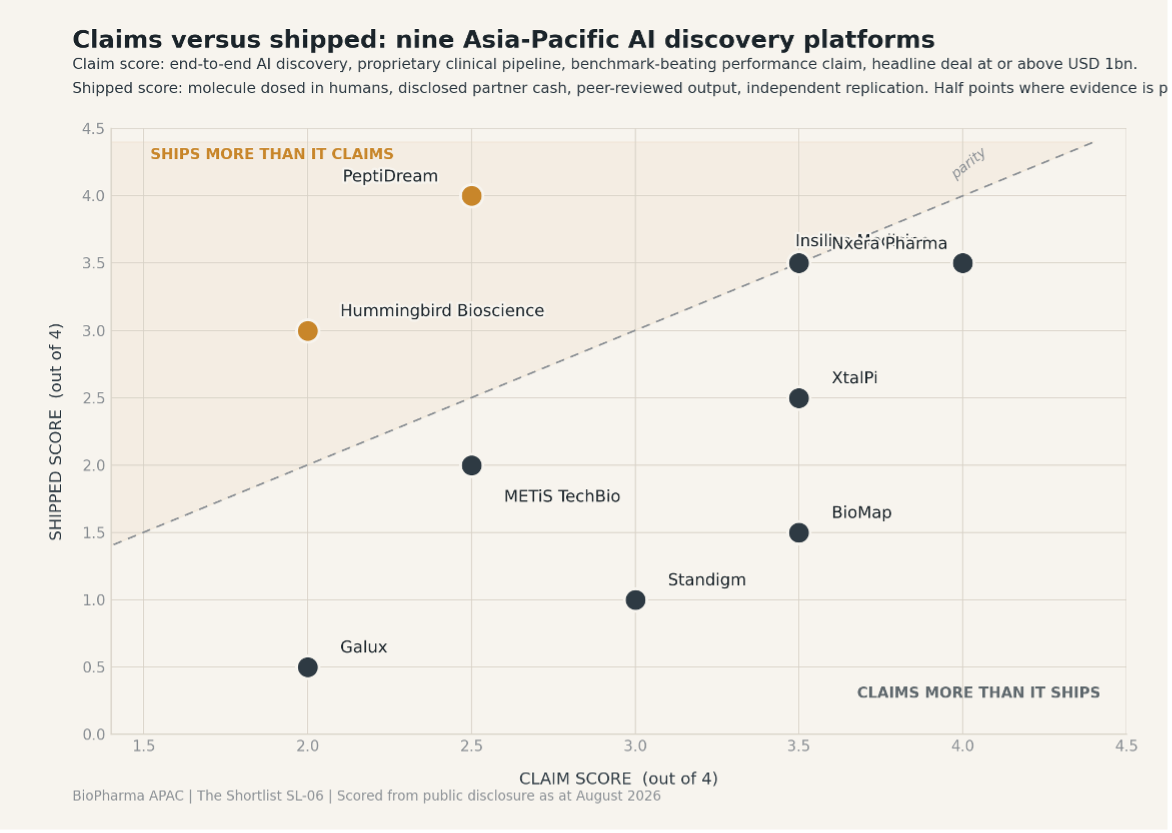
FIGURE 1 Claims versus shipped, nine platforms. Points above the diagonal ship more than they claim.
1 Insilico Medicine
Base: Hong Kong, with operations in Shanghai, Abu Dhabi and Boston. HKEX: 3696.
What it claims to do: End-to-end generative discovery through Pharma.AI, in which PandaOmics prioritises a target, Chemistry42 generates and optimises the molecule, and inClinico models the trial. The company describes the workflow as reproducible rather than a one-off.
What it has shipped: Rentosertib, a first-in-class oral TNIK inhibitor for idiopathic pulmonary fibrosis, with both the target and the structure attributed to the platform. Phase IIa results appeared in Nature Medicine in 2025 from a double-blind, placebo-controlled trial of 71 patients across 22 sites in China. The 60 mg once-daily arm recorded a mean forced vital capacity change of plus 98.4 mL against a decline of 20.3 mL on placebo. A Phase III registrational study began in July 2026. An inhaled formulation cleared CDE review in April 2026 as the thirteenth IND from the pipeline. On the commercial side, Exelixis paid USD 80 million upfront in 2023 for global rights to the USP1 inhibitor ISM3091, Menarini's Stemline took ISM5043, and the company listed in Hong Kong in December 2025 in the year's largest local biotech offering.
Strongest external validation: Peer review in Nature Medicine and Nature Biotechnology, plus an independent commercial partner in Exelixis running its own Phase 1 on an Insilico molecule.
Weakest link: The Phase IIa was powered for safety, not efficacy, and the confidence interval on the headline FVC gain ran from 10.9 to 185.9 mL, which is a wide band with a lower bound close to zero. Seven patients discontinued for liver injury or dysfunction, four of them while also taking standard antifibrotics. Quality-of-life measures were inconclusive. The dataset is also entirely Chinese, which matters for any future filing outside China.
Near-term proof point: Phase III enrolment and the first read on whether the FVC signal survives a properly powered study.
CLAIM 4.0 SHIPPED 3.5
2 XtalPi
Base: Shenzhen and Hong Kong, with Boston operations. HKEX: 2228.
What it claims to do: Quantum-physics-grade prediction combined with generative design and robotic wet-lab execution, spanning small molecules, biologics, antibody-drug conjugates and molecular glues, with the same stack applied to materials science.
What it has shipped: Cash, mostly. The DoveTree Medicines collaboration signed in mid-2025 carries a headline of up to USD 5.99 billion, and XtalPi has actually received USD 51 million upfront and a further USD 19 million as a second payment in May 2026, with the patents from the first tranche transferred and one preclinical candidate in IND-enabling studies. Full-year 2025 revenue reached RMB 802.6 million, up 201.2 per cent, with net profit of RMB 134.6 million in the company's first profitable year. On the molecule side, SIGX1094 for diffuse gastric cancer, co-developed with incubated company Signet Therapeutics, is in Phase I with FDA orphan drug and fast track designations and a Phase II start guided for the third quarter of 2026.
Strongest external validation: Audited revenue. XtalPi is the rare platform whose claims can be checked against a filed income statement, and the 2025 numbers show a discovery business that customers pay for.
Weakest link: Concentration. Drug discovery segment revenue grew 615.2 per cent in the first half of 2025 largely on the first DoveTree milestone, which means one counterparty carried the platform's best year. The clinical evidence is also thin and second-hand: the strongest efficacy datum in the public record for SIGX1094 is a 20 per cent lesion reduction in a single patient in one dose cohort, which is an anecdote rather than a result, and the asset belongs to an incubated company rather than to XtalPi outright.
Near-term proof point: Whether DoveTree milestones convert past the USD 70 million received, and whether SIGX1094 opens Phase II on schedule.
CLAIM 3.5 SHIPPED 2.5
3 METiS TechBio
Base: Beijing and Hangzhou, listed in Hong Kong in 2026.
What it claims to do: AI-designed formulation and nanodelivery rather than de novo molecule discovery, through AiTEM for small-molecule formulation, AiLNP for nucleic acid delivery and AiRNA for sequence optimisation.
What it has shipped: The most clinically advanced asset in this audit. MTS-004, an orally disintegrating tablet for pseudobulbar affect, met its primary endpoint in a Phase III trial reported in October 2025, with improvements on CNS-LS, CGI-C, PGI-C and the SF-36 mental health index, and a signal on bulbar function that matters for patients with swallowing difficulty. An NMPA filing was guided for 2026. The company reports that AiTEM compressed preclinical formulation development from one or two years to under three months, and MTS-004 was out-licensed in September 2025. Two further assets, MTS-201 and MTS-105, are in clinical development.
Strongest external validation: A completed, endpoint-meeting Phase III is a harder currency than anything else on this list, and the trial was run with named academic investigators.
Weakest link: Definitional. MTS-004 is an AI-designed formulation of a known therapeutic approach, not an AI-discovered molecule against an AI-discovered target, and readers comparing it with rentosertib are comparing different claims. The out-licensing terms were not disclosed in the material we reviewed, so the deal cannot be scored on economics. The company reports publications in Nature Communications and the Journal for ImmunoTherapy of Cancer, and we could not verify the specific citations before publication.
Near-term proof point: NMPA acceptance of the MTS-004 filing, which would make this the first AI-associated approval in the region.
CLAIM 2.5 SHIPPED 2.0
4 BioMap
Base: Beijing, with a Menlo Park presence and a Hong Kong accelerator.
What it claims to do: Foundation models for biology. xTrimo is described as a protein-centric large language model trained across seven biological modalities and running to 268 billion parameters, applied to target recommendation, antibody design and developability prediction.
What it has shipped: Disclosed partner cash and a corporate structure. Sanofi's 2023 collaboration carried a headline of more than USD 1 billion with USD 10 million paid upfront and milestones tied to model development rather than to drug progress, which was a genuinely novel deal shape. In June 2026, BioMap and Harbour BioMed co-founded MegaStream TechBio, an AI-native pipeline company pairing xTrimo with the Harbour Mice antibody platform, with founding economics undisclosed. The company filed confidentially for a Hong Kong listing in March 2026.
Strongest external validation: Sanofi, a large-cap buyer with its own substantial internal AI programme, chose to pay for module development rather than for a molecule.
Weakest link: No molecule from this platform has been dosed in a human that we could verify. The company's headline technical claim, that xTrimo outperformed AlphaFold 3 on antibody and single-domain antibody interaction prediction, is a self-reported internal benchmark, and we could not verify peer review of that specific comparison. The USD 10 million upfront against a billion-dollar headline is also a reminder that a foundation model deal and a molecule deal are priced very differently by the people writing the cheques.
Near-term proof point: The Hong Kong prospectus, which would put module milestone receipts and MegaStream economics on the public record for the first time.
CLAIM 3.5 SHIPPED 1.5
5 Nxera Pharma
Base: Tokyo, with research in Cambridge, United Kingdom. TSE: 4565.
What it claims to do: Structure-based discovery against G protein-coupled receptors through the NxWave platform, with computational design layered onto stabilised receptor structures. The company joined the OpenFold consortium in June 2026.
What it has shipped: NBI-1117568, an oral M4-selective muscarinic agonist licensed to Neurocrine Biosciences, which posted positive Phase 2 data in schizophrenia in August 2024, triggering a USD 35 million milestone. Neurocrine opened a Phase 3 registrational programme in May 2025 and a further USD 15 million became payable on first patient dosing in June 2025, recognised as revenue that quarter. Phase 3 readouts are guided for 2027 and 2028, with a Phase 2 study in bipolar mania also running. Nxera reports more than 30 active programmes and already sells two products in Japan.
Strongest external validation: The cleanest case of independent replication in this audit. Neurocrine, a company with no interest in flattering a Japanese platform, designed, funded and ran the Phase 2 and Phase 3 studies on a molecule Nxera designed, and paid cash at each gate.
Weakest link: The AI question. NxWave is structure-based drug discovery with computational chemistry, and Nxera does not present NBI-1117568 as a generatively designed molecule. Joining an open protein-modelling consortium in 2026 reads more like a platform adding machine learning than a platform built on it. We also did not verify a peer-reviewed publication of the M4 Phase 2 dataset, which was presented at ASCP in 2025.
Near-term proof point: The 2027 Phase 3 readout, which will be the first registrational result for a computationally designed molecule from a Japanese platform.
CLAIM 3.5 SHIPPED 3.5
6 PeptiDream
Base: Kawasaki, Japan. TSE Prime: 4587.
What it claims to do: Discovery of non-standard macrocyclic peptides through the Peptide Discovery Platform System, with computational design and, more recently, machine learning applied to efficiency. Notably, the company does not claim its clinical assets were AI-designed.
What it has shipped: The largest disclosed partner economics in the region by a wide margin. Novartis paid USD 180 million upfront in 2024 to expand a peptide collaboration first struck in 2010, with up to USD 2.71 billion in milestones and tiered royalties. Genentech paid USD 40 million upfront in 2023 against up to USD 1 billion for peptide-radioisotope conjugates. Separate agreements with MSD and Lilly carry headline values above USD 1 billion each. The pipeline spans radioligand therapy, peptide-drug conjugates and diagnostics, with partnered assets in clinical development and a royalty-bearing portfolio behind them.
Strongest external validation: More than twenty pharmaceutical companies have licensed the platform or taken its output into their own programmes, several of them repeatedly across fifteen years. Repeat buyers are the hardest validation there is.
Weakest link: Whether it belongs in an AI audit at all. On the company's own description, PDPS is a library synthesis and screening platform with computational and machine learning layers added. It appears on global AI discovery rankings largely because others put it there. We include it because it sets the ceiling for what shipped output looks like in this region, and because the honest comparison is useful.
Near-term proof point: Whether a partnered radioligand programme reaches registrational data, which would give the region its first approval-adjacent asset from a discovery platform of any kind.
CLAIM 2.5 SHIPPED 4.0
7 Standigm
Base: Seoul.
What it claims to do: Workflow AI covering the full early pipeline, with Standigm ASK for target discovery, Standigm BEST for lead design, Standigm Insight for repurposing and DarkMolFactory for molecular generation. The company has said the approach cuts time and cost by roughly 30 per cent.
What it has shipped: Collaborations rather than candidates. Standigm has run in-house and partnered programmes with Korean pharmaceutical companies and research institutions including Institut Pasteur Korea, where a grant-funded programme targeted drug-resistant tuberculosis, and it has raised roughly USD 70 million across five rounds. We could not verify a Standigm-originated molecule dosed in humans, and we could not verify a partnership with a disclosed cash figure. Korean industry reporting in 2025 recorded the company reducing headcount from around 80 to 27, and the same reporting noted that no AI-identified drug candidate in Korea had reached commercialisation.
Strongest external validation: Third-party research groups have generated data on Standigm outputs, and its investor base includes strategic pharmaceutical money.
Weakest link: The absence of a disclosed economic figure anywhere in the partnership record. A platform can be technically sound and still fail this test, and the test exists because a partner who will not name a number has usually not paid a large one. The headcount reduction is the more serious signal, because platform quality is largely a function of the people running it.
Near-term proof point: Any Standigm-originated candidate reaching IND, and any partnership announced with terms attached.
CLAIM 3.0 SHIPPED 1.0
8 Galux
Base: Seoul.
What it claims to do: De novo antibody and protein design through GaluxDesign, combining deep learning with physical models of folding and binding. The company reports designing high-affinity binders for eight of nine targets, an interface RMSD of 1.1 angstroms against an experimental cryo-EM structure, and a success rate above 30 per cent from design sets as small as 50 sequences.
What it has shipped: Preclinical evidence and partnerships without published terms. Co-development agreements are in place with Celltrion and LG Chem, a research agreement with Boehringer Ingelheim, and a technology validation project with AstraZeneca under the KHIDI Project NOVA programme. The company closed a USD 29 million Series B in February 2026, taking total funding to USD 47 million. Its most detailed design results were posted as a preprint in November 2025.
Strongest external validation: Two multinational pharmaceutical companies have signed research agreements, and the chief executive has been unusually candid in describing both as small-scale technology verification rather than drug programmes. That candour is worth more than a press release.
Weakest link: Nothing has left the laboratory. No clinical candidate, no disclosed partner economics, and design results that sat in preprint rather than peer review at the time of our check. The performance claims are also entirely self-generated, benchmarked internally against other models rather than replicated by a third party, which is the normal state of affairs in protein design and still a gap.
Near-term proof point: Peer review of the November 2025 results, and conversion of at least one validation project into a funded programme with disclosed terms.
CLAIM 2.0 SHIPPED 0.5
9 Hummingbird Bioscience
Base: Singapore, with United States operations.
What it claims to do: Computational and systems biology applied to antibody discovery, target selection and patient stratification, described by the company as working at the interface of artificial intelligence and human innovation. It is the most measured claim in this audit.
What it has shipped: Three clinical-stage assets from one platform. HMBD-001, an anti-HER3 antibody targeting the heterodimerisation interface, has run a Phase I/IIa sponsored and managed by Cancer Research UK's Centre for Drug Development, with dose-escalation data presented at ESMO in 2023 and Phase IB studies in Australia recruiting through Omico's genomics network. HMBD-002 against VISTA is in Phase 1. HMBD-501, a HER3-targeted antibody-drug conjugate with an exatecan payload, dosed its first patient in January 2026. Merck KGaA supplies cetuximab for a combination study, and Caris Life Sciences is working on response biomarkers.
Strongest external validation: Cancer Research UK's drug development unit sponsored and ran a trial on a Hummingbird molecule, which is a genuinely independent party generating clinical data on platform output. The HER3 mechanism was published in Molecular Cancer Therapeutics.
Weakest link: Money. We could not verify a partnership with disclosed economics anywhere in the record, and the collaborations named above are supply, biomarker and recruitment arrangements rather than licences with cash attached. For a company with three assets in humans, that absence is the thing to watch.
Near-term proof point: HMBD-501 dose-escalation data, guided for the second half of 2026.
CLAIM 2.0 SHIPPED 3.0
The ledger
|
Platform |
Base |
Claim |
Shipped |
Gap |
|
Insilico Medicine |
Hong Kong |
4.0 |
3.5 |
-0.5 |
|
XtalPi |
Shenzhen and Hong Kong |
3.5 |
2.5 |
-1.0 |
|
METiS TechBio |
Beijing and Hangzhou |
2.5 |
2.0 |
-0.5 |
|
BioMap |
Beijing |
3.5 |
1.5 |
-2.0 |
|
Nxera Pharma |
Tokyo |
3.5 |
3.5 |
0.0 |
|
PeptiDream |
Kawasaki |
2.5 |
4.0 |
+1.5 |
|
Standigm |
Seoul |
3.0 |
1.0 |
-2.0 |
|
Galux |
Seoul |
2.0 |
0.5 |
-1.5 |
|
Hummingbird Bioscience |
Singapore |
2.0 |
3.0 |
+1.0 |
What the ledger counts
Five of the nine have a platform-originated molecule dosed in a human. Five have at least one partnership with a disclosed cash figure that has been contracted or paid. Six have platform output in a peer-reviewed journal, though in three of those cases the peer-reviewed material describes the method rather than a clinical result. Four have something a reasonable person would call independent replication.
Two of the nine ship more than they claim, and both of them make the smallest claims about artificial intelligence. Two show a gap of two full points between what they assert and what can be checked, and in both cases the missing evidence is a molecule in a human rather than a technical shortfall.
Across the seven collaborations in this audit with both figures on the record, upfront cash averages well under a tenth of the headline value, and in the two largest headline deals the ratio is closer to one part in sixty. Nothing in that arithmetic is unusual for preclinical licensing. It is simply worth stating plainly, because headline values are what get reported and upfront payments are what get banked.
What we could not verify
We could not verify a Standigm-originated molecule in clinical development, or any Standigm partnership with a disclosed cash figure. We could not verify peer review of BioMap's comparative benchmark against AlphaFold 3, or the founding economics of MegaStream TechBio. We could not verify the specific METiS publications the company cites, or the terms under which MTS-004 was out-licensed. We could not verify a peer-reviewed publication of the NBI-1117568 Phase 2 dataset. We could not verify disclosed partner economics for Hummingbird Bioscience or Galux.
In each case the absence may reflect confidentiality rather than nonexistence, and each company was invited to close the gap ahead of publication.
Stated absences
No India-headquartered platform cleared the inclusion threshold on our checks. The country has a substantial and growing layer of computational chemistry, data engineering and multinational capability centres, but we could not verify an Indian-originated AI discovery platform with a molecule in humans and disclosed partner economics attached to its own IP. That is recorded as an absence rather than filled with a company that does not meet the test.
The same applies to Australia and New Zealand, which appear in this audit only as trial geographies, and to Southeast Asia outside Singapore. Taiwan hosts significant AI infrastructure and contract capability but no platform that met the threshold on our screen.
Absences are findings. They are recorded here so that the next edition of this audit can be scored against them.
Sources and method
All figures are drawn from company disclosures, exchange filings, partner announcements, regulatory registries and peer-reviewed publications, with the disclosure date attached wherever the figure moves. Deal values distinguish between cash contracted or paid and milestone ceilings, and the two are never combined. Clinical claims are attributed to the trial registry identifier or the publication in which they appeared. Where a company's own materials are the only source for a figure, the entry says so.
Scoring is deterministic and reproducible from the definitions published above. Half points are used only where evidence exists but is partial, and every half point is explained in the entry it belongs to. Nothing in the scoring rests on an assessment of scientific merit.
This audit is a snapshot. Platforms move, and the scores below the top of the table move fastest.
Right of reply
Each of the nine companies named was contacted with the specific findings in its entry, including every instance in which this audit records that something could not be verified, and given seven working days to respond before publication. Responses received are reflected in the entries above. Where a company supplied evidence that changed a score, the entry records both the original finding and the correction. Where a company did not respond, the finding stands as documented.
Disclaimer
Nature of this publication. This audit is journalism, not investment research, and nothing in it constitutes a recommendation to buy, sell or hold any security.
Basis of assessment. Scores reflect verifiable public disclosure as at the date of publication. A low shipped score records an absence of public evidence, not a finding of scientific weakness, commercial failure or misconduct.
Verification limits. Where this audit states that something could not be verified, that statement describes the outcome of our checks against public sources within the reporting period and should not be read as an assertion that the underlying evidence does not exist.
Company statements. Claims attributed to companies are reproduced as they were made publicly and are not endorsed. Headline collaboration values are contingent, largely milestone-based, and rarely realised in full.
Clinical data. Trial results described here are summarised from published or presented data and are not a substitute for the primary source. Early-phase results do not predict later-phase outcomes.
Currency and rounding. Amounts are stated in the currency of original disclosure. Conversions, where given, use the rate cited in the source document.
BioPharma APAC | The Shortlist
arcilla.fran@biopharmaapac.com
© 2026 BioPharma APAC. All rights reserved. Reproduction in whole or in part without written permission is prohibited
Most Read
- Can APAC Biomanufacturing Decarbonise Without Pricing Itself Out?
- The Algorithm on the GMP Floor: AI Promises a Smarter Plant. Regulators Demand the Audit Trail.
- APAC's Peptide-Capacity Gamble
- After the Rush: APAC's mRNA and Vaccine Capacity Hangover
- The Biosimilar Race: Factory to the World — or Stuck in the Copycat Economy?
- The Vein-to-Vein Problem: Can APAC's Cold Chain Carry Advanced Therapies?
- Vectors, Plasmids and the CGT Trap: APAC's Cell and Gene Therapy Ambitions Face an Upstream Bottleneck
- Can APAC Build Radioligand Therapy Before the Atoms Decay?
- The Great Biopharma Reset: 50 Developments That Changed Everything in H1 2026
- Beyond the Trial: Can Real-World Evidence Earn Regulatory Trust in APAC?
- Beyond the Obvious Giant: Where APAC's Clinical Trials Go Next
- The Frontier That Won’t Quite Arrive
Bio Jobs
- Sanofi Turns The Page As Belén Garijo Steps In And Paul Hudson Steps Out
- Global Survey Reveals Nearly 40% of Employees Facing Fertility Challenges Consider Leaving Their Jobs
- BioMed X and AbbVie Begin Global Search for Bold Neuroscience Talent To Decode the Biology of Anhedonia
- Thermo Fisher Expands Bengaluru R&D Centre to Advance Antibody Innovation and Strengthen India’s Life Sciences Ecosystem
- Accord Plasma (Intas Group) Acquires Prothya Biosolutions to Expand Global Plasma Capabilities
- ACG Announces $200 Million Investment to Establish First U.S. Capsule Manufacturing Facility in Atlanta
- AstraZeneca Invests $4.5 Billion to Build Advanced Manufacturing Facility in Virginia, Expanding U.S. Medicine Production
News