Where the Longevity Money Actually Goes
07 September 2026 | Monday | Analysis
METHOD IN BRIEF
Window: 1 January to 31 August 2026 for round-level claims, with full-year 2024 and 2025 figures for context. Attribution follows scientific and capital origin rather than legal domicile, with every divergence flagged in the text. Disclosure floor USD 5 million, set low enough to capture Southeast Asian and Indian rounds that international trackers, which typically observe reliably only above roughly USD 50 million, systematically miss; absences at that floor are stated as documented absences against the sources searched, not as proof that no round occurred. Clinic and wellness operator financing is tracked as a separate channel from therapeutic financing and is never blended into any headline total. Market sizing that traces only to commissioned market research is reported as the category's framing of itself, not as a finding. This story coordinates with this title's funding rounds franchise, which owns general biotech capital: that franchise's first edition closed a window of 1 January to 28 July 2026, none of its twelve entries claimed aging biology as the round's rationale, and the Gero round of 17 June, which falls inside both windows, was not among the twelve. No entry is duplicated between the two stories. This story recurs annually on the same tracking structure, so that next year's edition is assembly rather than research.
The number, and what it excludes
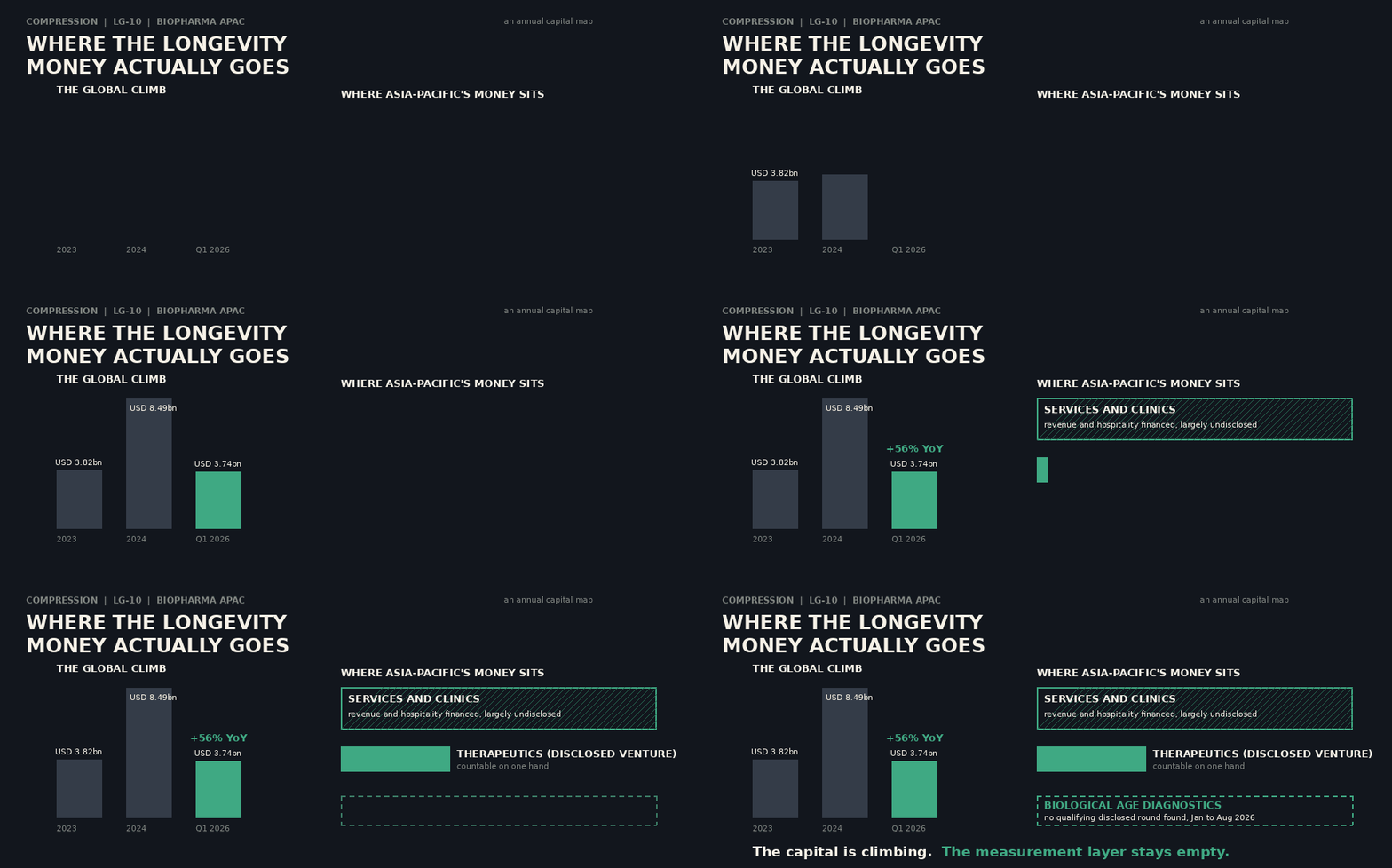
Start with the number everyone quotes. In the first quarter of 2026, longevity biotech companies worldwide raised approximately USD 3.74 billion across 49 financing events, according to an analysis by Longevity.Technology built on PitchBook data. That figure is 56 percent ahead of the same quarter a year earlier, on more deals, and the same analysis converges on a full-year 2026 outcome in the USD 8 billion to 9 billion range as the most probable case. The year before was already a record. The Annual Longevity Investment Report counted USD 8.49 billion across 325 deals in 2024, more than double the USD 3.82 billion raised in 2023.
Now ask where Asia-Pacific sits in that climb. The same 2024 report put the United States at 83 percent of total funding and Asia, defined there as China, India, Japan, Singapore and South Korea combined, at 2 percent, across 29 deals. A stricter pure-play tracker maintained by New Market Pitch, covering disclosed equity rounds of USD 300,000 and above from June 2025 to May 2026, is harsher still: North America took 96.74 percent of disclosed capital, and Asia-Pacific produced four qualifying deals worth USD 14.4 million in total, or 2.03 percent of capital, at an average round of USD 3.6 million and a median of USD 2.85 million.
Read literally, those figures say the region has no longevity capital worth mapping. This story exists because that reading is wrong, and it is wrong in a specific, structural way. Every one of those databases is a venture equity tracker. Each applies exclusions that are individually defensible for its purpose, and each of those exclusions happens to remove a channel where Asia-Pacific longevity money is actually concentrated.
Consider what a disclosed-equity methodology cannot see. It cannot see fund vehicles, so Immortal Dragons, the USD 40 million longevity-focused fund launched in Singapore that has invested in more than 15 startups across gene therapy, 3D bioprinting, xenotransplantation and cryopreservation, appears only if and when its portfolio companies announce rounds. It cannot see pharmaceutical collaboration money, so the Chugai Pharmaceutical partnership that carries an upfront payment and up to USD 250 million in milestones for Singapore-headquartered Gero is invisible, while Gero's much smaller USD 17 million equity announcement in June is the only part that registers. It cannot see self-pay clinical provision, so Japan's regenerative medicine economy, which by the register's own record runs through more than 1,000 active provision plans treating more than 10,000 patients a year, contributes nothing to any funding total anywhere. It cannot see clinic and wellness operators financed from revenue, hospitality balance sheets and private family capital, which is precisely how most of the region's longevity service infrastructure has been built. And it cannot see government instruments, from Singapore's national healthy longevity programmes to AMED's grant lines in Japan, because grants are excluded by design.
So the honest headline is not a single regional total. Following the funding tracker methodology this title uses for general biotech capital, this story refuses to publish a blended number that adds venture equity to clinic revenue to collaboration milestones, because those are different kinds of money with different obligations attached. What it publishes instead is a map of four channels, sized where disclosure allows, with the gaps stated as gaps. The disclosed venture channel for Asia-Pacific longevity therapeutics in the first eight months of 2026 is small enough to count on one hand. The diagnostics channel, at the disclosure floor this title applies, is empty. The service channel is where most of the money actually is, and it is the channel no tracker was built to record. And running parallel to all three is capital raised outside the region to develop science that originated inside it.
That allocation, once you see all four channels at once, is not a gap in the data. It is the finding.
Three channels, and one of them is empty
Take the channels in the order the narrative usually presents them, which is also the reverse of their actual size.
Therapeutics. The disclosed venture channel is countable. The most consequential regional round of the year so far is Gero's, announced on 17 June 2026: USD 17 million in new financing, bringing total equity funding to USD 34 million, for a company that combines longitudinal human data, physics-based models of aging and AI-driven target identification, and that has already converted its platform into a collaboration with Chugai Pharmaceutical, a member of the Roche Group, carrying an upfront payment and up to USD 250 million in milestones plus royalties. Backers in the new round included Melnichek Investments alongside operators from the pharmaceutical and technology sectors.
Under this title's standing methodology, attribution follows scientific and capital origin rather than legal domicile, and every divergence gets flagged. Gero is the divergence case of the year. The company is headquartered in Singapore with a US subsidiary in San Francisco. Its regional anchoring is real but partial: the strategic partner is Japanese, National University of Singapore professor Brian Kennedy sits on the board as an independent director, and the scientific framework travelled to Singapore with a founding team whose lineage is not Asia-Pacific. Its disclosed investor base is not principally regional either. A tracker attributing by domicile books the full USD 17 million to Singapore. An attribution by origin books a company that chose Singapore as its base and is progressively growing regional roots through Chugai and NUS. Both readings are published here; neither is blended into a total.
Beyond Gero, the pattern this title documented in its August audit of aging-adjacent clinical assets holds for the money as well as the science. Of the five Asia-Pacific assets that cleared that audit's inclusion bar, not one is financed through a venture round a longevity tracker would capture. Rentosertib sits inside Insilico Medicine, a Hong Kong-listed company, so its funding arrives as public equity. Amimestrocel sits inside a company with an approved product and hospital partnerships. GV1001 sits inside listed GemVax. The two Singapore academic trials, alpha-ketoglutarate and multivitamin, are grant-funded through NUS. The region's aging-relevant therapeutic work is real, but it is financed inside listed vehicles, approved-product cash flows and public grants. Venture equity, the only instrument the global trackers count, is the instrument the region uses least.
There is also a fund layer forming beneath the round data, and it deserves its own line because it is the leading indicator the trackers will eventually catch. Immortal Dragons in Singapore is the visible case, but this title's general funding tracker documented the same structure in Japan earlier this year: dedicated life science vehicles closing at the fund level faster than they convert into disclosed company rounds. A region can hold substantial committed longevity capital that appears in no deal database for two or three years, because commitments are announced once and deployments often are not. The correct reading of a thin regional round count is therefore not that the capital is absent. It is that the capital is early in its deployment cycle, and the round data will lag the commitment data by design. Next year's edition will track the conversion rate directly.
Diagnostics. Here the channel is not small. It is empty. Across the sources searched for this story, at the USD 5 million disclosure floor this title applies precisely so that Southeast Asian and Indian rounds are not missed, no Asia-Pacific biological age diagnostics company disclosed a qualifying equity round between 1 January and 31 August 2026. That is a documented absence, stated as such, and it is consistent with the global picture rather than an exception to it: in New Market Pitch's 24-month pure-play dataset, age biomarker companies captured roughly 1 percent of 2025 capital and none of the 2026 total at the time of its mid-year update.
This is the conspicuous part, because biological age measurement is the single most prominent element of the longevity narrative in the region. It is on the clinic menus, in the marketing, on the conference stages. This title mapped the category in August and found it sitting outside diagnostic regulation in every major Asia-Pacific market, with the multi-omic composite report unclassified in all six markets examined. The same piece set out the qualification arithmetic that explains the missing money. The US biomarker qualification programme has accepted 61 projects since 2007 and fully qualified eight biomarkers, most before the end of 2016, with a median development time of 32 months rising to 47 for surrogate endpoints. Qualification is slow, expensive and buys a narrower permission than wellness framing already grants. So biological age testing in Asia-Pacific is not financed as a diagnostics business at all. It is financed as a customer acquisition line inside the service channel, from clinic cash flow, with retest intervals of three to six months doing the work that recurring revenue models do elsewhere. Investors are not failing to notice the diagnostics opportunity. They are pricing, correctly under current rules, that a standalone biological age diagnostics company has no regulated market to grow into, no payer, and no moat that a clinic cannot replicate by white-labelling the same assay.
The consequence sits at the centre of this story. Every serious version of the longevity investment thesis depends on measurement: a validated way to show, inside a fundable trial window, that an intervention changed the trajectory of aging. The channel that would build that measurement layer is the one channel attracting effectively nothing, in this region and almost everywhere else.
Service operators. Which brings the map to where the money actually is.
The clinic channel
The largest flows of longevity money in Asia-Pacific never touch a cap table that trackers can see, because the operators taking that money are clinics, and clinics are financed by customers.
The unit economics explain why the channel needs so little external capital. In Singapore, Chi Longevity, co-founded by Professor Andrea Maier and operating from premises at the Four Seasons Hotel, offers packages reported by Fortune at 4,250 to 18,000 Singapore dollars, with the top tier spanning blood tests and gene panels, physical and cognitive assessments and ongoing lifestyle management. A clinic that can sell assessment programmes at those prices, with retesting built into the product, funds its own expansion. The same city has added a cluster of new entrants inside two years, from The Longevity Suite Asia, an offshoot of the Milan-based operator, to concierge services such as Elyx Life, and the pattern repeats across the region's wealth centres. Fortune's July reporting on Asia's clinic boom made the essential observation in its headline: the region's super-aging societies are driving high-end longevity clinic growth even as public enthusiasm outpaces the science.
Where venture capital does enter this channel, it confirms the shape rather than changing it. The most instructive regional round of the year is not a therapeutics round at all. YIYUAN Longevity, a Chinese startup, raised angel funding reported by Pandaily at roughly USD 5 million to 7 million to commercialise what it calls a quantifiable anti-aging service system, built around a proprietary oxygen chamber and a consultant-led service model. Note what was funded: not a molecule, not a diagnostic seeking classification, but a replicable service format with measurement as the sales layer. That is the channel's centre of gravity, and one visible angel round in China is the tip of a financing structure that otherwise runs through hospitality groups, hospital systems, family offices and franchise capital, none of which files a funding announcement.
The biggest single flow in the channel has no announcements at all. Japan's regenerative medicine provision economy, running lawfully under the country's regenerative medicine framework through more than 1,000 provision plans and more than 10,000 patients a year, is a self-pay clinical market that has operated at scale for a decade. This title has reported at length on what that register does and does not certify, and the house rule stands: lawful provision is not approval, and none of this money purchases evidence in the regulatory sense. But as a map of where Asia-Pacific longevity spending concentrates, the register economy dwarfs the region's entire disclosed venture channel, likely by an order of magnitude annually, and it appears in no funding database on earth.
What is the channel worth in aggregate? Honestly, nobody knows, and this title will not pretend otherwise. Commissioned market research sizes the global longevity clinic services market anywhere from roughly USD 4 billion to 11 billion in 2025 depending on the report, with Asia-Pacific consistently described as the fastest-growing region on compound growth rates between roughly 12 and 25 percent. Those figures trace only to the market research industry's own models, so they are reported here as the category's framing of itself, not as findings. What can be said from primary evidence is narrower and more useful: the channel is large enough to support double-digit new clinic openings in Singapore alone inside two years, price points that reach five figures per customer per year, and the entry of hospitality groups whose capital commitments are made at the property level and never disclosed as longevity investment.
One regulatory event will decide how this channel consolidates. Singapore's Healthcare Services Act Phase 2 licensing, expected across 2026 and 2027, will determine whether longevity clinics are classified under medical or wellness categories. Classification under clinical standards would impose data requirements that the evidence-led operators can meet and many cannot, which is why the most credible operators in the market have been quietly arguing for the stricter reading. When the classification lands, expect the channel's first real consolidation, and expect the survivors to start raising institutional capital in disclosed rounds. That is the moment this channel becomes visible to the trackers. It has not arrived yet.
Per this title's standing methodology, none of the clinic channel's flows are blended into any therapeutic funding total, here or in the graphic. They are a different kind of money. The point of this section is that they are also most of the money.
The parallel channel
The fourth channel runs in the opposite direction to the usual complaint. The familiar worry is foreign capital buying regional science cheaply. In longevity, the sharper pattern is regional science and regional capital both being monetised through vehicles that sit outside the region, so that the value created never appears in any Asia-Pacific column.
The cleanest case comes from the adjacent metabolic space, which this title treats as the region's de facto gerotherapeutic category and covers fully elsewhere in this series, so one line suffices here: orforglipron, the first oral small-molecule GLP-1 agonist approved in the United States on 1 April 2026 and priced at USD 149 to 399 a month, was discovered by Chugai. The molecule most likely to function as a mass-market longevity-adjacent therapeutic worldwide is Asia-Pacific science, and every dollar of its development financing and product revenue accrues to a US company under license. On the funding maps this story opened with, that value registers as American.
The same structure operates at smaller scale in longevity proper. Chugai's collaboration with Gero sends Japanese pharmaceutical capital into a Singapore-domiciled company whose scientific and capital origins are largely external to the region, which is the mirror image of the NewCo pattern this title's funding tracker documents in general biotech, where non-regional vehicles raise Western capital to develop Asia-Pacific molecules. Both patterns end the same way: the region participates as licensor, partner, cohort supplier and increasingly as limited partner, while the equity value concentrates elsewhere.
And elsewhere, the equity value is now very large. NewLimit closed a USD 435 million Series C on 2 June 2026, led by Founders Fund at an approximately USD 3.1 billion valuation, to take partial epigenetic reprogramming toward a first human study expected in 2027. Retro Biosciences, which raised USD 1 billion in early 2025, has announced the initial close of a further round at a USD 1.8 billion pre-money valuation to advance its first clinical programme. Nothing remotely comparable exists in Asia-Pacific. There is no regional reprogramming company, no regional billion-dollar longevity vehicle, and no regional fund at the scale that would create one. Immortal Dragons, at USD 40 million, is the region's most visible dedicated fund, and a meaningful share of its stated portfolio interests, from organ printing to cryopreservation, sits in science and companies outside the region. Even the region's own longevity-dedicated risk capital, in other words, partly deploys outward.
The parallel channel matters to this story for one reason. When the region's strongest longevity-relevant science is monetised through external vehicles, the disclosed regional funding total is not just an undercount of regional activity. It is a systematically biased undercount, because the highest-value activity is precisely the activity most likely to be structured offshore. Any future edition of this story that shows the regional venture number rising should check first whether the rise is real or whether a vehicle simply moved its domicile.
What the allocation says
Strip the four channels down to what investors are actually doing, and a coherent set of beliefs emerges. It is worth stating them plainly, because the allocation is more honest than the narrative.
First, investors believe the service business is real now. Money flows to clinics because clinics have customers, prices and cash cycles that exist today, and because in most of the region the regulatory position of a longevity service is more settled, or at least more permissive, than the regulatory position of a longevity drug or a longevity diagnostic. The channel where evidence is not required is the channel where capital does not wait.
Second, investors believe the therapeutic thesis, but not that it will be financed here as venture equity. The region's aging-relevant therapeutic work advances inside listed companies, approved-product cash flows, grants and pharmaceutical collaborations. That is not a deficiency of conviction. It is a rational response to the structure this series has mapped across nine stories: no approvable indication anywhere in the region, no qualified surrogate endpoint anywhere in the world, and no payer system on the continent currently able to value a multi-decade prevention claim. Venture equity needs an exit story, and the exit story for a pure aging therapeutic in Asia-Pacific still does not parse. The money is not wrong about this. The rules are.
Third, and most tellingly, investors do not believe that standalone measurement is a business, and their disbelief is the single best diagnostic of the category's condition. If sophisticated capital expected aging therapeutics to mature into a regulated category in this region within a fund's lifetime, the measurement layer would be a land grab, because whoever owned the validated endpoint would tax every trial that followed. This series made that argument about endpoint definitions in muscle, where the asset being fought over is a consensus document. A funded biological age diagnostics sector would be the same fight, waged with capital. The fight is not happening. At this title's disclosure floor, not one Asia-Pacific biological age diagnostics round was found in eight months of 2026, against a global backdrop where the biomarker category took around 1 percent of last year's capital and none of this year's. The tool that would unlock the category is unfunded precisely because the people with the strongest financial incentive to unlock it have concluded, for now, that it will not unlock on any timeline they can underwrite.
So the money is not confused. The money is downstream of evidence, and it has arranged itself with some precision around where evidence is and is not required: heavily into services that need none, selectively into therapeutics through instruments that do not depend on an aging indication, and not at all into the measurement layer whose entire value depends on a regulatory future nobody will fund on spec. The steep global funding curve this story opened with does not contradict that reading. Most of that curve is a small number of very large American bets on reprogramming platforms, which is a wager that the science will eventually force the rules to move. Asia-Pacific capital, on the evidence of this map, is making the opposite wager: that the rules move slowly, that services collect the cash meanwhile, and that the region's best science is worth more inside somebody else's vehicle than inside a regional one.
This story becomes an annual franchise, and the test it will apply next year is simple. Three events would each falsify the current reading: a disclosed Asia-Pacific biological age diagnostics round above the floor, a regional longevity-dedicated fund above USD 100 million deploying principally into regional science, or a clinic operator raising institutional equity on the strength of published outcome data rather than package pricing. Any one of those would mean the allocation is starting to believe in the category's regulated future. Until then, the map is the message: the longevity money is here, it is larger than any tracker records, and almost none of it is buying the one thing the narrative says the field is about.
arcilla.fran@biopharmaapac.com
Sources and method
Global quarterly and annual funding figures: Longevity.Technology analysis of PitchBook data (Q1 2026, published 31 March 2026); Annual Longevity Investment Report 2024 as reported by Asia Tech Lens (August 2025); New Market Pitch pure-play longevity funding trackers (12-month and 24-month datasets, updated to mid-2026), each applying its own inclusion rules as described in the text. Gero financing: company announcement via Business Wire, 17 June 2026, and contemporaneous coverage (BioSpace, MobiHealthNews, FinSMEs). Immortal Dragons: Asia Tech Lens, August 2025. YIYUAN Longevity: Pandaily. Chi Longevity pricing and the regional clinic boom: Fortune, 8 July 2026. Singapore HCSA Phase 2 timing and classification question: contemporaneous regional coverage; timing rests on professional commentary rather than a published government schedule. NewLimit and Retro Biosciences: company announcements and contemporaneous coverage, June to August 2026. Orforglipron approval and pricing, Japan provision plan figures, biomarker qualification arithmetic, and the aging-adjacent asset audit: this title's prior reporting in this series, sourced there to primary documents. All URLs and capture dates are held on file.
Live at publication: the HCSA Phase 2 licensing schedule and the New Market Pitch tracker totals are the fastest-moving facts in this story and were checked in the week of publication.
Most Read
- Can APAC Biomanufacturing Decarbonise Without Pricing Itself Out?
- The Algorithm on the GMP Floor: AI Promises a Smarter Plant. Regulators Demand the Audit Trail.
- APAC's Peptide-Capacity Gamble
- After the Rush: APAC's mRNA and Vaccine Capacity Hangover
- The Biosimilar Race: Factory to the World — or Stuck in the Copycat Economy?
- The Vein-to-Vein Problem: Can APAC's Cold Chain Carry Advanced Therapies?
- Vectors, Plasmids and the CGT Trap: APAC's Cell and Gene Therapy Ambitions Face an Upstream Bottleneck
- Can APAC Build Radioligand Therapy Before the Atoms Decay?
- The Great Biopharma Reset: 50 Developments That Changed Everything in H1 2026
- Beyond the Trial: Can Real-World Evidence Earn Regulatory Trust in APAC?
- Beyond the Obvious Giant: Where APAC's Clinical Trials Go Next
- The Frontier That Won’t Quite Arrive
Bio Jobs
- Sanofi Turns The Page As Belén Garijo Steps In And Paul Hudson Steps Out
- Global Survey Reveals Nearly 40% of Employees Facing Fertility Challenges Consider Leaving Their Jobs
- BioMed X and AbbVie Begin Global Search for Bold Neuroscience Talent To Decode the Biology of Anhedonia
- Thermo Fisher Expands Bengaluru R&D Centre to Advance Antibody Innovation and Strengthen India’s Life Sciences Ecosystem
- Accord Plasma (Intas Group) Acquires Prothya Biosolutions to Expand Global Plasma Capabilities
- ACG Announces $200 Million Investment to Establish First U.S. Capsule Manufacturing Facility in Atlanta
- AstraZeneca Invests $4.5 Billion to Build Advanced Manufacturing Facility in Virginia, Expanding U.S. Medicine Production
News