The Bioreactors Are Ours. The Consumables Are Not.
22 July 2026 | Wednesday | Analysis
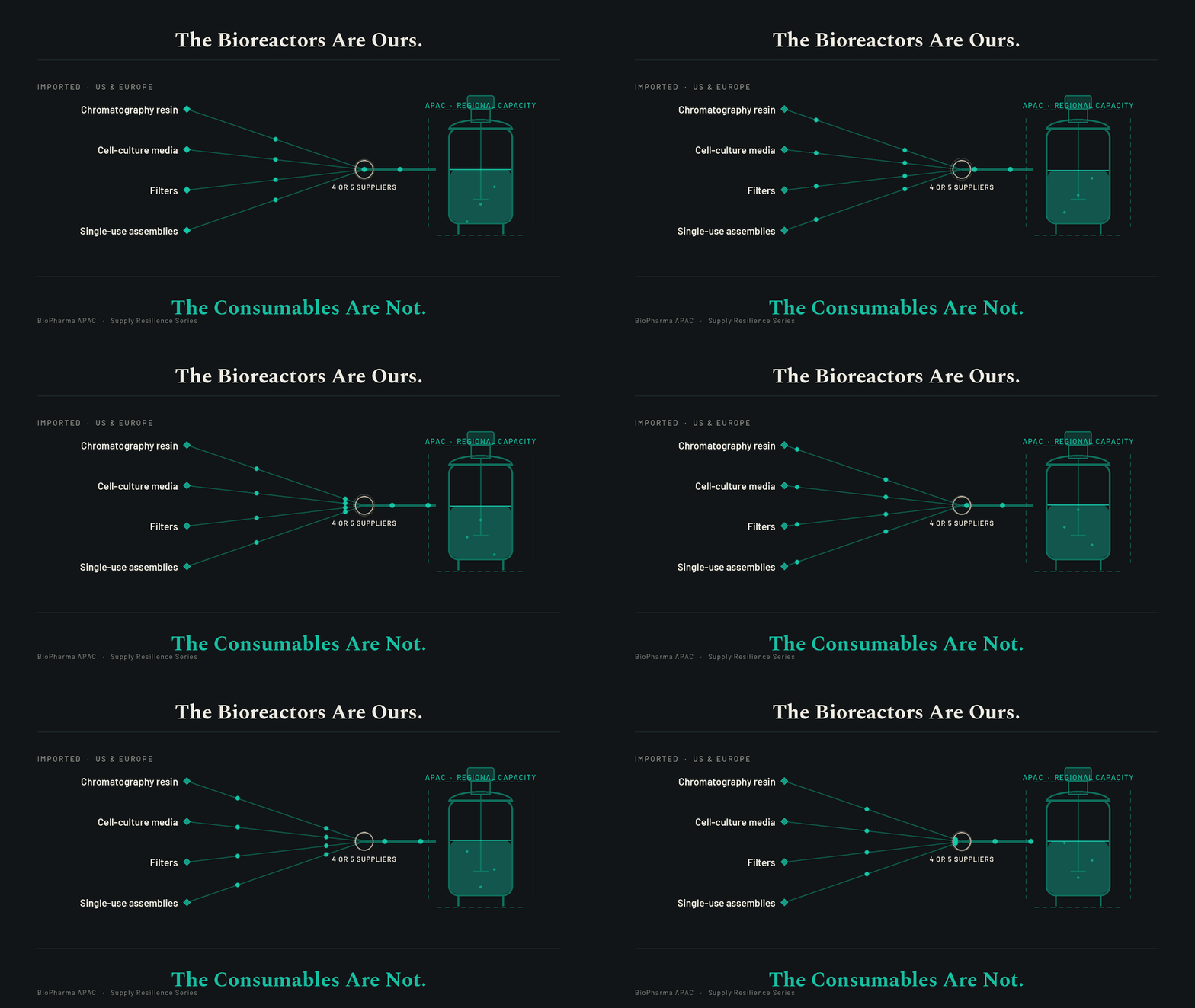
A new biologics plant is one of the easier things in medicine to photograph. The bioreactors are large and gleaming, the capacity figures are big and round, and between Hyderabad and Songdo there are more of both every year. Governments cut the ribbons. Trade ministries circulate the images. Analysts tally the installed litres and pronounce the region self-reliant in biomanufacturing. The steel, and the growing wall of single-use hardware beside it, looks like the story.
It is not the whole story. Inside those vessels, the things that make a biologic possible are chromatography resins, cell-culture media, sterilising and virus-retentive filters, and the bags and tubing sets that connect everything together. Almost none of it is made in the region at the quality and scale that a licensed commercial process demands. The bioreactor may be Korean or Indian. The Protein A resin that captures the antibody, the media that feeds the cells, the filter that guarantees viral safety: those are still shipped in, usually from a very short list of suppliers concentrated in the United States and Europe.
A companion feature in this series looked at single-use versus stainless as a plant-model choice, the decision a manufacturer makes when it designs a facility. This one is about something the design brief cannot fix. It is about who controls the consumables, how few of them there are, and what happens on the day one of those suppliers cannot ship. The most exposed supply risk in APAC biomanufacturing is not the headline capacity that everyone measures. It is the quiet dependency underneath it.
Where the consumables actually come from
Start with the resin, because it is the sharpest example. Chromatography resin is the packed media inside the columns that purify a biologic, and for monoclonal antibodies the critical one is Protein A, the affinity resin that captures the antibody out of the harvest. This is a genuinely small market. Industry analysts put the global chromatography resin market at roughly US$2.7 billion in 2026, and within it a single supplier, Cytiva, has been credibly described as holding on the order of 80 percent of the resin segment. The rest is divided among Merck KGaA, Thermo Fisher, Sartorius and Bio-Rad, with second-tier specialists such as Purolite and JSR Life Sciences filling niches. For the specific job of Protein A capture, the practical field a plant can qualify from is smaller still.
The concentration is deeper than the vendor list suggests, too. A resin is a base bead, usually a cross-linked agarose or a polymethacrylate, carrying a ligand, and for Protein A the ligand is an engineered protein produced by fermentation. The specialised inputs behind those beads and ligands come from an even shorter roster of upstream chemistry suppliers, several of them the same firms again. So a manufacturer that dutifully qualifies a second resin brand may discover the two supposed alternatives lean on overlapping raw materials. Diversifying the label is not the same as diversifying the supply chain, and the true chokepoint often sits a tier below the name on the drum.
Cell-culture media is a little broader, but the pattern rhymes. The market is dominated by Thermo Fisher, Danaher's Cytiva, Corning, Merck KGaA, Sartorius and Lonza, the same names that appear on the bioreactors. Media is a formulation as much as a product: hundreds of components blended to a recipe that a specific cell line has been adapted to over years. A media lot is not a commodity you swap on price. It is a qualified input tied to a particular clone and a particular process.
Filters and single-use assemblies complete the picture, and here the concentration comes with a twist. Danaher's ownership of both Cytiva and Pall means one corporate parent sits across resins, filters and single-use hardware, able to bundle them into an integrated workflow. Sartorius, Merck's MilliporeSigma and Thermo Fisher round out an oligopoly that industry reports describe as moderately consolidated and, in single-use, closer to an outright oligopoly of end-to-end providers. These firms no longer sell bags. They sell validated workflows, and a workflow is far harder to leave than a bag.
The through-line is that every category a plant depends on, resin, media, filters and assemblies, resolves to four or five global suppliers, and in the most critical sub-categories to one or two. That is the dependency map. The bioreactor was the easy part to regionalise. The consumables are where the concentration lives.
The APAC Consumable Dependency Map
Who makes the things that flow through the region's bioreactors, and how hard each one is to replace.
|
Consumable |
Who makes it |
Concentration |
Made for APAC where |
|
Chromatography resin (Protein A) |
Cytiva (dominant), Merck KGaA, Thermo Fisher, Sartorius, Bio-Rad; Purolite, JSR in niches |
Very high |
US and Europe; APAC packing/finishing only |
|
Cell-culture media & feeds |
Thermo Fisher, Cytiva, Corning, Merck KGaA, Sartorius, Lonza |
High |
US and Europe; growing dry-powder/liquid capacity in APAC |
|
Sterilising & virus filters |
Merck/MilliporeSigma, Pall (Danaher), Sartorius, Cytiva |
High |
US and Europe; select APAC assembly |
|
Single-use bags & assemblies |
Cytiva, Sartorius, Thermo Fisher, Merck |
High |
Regional lines rising: China, India, South Korea |
|
Tubing, connectors, sensors |
Same oligopoly, plus specialist licensors |
Medium |
Partly regional; film and sensor IP still foreign |
Concentration bands are editorial estimates drawn from public market analyses; they describe the practical qualifiable field for a commercial process, not raw vendor counts.
Why you cannot just switch
If the supply were concentrated but easily substitutable, none of this would matter much. You would hold a second supplier in reserve and move volume when you needed to. Bioprocessing does not work that way, and the reason is qualification.
A biologic is licensed as a process, not just as a molecule. The regulatory filing, the BLA in the United States, the marketing authorisation in Europe, and the equivalent dossiers a manufacturer holds across APAC, all name the resin, the media and the critical filters that were used to make the material regulators reviewed. Change any of them and you have to prove the product is still the same. That proof is called comparability, and it is not a formality. It means running the new consumable at scale, characterising the product it yields against the approved one, demonstrating that impurity profiles, glycosylation, aggregation and potency all sit inside the same envelope, and then persuading every regulator who approved the drug that the change is safe.
For a chromatography resin on a commercial product, a second-source qualification programme typically runs 18 to 24 months, and for the most sensitive changes it can run longer once regulatory review is added. Depending on the market, the change may require a prior-approval supplement, which means you cannot ship product made the new way until the agency signs off. Multiply that across the dozen or more markets a regional exporter sells into, each on its own timeline, and the true cost of switching is measured in years and in millions of dollars of characterisation work, engineering runs and lost flexibility.
An MSAT lead at a South Korean biosimilar manufacturer, who has taken a second Protein A source through qualification, put the arithmetic plainly. “The resin costs a fraction of the programme,” the lead said. “What you are really paying for is the comparability package and the regulatory risk. You do all of that work, and at the end you have earned the right to use a second supplier you hope you never need. Finance asks why we spend a year and a half qualifying something we may never buy in volume. The answer is that the year and a half is the insurance premium.”
That is the lock-in mechanism, and it is worth being clear that it is nobody's conspiracy. It falls out of doing biologics safely. Regulators demand comparability because patients depend on it. Suppliers bundle workflows because integration genuinely reduces variability. The result, though, is that a plant which qualified on Supplier A five years ago is, in any practical sense, married to Supplier A. The switching cost is the moat, and the moat is why concentration at the top of the market is so durable. The steel can be regionalised in eighteen months. The qualified consumable relationship cannot.
The stress tests already run
None of this is theoretical, because the system has already been tested. The pandemic was the stress test nobody designed, and it exposed exactly this fault line. When global vaccine and antibody manufacturing surged at once, demand for the same short list of consumables spiked everywhere simultaneously. Suppliers moved to allocation, the polite industry word for rationing. Instead of ordering what you needed, you were told what you would get.
Lead times that had sat comfortably at eight to sixteen weeks blew out. Single-use bags, certain filters and Protein A resin moved onto allocation regimes where six to twelve months, and in the worst cases longer, became the working assumption. Priority went to the largest and longest-standing accounts, which in practice meant the big Western manufacturers and the vaccine programmes with government backing. A newer plant in APAC, without decades of purchasing history, could find itself at the back of the queue for the very inputs its shiny bioreactors were built to consume.
A supply-resilience lead at a Singapore-based biologics manufacturer described hitting that ceiling directly. “We had capacity sitting idle because we could not get film and filters on any reliable date,” the lead recalled. “The bioreactor was the last thing we worried about. We could have built another one faster than we could get a firm delivery date on a consumable. That was the moment the board understood the difference between installed capacity and usable capacity.”
What made the ceiling so hard to climb over was that consumables are not interchangeable even within a category. A single-use bag is not a generic bag: it is a specific film, a specific assembly drawing, sterilised and qualified for a specific process. When the incumbent supplier put that exact assembly on allocation, there was no shelf of equivalent bags to buy instead, because an equivalent would itself have to be qualified. Allocation, in other words, did not just slow deliveries. It froze a plant into a supplier at the precise moment that supplier could not deliver, and the only fast lever left was to draw down whatever inventory the plant had been prudent enough to hold.
The episode did two things. It taught manufacturers that a capacity number with no secured consumable supply behind it is a vanity metric, and it taught suppliers that concentration cuts both ways. A market where a handful of firms hold most of the volume is a market where a single disrupted plant, a fire, a contamination event, a raw-material shortfall for a specialised polymer or ligand, propagates fast because there is nowhere else for demand to go. The polymer shortages of the early 2020s made that concrete, and the memory has driven a wave of investment ever since. The uncomfortable question is whether the region has fixed the exposure or merely moved it a little closer to home.
The regional answer, and its limits
The response has taken two forms. The first is the suppliers themselves building in the region, the in-region-for-region strategy that every major consumables firm now recites. The second is manufacturers qualifying second sources so they are not hostage to one vendor. Both are real. Neither is a clean fix.
On the supplier side, the build-out is substantial. Cytiva has committed roughly US$1.6 billion since 2019 to expand resin, filtration, single-use and media capacity, including trebling single-use consumable manufacturing in Beijing, a film plant in South Korea worth around US$52.5 million, and expanded facilities in Pune and a Fast Trak centre in Bengaluru. Sartorius has run a multi-year investment plan into India, employing hundreds of staff locally to make mixing tanks and filters closer to Asian customers. Thermo Fisher has stood up bioprocess design centres in Hyderabad, Incheon and Singapore. Merck has added capacity in South Korea. A contract partner such as Wego in China has for years assembled single-use consumables on Cytiva's behalf.
This is genuine regionalisation of manufacturing footprint, and it shortens the physical shipping leg that hurt so badly during the pandemic. But it is worth being precise about what it does and does not change. A Cytiva bag line in Beijing or a Sartorius filter plant in India is still a Cytiva or Sartorius product. The intellectual property, the specialised base polymer, the ligand chemistry on the resin, the film formulation, frequently still originates elsewhere. In-region manufacturing reduces distance and lead-time risk. It does not, by itself, reduce supplier concentration, because the same four or five companies own the regional plants too. If an export restriction targeted a technology rather than a shipment, or if a corporate decision reallocated regional output to another market, local presence would not necessarily protect the local customer.
The second-source route addresses concentration more directly, and this is where the harder work sits. A manufacturer running a second-source qualification programme is deliberately spending money and time to earn the option of switching. A consumables-supplier executive with regional responsibility was candid about how customers now behave. “Five years ago a second source was a nice-to-have that finance would cut,” the executive said. “Now the serious manufacturers treat it as table stakes, at least for the two or three consumables that would stop the plant. They will qualify a backup even knowing they will buy ninety-five percent from the incumbent. What they are buying is the right to move.”
The credibility question is really about quality, not ambition. Dual sourcing across two established global suppliers is achievable because both already meet the material traceability, sterility assurance and quality-system bar that a licensed process and its regulators demand. The gap opens when the second source is a regional newcomer. Meeting that bar for a commercial biologic means audited manufacturing, validated sterilisation, documented extractables and leachables data, lot-to-lot consistency proven over time, and a quality history a regulator will trust. That is a formidable barrier, and it is the honest reason so much of the regional build-out has been global suppliers localising their own footprint rather than home-grown firms displacing them. Capacity is buildable in a couple of years. A trusted quality record is not.
Truly local consumable manufacturing, an APAC-owned resin or media house producing at licensed commercial quality, remains the exception rather than the rule. There are credible regional players in adjacent categories and a rising pool of local assembly, and India's and South Korea's national bioeconomy ambitions are pushing hard in this direction. But building a resin or a media business that a regulator will accept for a commercial biologic is a decade-long undertaking in materials science, quality systems and, above all, trust. A supply-chain analyst covering the sector framed the honest position: dual sourcing across two global suppliers is achievable now and is the region's realistic near-term resilience play, while a genuinely independent regional supply base is a strategic goal for the 2030s, not a switch anyone can flip this year.
Who pays for the insurance
Resilience is not free, and the bill lands somewhere specific. Because you cannot switch quickly, the near-term hedge is inventory: hold enough of the critical consumable that a disruption at the supplier does not immediately idle the plant. Across the region it is now common for manufacturers to carry substantial safety stock of the resins and media that would be slowest to replace, in many cases cover measured in many months rather than weeks.
That inventory is expensive in ways that do not show up cleanly on a plant tour. Chromatography resin is costly per litre and has a finite shelf life, so stock that is never used can expire and be written off. Media and some single-use items have their own dating. Holding months of cover ties up working capital, consumes qualified cold and controlled storage, and carries the risk that a process change makes the hoarded lot obsolete before it is used. The supply-resilience lead in Singapore described it as “paying to warehouse a risk that may never arrive”, and noted that the finance conversation never gets easier: every quarter without a disruption is a quarter in which the safety stock looks like waste, right up until the quarter it looks like foresight.
There is a strategic version of the same question. Second-source qualification, regional inventory and the premium a supplier can charge for guaranteed allocation all raise the cost of goods for medicines made in the region. In a market increasingly built on biosimilars and cost-competitive supply, that matters. The manufacturers that carry the resilience cost protect their patients and their revenue, but they do so against competitors who may choose to run lean and gamble that the next shock stays away. Resilience, in other words, is a cost borne unevenly by the cautious, and its value is invisible precisely until the moment it is not.
Ultimately that cost lands somewhere. It is absorbed into the price of the medicine, shared with payers and patients, or swallowed as thinner margins in a segment already competing hard on cost. Policymakers who celebrate the region's capacity build-out rarely account for it, because it is a defensive expense with no ribbon to cut. Yet it is precisely this line, the cost of holding what you hope never to need, that separates a plant that keeps running through a shock from one that merely looked impressive until the shock arrived.
The risk that never makes the announcement
Put the pieces together and the shape of the exposure is clear. APAC has succeeded, impressively, at the visible layer of biomanufacturing. It has bioreactors, it has plants, it increasingly assembles single-use hardware at home. Underneath that layer sits a set of consumables supplied by four or five global firms, and in the most critical categories by one or two, locked in by a qualification system that makes switching a matter of years rather than weeks, and stress-tested once already by a pandemic that turned lead times into allocation queues.
The regional response is real but partial. Suppliers are building locally, which shortens the shipping leg without loosening the concentration. Manufacturers are qualifying second sources, which buys the option to move at a cost few advertise. A truly independent regional consumable base is a project for the next decade, not a line item for the next budget. In the meantime, the hedge is inventory, and inventory is a bill paid quietly by the manufacturers prudent enough to carry it.
Which returns to the point a capacity announcement can never capture. When a minister opens a plant, the number on the banner is litres of bioreactor capacity. It is a true number, and it is the wrong one to worry about. The figure that would actually predict whether the region keeps making medicine through the next shock is one nobody puts on a banner: how many months of qualified resin and media sit in the warehouse, and how many suppliers the plant is truly free to buy them from. The bioreactors are ours. The consumables are not. And the most exposed risk in APAC biomanufacturing is the one that never shows up in a capacity announcement.
Note:This feature is an analytical overview of supply concentration in APAC biomanufacturing. The voices quoted are illustrative and composite, attributed by role rather than by name, and stand for the categories of practitioner active across the region. Supplier concentration levels, lead times, qualification timelines and inventory-cover practices are drawn from public market analyses and industry reporting, and are presented as indicative estimates rather than audited figures.
What a second-source qualification actually involves
Select and screen
Identify a technically comparable resin, media or filter from an alternate supplier and confirm it can meet the process's performance on small-scale runs. Even reaching this point can take months of vendor engagement and sampling.
Engineering and characterisation runs
Run the alternate consumable at representative scale and characterise the product it yields: impurity clearance, aggregation, glycosylation, potency, yield. The output must sit inside the approved product's envelope.
Comparability assessment
Build the formal package demonstrating the change does not alter safety, quality or efficacy. This is the technical heart of the exercise and the part regulators scrutinise most closely.
Regulatory filing
Depending on the market and the criticality of the change, file anything from a notification to a prior-approval supplement. For the most sensitive changes, product made the new way cannot ship until the agency signs off, and every export market runs on its own clock.
Maintain the option
Once qualified, keep the second source warm with periodic purchases and requalification so the option is live when it is needed. An unused, unmaintained qualification can lapse.
The takeaway in one line: the resin is cheap; the right to change resin is what costs a year and a half. That gap is the whole reason concentration in this market is so hard to unwind.
arcilla.fran@biopharmaapac.com
Most Read
- Can APAC Biomanufacturing Decarbonise Without Pricing Itself Out?
- The Algorithm on the GMP Floor: AI Promises a Smarter Plant. Regulators Demand the Audit Trail.
- APAC's Peptide-Capacity Gamble
- After the Rush: APAC's mRNA and Vaccine Capacity Hangover
- The Biosimilar Race: Factory to the World — or Stuck in the Copycat Economy?
- The Vein-to-Vein Problem: Can APAC's Cold Chain Carry Advanced Therapies?
- Vectors, Plasmids and the CGT Trap: APAC's Cell and Gene Therapy Ambitions Face an Upstream Bottleneck
- Can APAC Build Radioligand Therapy Before the Atoms Decay?
- The Great Biopharma Reset: 50 Developments That Changed Everything in H1 2026
- Beyond the Trial: Can Real-World Evidence Earn Regulatory Trust in APAC?
- Beyond the Obvious Giant: Where APAC's Clinical Trials Go Next
- The Frontier That Won’t Quite Arrive
Bio Jobs
- Sanofi Turns The Page As Belén Garijo Steps In And Paul Hudson Steps Out
- Global Survey Reveals Nearly 40% of Employees Facing Fertility Challenges Consider Leaving Their Jobs
- BioMed X and AbbVie Begin Global Search for Bold Neuroscience Talent To Decode the Biology of Anhedonia
- Thermo Fisher Expands Bengaluru R&D Centre to Advance Antibody Innovation and Strengthen India’s Life Sciences Ecosystem
- Accord Plasma (Intas Group) Acquires Prothya Biosolutions to Expand Global Plasma Capabilities
- ACG Announces $200 Million Investment to Establish First U.S. Capsule Manufacturing Facility in Atlanta
- AstraZeneca Invests $4.5 Billion to Build Advanced Manufacturing Facility in Virginia, Expanding U.S. Medicine Production
News