Can the 'Pharmacy of the World' Survive Its Own Scandals?
08 June 2026 | Monday | Analysis
In late September and early October 2025, children in the central Indian state of Madhya Pradesh began arriving at hospitals with the same grim trajectory: a common cold or low fever, then an inability to pass urine, then acute kidney failure. By the time investigators traced the thread, at least fourteen children — most under the age of five — were dead, and police in Madhya Pradesh had opened a manslaughter investigation into a locally made medicine called Coldrif Syrup, which testing showed contained diethylene glycol at a level reported to be up to 500 times the permissible limit. The World Health Organization issued an alert naming Coldrif and two other Indian-made oral liquids, manufactured by three small companies; state authorities ordered an immediate halt to production at all three.
For anyone who has followed Indian pharmaceuticals, the script was sickeningly familiar. It is, almost beat for beat, the same one that played out in The Gambia in 2022 and Uzbekistan in 2023, where contaminated Indian-made cough syrups were linked to the deaths of dozens of children, and in Cameroon, Indonesia and elsewhere. By the most cited tallies, glycol-contaminated syrups have been associated with more than 140 child deaths across The Gambia, Uzbekistan and Cameroon since 2022, with broader counts that fold in Indonesia running far higher. The mechanism is almost always the same: propylene glycol, a harmless solvent used to dissolve active ingredients, is substituted or cut with cheaper industrial-grade diethylene glycol or ethylene glycol — antifreeze chemicals that can be fatal in small quantities and should never be anywhere near a medicine.
This is the uncomfortable backdrop against which India and China — the twin engines of the world's medicine supply — are trying to move up the value chain. The ambition is enormous and, on the numbers, plausible. India's drug and pharmaceutical exports reached roughly $30.4 billion in the 2025 financial year, up from $27.8 billion the year before, and a widely circulated Bain & Company roadmap produced with Indian industry bodies projects exports growing to $65 billion by 2030 and an aspirational $350 billion by 2047. China, meanwhile, controls something on the order of 35% of the global outsourced active-pharmaceutical-ingredient market and supplies, together with India, the majority of the active ingredients in U.S. domestic drug production.
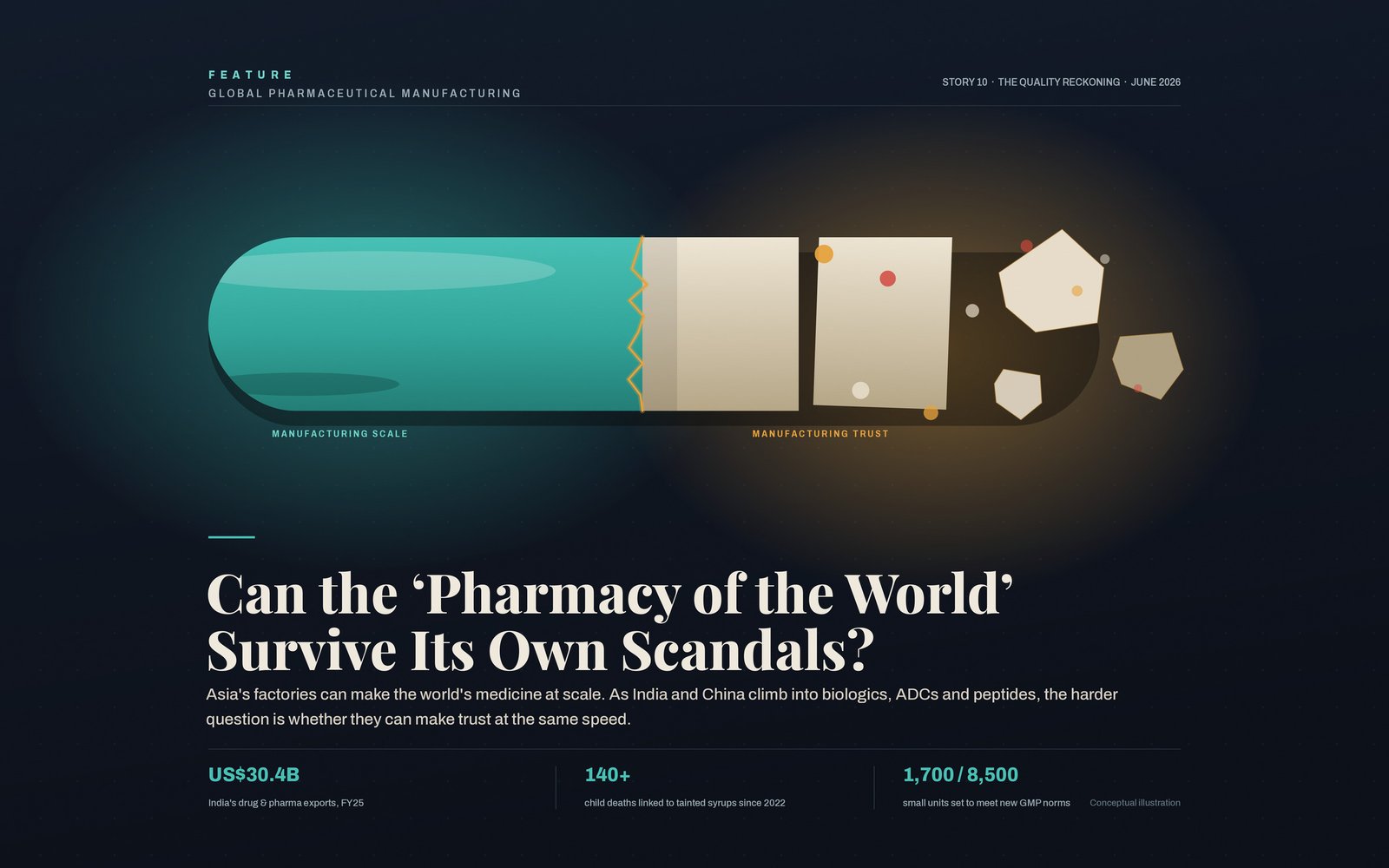
But scale and trust are not the same asset, and they do not necessarily grow together. The central question hanging over the region's next decade is whether the quality systems, pharmacovigilance infrastructure and regulatory culture are keeping pace with the manufacturing ambition — or whether one more high-profile failure, in a far less forgiving product category, could undo a decade of hard-won gains.
The quietest crisis
Reputation is the industry's quietest crisis precisely because it rarely shows up on a balance sheet until it is too late. A facility runs for years, passes audits, ships product, books revenue — and then a single inspection, recall or body count rewrites the story overnight.
"The thing executives consistently underprice is the asymmetry," says Nikhil Verma*, a pharmaceutical reputation analyst at a London advisory firm whose clients are institutional investors. "You build market access over fifteen years and you can lose it in fifteen days. Pricing power in generics is already thin; the only durable moat is reliability. The moment a regulator or a major buyer stops trusting your data, your cost advantage is worth nothing, because nobody will let your product through the door."
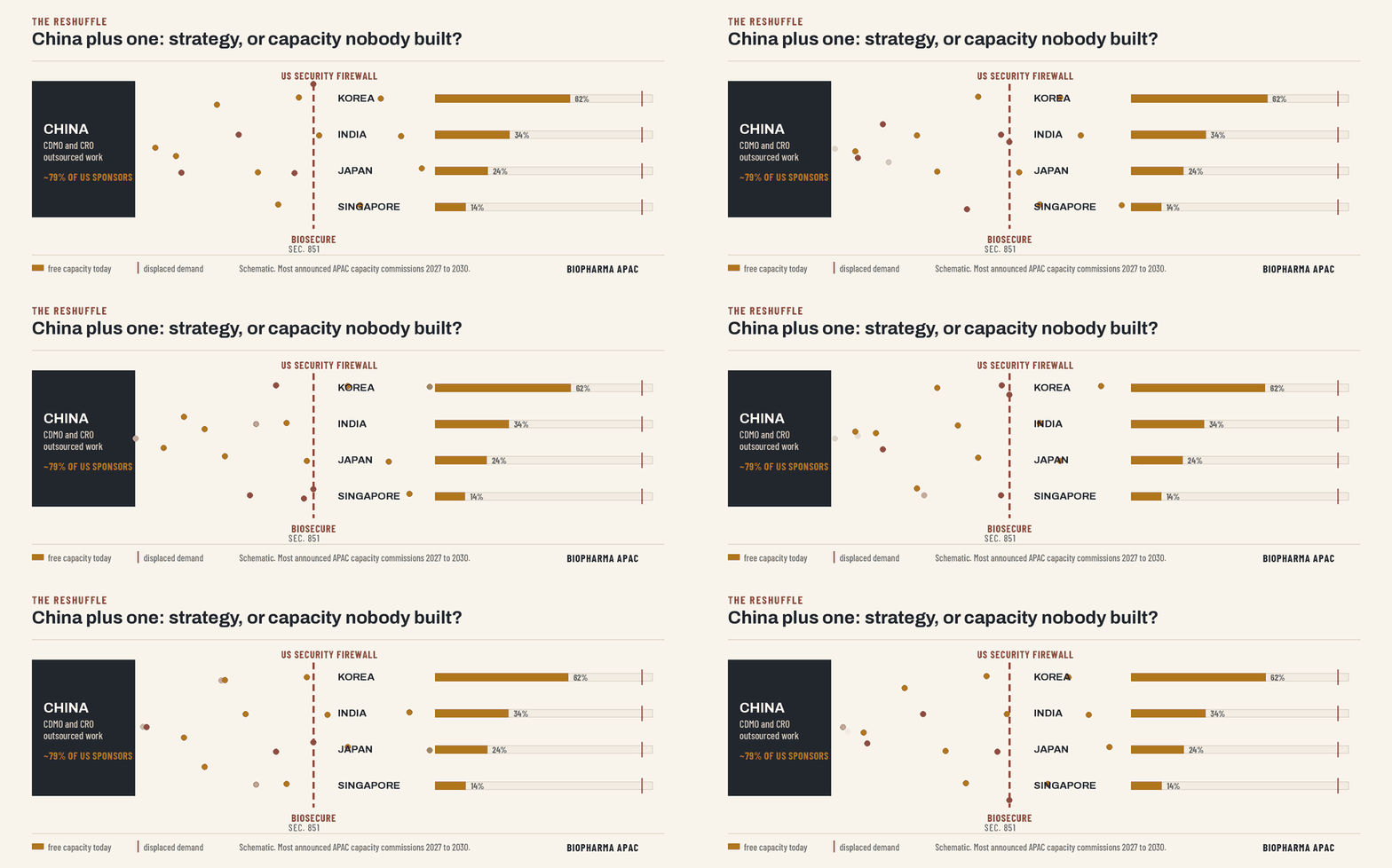
That asymmetry is not theoretical. When the U.S. Food and Drug Administration places a facility on import alert, finished product can be detained at the border immediately — a near-instant supply shock that can strand inventory, trigger contractual penalties and hand share to competitors. Industry analysts increasingly distinguish between two kinds of risk facing Asian makers: the slow, strategic decoupling threat embodied by the proposed U.S. BIOSECURE Act, which would over time restrict American firms from contracting with certain named Chinese biotech companies, and the fast, tactical threat of an FDA warning letter or import alert that can choke supply within days.
The market-access consequences are most visible in the United States, which is simultaneously the most important and most politically volatile destination for Indian and Chinese product. Nearly half of America's generic medicines now come from India, and the U.S., U.K., South Africa and France ranked among India's top export destinations in the 2025 fiscal year. That dependency cuts both ways: it gives Indian and Chinese makers extraordinary leverage over global drug supply, and it gives Western regulators — and Western headlines — extraordinary power to damage the region's reputation when something goes wrong.
The reference case: how nitrosamines reset the narrative
If the cough-syrup deaths are the industry's recurring nightmare, the nitrosamine saga is its defining structural lesson — the episode that forced the entire global supply chain to confront how little it understood about its own chemistry.
It began in July 2018, when valsartan, a generic blood-pressure drug, was recalled after the active ingredient was found to be contaminated with N-nitrosodimethylamine, or NDMA, a probable human carcinogen. The contaminated ingredient was traced in significant part to Zhejiang Huahai Pharmaceutical, a Chinese API supplier, with other affected ingredient linked to additional Chinese and Indian manufacturers. The FDA put Zhejiang Huahai on import alert that September and issued a warning letter citing manufacturing violations; investigators later concluded the impurity had been forming since around 2012, an unintended byproduct of a change in the manufacturing process that no one had thought to test for.
What made the episode so destabilizing was its scope. Over the following years, NDMA and the related compound NDEA turned up not just in valsartan but in losartan, irbesartan and other drugs in the same class, and nitrosamine concerns later spread to entirely different products including the diabetes drug metformin and the heartburn medicine ranitidine. By one accounting drawn from the FDA's database, more than 1,400 product lots were recalled over nitrosamine impurities exceeding acceptable intake limits; one tally cited by USA Today put the total at more than 18 million bottles of valsartan and related blood-pressure drugs recalled between 2018 and early 2023. These were not obscure medicines — losartan sits on the WHO's list of essential medicines, and tens of millions of people worldwide take these drugs for chronic conditions.
"Nitrosamines were a wake-up call because they exposed a category of risk the industry had been blind to," says Garry*, a former FDA investigator who spent years inspecting overseas plants. "It wasn't fraud, and it wasn't filth. It was a process-chemistry problem hiding inside drugs that had passed every test we knew how to run — because we weren't running the right test. That's a much scarier failure mode than a dirty facility, because you can clean a facility. You can't clean ignorance you don't know you have."
The nitrosamine episode reset the regional quality narrative in two ways. First, it demonstrated that contamination could be systemic, latent and invisible to existing controls — a reputational landmine that could detonate years after the product shipped. Second, it shifted the burden of proof. Regulators in the U.S. and Europe began demanding that manufacturers actively assess and control nitrosamine risk across their portfolios; the FDA issued formal guidance in 2020. For Indian and Chinese makers, the lesson was that the quality bar was no longer a fixed line to be cleared once, but a moving frontier that demanded continuous investment in analytical science.
The recurring pattern: from Ranbaxy to Coldrif
The deeper reputational problem is that the region's quality failures are not random one-offs. They form a pattern, and the pattern stretches back more than a decade.
The foundational case remains Ranbaxy. In 2013, Ranbaxy USA, a subsidiary of the Indian generics giant, pleaded guilty to seven U.S. federal counts — including charges related to adulterated drugs and making false statements to the FDA — and agreed to pay $500 million in criminal and civil penalties, then the largest settlement ever involving a generic drug maker. The fraud, exposed by whistleblower Dinesh Thakur, involved fabricated data and a trail of falsified records spanning years and multiple facilities. The case became a parable about how a company could industrialize the appearance of compliance while hollowing out the substance.
What is striking, more than a decade on, is how little the underlying dynamic appears to have changed. Data-integrity findings — torn or destroyed records, duplicate or "unofficial" datasets, failing results quietly not rejected — have recurred at Indian facilities through the 2010s and into the 2020s. A 2025 investigation by U.S. broadcasters reported the same patterns turning up again and again in FDA inspection records and warning letters, and noted that despite years of documented violations, U.S. prosecutors have only once since Ranbaxy pursued criminal charges against an Indian manufacturer linked to deaths or injuries.
The cough-syrup deaths sit at the most lethal end of this spectrum. After the 2022–2023 tragedies, India's government cancelled the licences of 18 companies and issued legal notices to dozens more; the manufacturer behind the Uzbekistan deaths, Marion Biotech, had its licence cancelled and saw employees arrested after government testing found a majority of sampled syrups adulterated and spurious. And yet, as the October 2025 Coldrif deaths showed, the system's first line of defence — state-level drug regulators, often without accredited testing labs, enough qualified inspectors, or digital batch-tracking — remained porous enough for the same poison to reach the same victims.
"You have to separate the headline from the mechanism," says Rohan Mehta*, head of quality and regulatory affairs at a large Indian generics exporter, who spoke on condition of anonymity. "The companies making the news for child deaths are, overwhelmingly, small domestic units selling into loosely regulated markets — not the firms shipping into the FDA and EMA systems. But that distinction is invisible to a parent in The Gambia, and increasingly invisible to a politician in Washington. The reputational damage doesn't respect the org chart of the industry. When one Indian syrup kills children, every Indian exporter pays for it."
The complexity jump: why the next decade is harder
Here is the part that should keep quality executives awake. Everything described so far — nitrosamines, glycol substitution, data fraud — happened in the comparatively forgiving world of small-molecule drugs: chemically defined, stable, relatively easy to characterize and test. The region's growth strategy now points directly at modalities where the quality bar is dramatically higher and the room for error dramatically smaller.
India is already a serious force in biosimilars. By December 2025 the country had approved on the order of 146 biosimilar recombinant products — insulins, growth factors, peptide hormones, fusion proteins and monoclonal antibodies — far more than have cleared the FDA or EMA, and Indian firms claim genuine industry firsts: Biocon's trastuzumab biosimilar with Mylan in 2013, Zydus's biosimilar of the world's top-selling drug Humira, and what Zydus describes as the world's first biosimilar antibody-drug conjugate, trastuzumab emtansine, in 2021. India's biosimilar exports, around $0.8 billion today, are projected by the Bain roadmap to grow fivefold to $4.2 billion by 2030. The same roadmap explicitly urges Indian firms to invest in peptides, high-potency APIs and ADCs, and to build a "scaled biologics play" benchmarked against the giants of the field, Samsung Biologics and WuXi Biologics. Granules India's February 2025 acquisition of Swiss peptide specialist Senn Chemicals was an early marker of that pivot into peptide therapeutics.
The strategic logic is sound. A wave of high-value biologic patents — by one count, more than 39 between 2025 and 2032 — is set to expire, and global capacity for GLP-1 peptides and ADCs is straining to meet demand. Supply-chain diversification away from China, accelerated by BIOSECURE, hands Indian contract manufacturers a once-in-a-generation opening.
But complexity is the enemy of quality control, and the jump from small molecules to biologics is not incremental — it is a change in kind.
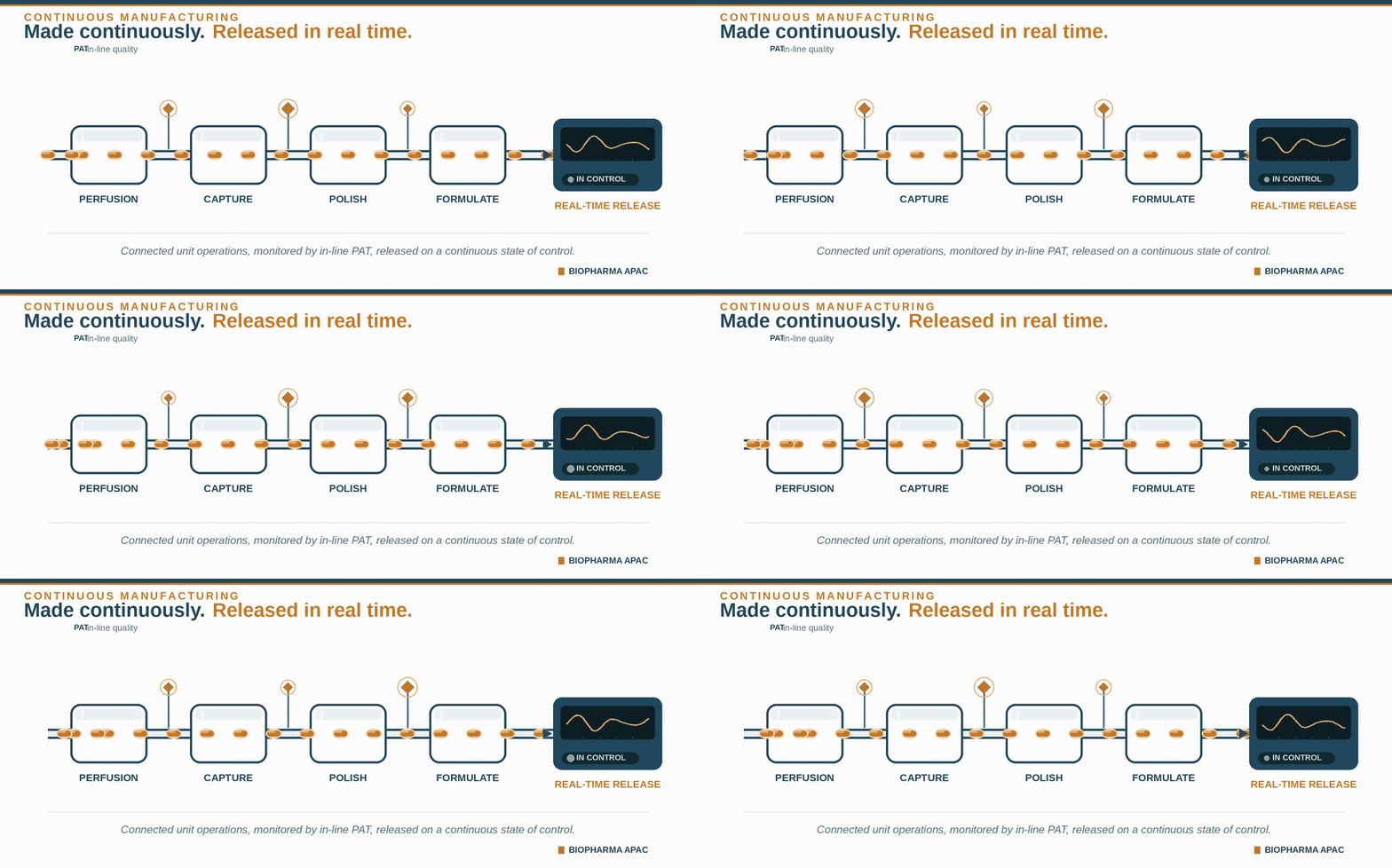
A small-molecule tablet is a defined chemical entity; you can synthesize it, characterize it precisely, and verify the finished product against a clear specification. A biologic is grown in living cells, and the product is, in a real sense, the process. Tiny variations in cell line, media, temperature, or purification can change the molecule's folding, its glycosylation, or its aggregation — alterations that may not announce themselves on a basic assay but can blunt efficacy or trigger dangerous immune reactions in patients. Sterility is non-negotiable because these drugs are injected, often into already-sick people. Cold-chain integrity must hold from factory to bedside. And antibody-drug conjugates raise the bar again: they marry a biologic antibody to a potent cytotoxic payload — essentially a controlled dose of a cell-killing poison — which means the manufacturer must master high-potency containment to protect workers, exquisite control over the drug-to-antibody ratio, and analytics sensitive enough to catch deviations that would be invisible in a conventional tablet line.
"The failure modes don't translate," says Maddox. "A small-molecule plant that's sloppy makes a pill that's slightly off-spec. A biologics plant that's sloppy can make something immunogenic that puts a patient in the ICU, and you may not see it in your release testing at all. The investment required in analytical capability, in process understanding, in the quality culture on the floor — it's an order of magnitude beyond what got you here. The danger is a company that's brilliant at making cheap metformin assuming that competence carries over. It doesn't."
The systems question: is the safety net scaling with the capacity?
Which brings the story to its hinge: are investments in quality and pharmacovigilance matching the breakneck growth in capacity and complexity? The evidence is genuinely mixed.
On the encouraging side, India has finally moved to harden its baseline. The government's revised Schedule M — a comprehensive overhaul of good-manufacturing-practice rules intended to align India with global standards, including pharmaceutical quality systems and quality risk management — took effect for large manufacturers (turnover above ₹250 crore) in mid-2024. Smaller units were given until the end of December 2025, conditional on filing an upgrade plan. After the October 2025 cough-syrup deaths, the Central Drugs Standard Control Organisation held firm against industry pleas for a further extension and directed state regulators to begin risk-based inspections from January 2026, with strict action promised for non-compliant units.
But the same effort exposes how far the long tail has to go. India has roughly 10,500 manufacturing units, about 8,500 of them in the micro, small and medium category. By industry estimates reported in late December 2025, only around 1,700 of those MSME units — somewhere near a quarter — were expected to meet the Schedule M deadline, with compliance wildly uneven across states (Gujarat reporting near-universal gap-analysis filings, others lagging badly). Many small manufacturers, officials say, are simply unwilling or unable to make the upgrades, raising the prospect of closures once inspections bite. That is the crux of the systems question: the firms most likely to cut corners are precisely the ones least able to afford the upgrades that would stop them.
The picture on the demand side — the regulators policing exports — is no more reassuring. The FDA, which the world implicitly relies on to police Indian and Chinese facilities, is itself under strain. A 2025 Government Accountability Office report found the agency contending with dozens of investigator vacancies, many in roles critical to foreign inspections, amid persistent attrition and difficulty staffing overseas posts. The agency has leaned into unannounced foreign inspections and a data-driven targeting approach, and warning-letter activity surged in 2025. But an analysis of 2025 warning letters found that after U.S. facilities, Chinese and Indian sites drew the most, and that Indian facilities in particular faced disproportionately high rates of data-integrity findings — a signal of weaknesses in data governance and oversight culture, not just isolated procedural lapses. Granules India, a major Hyderabad-based maker, received a February 2025 warning letter after inspectors reported finding, among other things, bird droppings in manufacturing zones and discarded GMP records.
"The dirty secret is that the whole edifice rests on a foreign regulator's enforcement capacity," says Dr. Adaeze Okoro*, a drug-regulatory official in an African importing market, speaking privately. "We can write the most beautiful rules in the world. But if the inspecting agency is short fifty investigators and a plant knows it'll be inspected once every few years with notice, the incentive structure is broken. Pharmacovigilance — actually tracking adverse events after a drug is on the market — is even weaker. In a lot of the markets these drugs are sold into, there's almost no signal coming back. A drug can be failing patients for years before anyone connects the dots."
That last point — pharmacovigilance — is the under-discussed half of the systems question. Good manufacturing prevents bad product from leaving the factory; pharmacovigilance is supposed to catch the failures that slip through, by monitoring real-world adverse events and feeding them back into recalls and corrective action. In the markets where contaminated syrups have killed children, that feedback loop barely exists, which is why fatalities, rather than lab alerts, have repeatedly been the first sign of disaster. As makers expand into biologics — where adverse events can be subtle, immune-mediated and delayed — the absence of robust post-market surveillance becomes not just a gap but a multiplier of risk.
The downside scenario
It is worth being explicit about how the bad version of this story unfolds, because it is neither far-fetched nor unprecedented.
Imagine a leading Indian or Chinese maker that has invested heavily to win a large Western contract for a biosimilar monoclonal antibody or an ADC. The plant clears its pre-approval inspection; product ships; revenue and reputation climb. Then a batch develops an aggregation or contamination problem that release testing misses, and patients — already seriously ill, since these are oncology and immunology drugs — begin suffering immune reactions or treatment failures. By the time the signal surfaces, the product is in hospitals across multiple countries. An import alert lands within days. The recall is global, the litigation is immediate, and the headline writes itself: not "small unit poisons syrup," but "major exporter's high-tech cancer drug harms patients in regulated markets."
The damage would not stay contained to one firm. The nitrosamine and cough-syrup episodes already demonstrate how readily a single failure metastasizes into a country-of-origin problem, with Western politicians and buyers reaching for the blunt instruments of onshoring mandates, tariffs and decoupling legislation. A high-profile biologics failure would arrive precisely as Western governments are already primed — by BIOSECURE, by supply-sovereignty anxiety, by a steady drumbeat of investigative journalism — to act on the conclusion that Asian quality cannot be trusted with complex medicine. A decade of climbing the value chain could be repriced in a quarter.
The Ranbaxy precedent is instructive here too: the company did not merely pay a fine. It effectively ceased to exist as an independent brand, absorbed by Sun Pharma, its post-2012 milestones erased. Reputational failure in this industry is not a line item. It can be existential.
The takeaway
None of this is destiny. India and China have repeatedly shown they can build world-class facilities when the incentives are aligned and the customer is demanding — the cleanest Indian and Chinese plants serving regulated markets are, by many accounts, as good as any in the world. The biosimilar firsts are real. The Schedule M overhaul, however belated, is a serious attempt to raise the floor. The talent and the capital exist.
The open question is one of synchronization. Ambition is racing ahead at the speed of capital expenditure and patent cliffs; quality discipline advances at the slower, less glamorous speed of culture change, inspector training, analytical investment and post-market surveillance. For two decades, scale outran everything and the region got away with it, because small molecules are forgiving and the worst failures landed mostly on the poor and the unwatched. Biologics, ADCs and peptides are not forgiving, and the next failure may well land in a hospital that files reports.
Whether the "pharmacy of the world" survives its own scandals depends on a single, unglamorous variable: whether the quietest investments — in quality systems, in data integrity, in pharmacovigilance — are made before the loudest failure, rather than after it. On current evidence, the race is closer than the industry's growth projections would have you believe.
(arcilla.fran@biopharmaapac.com )
Reader Disclaimer
This article is an analytical feature based on publicly available regulatory records, industry reports, company disclosures, inspection findings, and independent research. Certain expert perspectives referenced in the article are presented under pseudonyms and are illustrative composite viewpoints created to reflect commonly expressed positions within the pharmaceutical quality, regulatory, and market access ecosystem. These perspectives are intended to provide context and do not represent direct quotations from identifiable individuals.
All factual references, company information, regulatory actions, inspection outcomes, recall events, and market data have been drawn from publicly available sources believed to be reliable at the time of publication. Readers are encouraged to consult original regulatory filings, company statements, and official agency communications for the most current information.
The opinions and analysis expressed are intended to foster discussion on pharmaceutical manufacturing quality, regulatory oversight, and industry reputation, and should not be construed as regulatory, legal, investment, or medical advice.
Most Read
- Can APAC Biomanufacturing Decarbonise Without Pricing Itself Out?
- The Algorithm on the GMP Floor: AI Promises a Smarter Plant. Regulators Demand the Audit Trail.
- APAC's Peptide-Capacity Gamble
- After the Rush: APAC's mRNA and Vaccine Capacity Hangover
- The Biosimilar Race: Factory to the World — or Stuck in the Copycat Economy?
- The Vein-to-Vein Problem: Can APAC's Cold Chain Carry Advanced Therapies?
- Vectors, Plasmids and the CGT Trap: APAC's Cell and Gene Therapy Ambitions Face an Upstream Bottleneck
- Can APAC Build Radioligand Therapy Before the Atoms Decay?
- The Great Biopharma Reset: 50 Developments That Changed Everything in H1 2026
- Beyond the Trial: Can Real-World Evidence Earn Regulatory Trust in APAC?
- Beyond the Obvious Giant: Where APAC's Clinical Trials Go Next
- The Frontier That Won’t Quite Arrive
Bio Jobs
- Sanofi Turns The Page As Belén Garijo Steps In And Paul Hudson Steps Out
- Global Survey Reveals Nearly 40% of Employees Facing Fertility Challenges Consider Leaving Their Jobs
- BioMed X and AbbVie Begin Global Search for Bold Neuroscience Talent To Decode the Biology of Anhedonia
- Thermo Fisher Expands Bengaluru R&D Centre to Advance Antibody Innovation and Strengthen India’s Life Sciences Ecosystem
- Accord Plasma (Intas Group) Acquires Prothya Biosolutions to Expand Global Plasma Capabilities
- ACG Announces $200 Million Investment to Establish First U.S. Capsule Manufacturing Facility in Atlanta
- AstraZeneca Invests $4.5 Billion to Build Advanced Manufacturing Facility in Virginia, Expanding U.S. Medicine Production
News