7 Manufacturing Technologies Moving From Pilot to Plant in APAC
02 August 2026 | Sunday | Analysis
|
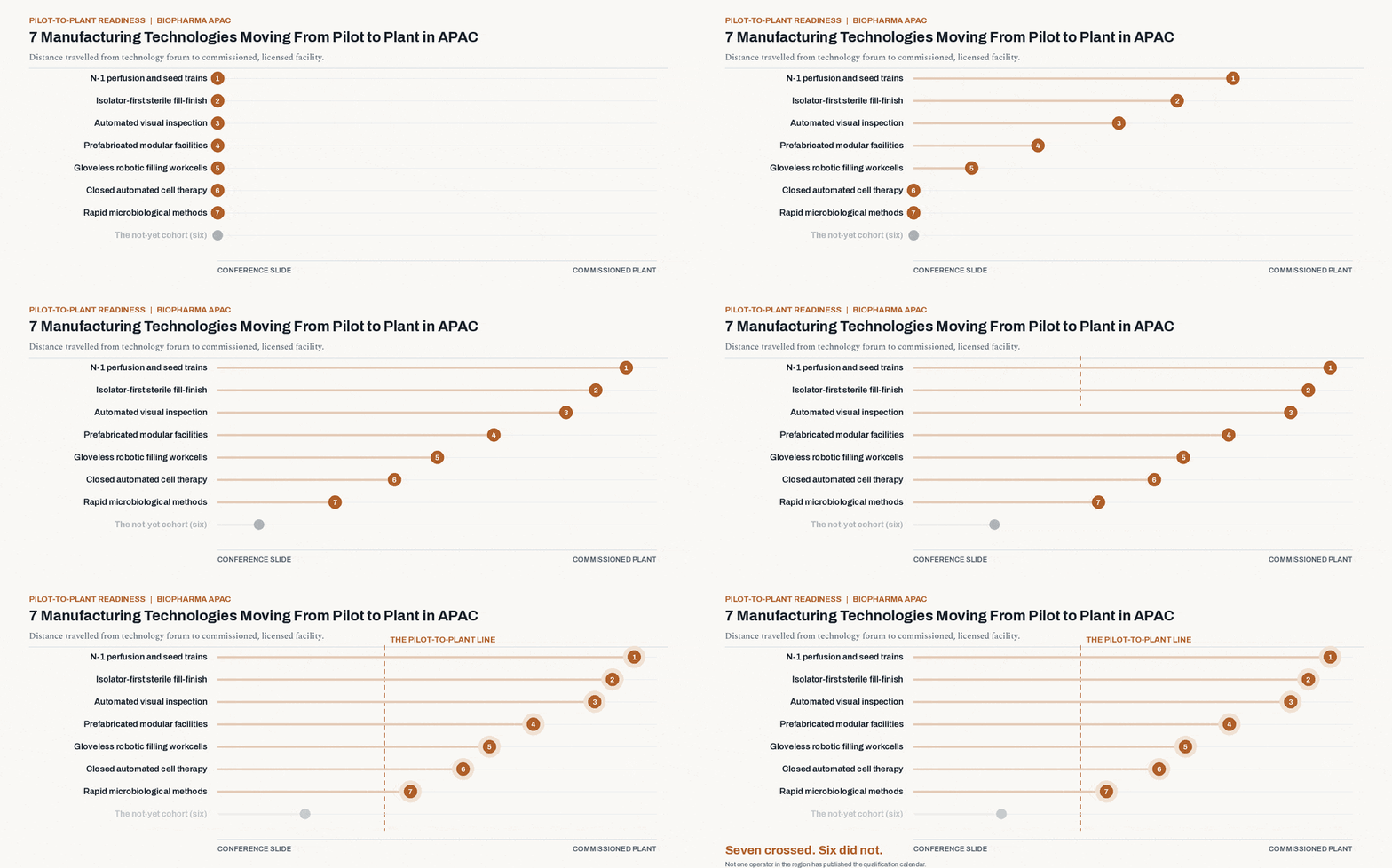
HOW THE SEVEN WERE CHOSEN Inclusion required evidence of at least two commercial-scale installations in the region, with sites named wherever public disclosure allows. A technology with one reference site, or with a regional footprint confined to process development and pilot suites, is listed in the not-yet cohort at the close rather than promoted into the main seven. Entries are ordered by how far each has travelled from pilot to plant, not by how interesting it is. Vendors were not consulted on inclusion, and inclusion was decided on installed base rather than on relationship. Continuous manufacturing as a regulatory question is treated separately in our feature on ICH Q13 adoption across PMDA, NMPA, CDSCO, HSA and TGA, and appears here only where it bears on a specific unit operation. |
Every manufacturing conference in Asia-Pacific runs a version of the same slide. A technology is introduced as transformational, a pilot dataset is shown, an adoption curve is drawn, and the room is told that the shift is already underway. Very few of those slides say where the technology is actually installed, what equipment or method it displaced when it went in, or how many months the site spent proving it to an inspector before a single vial was released against it.
That last number is the one that decides whether a technology is real. It is also the number nobody publishes.
This list is an attempt to publish it. Working from company disclosures, peer-reviewed implementation data, vendor case records and pharmacopoeial guidance, we looked for technologies that have stopped being conference material and started appearing in commissioned plant across the region. Seven qualified. Six more did not, and are named at the close rather than quietly dropped, because the boundary between the two groups turns out to be the most interesting finding in the exercise.
Three patterns run through the seven.
The first is that the technologies which crossed are not the ones with the best performance case. They are the ones that leave the licensed process untouched. Seed train intensification crossed because the production bioreactor does not change. Automated visual inspection crossed because it sits after the process, not inside it. Prefabricated facilities crossed because the process fits the box rather than the box fitting the process. Where a technology forces a change to the registered control strategy, it is still sitting in pilot, no matter how strong the data.
The second is that standardisation, not novelty, is the crossing mechanism. Every technology in the main seven has a configuration the vendor declines to customise, and that refusal is the point. A standardised workcell carries its environmental monitoring strategy from one site to the next. A standardised modular facility carries its commissioning package. Customisation is where qualification time goes to die.
The third is a disclosure problem, and it belongs to the region rather than to the vendors. Not one operator in Asia-Pacific has published a complete qualification calendar for any of the seven technologies below. The only full public timeline for a robotic aseptic filling workcell, from purchase order to completed validation, belongs to a site in Canada. Where a qualification figure appears in this piece, its provenance is stated. Where it does not appear, that absence is recorded rather than filled with an estimate.
1. Gloveless robotic aseptic filling workcells
The problem Conventional filling lines are built for volume and punished by variety. Changeovers run to hours or days, every line is a bespoke design that must be validated from first principles, and the operator remains the largest single contamination risk in the critical zone. None of that suits a pipeline of small-batch biologics, orphan products and personalised therapies.
Installed base Catalent runs gloveless robotic filling on the Microcell platform at Melbourne, operated alongside its San Diego installation, giving the technology a genuine Asia-Pacific commercial anchor rather than a demonstration site. The larger sibling, the SA25 workcell, fills nested vials, syringes and cartridges from 0.2 to 50 mL in batches to roughly 20,000 units, with format changeover quoted at around 45 minutes. Pooled operating data from eight independent user companies covering 2018 to 2021 has been published in the peer-reviewed literature, which is more than can be said for most equipment on this list.
Qualification burden This is the technology that most clearly buys qualification time rather than spending it. Because the design is standardised and not modified per customer, the same environmental monitoring strategy travels between installations. The vendor states that customers regularly reach GMP production within about 15 months of purchase, against a conventional isolated line where 15 months can be consumed by factory acceptance testing alone. The one complete public calendar, from Emergent BioSolutions, runs from purchase in October 2017 through factory acceptance in February 2018, installation in April 2018 and site acceptance in June 2018 to completed validation activities in April 2019. That site is in Winnipeg. No Asia-Pacific operator has published an equivalent.
Cost signal Capital is not where the economics sit. Because the chamber is closed and gloveless with no operator access during filling and stoppering, the background classification and the gowning and monitoring programme that goes with it can be argued down. The saving is in the room, not the machine.
Honest limitation Throughput. Scale is achieved by adding identical workcells, which suits cell and gene therapy, orphan biologics and clinical supply, and does not suit a 200,000-unit vaccine campaign. Anyone presenting this as a general replacement for high-speed filling is selling.
2. Isolator-first sterile fill-finish
The problem Open and restricted-access barrier operations depend on procedural control of human intervention, and the revised EU GMP Annex 1 has made that dependence expensive to defend. Published in August 2022 and effective from 25 August 2023, the revision requires a documented contamination control strategy, continuous monitoring in Grade A zones, and a risk-based justification for the barrier choice itself.
Installed base This is the largest capital movement in Asia-Pacific sterile manufacturing and the hardest to count, because retrofits are rarely announced. The forcing function is unambiguous: Annex 1 binds exporters into the European Union, not only manufacturers inside it, so every Korean, Japanese, Indian and Singaporean site with EU-bound product inherited the requirement without a domestic rule change. Samsung Biologics has disclosed an isolator-based prefilled syringe fill-finish line with full in-process control targeted to be GMP-ready in the fourth quarter of 2027, alongside a dedicated containment line for antibody-drug conjugates. Across the wider regional base, isolator conversion is now the default assumption for new sterile capacity and the live question for existing lines.
Qualification burden The long pole is vaporised hydrogen peroxide cycle development, which must demonstrate a six-log reduction against biological indicators and then aerate down to residual peroxide at parts-per-million levels without damaging product. Add cycle development, load pattern qualification, media fills and the contamination control strategy documentation itself, and this is a multi-year programme on an existing line.
Cost signal The trade is a higher equipment and cycle-development cost against a lower classified-room burden, since an isolator does not carry the Grade B background that a barrier system does. Retrofitting into an existing Grade B suite frequently costs more than building the line new, which is why several regional conversions have arrived as capacity announcements rather than upgrade announcements.
Honest limitation An isolator does not repair a weak contamination control strategy, and inspectors have become good at telling the difference between a barrier and a strategy. Glove-port integrity, transfer systems and the decontamination cycle simply relocate the risk rather than removing it.
3. Automated visual inspection with machine-learning defect classification
The problem Manual visual inspection is subjective by construction. Detection depends on the operator, the shift and the defect, and the grey area between a critical particulate and a cosmetic artefact is precisely where a batch decision gets made. Manual inspection also does not scale to the unit volumes that regional drug product capacity is now built for.
Installed base Samsung Biologics has been the most public regional operator on this technology, treating automated inspection as core drug product infrastructure rather than an ancillary step and publishing technical positions on how inspection systems should be qualified against manual baselines. Its next drug product line is specified with a fully automated inspection capability running to 400 units per minute with machine-learning defect classification and real-time feedback into the process. Automated inspection is now standard on new fill-finish investment across the Korean, Japanese and Indian commercial base, which is why it appears here rather than in the not-yet cohort.
Qualification burden Moderate, and front-loaded. The validated entity is the inspection recipe, not the machine, which means a physical defect kit has to be built and characterised, probability-of-detection curves generated, and equivalence to the manual method demonstrated across the defect classes that matter. The genuinely awkward part is change control on the model: a classifier that retrains on production data is a change to a validated method.
Cost signal The economics are in the false reject rate rather than in labour. On a high-value biologic, recovering a single percentage point of falsely rejected units can pay for the system inside a campaign, and that is the number the business case is usually built on.
Honest limitation Most regional installations run frozen models and retrain offline under change control, which means the adaptive capability being sold is not the capability being operated. The system is a very good fixed classifier, and describing it as learning in production overstates what any inspector has actually accepted.
4. N-1 perfusion and intensified seed trains
The problem A conventional commercial seed train walks cells from a vial through shake flasks and a series of increasingly large bioreactors before the production vessel is inoculated. Each stage is days, a transfer and a contamination opportunity. Adding production capacity means adding a tank, and a tank means cleanroom, utilities and years of qualification.
Installed base This is the most quietly widespread technology on the list. Samsung Biologics and Syngene International have each independently demonstrated alternating tangential flow perfusion at the N-1 stage, reporting productivity improvements in the range of two to ten times and cost reductions reported as high as 60 per cent while holding product quality across antibody formats and scales. In India, the biopharma division of Intas Pharmaceuticals has published its own implementation work, achieving roughly a tenfold increase in viable cell count at N-1 against a fed-batch control in six to eight days using single-use rocking-motion perfusion, explicitly directed at reaching 4,000 L production scale with fewer transfer steps.
Qualification burden The lightest of the seven relative to the benefit, and that is exactly why it crossed. The production bioreactor is not modified and continues to run fed-batch with no cell retention device. The change sits upstream of the licensed production step, so the comparability exercise is bounded: demonstrate that the intensified inoculum produces equivalent growth, titre and quality attributes, and the registered production process is untouched.
Cost signal The saving is avoided capital. A site that doubles output through seed train intensification has not built a tank, has not classified a new room and has not qualified new utilities, and in a region where capacity announcements are the currency of credibility, that is a strategically quiet way to grow.
Honest limitation Not every CHO clone tolerates high-density culture. Expression levels and genetic stability can both degrade at the densities that make the economics work, which means the technology is a clone-by-clone decision rather than a platform switch. Cell retention device fouling is the operational tax nobody puts on the slide.
5. Prefabricated modular facility platforms
The problem Conventional biomanufacturing construction takes years, prices move under the project, and the finished building is optimised for the product that was in the pipeline when the ground was broken. For companies entering biologics, the build itself is the risk.
Installed base Asia-Pacific, and China specifically, is the densest cluster of prefabricated biomanufacturing facilities anywhere. JHL Biotech assembled a modular plant in Wuhan from 62 shipped containers as early as 2015. Pfizer built its Hangzhou Biotechnology Center on the same platform, and the project took an ISPE Facility of the Year award for project execution in 2019. BeiGene, already operating an integrated single-use platform at Suzhou, brought a modular monoclonal antibody facility online at Guangzhou in 2019. At one point the entire announced installed base of the leading platform sat in China. In Japan, Taiyo Pharma Tech contracted for the same integrated single-use platform in December 2021 for adeno-associated virus manufacturing, extending the model from antibodies into viral vectors.
Qualification burden Substantial, but relocated. The vendor quotes construction, assembly and fit-out to handover after qualification in roughly 18 months. Commissioning work shifts into the factory, and the site inherits a documentation package rather than building one. What does not transfer is performance qualification and process validation, which remain entirely the licence holder’s problem and are frequently underestimated in the schedule.
Cost signal The signal is schedule certainty rather than capital reduction. Modular plants are not obviously cheaper per square metre. They are predictable, which for a first-time biologics manufacturer or a capacity-constrained CDMO is worth more than a discount.
Honest limitation The standardisation that delivers the speed is the same standardisation that constrains the plant. The process has to fit the box. Every deviation from the reference configuration erodes the schedule advantage, and a facility bought for flexibility can turn out to be flexible only within the envelope the vendor drew.
6. Closed automated cell therapy manufacturing platforms
The problem Autologous cell therapy is a batch size of one manufactured under open handling in high-grade cleanrooms by highly trained operators. The cost structure that results is the reason the modality has been effectively unavailable across most of the region.
Installed base India is the clearest case anywhere in Asia-Pacific of this technology reaching licensed commercial operation. ImmunoACT received CDSCO marketing authorisation for NexCAR19 in October 2023 and launched commercially in 2024 at roughly USD 50,000 per patient, manufacturing lentiviral vector and plasmid in house. Immuneel Therapeutics followed with Qartemi, approved and commercially launched in January 2025 on phase 2 data reporting an 83.3 per cent overall response rate at 90 days. Platform-level adoption is broader still: the dominant closed automated instrument has been in cell therapy manufacturing since 2013 and its vendor records approved gene-modified cell therapies in Europe, the United States and India, while the competing single-use closed platform reports more than 150 instruments deployed globally.
Qualification burden Heavy at first product and light thereafter, which is the argument for the whole category. Closed automated processing is what allows a site to operate at Grade C background rather than Grade B, with reported manufacturing success rates near 89 per cent under those conditions. Once a platform process is validated, site-to-site technology transfer becomes a comparability exercise on a standardised instrument rather than a re-derivation of a manual method.
Cost signal The Indian approvals established a regional price benchmark roughly an order of magnitude below Western list prices for equivalent CD19-directed products, and that benchmark, more than any equipment specification, is what has moved the technology from interesting to strategic across the rest of the region.
Honest limitation Vendor lock is real and expensive. Interoperability gaps between the major platforms mean a change of instrument is a full comparability exercise rather than a procurement decision, and each instrument still processes one patient batch at a time. Automation has fixed variability and cleanroom grade. It has not yet fixed throughput.
7. Rapid microbiological methods
The problem The compendial sterility test takes 14 days and the mycoplasma test 28. For conventional products that is inventory sitting in quarantine; for short-shelf-life and cell-based products it is a release model that does not work at all.
Installed base The hardest of the seven to enumerate, because a rapid method is a laboratory technique rather than a machine on a plant floor, and adoption surfaces in filings rather than press releases. What is visible is that the regulatory scaffolding is now regionally in place, which is the precondition for installation. The Indian Pharmacopoeia has issued a guidance document on alternative microbiological methods for qualitative, quantitative and identification testing, built on the validation logic of USP general chapter 1223 and European Pharmacopoeia 5.1.6, although it remains informational rather than an official requirement. The Chinese Pharmacopoeia carries Chapter 9201 on validation of alternative microbial detection methods. Japan’s PMDA has supported rapid method implementation and has granted approvals including rapid sterility testing. WHO has revised its guidance on sterile products to accommodate rapid methods.
Qualification burden The heaviest on this list per unit of benefit. Validation runs to accuracy, precision, specificity, limit of detection, robustness and equivalence, and the new method must typically be run in parallel with the compendial method across a defined number of batches. Critically, the work is matrix-specific: each product may require its own validation package, so the burden scales with portfolio breadth rather than being paid once.
Cost signal Rapid methods reduce working capital and cycle time rather than cost of goods. Compressing a two-week hold releases inventory and shortens the distance between manufacture and patient, which matters most for exactly the products where it is hardest to validate.
Honest limitation This arrives as a post-approval change, and post-approval changes in a multi-market network move at the speed of the slowest authority in that network. A method validated in a Singapore or Korean laboratory can sit unused for release of a given product for years while variations queue elsewhere. The constraint is not the science and it is not the instrument. It is the filing.
|
THE NOT-YET COHORT Six technologies were assessed and did not meet the inclusion threshold. Each has real Asia-Pacific activity confined to development suites, single reference sites, or pilot-scale demonstration. They are named here because being close to the line is more informative than being off the page. Closed-loop spectroscopic process control. In-line Raman and capacitance monitoring is genuinely installed at commercial scale in the region. Automated feedback control acting on those signals, rather than an operator reading them, is not. Monitoring crossed. Control did not. Digital twins used in release decisions. Process models are in wide use for development and deviation investigation. No regional operator has disclosed a twin that carries evidentiary weight in a batch release decision. End-to-end continuous downstream processing. Multi-column capture is running at pilot and, in isolated cases, at commercial scale in the region, but the connected downstream train remains a regulatory question rather than an installation question. Treated in full in our companion feature on ICH Q13 adoption across regional authorities. Parallelised robotic cell therapy manufacture. Multi-batch automated platforms exist and have attracted regulatory designations elsewhere. Asia-Pacific installations are development-stage. In-line rapid biosafety testing for real-time release. Rapid bioburden and endotoxin methods are progressing. Rapid mycoplasma and adventitious agent testing integrated into a real-time release strategy is not yet an installed regional capability. Machine-learning batch disposition. Predictive models for deviation triage are being trialled. None is disposing of batches. |
What the ladder actually shows
Arrange the seven against installed base and qualification burden and the shape that emerges is not a technology readiness curve. It is a regulatory one.
Every technology that crossed did so by one of three routes. It left the licensed process alone, as seed train intensification, automated inspection and prefabricated facilities all do. It arrived pre-standardised, so that qualification could be inherited rather than derived, as the robotic workcells and the modular platforms did. Or a regulator forced it, which is the entire story of isolator conversion and the reason Annex 1 has reshaped more Asian sterile capacity than any commercial argument ever managed.
Every technology that did not cross fails the same test in the same way. Closed-loop control, digital twins used in release, connected downstream trains and predictive disposition all require an authority to accept a new definition of what release evidence is. That is a different and much slower conversation than the one about whether the equipment works. The equipment works. Rapid microbiological methods sit precisely on this line, which is why they are the last entry rather than the first: the science is settled, the pharmacopoeias have written the validation route, and the technology is still throttled by the post-approval variation queue.
Which points at the practical conclusion for anyone planning capital in this region. The rate limit on manufacturing modernisation in Asia-Pacific is not capability, and it has not been for some time. It is regulatory throughput, and specifically the speed at which a multi-market filing portfolio can absorb change. A site can install any technology on this list. Whether it can use it for every product on the line is decided somewhere else entirely.
And the region should fix its own disclosure while it waits. Seven technologies are running in commissioned Asia-Pacific plant, and the only complete published record of what any of them cost in qualification months belongs to a facility in Manitoba. Manufacturers here have the data. Publishing it would do more to accelerate regional adoption than another forum slide, and it would cost nothing but the decision.
arcilla.fran@biopharmaapac.com
Sources and method
Reporting for this piece drew on company disclosures and technical publications from Samsung Biologics, Catalent, Syngene International, Intas Pharmaceuticals, ImmunoACT, Immuneel Therapeutics, BeiGene, Pfizer, JHL Biotech and Taiyo Pharma Tech; equipment and platform documentation and case records from Cytiva, Repligen, Miltenyi Biotec, Lonza and Emergent BioSolutions; peer-reviewed implementation data on closed robotic filling published in AAPS PharmSciTech covering eight user companies over 2018 to 2021; the seed train intensification study published by the biopharma division of Intas Pharmaceuticals in BioProcessing Journal; EU GMP Annex 1 as published in August 2022 and effective from August 2023; and pharmacopoeial and regulatory guidance on alternative microbiological methods from the Indian Pharmacopoeia, the Chinese Pharmacopoeia, USP general chapter 1223, European Pharmacopoeia 5.1.6, PDA Technical Report 33, the WHO and Japan’s PMDA.
Performance figures reported by equipment vendors are identified as such in the text and have not been independently verified by this publication. Qualification durations are quoted only where a named party has published them. Where no regional operator has disclosed a figure, that absence is stated rather than estimated. Installation counts reflect public disclosure as at the date of publication and are likely to understate the true installed base, particularly for retrofits and laboratory methods, which are rarely announced.
Most Read
- Can APAC Biomanufacturing Decarbonise Without Pricing Itself Out?
- The Algorithm on the GMP Floor: AI Promises a Smarter Plant. Regulators Demand the Audit Trail.
- APAC's Peptide-Capacity Gamble
- After the Rush: APAC's mRNA and Vaccine Capacity Hangover
- The Biosimilar Race: Factory to the World — or Stuck in the Copycat Economy?
- The Vein-to-Vein Problem: Can APAC's Cold Chain Carry Advanced Therapies?
- Vectors, Plasmids and the CGT Trap: APAC's Cell and Gene Therapy Ambitions Face an Upstream Bottleneck
- Can APAC Build Radioligand Therapy Before the Atoms Decay?
- The Great Biopharma Reset: 50 Developments That Changed Everything in H1 2026
- Beyond the Trial: Can Real-World Evidence Earn Regulatory Trust in APAC?
- Beyond the Obvious Giant: Where APAC's Clinical Trials Go Next
- The Frontier That Won’t Quite Arrive
Bio Jobs
- Sanofi Turns The Page As Belén Garijo Steps In And Paul Hudson Steps Out
- Global Survey Reveals Nearly 40% of Employees Facing Fertility Challenges Consider Leaving Their Jobs
- BioMed X and AbbVie Begin Global Search for Bold Neuroscience Talent To Decode the Biology of Anhedonia
- Thermo Fisher Expands Bengaluru R&D Centre to Advance Antibody Innovation and Strengthen India’s Life Sciences Ecosystem
- Accord Plasma (Intas Group) Acquires Prothya Biosolutions to Expand Global Plasma Capabilities
- ACG Announces $200 Million Investment to Establish First U.S. Capsule Manufacturing Facility in Atlanta
- AstraZeneca Invests $4.5 Billion to Build Advanced Manufacturing Facility in Virginia, Expanding U.S. Medicine Production
News