Innovation Powerhouse or Inflated Bubble? Reading China’s First-in-Class Boom
02 June 2026 | Tuesday | Analysis | By arcilla.fran@biopharmaapac.com
A decade ago, the phrase “Chinese first-in-class drug” would have drawn a raised eyebrow in any Western boardroom. China made generics, copied mechanisms, and ran cheap trials. The frontier of biology was invented in Boston, Basel, and South San Francisco, then licensed eastward. That story is now inverted, and the speed of the inversion is the single most disorienting fact in the global drug business.
The numbers are genuinely startling. China’s count of self-developed first-in-class (FIC) candidates entering clinical trials rose from nine in 2015 to roughly 120 by 2024 — a more-than-twelvefold jump in under a decade. By 2025, Chinese companies accounted for about 24 percent of the world’s FIC pipeline, second only to the United States. On the broader measure of innovative drug candidates, the gap has nearly closed: China sat at roughly 30.5 percent of the global pipeline in 2025 against the U.S. at 33 percent, per Council on Foreign Relations analysis — a 2.5-point gap, down from 13 points two years earlier.
Then there is the money, which is where the argument really lives. Chinese biotechs generated a record $135.7 billion in license-out transaction value in 2025, nearly triple the prior year, and by Goldman Sachs’ reckoning China accounted for roughly half of global licensing-deal value by dollars that year. Some 46 percent of all new drug molecules that entered human trials in the first half of 2025 originated in Chinese companies. Large pharma now sources nearly a third of its externally acquired candidates from China.
So: innovation powerhouse, or inflated bubble? The honest answer is that both readings are partly right, and the only way to tell substance from froth is to stop arguing about the aggregate and start reading the deals one by one.
The bull case: speed, cost, and a regulator that grew up
The strongest version of the bull case is not about cleverness; it is about velocity. China’s 2015 regulatory overhaul — the “Opinions on Deepening the Reform of the Review and Approval Processes” — dismantled a backlog-choked approval system and rebuilt it for speed. First-in-human approval times collapsed from around 500 days to under 90. A Chinese biotech can move a molecule from discovery into the clinic in 12 to 20 months, against 24 to 26 globally, and enroll trials two to three times faster thanks to enormous, concentrated patient populations and a dense hospital network.
Cost compounds the speed advantage. Discovery runs an estimated 30 to 40 percent cheaper than in the U.S. or Europe. For a Western buyer staring down a patent cliff, the math is seductive: in-licensing a Phase II Chinese asset compresses a 10-to-15-year internal R&D cycle to five years or fewer, at an upfront price 60 to 70 percent below a comparable Western deal. When 36 drugs account for 70 percent of the top 20 pharmas’ new-drug sales, losing two or three blockbusters leaves a hole that internal pipelines cannot fill fast enough. China is, quite simply, the fastest and cheapest place to refill it.
And the engineering is real, particularly in two modalities. Chinese firms now lead global development in antibody-drug conjugates (ADCs), where they account for roughly 54 percent of the pipeline, and in cell therapies at around 48 percent. These are not me-too molecules; they are complex, format-heavy constructs where China’s deep bench of protein engineers and its willingness to run many shots on goal have produced genuine differentiation. Pfizer’s own CEO conceded in early 2026 that U.S. biotech dominance is, for the first time in decades, being challenged — noting that 8 of the top 10 global research institutions on the 2025 Nature Index are now Chinese.
The bear case: when the data has to travel
Here the froth thesis finds its footing, and its central claim is precise: a drug that works in a Chinese trial has not yet been shown to work in a global one. The two are not the same experiment.
The cautionary precedent everyone cites is sintilimab. In 2022, Eli Lilly and Innovent brought a China-only data package for the PD-1 inhibitor to the FDA, betting the agency would accept single-country evidence. An advisory committee voted 14-1 against, with the FDA’s oncology chief calling a China-only trial “a step backward.” The objections have hardened into doctrine: Chinese pivotal trials lean heavily on single-arm designs without control groups (around 58 percent, versus 37 percent in the U.S.), often power for progression-free survival without pre-planned testing of overall survival — the oncology gold standard — and fewer than a third include international sites, against roughly 80 percent of U.S. Phase III programs.
The reproducibility worry is not hand-waving about fraud. As one cross-border clinical executive put it, the doubt stems less from poor science than from differences in patient profiles, standard of care, and study design — for global stakeholders, reproducibility and transparency are the currency, and China-only datasets are short on both. The FDA’s limited capacity to conduct on-site bioresearch-monitoring inspections at Chinese trial sites compounds the trust gap, and has already delayed or blocked multiple market-entry attempts.
Which brings the bear case to its sharpest question: is a licensing deal a quality signal, or a discount play? When Chinese assets sell at 60-to-70-percent discounts on upfront payments, a rational buyer loads up on cheap optionality — many small bets, most expected to fail, a few to pay for the rest. That is portfolio behavior, not a verdict on scientific leadership. The risk is that the industry reads its own buying as proof of Chinese quality, when the buying may simply reflect Chinese cheapness. Deal volume validates the price, not necessarily the science.
The anchor case: one molecule that holds both truths
No asset captures the tension better than ivonescimab. In December 2022, the then-obscure Summit Therapeutics paid Akeso $500 million up front, with up to $5 billion in total value, to license the PD-1×VEGF bispecific antibody for the U.S., Canada, Europe, and Japan — a record sum for a single Chinese drug at the time, and the deal that effectively opened the floodgates.
For a while it looked like vindication of the purest bull case. In the China-run HARMONi-2 trial, ivonescimab beat Merck’s Keytruda — the best-selling drug in the world — on progression-free survival in first-line lung cancer, a result that sent Summit’s stock soaring and triggered an industry-wide scramble for PD-1×VEGF assets. A Chinese molecule had, on its home turf, outperformed the Western standard of care.
Then the data had to travel, and the cracks showed. The global HARMONi trial — with about 38 percent of patients enrolled in Western countries — hit its progression-free survival endpoint but missed statistical significance on overall survival, the co-primary endpoint that regulators weight most heavily. Summit’s shares fell sharply. A later interim readout in 2026 missed an early survival mark again, and the squamous cohort of another global trial reportedly fell short on PFS at interim analysis. The China data was strong; the global data was murkier. Analysts split exactly along the bull-bear line — some insisting the East-West populations looked “similar enough” for the China results to reproduce, others warning of “degradation in benefit from the Chinese to global studies.”
Ivonescimab is not a failure — it won approval in China and may yet clear global regulators. But it is the perfect parable: a genuinely innovative, first-in-class Chinese molecule whose value depends entirely on whether spectacular home-market data survives the trip to a multi-regional trial. That, in one drug, is the whole debate.
The geopolitical overlay: BIOSECURE distorts the lens
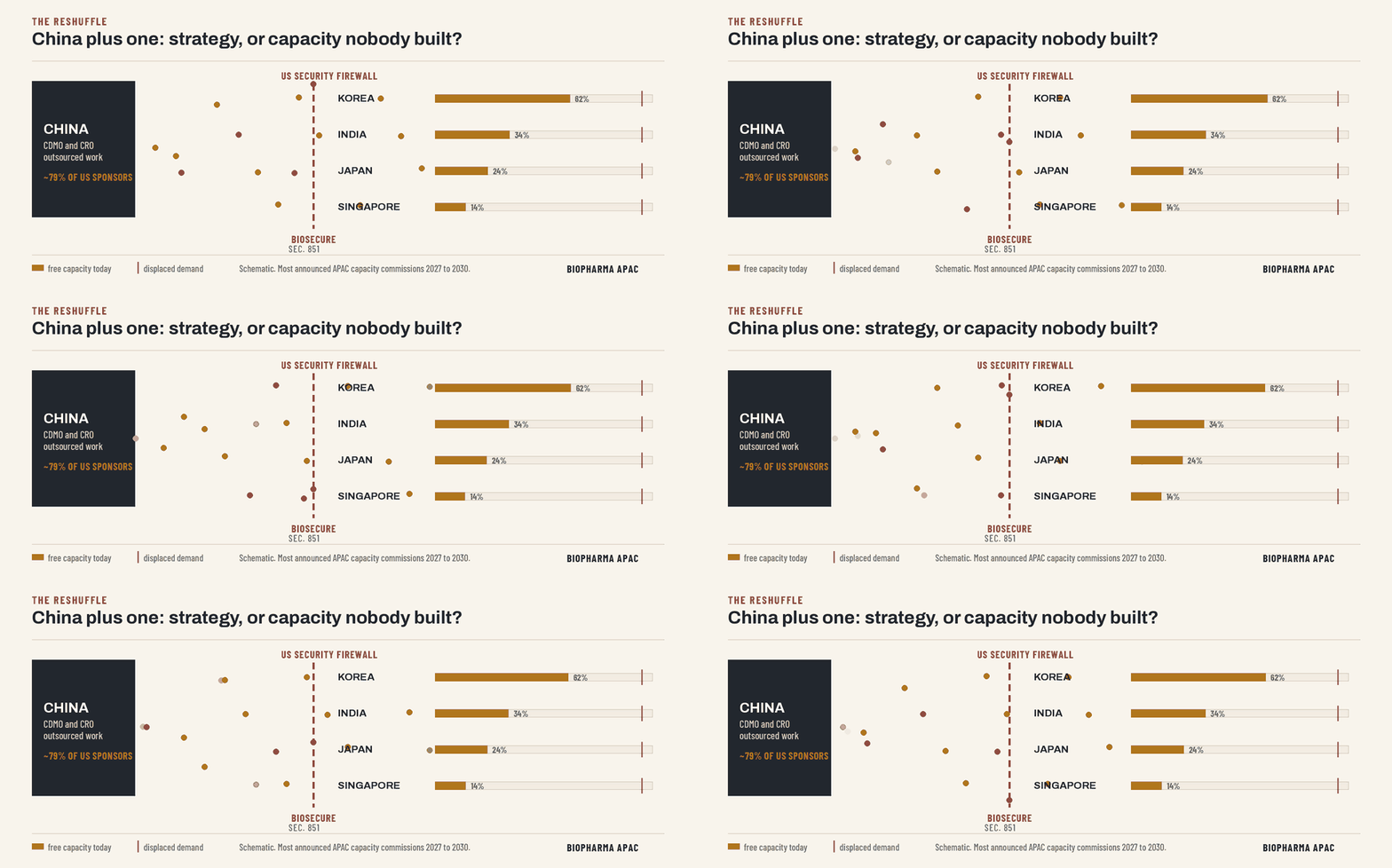
Layered on top of the science is a policy environment that makes clear-eyed assessment harder, not easier. The BIOSECURE Act, signed into law in December 2025, restricts U.S. federal dollars from flowing to Chinese “biotechnology companies of concern” — and while it targets manufacturing and genomics services rather than licensing, it has saturated the sector with caution. Reporting in 2025 that the Trump administration was weighing a crackdown specifically on licensing deals for China-invented medicines added a fresh layer of deal risk, even after the White House said no such order was “actively” under consideration.
The distortion cuts both ways. On one side, security anxiety and FDA skepticism may cause buyers to under-rate genuinely good Chinese science, treating provenance as a defect regardless of the data. On the other, the rush to lock in assets before the regulatory door narrows can inflate prices and accelerate deals past the point where due diligence is comfortable. Either way, geopolitics is now a variable in every China deal model — and a confounder in any honest attempt to read the underlying quality.
A sober framework: separating substance from froth
Strip away the noise and a usable test emerges. Froth tends to look like this: a headline deal value dominated by back-loaded milestones rather than cash up front; efficacy resting on single-arm or China-only data; progression-free survival celebrated while overall survival goes untested; and a buyer whose thesis is explicitly about cheapness. Substance looks different: multi-regional trials that include Western sites; overall-survival endpoints met, not just surrogates; differentiated mechanisms in modalities where China genuinely leads, like ADCs and bispecifics; and a buyer paying real up-front money because it believes the science, not merely the price.
By that test, the boom is neither pure powerhouse nor pure bubble. China has unambiguously become a first-rank source of innovative chemistry and biology — the FIC counts, the modality leadership, and the willingness of the most sophisticated buyers to pay billions are not illusions. But the licensing-value figures overstate proven leadership, because so much of that value is cheap optionality on data that has not yet cleared the only bar that ultimately matters: reproducing in a global trial that a stringent regulator will accept.
The most likely outcome is the least satisfying one for headline writers. China’s first-in-class surge is real and durable, but it will be sorted, over the next few years of clinical readouts, into a minority of genuine global winners and a long tail of assets that worked at home and faltered abroad. The bulls are right about the engine. The bears are right about the filter. The deals scorecard below is where the sorting is already underway — and where any reader serious about telling substance from froth should be watching, line by line, as the global data comes in.
Deals Scorecard: Reading the Wave, One Transaction at a Time
Five transactions that, between them, contain the entire bull-bear argument.
|
Deal |
Year |
Value |
What it tells us |
|
Akeso → Summit (ivonescimab, PD-1×VEGF bispecific) |
2022 |
$500M up front / $5B total |
The signature deal of the wave. Beat Keytruda on PFS in China, but the global HARMONi trial missed on overall survival — the reproducibility test in miniature. |
|
Innovent → Eli Lilly (sintilimab, PD-1) |
2015 |
Undisclosed |
The cautionary precedent: FDA rejected the China-only package in 2022, demanding multi-regional data. Cited ever since as the reason single-country trials don’t travel. |
|
RemeGen → AbbVie (cancer ADC) |
2026 |
Up to $5.6B |
A 2026 vote of confidence in Chinese ADC engineering — the modality where China leads global development. |
|
CSPC → AstraZeneca (obesity / chronic disease) |
2025/26 |
Up to $18.5B |
Among the largest China-origin deals ever struck; evidence the buying has moved beyond oncology into metabolic disease. |
|
BioNTech / Bristol Myers Squibb (PD-L1×VEGF, rival class) |
2024 |
Up to ~$11B |
A Western-partnered rival to ivonescimab’s mechanism — proof the category, not just one molecule, is being bid up. |
Deal values reflect total potential including milestones; upfront cash is typically a fraction. Figures are point-in-time and several programs remain in active clinical readout.
(arcilla.fran@biopharmaapac.com )
Most Read
- Can APAC Biomanufacturing Decarbonise Without Pricing Itself Out?
- The Algorithm on the GMP Floor: AI Promises a Smarter Plant. Regulators Demand the Audit Trail.
- APAC's Peptide-Capacity Gamble
- After the Rush: APAC's mRNA and Vaccine Capacity Hangover
- The Biosimilar Race: Factory to the World — or Stuck in the Copycat Economy?
- The Vein-to-Vein Problem: Can APAC's Cold Chain Carry Advanced Therapies?
- Vectors, Plasmids and the CGT Trap: APAC's Cell and Gene Therapy Ambitions Face an Upstream Bottleneck
- Can APAC Build Radioligand Therapy Before the Atoms Decay?
- The Great Biopharma Reset: 50 Developments That Changed Everything in H1 2026
- Beyond the Trial: Can Real-World Evidence Earn Regulatory Trust in APAC?
- Beyond the Obvious Giant: Where APAC's Clinical Trials Go Next
- The Frontier That Won’t Quite Arrive
Bio Jobs
- Sanofi Turns The Page As Belén Garijo Steps In And Paul Hudson Steps Out
- Global Survey Reveals Nearly 40% of Employees Facing Fertility Challenges Consider Leaving Their Jobs
- BioMed X and AbbVie Begin Global Search for Bold Neuroscience Talent To Decode the Biology of Anhedonia
- Thermo Fisher Expands Bengaluru R&D Centre to Advance Antibody Innovation and Strengthen India’s Life Sciences Ecosystem
- Accord Plasma (Intas Group) Acquires Prothya Biosolutions to Expand Global Plasma Capabilities
- ACG Announces $200 Million Investment to Establish First U.S. Capsule Manufacturing Facility in Atlanta
- AstraZeneca Invests $4.5 Billion to Build Advanced Manufacturing Facility in Virginia, Expanding U.S. Medicine Production
News