7 Countries Competing to Be the Region’s Next Biomanufacturing Hub
27 July 2026 | Monday | Analysis
A siting decision for a biomanufacturing facility is one of the most expensive commitments a company makes, and it is made against a fifteen to twenty year horizon. The incentive package that dominates the press release is real money, but it is also the most reversible thing in the calculation. Tax holidays lapse, grant envelopes empty, and a government that changes can withdraw what the last one offered. The things that are hard to reverse, which is to say a mature regulator, a deep talent pool, and reliable power, are the things that get talked about least and matter most.
So we built a scoring model that deliberately underweights the loudest variable. Seven markets, four dimensions, weighting published in full and open to challenge. Regulatory maturity carries the most weight at 30 per cent, because a plant is only as valuable as the number of markets its output can reach without a fight. Incentive package and talent depth sit at 25 per cent each. Utilities and logistics, the least glamorous and most binding constraint of all, carries 20 per cent.
The scores that follow are judgements, not measurements. They are built from public incentive documents, regulatory-authority disclosures, graduate-output figures, and industrial land and power data, and every national investment agency was offered a right of reply on its own row. You will disagree with some of them. Good. The interactive version of this piece lets you change the weighting and watch the ranking re-sort, because the honest truth of hub competition is that the right answer depends entirely on what you are trying to build.
How the scoring works
Four dimensions, each scored 0 to 10 for each market, combined using a published weighting to produce a single weighted score out of 10.
Weighting: regulatory maturity 30 per cent, incentive package 25 per cent, talent depth 25 per cent, utilities and logistics 20 per cent. The weighting reflects our editorial view that durable factors should outweigh reversible ones. It is not the only defensible weighting, which is exactly why the interactive version exists.
Sources: national investment-agency incentive documents, regulatory-authority disclosures and approval-timeline data, tertiary graduate-output statistics, and published industrial land and electricity cost data. Where a figure is a government projection rather than an audited outcome, it is labelled as such in the text.
1. Singapore Weighted score 8.75
The pitch. If you need the output to clear every regulator on earth without an argument, you build here and you pay for the privilege.
Singapore does not win on incentives and does not pretend to. It wins on the two things money cannot buy quickly: a regulator, the Health Sciences Authority, whose word is trusted globally, and two decades of accumulated cluster depth at Tuas Biomedical Park and Biopolis. The RIE 2030 plan commits S$37 billion to research and enterprise including health and biomedical sciences, and the recent anchor investments are enormous, with AstraZeneca committing US$1.5 billion to its first end-to-end ADC facility in Tuas and WuXi Biologics investing US$1.4 billion over ten years. Around 60 biopharmaceutical manufacturing sites already operate there.
The constraint nobody mentions. Cost and scale ceiling. Singapore is a small country with expensive land and labour, and biomedical output is volatile, having fallen sharply in early 2025. It cannot host the low-cost, high-volume end of manufacturing, and it does not try to. Its own success also prices out the mid-tier work that seeds the next generation of local operators.
Score line: incentive 7, regulatory 10, talent 8, utilities 10. The utilities and regulatory maximums are earned. The incentive score is capped because Singapore will not out-subsidise its larger neighbours and knows it does not need to.
What moves it. Down, if a competitor matches its regulatory credibility, which is a decade-scale project for anyone. Up is barely possible; it is already near the ceiling on three of four axes.
2. South Korea Weighted score 8.45
The pitch. The only cluster on earth that can put half a million litres of installed antibody capacity within an hour of one airport, and it is still building.
The Songdo Bio Cluster in the Incheon Free Economic Zone is the most concentrated large-scale biomanufacturing agglomeration in the region, anchored by Samsung Biologics, Celltrion and Lotte Biologics. The national bio strategy pairs infrastructure with a substantial R&D budget, and the free-economic-zone framework provides the incentive layer. What South Korea has that no challenger can replicate at speed is proven execution at commercial scale, batch after batch, for the world’s most demanding sponsors.
The constraint nobody mentions. Concentration risk and modality lag. Almost everything sits in one zone built for large-volume monoclonal antibodies, and the pipeline is shifting toward conjugates, cell and gene therapy, and smaller batches. Korea is retooling, but its advantage is deepest in exactly the modality whose share is peaking. The K-Bio Vaccine Fund has also struggled to hit its targets, a reminder that a headline fund and deployed capital are different things.
Score line: incentive 8, regulatory 8, talent 9, utilities 9. Talent and utilities are near best-in-class. Regulatory sits below Singapore because the MFDS, while strong, does not yet carry quite the same global reliance weight.
What moves it. Up, if the conjugate and cell-therapy retooling lands and the regulator continues gaining international recognition. Down, if concentration becomes a liability that sponsors start pricing in.
3. China Weighted score 7.65
The pitch. The deepest capacity, the fastest build times, and the most aggressive incentives in the region, available to anyone willing to accept the geopolitical overhang.
On raw capability China is arguably first, not third. It has unmatched scale, a vast and rapidly improving contract-manufacturing sector, aggressive local and provincial incentives, and build speeds that embarrass most competitors. Clusters in the Yangtze and Greater Bay areas and the Suzhou biopharma corridor combine capacity with genuine scientific depth. On a pure capability weighting it would rank first or second.
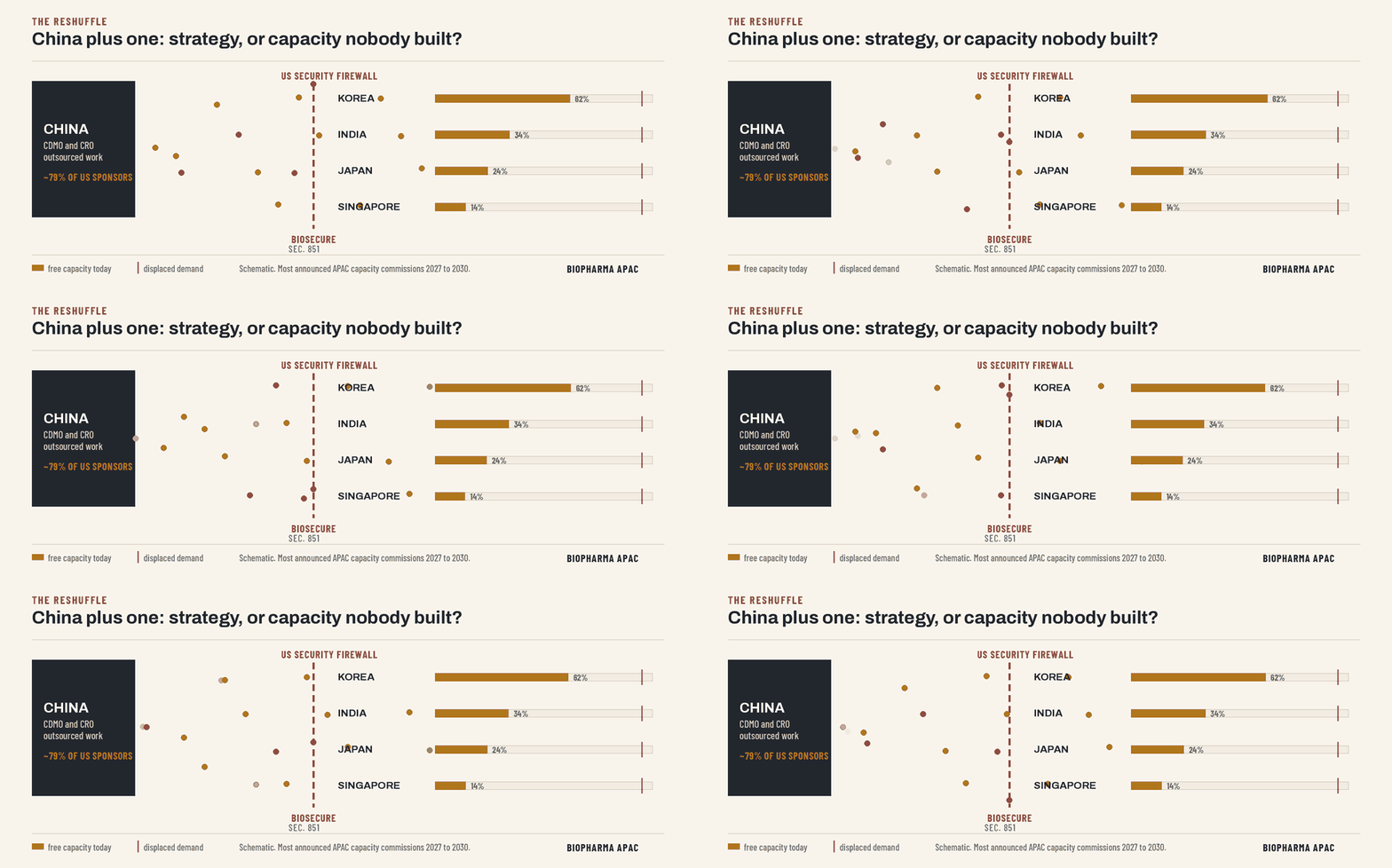
The constraint nobody mentions. Market access risk, and it is not really hidden. Legislative attention in the United States to biomanufacturing supply-chain origin has made China-sited output a strategic question for any sponsor selling into Western markets, regardless of the plant’s quality. This is the single reason a manufacturer might pay more to build elsewhere, and it is why WuXi XDC built in Singapore. It suppresses the regulatory-maturity score not because Chinese regulators are weak, but because the market-access consequence of siting there is now a live risk for a large class of customers.
Score line: incentive 9, regulatory 6, talent 8, utilities 8. The incentive and talent scores are genuinely high. The regulatory score reflects external market-access risk rather than the NMPA’s domestic capability, which is considerable.
What moves it. Up sharply, if the geopolitical picture stabilises, because everything else is already in place. Down, if supply-chain-origin restrictions harden into law.
4. Japan Weighted score 7.55
The pitch. A vast domestic market and a first-rate regulator, finally getting serious about merchant biomanufacturing rather than in-house-only supply.
Japan has always had the demand and the regulatory quality; the PMDA is among the most respected authorities anywhere. What it historically lacked was a merchant contract-manufacturing sector at scale. That is now changing, with Fujifilm building its first domestic antibody plant at Toyama and AGC Biologics investing around US$350 million in an advanced-therapy facility at Yokohama, the latter selected under a government programme to strengthen domestic vaccine capacity. The public-money backing signals genuine national intent.
The constraint nobody mentions. Cost structure and language-plus-business-culture friction for foreign sponsors, plus a demographic squeeze on the technical workforce. Japan’s facilities are excellent and its costs are high, and the domestic orientation that makes the market large can also make it inward-facing for an overseas client trying to place work.
Score line: incentive 6, regulatory 9, talent 7, utilities 8. Regulatory is a near-maximum. Incentive lags because Japanese support, while real, is less aggressive than Chinese or Indian offers. Talent reflects quality constrained by demographics.
What moves it. Up, if the new merchant capacity books international work and proves Japan is open for third-party business. Down, if it ends up serving only domestic sponsors.
5. India Weighted score 6.50
The pitch. The lowest cost base and the deepest scientific labour pool in the region, backed by real central money, if you can tolerate the infrastructure gaps.
India’s case is cost and talent. Its Production Linked Incentive schemes for bulk drugs and pharmaceuticals commit thousands of crores, with the bulk-drug PLI running a total outlay around 6,940 crore rupees to 2029-30 and offering incentives as high as 20 per cent of eligible sales in early years for fermentation-based products. State-level competition adds to it, with Telangana securing around 11,000 crore rupees of life-sciences commitments at BioAsia 2025 for its Genome Valley and Green Pharma City. The scientific workforce is enormous and cheap by regional standards.
The constraint nobody mentions. Utilities and logistics, which is why the score sits where it does. Reliable power, water quality, and cold-chain logistics remain genuinely variable across Indian industrial sites, and for biomanufacturing, where a power interruption can destroy a batch, that is not a footnote. The incentive money is real; the ground it lands on is uneven.
Score line: incentive 8, regulatory 5, talent 8, utilities 5. Incentive and talent are strong. Regulatory reflects the CDSCO’s more limited international reliance weight. Utilities is the binding constraint and the honest reason India is mid-table rather than higher.
What moves it. Up substantially, if the bulk-drug-park infrastructure delivers reliable utilities at scale and the regulator continues its international engagement. Down, if the parks underdeliver on common infrastructure.
6. Australia Weighted score 6.35
The pitch. A trusted regulator, strong science, and a genuine advantage in the early clinical and cell-therapy niche, at a scale that will never be large.
Australia’s strengths are real and specific. The TGA is a respected regulator, the research base is strong, and the R&D tax incentive is genuinely generous for early-stage and clinical-scale work. The country has carved a defensible position in early-phase manufacturing and in cell and gene therapy, where its clinical-trial ecosystem is a genuine draw. For the right kind of work, it is an excellent choice.
The constraint nobody mentions. Commercial-scale economics and distance. Australia is a long way from the major markets and its domestic scale is small, so it struggles to justify large-volume commercial biomanufacturing on cost. Its incentive score is the lowest here not because support is absent but because it is aimed at R&D rather than at large-scale production siting.
Score line: incentive 4, regulatory 8, talent 7, utilities 6. Regulatory and talent are strong. The incentive and utilities scores reflect a system optimised for research and clinical scale rather than for commercial production, and a logistics position far from end markets.
What moves it. Up, if cell and gene therapy demand grows enough to reward its niche strength at higher volume. It is unlikely to move up as a large-scale commodity hub, and does not really aim to.
7. Malaysia Weighted score 6.20
The pitch. Singapore-adjacent, materially cheaper, and offering some of the most generous headline tax incentives in the region for anyone willing to build the ecosystem alongside the plant.
Malaysia competes on price and proximity. Its Pioneer Status and Investment Tax Allowance can exempt a large share of statutory income or offset 60 to 100 per cent of qualifying capital expenditure, the BioNexus Status targets biopharmaceuticals specifically, and the new Johor-Singapore Special Economic Zone, formalised in January 2025, positions Malaysian sites as a lower-cost complement to Singapore next door. On headline incentive generosity it is highly competitive.
The constraint nobody mentions. Ecosystem depth, which is the hardest thing to subsidise. Malaysia has the incentives and the land but a thinner base of experienced biomanufacturing talent and supporting suppliers than the leaders, and a generous tax holiday does not conjure a trained workforce or a local supply chain. This is why it scores lowest on talent despite a strong incentive offer.
Score line: incentive 7, regulatory 6, talent 5, utilities 7. The incentive and utilities scores are solid. Talent is the honest weak point, and the New Investment Incentive Framework piloting in 2025 will not change that quickly.
What moves it. Up, if the Johor-Singapore zone lets it borrow Singapore’s ecosystem while offering its own cost base, which is the most plausible upgrade path for any market on this list. Down, if the talent gap keeps anchor investors away.
What the scores actually say
Three things stand out once the rows are sorted. The first is that incentives, the variable every press release leads with, correlate weakly with the final ranking. China and India post the joint-highest incentive scores and sit third and fifth. Singapore leads the table on the strength of factors that no budget line can buy this year. If you take one thing from this piece, take that: a siting decision made on incentive generosity is a decision made on the least durable input.
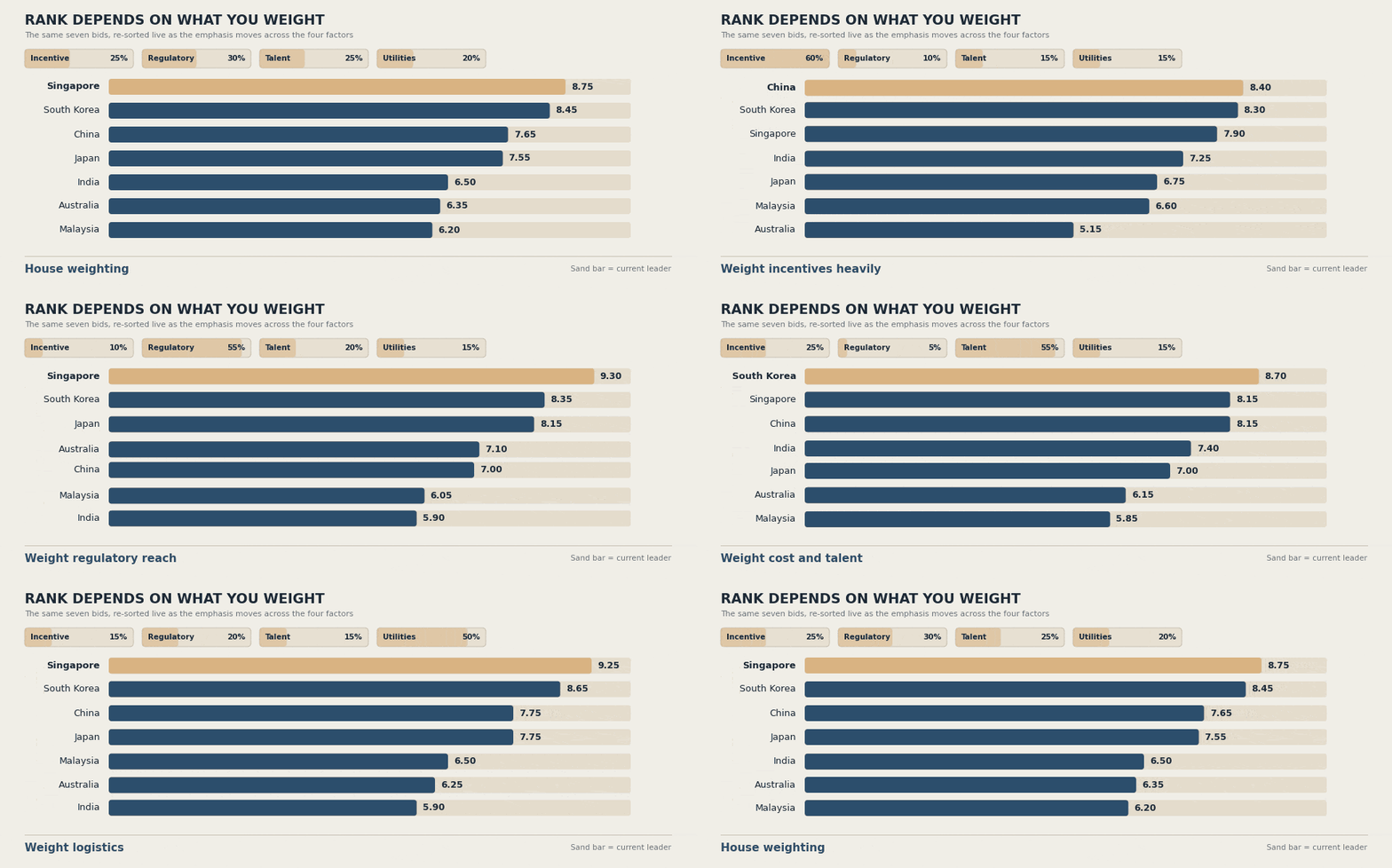
The second is that the ranking is unusually sensitive to weighting, which is a feature rather than a flaw. Weight incentives and raw capability heavily and China moves toward the top. Weight market access and regulatory reach and Singapore and Korea pull away. Weight cost and talent and India climbs. There is no single correct order, only an order that is correct for a given kind of facility. A commodity biosimilar plant for emerging markets and a first-in-class ADC facility for the United States and European Union should reach opposite conclusions from the same table. That is the whole reason the interactive re-ranker exists.
The third is the uncomfortable one for regional policymakers. The two markets that lead this table, Singapore and Korea, lead on durable factors that took decades and are hard to erode. The markets competing hardest on incentives are competing on the one dimension a rival can match with a bigger cheque next budget cycle. Incentive-led hub strategies are, almost by definition, strategies built on the least defensible ground. The governments that will still have a hub in 2040 are the ones investing in regulators and graduates now, and those investments do not photograph well at a ribbon-cutting.
This is a scored judgement, published as an annual assessment and rescored each year. The scores invite argument, which is why the weighting is set out in full, why each agency held a right of reply on its own row, and why any correction is shown as a versioned update rather than absorbed silently. The order above is our answer to a general question. The interactive re-ranker is there to give you yours.
The scores in one picture
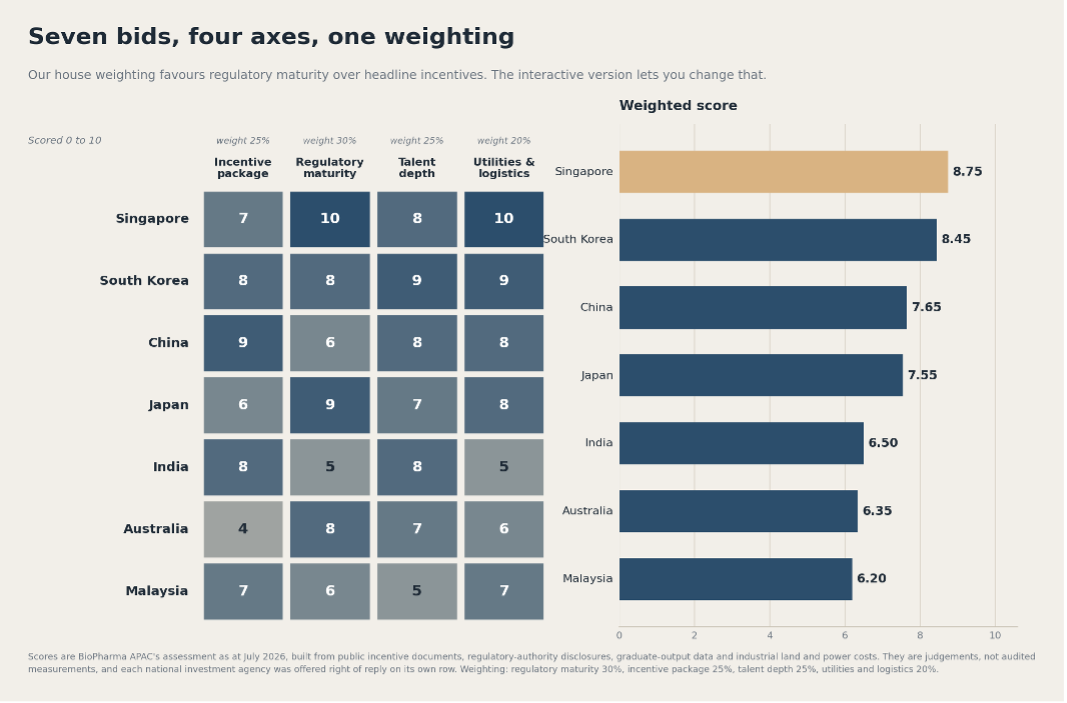
Left: each market scored 0 to 10 on four dimensions, sorted by weighted total. Right: the weighted score that results from the house weighting. Scores are BioPharma APAC’s assessment as at July 2026 and are judgements rather than audited measurements.
Weighted scores under the house weighting: Singapore 8.75, South Korea 8.45, China 7.65, Japan 7.55, India 6.50, Australia 6.35, Malaysia 6.20.
The four dimensions at a glance
|
Dimension |
Weight |
What it captures |
|
Incentive package |
25% |
Tax holidays, capital allowances, grants and cluster subsidies on offer, weighted for how much is funded rather than announced |
|
Regulatory maturity |
30% |
The international reliance weight of the national regulator, and the market-access consequence of siting output there |
|
Talent depth |
25% |
Depth and cost of experienced biomanufacturing and scientific labour, and the pipeline of graduates feeding it |
|
Utilities & logistics |
20% |
Reliability of power, water and cold chain, industrial land cost, and distance to major end markets |
arcilla.fran@biopharmaapac.com
Disclosure
BioPharma APAC holds no commercial relationship with any national investment agency named in this article that would affect its scoring. Scores were set by the editorial team against the published weighting before any commercial team saw them.
Disclaimer
- Informational purpose. This article is published for general information and industry analysis. It is not advice on any siting, investment or location decision.
- Scores are judgements. The scores are the analytical opinion of BioPharma APAC based on documentary sources, arrived at through a published weighting. They are not audited measurements and reasonable analysts will disagree.
Most Read
- Can APAC Biomanufacturing Decarbonise Without Pricing Itself Out?
- The Algorithm on the GMP Floor: AI Promises a Smarter Plant. Regulators Demand the Audit Trail.
- APAC's Peptide-Capacity Gamble
- After the Rush: APAC's mRNA and Vaccine Capacity Hangover
- The Biosimilar Race: Factory to the World — or Stuck in the Copycat Economy?
- The Vein-to-Vein Problem: Can APAC's Cold Chain Carry Advanced Therapies?
- Vectors, Plasmids and the CGT Trap: APAC's Cell and Gene Therapy Ambitions Face an Upstream Bottleneck
- Can APAC Build Radioligand Therapy Before the Atoms Decay?
- The Great Biopharma Reset: 50 Developments That Changed Everything in H1 2026
- Beyond the Trial: Can Real-World Evidence Earn Regulatory Trust in APAC?
- Beyond the Obvious Giant: Where APAC's Clinical Trials Go Next
- The Frontier That Won’t Quite Arrive
Bio Jobs
- Sanofi Turns The Page As Belén Garijo Steps In And Paul Hudson Steps Out
- Global Survey Reveals Nearly 40% of Employees Facing Fertility Challenges Consider Leaving Their Jobs
- BioMed X and AbbVie Begin Global Search for Bold Neuroscience Talent To Decode the Biology of Anhedonia
- Thermo Fisher Expands Bengaluru R&D Centre to Advance Antibody Innovation and Strengthen India’s Life Sciences Ecosystem
- Accord Plasma (Intas Group) Acquires Prothya Biosolutions to Expand Global Plasma Capabilities
- ACG Announces $200 Million Investment to Establish First U.S. Capsule Manufacturing Facility in Atlanta
- AstraZeneca Invests $4.5 Billion to Build Advanced Manufacturing Facility in Virginia, Expanding U.S. Medicine Production
News