Making a Drug People Take for Twenty Years
31 August 2026 | Monday | News
|
METHOD IN BRIEF Cost-of-goods figures in this article are reconstructions, not disclosures. No company supplied a cost-of-goods figure and none is represented as having done so. Each reconstruction is built from published benchmarks and from stated dosing assumptions, all of which appear in full in the body text so that a reader can substitute different inputs and watch the answer move. Where a figure is an estimate it is labelled an estimate. Prices are kept separate from costs throughout, are attributed and carry a date. Population figures are from ESCAP drawing on UN DESA World Population Prospects 2024. Clinical findings are taken from primary trial publications and regulatory records. Company facts are taken from company disclosure with the disclosure date attached. No interview material appears in this article and no quotation is attributed to any individual. |
The morning the region priced its own answer
This morning in Zug, a Swiss company incorporated for a single purpose published a tender offer prospectus. Samsung Peptide AG, a direct subsidiary of Samsung Biologics, is offering CHF 44.31 in cash for every publicly held registered share of PolyPeptide Group AG. The implied equity value is roughly CHF 1.46 billion, about 1.8 billion US dollars, and the offer price sits 40 per cent above where PolyPeptide traded on 10 April, the last day before the market began speculating. Acceptance is conditioned on two thirds of the register, and the parties expect to close towards the end of 2026.
It is the largest acquisition in the history of the Korean biopharmaceutical industry. It was made by a company that already holds 845,000 litres of bioreactor capacity, 785,000 of them across two campuses in Songdo and 60,000 more at the Rockville site it took over from GSK in March. Samsung Biologics did not buy more litres. It bought chemistry.
Read that decision alongside the rest of the region's build-out and something uncomfortable appears. Asia-Pacific has spent the better part of a decade, and tens of billions of dollars, installing capacity optimised for high-value biologics: large single-use and stainless mammalian trains, antibody-drug conjugate suites, viral vector and cell therapy lines. That capacity is well matched to the products it was built for. It is poorly matched to the product that the longevity category, if it produces anything at all, is most likely to produce.
The economics of the build-out tell you who it is for. Plant 5 in Songdo cost roughly 1.5 billion US dollars for 180,000 litres, which is a little over 8,000 dollars of capital per litre of installed capacity, and it is backed by an order book the company put at 21.4 billion dollars as of the first quarter of 2026. More than 80 per cent of that revenue comes from the United States and Europe. This is a business built to make expensive molecules for wealthy reimbursement systems, and it is extremely good at it. It is not, on any reading of its own numbers, a business built to serve 700 million ageing people in its own region at a price they can pay.
Because the most plausible mass-market gerotherapeutic is not an antibody. It is a cheap oral, or a long-acting injectable that costs less than a hundred dollars a year to make. And the difference between those two worlds is not a margin question. It is the difference between a product that reaches 700 million people and one that reaches two million.
The buyer who is not a patient
Start with what actually changes when the recipient is well.
An oncology biologic is sold into a situation of extreme urgency, to a patient with a documented disease, through a reimbursement system that has already accepted the principle that late-stage cancer justifies extraordinary spending. The price is set by what the payer will bear. Cost of goods is a rounding error inside the gross margin. Adherence is close to total because the alternative is the disease. And the safety bar, while real, is calibrated against a counterfactual in which the patient dies.
Now change one variable. The recipient is a 58-year-old accountant in Surabaya who feels fine.
Every one of those conditions inverts. There is no urgency, so the purchase competes with everything else the household buys. There is no documented disease, so in most of the region there is no reimbursement, and the money comes out of pocket. Adherence is voluntary and therefore fragile, which means the effective cost of a delivered year of benefit is the manufactured cost divided by the fraction of people still taking it. And the safety bar is no longer calibrated against death. It is calibrated against feeling fine.
The out-of-pocket point deserves more weight than it usually gets in category presentations. On UN agency estimates for Asia and the Pacific, only around 30 per cent of the older population receives any form of pension. The single largest cohort of people this category exists to serve is, in the majority, without a retirement income, in countries whose own demographers warn they will grow old before they grow rich. Price sensitivity in this market is not a preference. It is arithmetic.
That last inversion is the one the category has not internalised. A well population does not offer a benefit large enough to absorb harm. If the compression-of-morbidity thesis is right, the benefit of a gerotherapeutic arrives slowly, in aggregate, over a horizon measured in decades, and is close to invisible to the individual taking it. The harm, if there is harm, arrives on an ordinary schedule and is entirely visible. Asymmetry of that shape does not just make regulators cautious. It changes what you are permitted to manufacture.
The arithmetic, with every assumption on the table
Nobody publishes cost of goods for a gerotherapeutic, because there is no approved gerotherapeutic. So this section reconstructs it from published benchmarks. Every assumption is stated so that anyone who disagrees can substitute their own and watch the answer move.
Assumption one. Cost of goods means drug substance, drug product, primary packaging and quality control release. It excludes research, regulatory affairs, distribution, marketing, margin and tax. It is a manufacturing number, not a price.
Assumption two. A chronic oral is dosed at 10 mg daily, which is 3.65 grams of active ingredient per patient-year. Commodity active ingredient in the metformin and statin class runs at roughly 200 to 500 dollars a kilogram, giving 0.73 to 1.83 dollars of active ingredient per patient-year. Conversion, coating and blister packaging at scale run in the region of one to two US cents a tablet, so 3.65 to 7.30 dollars a year. Total: roughly 4 to 10 dollars per patient-year.
Assumption three. The same oral as a novel chemical entity at commercial but not commoditised scale carries active ingredient at 2,000 to 10,000 dollars a kilogram and higher conversion cost. Total: roughly 20 to 70 dollars per patient-year.
Assumption four. A chronic monoclonal antibody dosed at 150 mg subcutaneously every four weeks consumes 1.95 grams of drug substance a year. Published commercial cost of goods for antibody drug substance runs at roughly 50 to 150 dollars a gram, falling to 30 to 80 dollars for a biosimilar process, with the modelled floor for conventional fed-batch platforms sitting near 30 dollars. In 2024 the Gates Foundation and LifeArc opened a grand challenge explicitly targeting 10 dollars a gram, which tells you both that the number is thought reachable and that nobody has reached it. Add a prefilled syringe or autoinjector presentation at an estimated 3 to 12 dollars a unit across thirteen units a year. Total at today's costs: roughly 290 to 2,100 dollars per patient-year. Total if the 10 to 50 dollar target is met: roughly 60 to 450 dollars.
Assumption five. A long-acting injectable is benchmarked directly on lenacapavir, because it is the only product in the world that combines a twice-yearly subcutaneous depot with a healthy recipient population and a published cost analysis. The published work put active ingredient requirements at approximately 2,000 kilograms for one million person-years and 20,000 kilograms for ten million, with target active ingredient pricing of 25,000 dollars a kilogram falling to 10,000 dollars at the higher volume. That is roughly 2 grams of active ingredient per person-year, so 20 to 50 dollars of active ingredient. Add sterile fill, finish and kit assembly for two administrations at an estimated 3 to 8 dollars each. Total: roughly 26 to 66 dollars per patient-year.
Assumption six. Autologous cell therapy carries published cost of goods of roughly 50,000 to 100,000 dollars a dose. Amortise a single dose across ten years and the figure is 5,000 to 10,000 dollars per patient-year, which is generous to the modality.
Where the numbers land
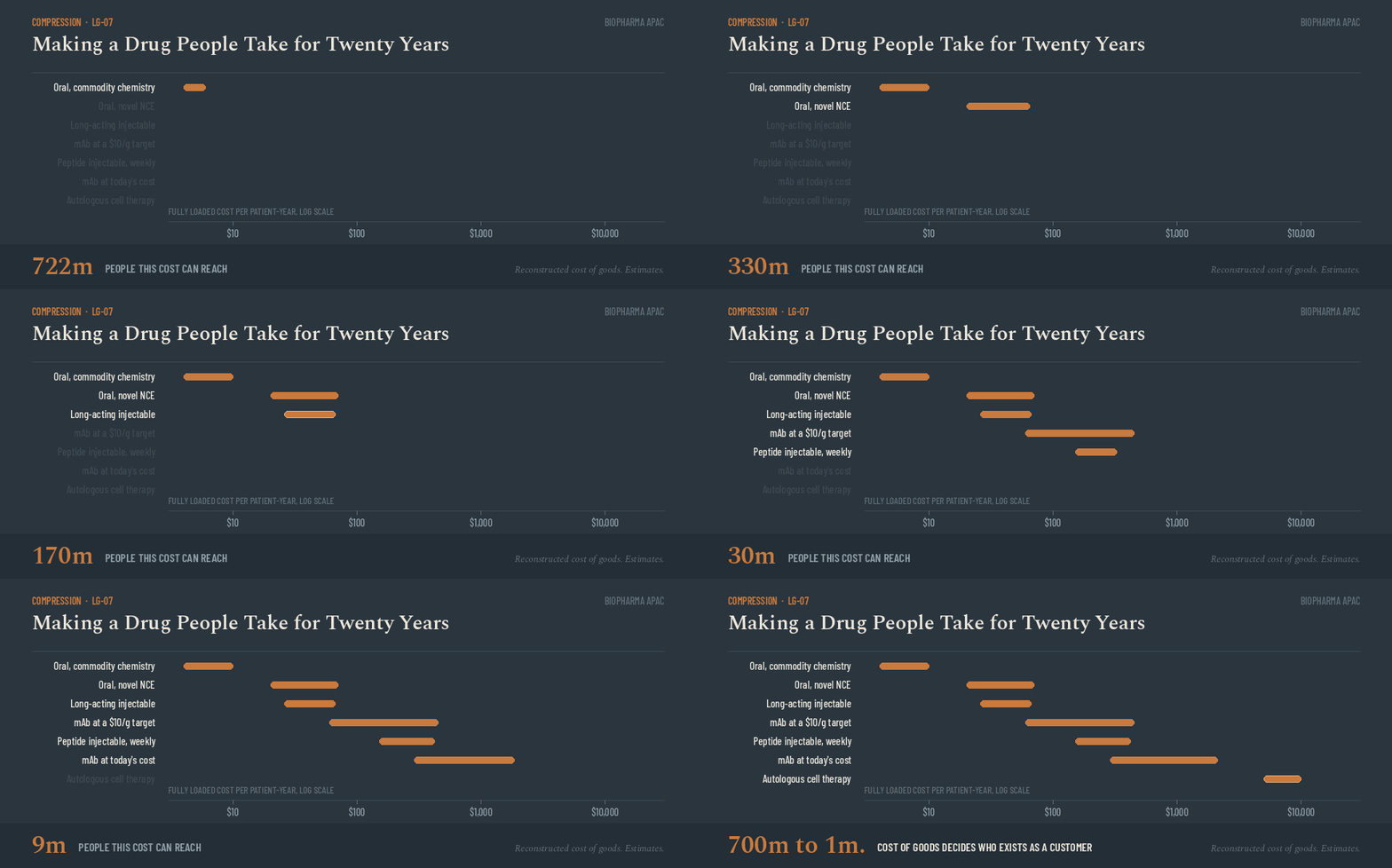
Figure 1 plots those reconstructions against the population each cost makes reachable. Two things are worth pausing on.
Figure 1. Cost per patient-year by modality against the population that cost makes reachable. Copper bars are cost-of-goods reconstructions under the assumptions stated above. Steel markers are observed prices and are not comparable with them.
The first is a validation, and it is the strongest one available for an exercise of this kind. The bottom-up reconstruction of a long-acting injectable lands at 26 to 66 dollars per patient-year. The announced generic price for lenacapavir, agreed in September 2025 between the Gates Foundation and Hetero Labs and between Unitaid and Dr Reddy's Laboratories, is about 40 dollars per person per year across 120 low and middle income countries from 2027. A price and a cost of goods are not the same thing, and the price includes margin, tax and distribution. But when a bottom-up manufacturing reconstruction and an independently negotiated commercial price agree to within a factor of about one and a half, the method is doing something real. The same published analysis argues that at five to ten million committed patients the figure falls to roughly 25 dollars, below the cost of generic oral pre-exposure prophylaxis.
The second is the spread. From the cheapest oral to the cheapest cell therapy is roughly three orders of magnitude. That is not a difference in profitability. It is a difference in who exists as a customer.
Here is the point where longevity stops resembling oncology entirely. In oncology, cost of goods determines margin. In a well population, cost of goods determines eligibility. Asia-Pacific held 722 million people aged 60 or over in 2024 on ESCAP's count, drawing on UN population data, and that cohort is projected to reach roughly 1.3 billion by 2050. At 10 dollars a patient-year, a product can be tendered into public procurement and stocked in mass retail, and essentially the whole cohort is addressable. At 300 dollars, the addressable population collapses to urban self-pay households in a handful of markets. At 15,000 dollars, it is a private clinic product for a few million people in Japan, Korea, Australia, Singapore and Taiwan, which is a perfectly good business and is not a longevity business.
So the modality decision sets the market size before a single trial reads out. It is made at candidate selection, years before anyone knows whether the molecule works, and it is effectively irreversible: you cannot reformulate an antibody into a tablet, and you cannot value-engineer a fed-batch mammalian process down by two orders of magnitude.
The region's own pricing history already made this argument, in a category adjacent to this one. LG-06 traced what happened when incretins went generic in India in March 2026: monthly costs in the range of a few hundred rupees to a few thousand, an order of magnitude below the originator, set by manufacturers the originator does not control. Whoever eventually launches a gerotherapeutic in Asia-Pacific will be pricing against that reference point, in a category with a weaker clinical claim.
The margin you do not get back
Now the harder half of the problem, and the reason cheapness alone does not solve it.
In February 2018 the ASPREE investigators reported on 19,114 community-dwelling adults aged 70 and over in Australia and the United States, randomised to 100 milligrams of enteric-coated aspirin daily or placebo, followed for a median of 4.7 years. Aspirin is the cheapest, most studied, most familiar drug in the world. The primary composite of death, dementia or persistent physical disability came in at 21.5 events per 1,000 person-years on aspirin against 21.2 on placebo. Cardiovascular events were nominally lower and not significant. Major haemorrhage was 8.6 events per 1,000 person-years against 6.2, a hazard ratio of 1.38 with a confidence interval well clear of one. All-cause mortality was higher on aspirin, driven mainly by cancer deaths, a finding the investigators themselves flagged as unexpected and to be treated with caution. Extended follow-up published in 2025 has continued to track the cohort.
Read ASPREE as a manufacturing document rather than a clinical one and it says something specific. In a healthy older population, a drug with almost no cost, a sixty-year safety record and a plausible mechanism produced measurable harm and no measurable benefit on the endpoint that mattered. That is the base rate against which any gerotherapeutic will be judged.
The commercial consequences are documented too. Rimonabant received European marketing authorisation on 19 June 2006 for obese and overweight patients, a population that is largely well by the standards of oncology. Marketing was suspended across member states on 13 November 2008 over psychiatric adverse effects, and the marketing authorisation holder notified the Commission of voluntary withdrawal on 5 December. That is a commercial life of roughly twenty-nine months. Sibutramine did better and still lost: thirteen years on the market and, by the manufacturer's own account, more than six million patient-years of exposure, ended by a cardiovascular outcomes trial showing a 16 per cent relative increase in serious events, with European suspension in January 2010 and United States withdrawal in October.
For a plant, this translates into a specification problem that is genuinely awkward. A twenty-year product taken by well people needs tighter control than an oncology biologic, not looser. The tolerance for batch-to-batch variability is lower because there is no disease benefit to offset a bad batch. The tolerance for nitrosamine, elemental impurity and degradant findings is lower because cumulative exposure over two decades is the relevant metric, not exposure over six cycles. Stability programmes have to support long shelf life in hot, humid distribution. Pharmacovigilance has to detect signals in a population where the background event rate is the signal's competitor.
So the two pressures point in opposite directions. Cost of goods has to come down by one to two orders of magnitude. Process control has to go up. Very few process architectures satisfy both, and the ones that do tend to be the boring ones: well-characterised synthetic chemistry with few steps, robust crystallisation, simple solid dosage forms, and processes with the smallest number of degrees of freedom you can arrange. That is an unfashionable conclusion in a region that has spent a decade buying flexibility.
What the plants would have to change
Four things, and none of them are the things currently being announced.
The scale is chemical, not pharmaceutical. Ten million patients on a 10 mg daily oral consume 36.5 tonnes of active ingredient a year. Fifty million consume 182 tonnes. Those are commodity chemistry volumes. Very few producers of novel chemical entities anywhere in Asia-Pacific run a single molecule at that scale outside the metformin and paracetamol class. The capability exists in the region, sitting in plants that were built for off-patent products at low margin, and it is not the same capability, the same quality system or the same corporate culture as the one running a 15,000 litre bioreactor to good manufacturing practice for an American client.
The oral capacity is already there and is not counted as strategic. On the USP Medicine Supply Map's 2024 analysis, India accounts for around 60 per cent of solid oral dose production volume for the United States market. If the mass-market gerotherapeutic is an oral, the region's most important longevity asset is not a bioreactor campus. It is an installed base of tablet lines that most strategic planning treats as a low-value commodity to be defended rather than a platform to be aimed.
The constraint on a long-acting injectable is sterile, not upstream. If the answer is a twice-yearly depot, no bioreactor is involved at any point. The binding constraints become isolator or restricted-access barrier fill lines, vial and stopper supply, terminal inspection capacity, and device assembly. Those lines are being built in the region, but they are being built and priced for high-value low-volume sterile work. A product needing 1.4 billion vials a year for 700 million people is a different plant and a different unit economics conversation.
Single-use may be the wrong default. The region standardised on single-use flexibility because it suits a world of many products at modest volume with fast changeover. Consumables are a variable cost per gram. In a world of one product at enormous volume and razor-thin cost of goods, that variable cost becomes a structural disadvantage, and the argument swings back toward stainless steel, higher titre, intensified processing and the longest possible campaign. This is the point at which the product economics touch process technology, and it is the boundary of this story. Our next-generation manufacturing coverage owns the question of which technologies have actually crossed from pilot into commissioned plant in Asia-Pacific, and readers should take the technology assessment from there.
The twenty-year supply problem
The last piece is the one most likely to be treated as somebody else's department, and it is the one that quietly decides the market.
Consider a formulation decision buried in the lenacapavir record. Early clinical work used a 100 mg/mL injectable suspension stored refrigerated at 2 to 8 degrees. The commercial product is a 309 mg/mL solution, and the approved label stores it at 20 to 25 degrees with excursions permitted between 15 and 30. Somewhere between those two formulations, the product left the cold chain.
That is not a logistics detail. It is the difference between a product that can only be given where there is a validated refrigerated chain with a monitored last mile, and one that can sit in a pharmacy cabinet in a tier-three Indian city, a rural Indonesian clinic or a Vietnamese commune health station. For a drug taken for twenty years by people who are not ill, that distinction is close to determinative. A well person will not travel three hours to a hospital pharmacy twice a year for a preventive injection. They will do it once, feel fine, and not return.
Anyone building for this market should treat room-temperature stability as a design requirement rather than a nice outcome, and should be sceptical of the reflex that cold chain is a solved problem because it was solved for vaccines during a pandemic. It was solved with extraordinary capital, temporary infrastructure and a public emergency behind it. None of those apply to a preventive taken by choice over two decades.
Then there is adherence, which behaves as a cost multiplier in reverse. If cost of goods is 40 dollars a patient-year and half the cohort stops within eighteen months, the manufactured cost per delivered year of benefit is 80 dollars, and the marketing cost of replacing the lapsed half is larger than the manufacturing cost of serving them. This is why route of administration is not a convenience question in this category. A twice-yearly injection given by a health worker has a structurally different persistence profile from a daily tablet, and a long-acting product with a higher unit cost can beat a cheaper daily oral on cost per delivered year. The comparison that matters is not cost per unit. It is cost per adherent patient-year, and almost nobody models it that way at candidate selection.
What this adds up to
The region is making a large, mostly unexamined bet. The capital is going into capacity for a modality that, on the arithmetic above, cannot serve the population the longevity thesis is actually about. Samsung Biologics is the exception rather than the counterexample: it did not defend the bet, it hedged it, spending 1.8 billion dollars on a peptide chemistry platform whose prospectus went out this morning. Fujifilm's Toyama antibody plant, the antibody-drug conjugate suites in Songdo and Singapore, the vector and cell therapy lines across the region are all sound investments in the businesses they were built for, and none of them is a longevity asset.
If a gerotherapeutic arrives, and that remains a genuine if rather than a when, the plants that make it will look like the plants that make cardiovascular generics: high-volume synthesis, simple dosage forms, punishing unit costs, tight impurity control, room-temperature stability, and a distribution model built for pharmacies rather than hospitals. Asia-Pacific owns more of that capacity than any other region on earth. It has simply not been told that this is what it is for.
The capital allocation question is therefore not whether to keep building biologics capacity. It is whether anyone in the region is deliberately positioning the oral and sterile-fill assets that a well population would actually buy from, or whether that positioning is going to be left to happen by accident, several years too late, in a market where the reference price has already been set by somebody else.
arcilla.fran@biopharmaapac.com
Most Read
- Can APAC Biomanufacturing Decarbonise Without Pricing Itself Out?
- The Algorithm on the GMP Floor: AI Promises a Smarter Plant. Regulators Demand the Audit Trail.
- APAC's Peptide-Capacity Gamble
- After the Rush: APAC's mRNA and Vaccine Capacity Hangover
- The Biosimilar Race: Factory to the World — or Stuck in the Copycat Economy?
- The Vein-to-Vein Problem: Can APAC's Cold Chain Carry Advanced Therapies?
- Vectors, Plasmids and the CGT Trap: APAC's Cell and Gene Therapy Ambitions Face an Upstream Bottleneck
- Can APAC Build Radioligand Therapy Before the Atoms Decay?
- The Great Biopharma Reset: 50 Developments That Changed Everything in H1 2026
- Beyond the Trial: Can Real-World Evidence Earn Regulatory Trust in APAC?
- Beyond the Obvious Giant: Where APAC's Clinical Trials Go Next
- The Frontier That Won’t Quite Arrive
Bio Jobs
- Sanofi Turns The Page As Belén Garijo Steps In And Paul Hudson Steps Out
- Global Survey Reveals Nearly 40% of Employees Facing Fertility Challenges Consider Leaving Their Jobs
- BioMed X and AbbVie Begin Global Search for Bold Neuroscience Talent To Decode the Biology of Anhedonia
- Thermo Fisher Expands Bengaluru R&D Centre to Advance Antibody Innovation and Strengthen India’s Life Sciences Ecosystem
- Accord Plasma (Intas Group) Acquires Prothya Biosolutions to Expand Global Plasma Capabilities
- ACG Announces $200 Million Investment to Establish First U.S. Capsule Manufacturing Facility in Atlanta
- AstraZeneca Invests $4.5 Billion to Build Advanced Manufacturing Facility in Virginia, Expanding U.S. Medicine Production
News