12 Funding Rounds That Show Where APAC Biotech Capital Is Going
30 July 2026 | Thursday | News
There is a version of this story that lists twelve press releases and calls it analysis. This is not that story. Every round below has already been announced, covered and forgotten. What has not been done is the reading across them, and the reading is where the useful information sits.
So here is the short version, before the detail. Across the twelve rounds in this edition, roughly USD 1.24 billion of disclosed venture capital went into Asia-Pacific biotech companies in the first seven months of 2026. About 74 per cent of it went to companies whose science and capital base sit in mainland China. South Korea took about 16 per cent, almost all of it in one late-stage cell therapy round. Japan appeared twice, and only one of those two is a Japanese company in any conventional sense. Singapore, India, Australia and Taiwan did not produce a single disclosed therapeutics round at or above USD 50 million in the window.
That last sentence is the one founders should sit with.
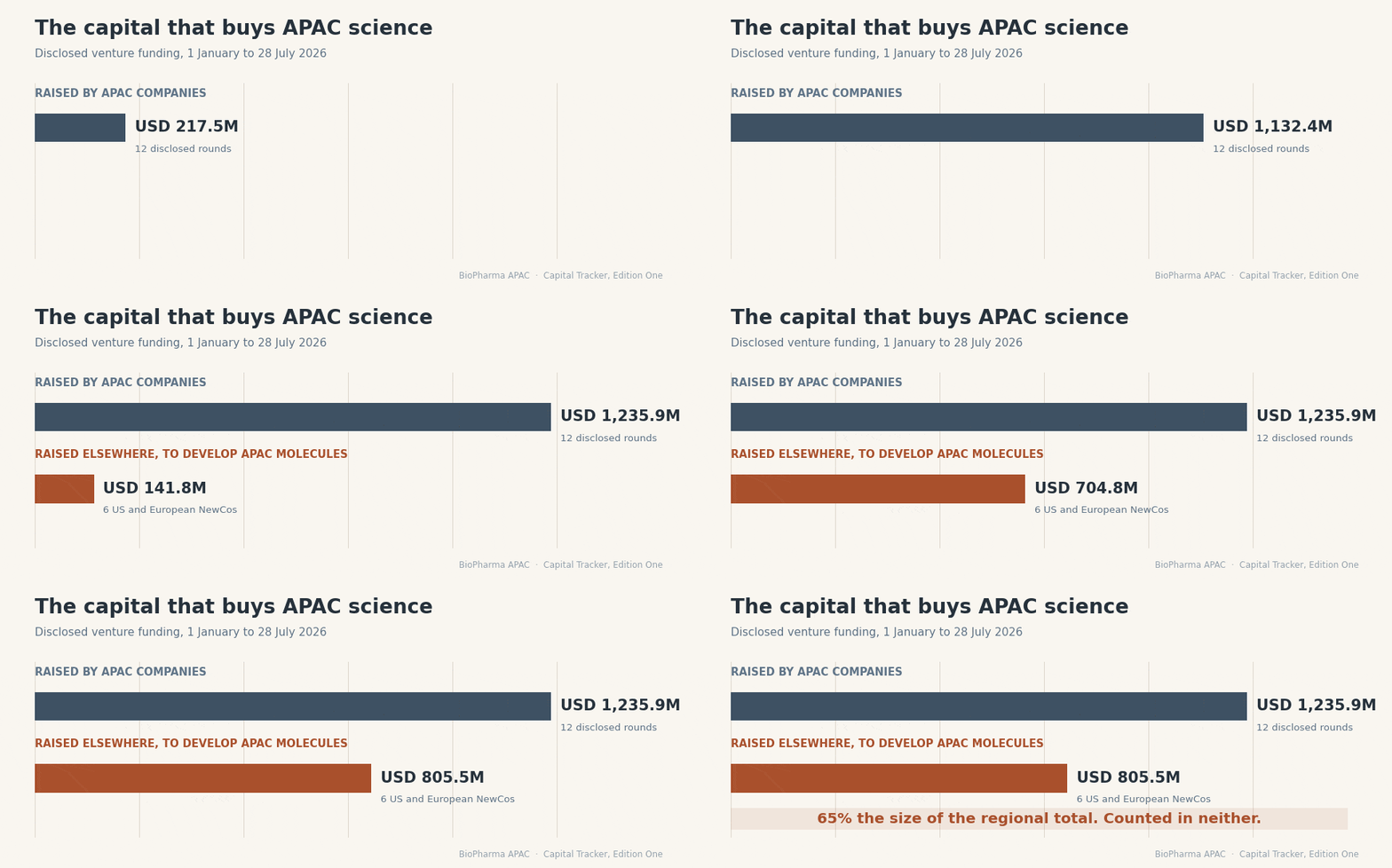
And there is a second number that matters more than any single round on the list. Over the same window, at least USD 805 million of venture capital was raised by companies domiciled in the United States and Europe, for the specific purpose of developing molecules that originated in Asia-Pacific laboratories. That capital is buying APAC science. It is not, in any meaningful accounting sense, APAC capital. The gap between those two figures, USD 1.24 billion in and USD 805 million alongside, is the most important structural fact in the region's financing market right now.
How the twelve were chosen
Twelve rounds of disclosed value that closed in the reporting window. Selected to cover the spread of modality and stage rather than to rank the largest cheques, which is why a USD 21 million Series A sits in the same list as a USD 287 million Series D. Round sizes are cited to company announcements, regulatory filings or the public fundraising trackers that carry the primary release, and valuations appear only where a company disclosed one. In this window, none did, which is itself worth noting.
Three methodological choices need stating up front, because they change how the numbers read.
First, this edition attributes rounds by scientific and capital origin rather than by legal domicile. A company incorporated in Delaware, funded entirely by a Korean syndicate, developing a platform built in a Korean research affiliate, is counted here as a Korean round. Domicile has become close to meaningless as a signal in this market, and pretending otherwise would produce a cleaner table and a worse story. Every case where the two diverge is flagged in the entry.
Second, the visible floor for this kind of reporting sits around USD 50 million, because that is where the international trackers begin recording. Southeast Asian and Indian rounds mostly close below that line and are therefore systematically under-observed in any list assembled this way, including this one. That limitation is discussed properly further down rather than buried in a footnote. The floor was relaxed exactly once, to admit the CORE Biomedicine round, for reasons the entry explains.
Third, one round in the set is genuinely co-financed across two markets and is recorded as cross-border rather than forced into a single country column.
The window itself is deliberately long. This is a first edition establishing a baseline, and it was extended by four days to close on 28 July in order to capture a round that arrived late and changed one of the conclusions. From 2027 the franchise runs quarterly, and the window tightens accordingly.
The twelve
01 Corxel Pharmaceuticals
Round USD 287 million, Series D, closed 22 January
Lead SR One, with TCGX, RA Capital Management, HBM Healthcare Investments, SymBiosis, Adage, Invus, SilverArc, RTW and Hengdian Group Capital
Modality Oral small-molecule GLP-1 receptor agonist
Use of proceeds Shanghai-headquartered Corxel licensed ex-China rights to CX11 from Vincentage in late 2024. The Series D funds a global Phase 2 study in Type 2 diabetes and preparation for the company's own Phase 3 programme, alongside an ongoing US Phase 2 in overweight and obesity. Vincentage has already taken CX11 into Phase 3 in China.
THE SIGNAL The largest APAC round of the window is a metabolic asset with an ex-China licensing structure wrapped around it. Investors are not paying for the discovery. They are paying for the geographic rights and the clinical path outside the home market. That is a very different proposition from funding a research organisation, and it prices very differently too.
02 Syneron Bio
Round USD 150 million, Series B, closed 3 April
Lead An unnamed international life sciences fund, with Decheng Capital, CDH VGC, True Light Capital, Qiming Venture Partners, BioTrack, AstraZeneca and a subsidiary of the Abu Dhabi Investment Authority
Modality AI-designed macrocyclic peptides
Use of proceeds Development of the Synova platform and programmes across oncology, autoimmune, metabolic and rare disease.
THE SIGNAL Syneron closed its second round in four months, following combined Series A and A+ financings worth close to USD 100 million in December. What sits underneath both is a partnership with AstraZeneca announced in March 2025 with a headline value of up to USD 3.4 billion in milestones. The sequencing is instructive. Pharma validation first, then capital at speed and at scale. For platform companies in this region, a named pharma partner has become close to a prerequisite for a nine-figure round, not a bonus on top of one.
03 Medipost
Round USD 140 million, growth financing, closed 9 January
Lead Skylake Equity Partners, with Crescendo Equity Partners and an undisclosed Korean growth equity fund
Modality Allogeneic mesenchymal stem cell therapy
Use of proceeds A Phase 3 trial in patients with symptomatic cartilage defects and knee osteoarthritis.
THE SIGNAL This is the only round in the twelve that is unambiguously late-stage, domestically financed and domestically controlled. Korean capital funding a Korean company through a Korean pivotal trial, with no US structure and no licensing counterparty. It is also, not coincidentally, in cell therapy, where Korea has both regulatory familiarity and a manufacturing base. When people ask what a mature domestic financing market looks like in this region, this round is the closest available answer.
04 Angitia Biopharmaceuticals
Round USD 130 million, Series D, closed 5 February
Lead Frazier Life Sciences, with Venrock, Ascenta Capital, funds managed by BlackRock, BVF Partners, Logos Capital, RA Capital, Wellington, Bain Capital Life Sciences, Hillhouse, Legend Capital, Morningside, OrbiMed and others
Modality Recombinant protein and bispecific antibodies for bone disease
Use of proceeds Advancing three candidates already in Phase 2 and Phase 3, led by AGA111, a recombinant human BMP-6 protein in a Phase 3 trial in lumbar interbody fusion.
THE SIGNAL The second mega-round in fourteen months for a company operating across China and the US, and the investor list is the tell. Frazier, BlackRock, Wellington, RA Capital and Bain sitting alongside Hillhouse, Legend and Morningside is what a genuinely blended syndicate looks like. Companies capable of assembling that mix are getting funded at scale. Companies that can only reach one side of it are not.
05 Oricell Therapeutics
Round USD 110 million, pre-IPO round, closed 10 April
Lead Vivo Capital, with Beijing Medical and Health Care Industry Investment Fund, Qiming Venture Partners, E-Town Capital, Luxin Venture Capital, NGS Super, Elikon Investment, Talon Capital and an undisclosed global healthcare fund
Modality CAR-T cell therapy for solid tumours
Use of proceeds Further studies of lead asset Ori-C101, with the stated aim of becoming the first globally approved CAR-T in hepatocellular carcinoma.
THE SIGNAL Oricell raised roughly USD 70 million in a Series C1 in January and came back three months later for a final private round before an intended listing. Two things follow. Chinese companies with credible clinical assets can still raise twice inside a quarter, and the exit route being priced is a public listing rather than a trade sale. Note also the appearance of NGS Super, an Australian pension fund, in a Shanghai CAR-T round. Australian institutional money is finding its way into APAC biotech, just not into Australian biotech companies.
06 Rakuten Medical
Round USD 100 million, Series F, closed 7 January
Lead TaiAx Life Science Fund, with Daiwa Securities, Mitsui Sumitomo Insurance, Sumitomo Mitsui Banking, ABIES Capital, Nexus CVC, OEP Group, SBI Group, Rakuten Group and chief executive Mickey Mikitani
Modality Photoimmunotherapy: an anti-EGFR antibody conjugated to a light-activatable dye
Use of proceeds A global Phase 3 trial of ASP-1929 in combination with Merck's Keytruda as first-line treatment in recurrent head and neck cancer.
THE SIGNAL Read the investor list, not the headquarters address. Rakuten Medical is based in San Diego, but every institution in this round is Japanese, spanning securities houses, insurers, a major bank, corporate venture arms and the founding group. This is Japanese balance-sheet capital funding a late-stage oncology programme, routed through a US entity. It is the clearest example in the twelve of why domicile-based geography produces misleading tables.
07 QL Biopharm
Round USD 72.9 million, Series C, closed 2 March
Lead OrbiMed, with Qiming Venture Partners, Five Sources Capital, Xingze Capital, Huagai Capital, Taifu Capital, BlueRun Ventures and Taiyu Investment
Modality Long-acting injectable GLP-1 receptor agonist
Use of proceeds Chronic metabolic disease programmes led by zovaglutide, a monthly-dosed GLP-1 currently in a Phase 3 obesity trial.
THE SIGNAL Also known as Zhitai Biopharmaceutical, QL raised more than RMB 500 million in a round championed by OrbiMed. The differentiator being funded here is not the target, which is thoroughly crowded, but the dosing interval. Monthly administration is a commercial claim rather than a scientific one, and investors were willing to write a Series C against it at Phase 3. In metabolic disease, the science is now assumed and the fight has moved to convenience, adherence and cost of goods.
08 Vibrant Therapeutics
Round USD 61 million, stage not specified, closed 12 January
Lead Pfizer Ventures, with Apricot Capital, Bayland Capital, HSG, Northern Light Venture Capital and First Principle Venture
Modality Masked T-cell engager prodrug
Use of proceeds Advancing VIB305, targeting EGFR-expressing solid tumours, already in Phase 1 trials in Australia and China. The company also appointed Han Lee as co-chief executive alongside the raise.
THE SIGNAL The Australia-plus-China trial design is now close to standard practice, and it is worth being explicit about why. Australia offers fast ethics approval and an R&D tax incentive; China offers patient volume and cost. Running both in parallel produces a dataset that reads credibly to a US regulator and a US acquirer. Australia's contribution to APAC biotech in this window is largely as clinical infrastructure for other people's companies rather than as a home for financed ones.
09 BreezeBio
Round USD 60 million, Series B, closed 25 February
Lead A syndicate with no single named lead, including Yuanta Investment, DSC Investment, SV Investment, Kiwoom Investment, STIC Ventures, Top Harvest Capital, DAYLI Partners, Pathway Investment, Loftyrock Investment, Korea Investment Partners, WOORI Venture Partners, KDB Silicon Valley and ACVC Partners
Modality mRNA-encoded autoantigens with tolerogenic co-factors, delivered by the NanoGalaxy platform
Use of proceeds Taking BRZ-101, designed to restore immune tolerance in Type 1 diabetes, into IND-enabling studies, and expanding platform delivery into immune, cardiac, pulmonary and central nervous system tissue.
THE SIGNAL Formerly GenEdit, the company is headquartered in Brisbane, California with a research and development affiliate in South Korea, and the syndicate is almost entirely Korean, including the policy-linked KDB. Two readings are available. The generous one is that Korean investors are willing to fund preclinical, platform-stage science, which is genuinely rare in this region. The less generous one is that they preferred to do it through a US corporate structure. Both are probably true.
10 Vivatides Therapeutics
Round USD 54 million, Series A, oversubscribed, closed 10 April
Lead Qiming Venture Partners, with Highlight Capital, TF Capital, Apricot Capital and an undisclosed leading industry fund
Modality siRNA and antisense oligonucleotides with an extrahepatic delivery platform
Use of proceeds Moving multiple RNA therapeutics toward the clinic.
THE SIGNAL Founded in 2025, split between Suzhou and Boston, oversubscribed at Series A on a preclinical delivery platform. Extrahepatic delivery is the acknowledged bottleneck in RNA medicine, and this is the clearest case in the twelve of investors funding a hard technical problem rather than a de-risked asset. Early-stage platform capital has not disappeared from this market. It has concentrated into a small number of unsolved problems with obvious commercial consequences.
11 Accro Bioscience
Round USD 50 million, Series C, closed 19 May
Lead OrbiMed, with TCG Crossover, LAV, Cenova Capital, Shenzhen Capital Group and Oriza Holdings
Modality Small-molecule RIPK2 inhibitor
Use of proceeds A Phase 2b trial of AC-101 in ulcerative colitis, plus broader work across the company's inflammatory and immunological pipeline. Earlier studies ran in China and Australia; the Suzhou company is now moving into US patients.
THE SIGNAL OrbiMed leads its second round in this list of twelve, having also led QL Biopharm's Series C in March, and the pattern in both is the same: a Chinese company with mid-stage clinical data preparing to enter US trials. The strategic logic is not subtle. Data generated cheaply in China and Australia, validated in the US, sold or partnered into a Western market. Investors are underwriting a regulatory arbitrage as much as a molecule.
12 CORE Biomedicine
Round USD 21 million, Series A, closed 28 July
Lead UTokyo Innovation Platform and Elikon Venture, co-leads, with InnoPinnacle Fund, Mitsubishi UFJ Capital, Suzhou Capital Group, CD Capital, YuanBio Venture Capital, Vision Incubate and Root Venture Partners
Modality Lineage-based precision oncology, targeting the drivers of cancer cell identity beyond genomics
Use of proceeds Advancing lead programmes through discovery and early clinical development. The company's Japanese subsidiary separately received a grant from AMED, and on the same day CORE announced exclusive global rights to multiple preclinical oncology programmes licensed from Eisai.
THE SIGNAL The smallest round in the set and arguably the most consequential. Japanese institutional money has spent two years accumulating at the fund layer without converting into company rounds, and this is the conversion: a university investment platform and a bank-affiliated fund co-leading with Chinese capital, an AMED grant attached, and a Japanese pharma out-licence flowing into a company that APAC investors actually own. Founded by former H3 Biomedicine leaders and operating across Boston, Tokyo and Suzhou. It sits below the tracker floor, which is precisely why it would have been missed.
The capital split
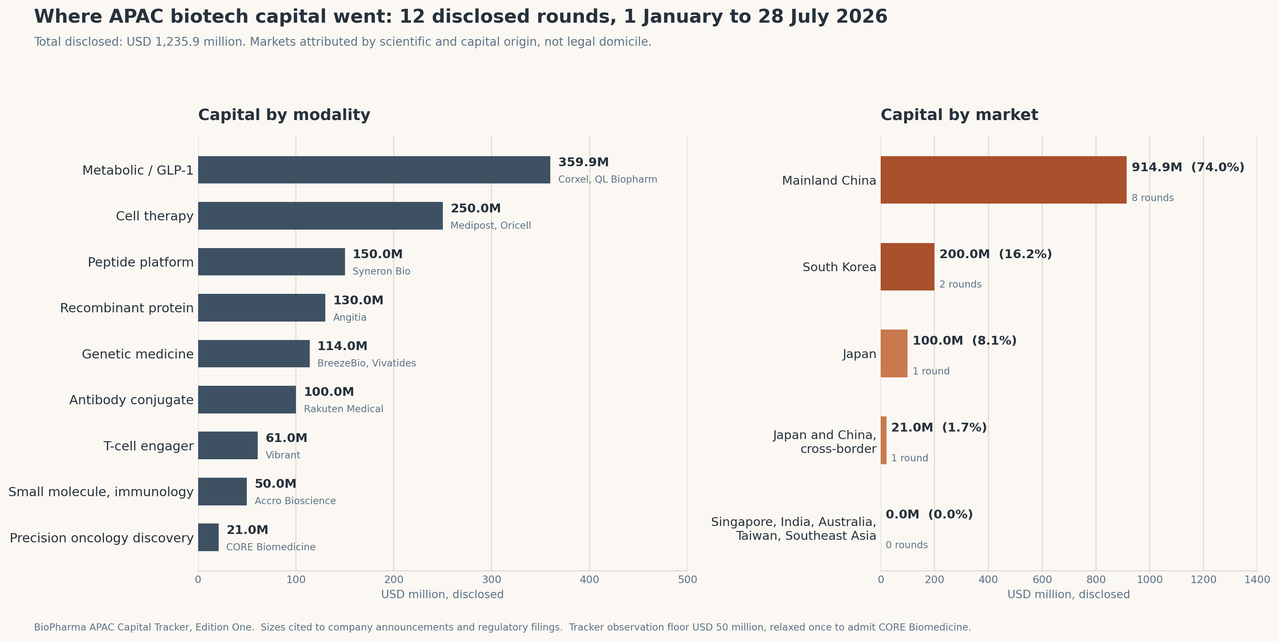
Capital by modality and capital by market, twelve disclosed rounds, 1 January to 28 July 2026.
Reading across the twelve
Modality: metabolic disease took nearly a third
Metabolic programmes, both of them GLP-1 receptor agonists, accounted for roughly USD 360 million across two rounds, or about 29 per cent of the disclosed capital in this edition. Cell therapy took USD 250 million across two, split between Korean mesenchymal stem cells and Chinese CAR-T. Peptides took USD 150 million in a single round, recombinant proteins USD 130 million, and conjugates USD 100 million.
At the other end, the genetic medicine entries, BreezeBio and Vivatides together, drew USD 114 million between them, and both are preclinical. The distribution tells a fairly blunt story. Capital in this region is flowing toward modalities with a proven commercial template, and toward the two or three specific modalities where APAC companies have a manufacturing or cost advantage that survives contact with a Western market.
Notice also what is missing. Not one gene therapy round. No microbiome. No radiopharmaceuticals, despite that being one of the more active categories globally. No vaccines. For founders in those spaces, the absence across an entire region in a seven-month window is not noise.
Stage: the barbell is real, and the middle is thin
Sort the twelve by stage and the shape is unmistakable. At the late end sit Corxel, Medipost, Angitia, Oricell, Rakuten Medical and QL Biopharm, six rounds carrying assets in or entering Phase 3, and together taking about USD 840 million, or roughly 68 per cent of the total. At the early end sit Vivatides, BreezeBio and CORE Biomedicine, together USD 135 million, or about 11 per cent.
The Series B tier is where it gets uncomfortable. Only Syneron and BreezeBio raised Series B rounds in this window. Syneron did so with a multi-billion-dollar AstraZeneca partnership already signed, and BreezeBio did so through a US corporate structure with an entirely domestic Korean syndicate. Neither raised on platform promise alone into an open market.
The practical translation for founders is direct. If you are raising a Series B in this region on preclinical or early clinical data with no pharma counterparty, the evidence from this window is that the round is difficult and the pricing will reflect it. The successful Series B raises here all imported validation from somewhere outside the venture market. That aligns with what regional observers noted through 2025, when early-stage activity held reasonably steady while companies seeking Series B and beyond met genuine resistance, and larger growth rounds were delayed, downsized or reprioritised.
Geography: one market, and then everyone else
Of the roughly USD 1.24 billion in this edition, about USD 915 million is attributable to mainland China science and capital, spread across eight of the twelve rounds. South Korea accounts for USD 200 million across two. Japan accounts for USD 100 million in the Rakuten Medical round, plus a share of the cross-border CORE Biomedicine financing, taking Japan-linked capital to roughly 10 per cent of the total.
Singapore, India, Australia, Taiwan, Indonesia, Malaysia, Thailand and Vietnam produced no disclosed therapeutics round at or above the USD 50 million observation floor in nearly seven months.
Some of that is a genuine measurement artefact and is dealt with below. Some of it is not. India in particular has a large, sophisticated pharmaceutical industry and a persistently thin innovative-therapeutics venture layer, and the two facts have coexisted long enough that the gap is structural rather than cyclical.
Singapore is the more interesting case, because the capital demonstrably exists. ClavystBio, established by Temasek, has committed more than USD 220 million since 2022. EDBI merged with SEEDS Capital in 2025 to form SG Growth Capital. What has been harder to produce is companies reaching the size of round that registers internationally. Singapore's visible activity in this window sat in medtech rather than therapeutics: Biobot Surgical raised roughly USD 15.5 million with ClavystBio anchoring, to expand its Mona Lisa robotic prostate platform. That is a real round and a real company, and it is a fifth the size of the median entry in the twelve.
Japan needs a longer note, because it is the one conclusion this edition had to revise before publication. For two years the activity in Japan has been happening one layer up, at the fund level. AN Venture Partners closed a first fund at USD 200 million. University of Tokyo Edge Capital Partners closed its sixth fund at JPY 47 billion, taking assets under management past USD 1 billion. Fast Track Initiative closed Fund IV at approximately USD 130 million. Olympus committed USD 150 million to a second innovation ventures fund. In April 2026, B Capital was designated a registered venture capital firm under AMED's programme for strengthening the pharmaceutical startup ecosystem. Through most of this window, none of that had visibly converted into company rounds, and the working conclusion was that Japan had assembled the plumbing without turning on the tap.
Then, four days after this edition's original cut-off, CORE Biomedicine closed. It is small, at USD 21 million, but it is exactly the shape the conversion was expected to take: a university investment platform co-leading, a bank-affiliated fund participating, an AMED grant attached to the Japanese subsidiary, and a Japanese pharma company out-licensing preclinical assets into it. One round does not make a trend, and the honest position is that Japan's fund layer has now demonstrated it can deploy rather than that it is deploying at scale. Edition two will be able to say which.
The parallel channel nobody counts
Now the number from the opening.
While APAC-domiciled companies raised the USD 1.24 billion catalogued above, a separate set of companies raised capital specifically to develop molecules that came out of Asia-Pacific laboratories. In this window alone:
- Serapha Bio raised USD 230 million, launching through a reverse merger with Boundless Bio around an alpha-1-antitrypsin deficiency candidate licensed from China's YolTech Therapeutics.
- AirNexis Therapeutics launched with USD 200 million and a PDE3/4 inhibitor for COPD from Haisco Pharmaceutical, paying USD 40 million cash for ex-China rights while Haisco retained a 20 per cent equity stake.
- Slate Medicines raised USD 130 million to advance an anti-PACAP migraine antibody licensed from China's DartsBio.
- Tortugas Neuroscience raised USD 106 million around a clinical-stage neuroscience pipeline licensed from Eisai and Hansoh Pharmaceutical.
- R1 Therapeutics raised USD 77.5 million on a global licence to AP306 for chronic kidney disease from China's Alebund Pharmaceuticals.
- Oblenio Bio raised a USD 62 million Series B to take a trispecific T-cell engager from China's Leads Biolabs into the clinic.
That totals roughly USD 805 million, equivalent to about 65 per cent of everything raised by APAC companies themselves in the same period. None of it appears in regional funding statistics.
Look at the AirNexis structure in particular, because it is the template being replicated. Haisco received USD 40 million in cash and a 20 per cent stake, and a US entity raised USD 200 million to run the global development. The originating company is well compensated and permanently subordinate. It captured the discovery value and gave away the development and commercial value, which is where the returns compound.
The sharpest available comparison sits inside this edition. Eisai out-licensed preclinical oncology assets twice in the same window. One package went to Tortugas Neuroscience, a US company that raised USD 106 million from US investors. The other went to CORE Biomedicine, which raised USD 21 million from Japanese and Chinese investors and holds global rights. The molecules are different and the sums are not comparable, but the ownership structures are, and they point in opposite directions. The second model keeps the upside inside the region. It is also, on this evidence, five times harder to fund.
There is a legitimate defence of the first model. It gets good molecules developed, it returns cash to APAC balance sheets, and it does so faster than waiting for a domestic late-stage financing market that may take another decade to mature. Several entries in the twelve run versions of the same logic in the other direction, with Corxel and Accro both structuring around US market access. For early-stage companies, an out-licence at Phase 1 may simply be better risk-adjusted economics than a dilutive Series B raised into a hostile market.
The counter-argument is about compounding. Every asset developed through this channel builds late-stage clinical capability, regulatory relationships and commercial infrastructure somewhere other than Asia-Pacific. Repeat that for a decade and the region has a permanent discovery function and a permanently absent development function. Which reading is correct will not be settled by argument, and this franchise will keep tracking the number either way.
What this edition cannot see
Honesty about the method matters more than a tidy conclusion.
The USD 50 million observation floor is the binding constraint. International trackers begin recording at roughly that level, which means a Series A in Bengaluru, a seed round in Ho Chi Minh City and most of Singapore's therapeutics activity are invisible to a list assembled this way. The concentration figures in this edition should therefore be read as accurate for large rounds and unreliable for small ones. The claim that 74 per cent of APAC biotech capital went to China is well supported. The claim that India raised nothing is not supported, and is not being made.
CORE Biomedicine is the proof of that limitation rather than an exception to it. At USD 21 million it sits below every tracker threshold used to assemble this list, it was found only because it closed during production, and it changed a conclusion about an entire national market. There is no reason to assume it is the only such round in the window. There is every reason to assume it is not.
Valuation disclosure was non-existent. Not one of the twelve published a pre-money or post-money figure. Round-level lead investor disclosure has also weakened: MindRank AI's USD 52 million Series B in July, which narrowly missed inclusion here, named no lead investor at all and described its syndicate only as institutional and healthcare funds. Both trends make it harder to assess whether the recovery from the 2023 repricing is real or whether headline round sizes are being maintained at flat or down valuations. Founders should assume the latter until shown otherwise.
From edition two, the tracking sheet adds DealStreetAsia, national registry filings and regional sources at a USD 5 million floor, specifically to capture the Southeast Asian and Indian activity this edition structurally missed.
What a founder should take from this
Four things, stated plainly.
- Late-stage clinical assets are financeable in this region right now, and platform promise mostly is not. Six of the twelve rounds carried Phase 3 assets and took roughly two thirds of the capital.
- A pharma partnership or licensing counterparty has become close to a precondition for a large round rather than a validation of one. Syneron, Corxel, Angitia and CORE Biomedicine all had one. Structure it before you raise, not after.
- The China and Australia trial combination is now standard for a reason, and it is available to companies from any market in the region. Vibrant and Accro both used it, and both are positioning for US entry off the back of it.
- If a US or European NewCo offers to license your lead asset, understand precisely what you are selling. Look at what Haisco kept and what it gave away, then look at what CORE Biomedicine holds, and decide whether the alternative financing path genuinely exists for your company. Sometimes it does not, and taking the deal is right. Just take it with the arithmetic in front of you.
(arcilla.fran@biopharmaapac.com)
Sources and method
Reporting window: 1 January to 28 July 2026. Twelve rounds of disclosed value, selected to span modality and stage rather than to rank the largest financings.
Round sizes, stages, investor syndicates and stated uses of proceeds are taken from company announcements distributed via PR Newswire, Business Wire, GlobeNewswire and company newsrooms, and from the public fundraising trackers that carry those primary releases, principally the Fierce Biotech Fundraising Tracker for 2026, which records rounds of USD 50 million and above. Where a company published a figure in local currency, the company's own US dollar conversion is used. Where a round was reported at different values by different outlets, the company's own release governs.
The CORE Biomedicine entry is sourced to the company's PR Newswire release of 28 July 2026, its separate release of the same date on the Eisai licensing agreement, and corroborating coverage in FinSMEs and PharmExec.
Singapore, Japanese fund-formation and regional venture-climate context is drawn from Singapore Economic Development Board and A*STAR published material, DealStreetAsia, and BioSpectrum Asia's published analysis of the Japanese and Korean ecosystems. Parallel-channel deal terms are taken from the acquiring companies' own financing announcements.
Market attribution follows scientific and capital origin rather than legal domicile, and every divergence between the two is stated inside the relevant entry. One round, CORE Biomedicine, is recorded as cross-border because it is genuinely co-led across two markets. Percentages are calculated on disclosed value only and will not match datasets that include undisclosed rounds, debt, non-dilutive grants or public financings.
No valuations are reported because none of the twelve companies disclosed one. No figure in this article is estimated, modelled or derived from a private source. Where a lead investor was not named by the company, the entry says so rather than inferring one.
This article contains no interview material. All quoted positions are paraphrased from published statements and attributed in the text. Corrections and disclosed rounds we have missed are welcome and will be reflected in the running tracker.
Disclaimer
Not investment advice. This article is journalism and general information. It is not investment research, a recommendation, an offer or a solicitation to buy or sell any security or interest in any fund or company, and it is not a basis for any investment decision. Readers should take their own professional advice.
Accuracy and completeness. Figures are drawn from public disclosures believed reliable at the time of publication. Private financings are frequently restated, extended or corrected after announcement. BioPharma APAC makes no warranty as to accuracy or completeness and accepts no liability for loss arising from reliance on this material.
Selection and method. The twelve rounds are an editorially selected sample, not a complete record of Asia-Pacific biotech financing in the period. The observation floor described in the method note means smaller rounds, particularly in South and Southeast Asia, are systematically under-represented. Aggregate percentages describe this sample only.
Attribution and inference. Market attribution by scientific and capital origin is an editorial judgement, not a legal or regulatory classification, and reasonable analysts would allocate several of these rounds differently. Company domicile as registered is stated wherever it differs from the attribution used.
Forward-looking statements. Statements about clinical timelines, regulatory intentions, trial starts and listing plans reflect company guidance at the date of announcement and are subject to change. Nothing here should be read as a prediction of clinical, regulatory or commercial outcome.
No relationship. BioPharma APAC has no commercial relationship with any company or investor named in this article that influenced its selection or treatment. Editorial decisions on this franchise are made independently of commercial functions.
BioPharma APAC Capital Tracker, Edition One.
“12 Funding Rounds That Show Where APAC Biotech Capital Is Going”.
Reporting window 1 January to 28 July 2026. Published 29 July 2026.
Recurring franchise; quarterly from 2027.
© 2026 BioPharma APAC. All rights reserved. No part of this article may be reproduced, redistributed or transmitted in any form without prior written permission of the publisher. BioPharma APAC is an independent publication.
Most Read
- Can APAC Biomanufacturing Decarbonise Without Pricing Itself Out?
- The Algorithm on the GMP Floor: AI Promises a Smarter Plant. Regulators Demand the Audit Trail.
- APAC's Peptide-Capacity Gamble
- After the Rush: APAC's mRNA and Vaccine Capacity Hangover
- The Biosimilar Race: Factory to the World — or Stuck in the Copycat Economy?
- The Vein-to-Vein Problem: Can APAC's Cold Chain Carry Advanced Therapies?
- Vectors, Plasmids and the CGT Trap: APAC's Cell and Gene Therapy Ambitions Face an Upstream Bottleneck
- Can APAC Build Radioligand Therapy Before the Atoms Decay?
- The Great Biopharma Reset: 50 Developments That Changed Everything in H1 2026
- Beyond the Trial: Can Real-World Evidence Earn Regulatory Trust in APAC?
- Beyond the Obvious Giant: Where APAC's Clinical Trials Go Next
- The Frontier That Won’t Quite Arrive
Bio Jobs
- Sanofi Turns The Page As Belén Garijo Steps In And Paul Hudson Steps Out
- Global Survey Reveals Nearly 40% of Employees Facing Fertility Challenges Consider Leaving Their Jobs
- BioMed X and AbbVie Begin Global Search for Bold Neuroscience Talent To Decode the Biology of Anhedonia
- Thermo Fisher Expands Bengaluru R&D Centre to Advance Antibody Innovation and Strengthen India’s Life Sciences Ecosystem
- Accord Plasma (Intas Group) Acquires Prothya Biosolutions to Expand Global Plasma Capabilities
- ACG Announces $200 Million Investment to Establish First U.S. Capsule Manufacturing Facility in Atlanta
- AstraZeneca Invests $4.5 Billion to Build Advanced Manufacturing Facility in Virginia, Expanding U.S. Medicine Production
News