India’s Life Sciences Proposition Expands from Global Scale to Strategic Innovation
20 July 2026 | Monday | News
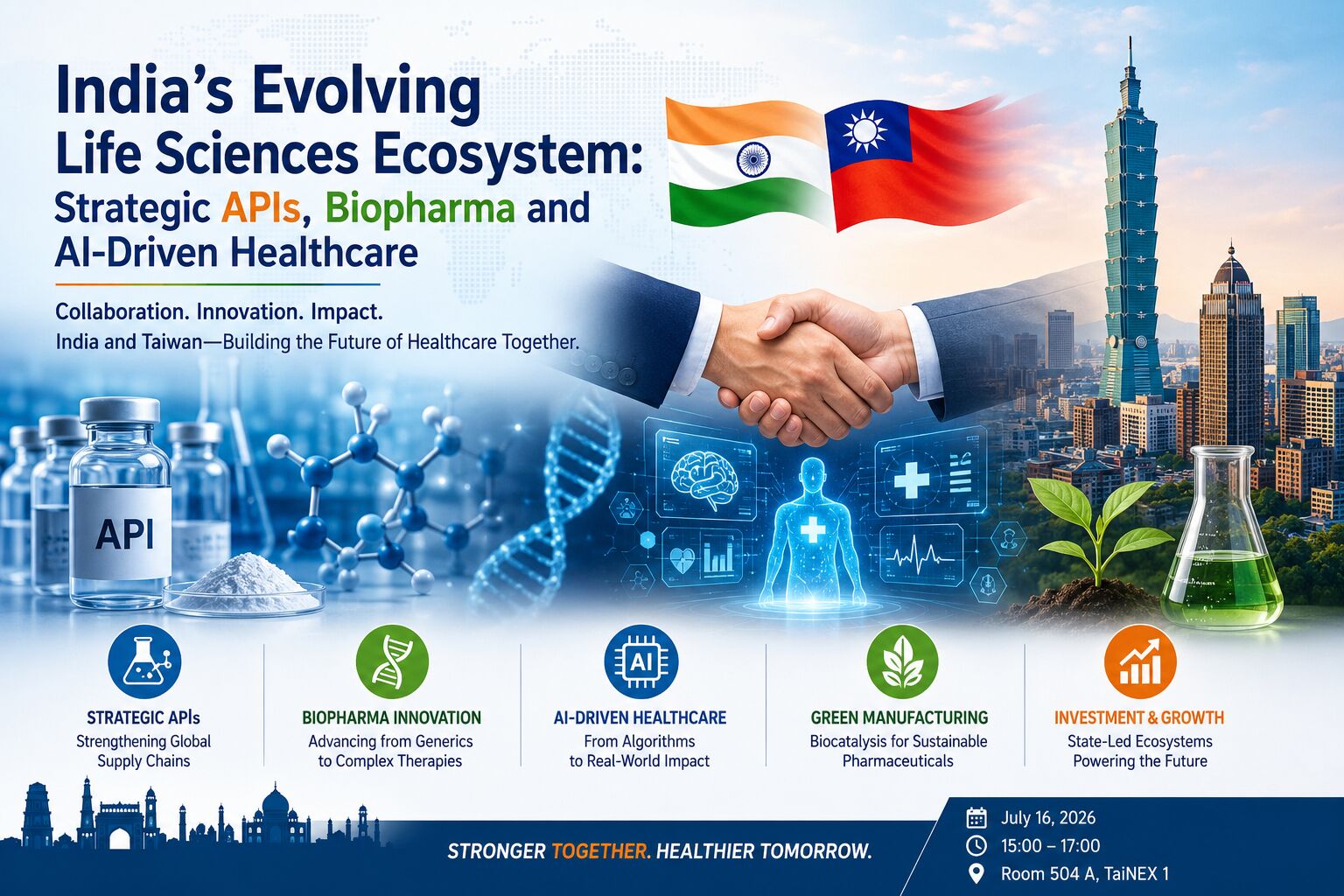
India’s position in the global life sciences economy has long been anchored in scale — from active pharmaceutical ingredients (APIs) and generic medicines to a manufacturing base that supplies healthcare markets worldwide. At BIO Asia–Taiwan 2026, however, the India Session presented a broader proposition: a country seeking to translate its established pharmaceutical strengths into the next generation of healthcare innovation.
Held on July 16 at TaiNEX 1, the session, “India's Evolving Life Sciences Ecosystem: Strategic APIs, Biopharma and AI-Driven Healthcare,” brought together government representatives, industry leaders and technology innovators to examine how India’s healthcare and biotechnology landscape is expanding across advanced manufacturing, artificial intelligence, sustainable pharmaceutical production and investment.
Opening the session, Vishwanjali Gaikwad, Acting Director General, India Taipei Association, and Tsai-Kun Li, President, Development Center for Biotechnology, set the context for deeper engagement between India and Taiwan. The presence of stakeholders from both ecosystems reflected the growing potential for collaboration that combines India’s pharmaceutical scale, talent and expanding innovation capabilities with Taiwan’s strengths in biotechnology, technology and advanced research.
Beyond Scale: India’s Life Sciences Story Is Changing
The keynote address by Dr. Murali Panchapagesa Muthuswamy, Chairman, Jananom Private Limited, placed the spotlight on the changing contours of India’s life sciences ecosystem.
While India remains globally recognised for its pharmaceutical manufacturing capabilities, its next phase of growth is increasingly being shaped by innovation-led enterprises, emerging biotechnology platforms and the integration of digital technologies into healthcare.
This evolution represents an important shift in how India can position itself internationally — not simply as a destination for cost-efficient production, but as an ecosystem capable of contributing across research, technology development, manufacturing and commercialisation.
Generics Remain a Foundation of India’s Global Healthcare Impact
India’s established pharmaceutical capabilities remained an important part of the discussion. Dr. Puneeth Kumar Surupa, Country Manager, Camber Pharmaceuticals Co., Ltd, highlighted Hetero’s role in the global generics landscape and the wider contribution of Indian pharmaceutical companies to expanding access to medicines.
The generics industry has given India enormous global reach, manufacturing experience and supply-chain expertise. These capabilities now provide a foundation upon which the country can build higher-value opportunities across complex medicines, biopharmaceuticals and new technology platforms.
The strategic question is therefore no longer whether India can manufacture at global scale, but how effectively that scale can be connected with the next wave of scientific and technological innovation.
Taking AI from the Algorithm to the Patient
One of the session’s strongest forward-looking themes emerged around artificial intelligence and its movement into real-world healthcare.
Rahul Singh, Founder and Managing Director, Sciverse Solutions Private Limited, addressed the journey of “AI at the Point of Care: From the First Algorithm to the First Patient.”
As healthcare systems worldwide explore AI for diagnostics, clinical decision-making and patient management, India presents a distinctive environment for developing and deploying such technologies. Its large and diverse healthcare landscape creates opportunities to build solutions capable of addressing real clinical needs at considerable scale.
Yet the transition from an algorithm to an actual patient outcome requires more than technological capability. Clinical validation, workflow integration, regulatory readiness and physician adoption will ultimately determine which AI innovations move beyond experimentation and become meaningful components of healthcare delivery.
Green Pharmaceutical Manufacturing Moves Up the Agenda
Sustainability also emerged as an important dimension of the pharmaceutical industry's future.
Dr. Tse Yu Chung, Division Director, Institute of Pharmaceutics at the Development Center for Biotechnology, presented the potential of building biocatalytic platforms for greener pharmaceutical synthesis.
Biocatalysis offers opportunities to rethink conventional pharmaceutical manufacturing by enabling potentially more efficient and environmentally sustainable production processes. As global pharmaceutical companies place greater emphasis on environmental performance and supply-chain sustainability, greener synthesis technologies could become increasingly important to manufacturing competitiveness.
For an industry operating at the scale of India’s pharmaceutical sector, the convergence of manufacturing efficiency and sustainability could represent a particularly significant opportunity.
Building Institutional Bridges Between India and Taiwan
The programme also included an MoU signing, signalling the intent to translate dialogue into more structured cooperation.
Such institutional partnerships could become increasingly important as India and Taiwan explore complementary opportunities across biotechnology, pharmaceutical manufacturing, research, technology and investment. The two ecosystems bring different but potentially synergistic capabilities, creating room for partnerships that extend beyond conventional trade relationships.
Tamil Nadu Makes Its Case for the Next Wave of Biotech Investment
The session concluded its industry discussions with a state-level investment perspective from Prakash Ekambaranellore, Associate Vice President, Guidance Tamil Nadu – Taiwan Desk, who presented Tamil Nadu’s proposition for biotechnology investment and innovation.
India’s life sciences growth story is increasingly being shaped at the state level, where governments are competing to attract investment through infrastructure, talent ecosystems, industrial clusters and policy support.
Tamil Nadu’s pitch highlighted this emerging dynamic. With Indian states becoming more proactive in building sector-specific investment ecosystems, international life sciences companies are gaining a wider range of options when evaluating research, manufacturing and innovation opportunities in the country.
From Pharmaceutical Powerhouse to Integrated Life Sciences Ecosystem
The India Session at BIO Asia–Taiwan 2026 ultimately reflected a country in transition — although not one abandoning the capabilities that established its global position.
APIs and generics remain critical pillars. But around those foundations, a more diversified ecosystem is emerging: biopharmaceutical innovation, AI-enabled healthcare, sustainable manufacturing technologies and increasingly competitive regional investment hubs.
For India, the opportunity lies in connecting these capabilities into a more integrated life sciences value chain. For Taiwan and the wider Asia-Pacific region, that transformation creates new possibilities for collaboration across science, technology, manufacturing and market access.
The next chapter of India’s life sciences growth may therefore be defined not simply by how much the country can manufacture, but by how successfully it can combine scale with science, technology with healthcare delivery, and industrial capability with global partnerships.
That evolution could make India not only one of the world’s largest contributors to healthcare supply, but an increasingly influential force in determining where the future of Asian life sciences is built.
Most Read
- Can APAC Biomanufacturing Decarbonise Without Pricing Itself Out?
- The Algorithm on the GMP Floor: AI Promises a Smarter Plant. Regulators Demand the Audit Trail.
- APAC's Peptide-Capacity Gamble
- After the Rush: APAC's mRNA and Vaccine Capacity Hangover
- The Biosimilar Race: Factory to the World — or Stuck in the Copycat Economy?
- The Vein-to-Vein Problem: Can APAC's Cold Chain Carry Advanced Therapies?
- Vectors, Plasmids and the CGT Trap: APAC's Cell and Gene Therapy Ambitions Face an Upstream Bottleneck
- Can APAC Build Radioligand Therapy Before the Atoms Decay?
- The Great Biopharma Reset: 50 Developments That Changed Everything in H1 2026
- Beyond the Trial: Can Real-World Evidence Earn Regulatory Trust in APAC?
- Beyond the Obvious Giant: Where APAC's Clinical Trials Go Next
- The Frontier That Won’t Quite Arrive
Bio Jobs
- Sanofi Turns The Page As Belén Garijo Steps In And Paul Hudson Steps Out
- Global Survey Reveals Nearly 40% of Employees Facing Fertility Challenges Consider Leaving Their Jobs
- BioMed X and AbbVie Begin Global Search for Bold Neuroscience Talent To Decode the Biology of Anhedonia
- Thermo Fisher Expands Bengaluru R&D Centre to Advance Antibody Innovation and Strengthen India’s Life Sciences Ecosystem
- Accord Plasma (Intas Group) Acquires Prothya Biosolutions to Expand Global Plasma Capabilities
- ACG Announces $200 Million Investment to Establish First U.S. Capsule Manufacturing Facility in Atlanta
- AstraZeneca Invests $4.5 Billion to Build Advanced Manufacturing Facility in Virginia, Expanding U.S. Medicine Production
News