The Footnote Test: When the Sustainability Pledge Met the Earnings Call
04 June 2026 | Thursday | Analysis
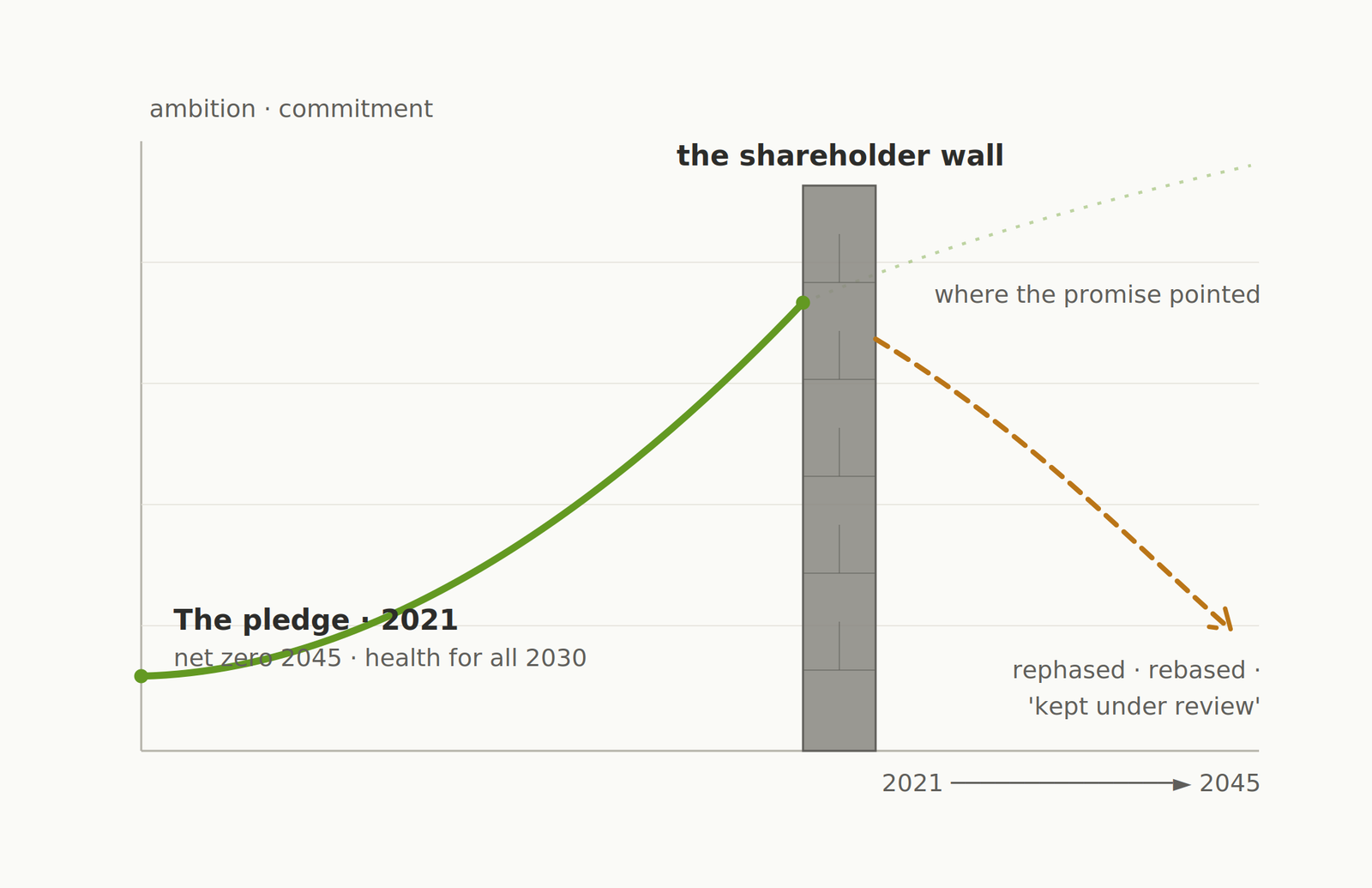
The slide had been on the screen for almost a minute, and no one in the room would meet its eye.
It was a simple chart, the kind that the company's investor-relations team had produced a thousand times: two lines climbing a grid, one labelled Net Zero Value Chain — 2045, the other Health for All — 2030. In the spring of 2021, when the company first unveiled them, those lines had been the centrepiece of a glossy report, a CEO video, and a London press conference at which the then-chairman had used the word "irreversible" four times.
Now, on a grey Tuesday evening in a glass tower near Paddington, the lines looked less like commitments than like exposed flank. Tomorrow morning the company would report its worst quarter in six years. Tonight, eleven board members and three executives had to decide what — if anything — to say about the promises underneath them.
"Let's be honest about the question we're actually here to answer," said Eleanor Vance, the chair, finally breaking the silence. "Not whether we believe in this. Whether we can afford to keep saying we do, on a call where we're cutting guidance and people want to know why the dividend isn't bigger."
This is the conversation happening, in some form, in pharmaceutical boardrooms on both sides of the Atlantic. The companies are real; the pressures are real; the recalibration is real. The boardroom in this account is not. It is a composite, reconstructed from how these debates actually unfold inside large drugmakers: picture a London-listed pharma company with roughly forty percent of its revenue in the United States, a sprawling R&D base in Massachusetts, and a manufacturing footprint stretching from Ireland to Singapore. No single real company is meant, and the executives and investors named in these pages are composites too, their names invented. But every figure in the room has a hundred living counterparts, and the dilemma they are turning over is the defining governance story of the sector this year: what happens to a long-horizon promise when it collides with a short-horizon market.
The promises, and the climate that made them
To understand why the room felt trapped, you have to remember the weather in which the pledges were made.
In 2020 and 2021, capital was cheap, sustainable-investment funds were absorbing money at record pace, and a chief executive who failed to produce a net-zero target risked looking like a laggard at every conference and on every analyst call. The largest drugmakers moved in a pack. AstraZeneca built its "Ambition Zero Carbon" programme around an aggressive interim date. GSK set 2030 goals for both climate and nature. Novartis committed to carbon neutrality in its own operations and net zero across its value chain by 2040. Novo Nordisk built a "Circular for Zero" identity. Pfizer aimed at net zero by 2040. On access, the biennial Access to Medicine Index turned tiered pricing, voluntary licensing, and registration in low-income countries into a competitive scoreboard, and firms jostled for the top rankings.
The company at the centre of this account, smaller than those giants but ambitious, had matched them stride for stride. Its 2021 pledge package, signed off by the same board now sitting in the room, had three pillars. First, science-based emissions targets validated by the Science Based Targets initiative, with deep near-term cuts and net zero across the full value chain by 2045. Second, a "Health for All 2030" access commitment: tiered pricing across more than eighty low- and middle-income countries, voluntary licences for two of its priority molecules, and not-for-profit supply in the poorest markets. Third, a promise to report all of it, transparently, against the emerging European disclosure rules.
"In 2021 the pledge was free, in the sense that the market paid you for it," said Dr. Priya Anand, the company's chief sustainability officer, in an interview after the meeting. She had joined the company precisely to deliver those targets and had spent four years building the machinery to do it. "Cheap capital, ESG inflows, regulators applauding. The cost of making the commitment was almost nothing and the reputational return was enormous. Nobody on a board in 2021 asked me what net zero would cost in 2027. That was somebody else's quarter."
That somebody else's quarter had now arrived.
The bad quarter
The numbers the company would publish in the morning were not catastrophic, but they were the kind that focus a board's mind.
A flagship cardiovascular drug, responsible for nearly a fifth of revenue, was sliding down the far side of its patent cliff faster than modelled. In the United States, the company's single largest market, the first wave of Medicare price negotiations under the Inflation Reduction Act had carved into the margins of two older products. A currency swing had gone the wrong way. Net result: revenue down four percent year on year, operating margin compressed by nearly three points, and full-year guidance about to be trimmed.
Into that picture had walked Pellis Partners.
Pellis was an activist fund — not a climate fund, not an ESG fund, but a returns fund — that had quietly built a position over the previous two quarters and then, three weeks earlier, sent the board a letter. The letter ran to eleven pages. It praised the science. It then argued that the company was carrying "discretionary overhead dressed as strategy," singled out the sustainability function and the access programme's "margin-dilutive" not-for-profit supply, and called for a buyback, a leaner cost base, and "a sober reassessment of commitments made in a different cost of capital."
"We are not anti-environment and we are not villains," Brandt Calloway, the Pellis partner who wrote the letter, said when reached for comment. He was crisp and unapologetic. "We are arithmetic. This company is spending real money and real management attention against a 2045 target while its 2026 earnings are under attack. Shareholders own the next twenty quarters. Tell me which of these green initiatives raises cash flow inside that window, and I'll defend it on the call myself. The ones that can't survive that question were never strategy. They were marketing, and they're being expensed to my returns."
It is a question that does not flatter easy answers, and it was hanging over the room.
The transatlantic split running through the company
Part of what made the company's decision so fraught was that it is, like most large pharma firms, two companies wearing one logo — and the two halves now live under opposite regulatory and political skies.
In Europe, the architecture of obligation has hardened. The Corporate Sustainability Reporting Directive requires detailed, audited disclosure of climate and social impacts, built on the principle of "double materiality" — not just how the planet affects the company, but how the company affects the planet. The Green Deal set the policy direction; the due-diligence rules reached up the supply chain. For the company's European operations, the sustainability report is no longer a glossy choice. It is a legal filing, with the same seriousness as the accounts.
That regime has not been static, and its evolution matters to the boardroom story. Brussels' 2025 "Omnibus" simplification effort narrowed the scope of who must report and pushed back timelines for later waves of companies, responding to a chorus of complaints about cost and complexity. For a firm like this one, already in scope, the relief was marginal; the obligation remained. But the signal — that even Europe was prepared to dial back the ambition of its disclosure machine under competitiveness pressure — travelled fast, and it had been quoted, pointedly, in the Pellis letter.
Across the Atlantic, the weather is entirely different. The US Securities and Exchange Commission's climate-disclosure rule had been finalised and then mired in litigation and political reversal, leaving federal mandates uncertain. A bloc of US states had passed laws restricting state pension money from flowing to managers seen as boycotting fossil fuels; "ESG" had become, in much of American political discourse, a slur. Large asset managers had stepped back from collective net-zero alliances. Sustainable-fund flows, which had once been a one-way escalator, had reversed in the US, with investors pulling money out of funds carrying the label even as European sustainable funds proved more resilient.
"That's the part outsiders miss," said Dr. Anand. "We don't face one investor base. We face two, and they want opposite things at the same time. Our Amsterdam and Edinburgh holders email me asking why our Scope 3 reduction has stalled. Our Texas and Florida-adjacent holders email the CFO asking why we have a Scope 3 target at all. I'm being told I'm too slow and too political by people who own the same share."
The chief financial officer, Yvonne Carrick, put it more bluntly in the meeting. "We can write a sustainability report that pleases Frankfurt and enrages Houston, or one that pleases Houston and breaches Frankfurt's law. There is no document that does both. So the only real question is which audience we're willing to disappoint, and by how much."
Where the pledges bend, and where they hold
The board did not, in the end, contemplate abandoning the commitments. That is not how recalibration works in practice. The interesting action, across the industry and in this room, is in the verbs.
Targets are not cancelled. They are delayed, rebased, rescoped, reframed. A "commitment" softens into an "ambition." An "ambition" softens into a "pathway." A hard interim date acquires the word "around." Absolute reductions quietly become intensity reductions — emissions per unit of revenue, which can fall on paper while total emissions rise as the business grows. None of these moves is dishonest in isolation. Together, they form a grammar of strategic retreat.
The draft plan, the one Carrick's office had prepared, followed exactly that grammar. The 2045 net-zero headline would survive untouched — it was far enough away to cost nothing today and to reassure European holders. But the near-term interim target, the one that was actually biting, would be "rephased": pushed out two years and recut on an intensity basis, with a footnote about "evolving methodology." The voluntary licensing of the second priority molecule, a genuine cost, would be "kept under review" — boardroom language for shelved. The not-for-profit supply in the poorest markets, the cheapest part of the access pledge in absolute money and the most visible in reputational terms, would be loudly reaffirmed.
"Watch what survives a bad quarter and you learn what the pledge was for," said Dr. Nadia Haddad, an access-to-medicine analyst who tracks the sector's commitments. "The commitments that survive are the ones that are cheap, visible, and good copy. Not-for-profit supply to the very poorest is tiny as a share of revenue but enormous as a headline, so it lives. The commitment that quietly dies is voluntary licensing of a profitable molecule into middle-income markets — because that one actually competes with paying customers. That's where the real money and the real access gains are, and that's the first thing that gets 'kept under review.'"
Her observation cuts to the reader's takeaway. The promises framed as moral are often the ones preserved, precisely because they are inexpensive to keep and expensive to be seen breaking. The promises that genuinely transfer value — to the climate, to patients in middle-income markets — are the ones recalibrated when margins tighten, because they were the ones that were ever really at stake.
The business case, argued both ways, in one room
What made the meeting more than a rubber stamp was that the business case genuinely cuts both ways, and two of the company's largest outside shareholders had been invited to make it in person, by video, before the directors deliberated.
The first was Anneke Visser, who ran responsible-investment strategy for a large Dutch pension manager holding nearly three percent of the company. She did not appeal to conscience. She appealed to risk.
"Treat this as risk management or you'll mis-price it," Visser told the directors. "Your supply chain runs through water-stressed regions and carbon-intensive chemistry. A carbon border adjustment in Europe is a cost to you whether or not you have a target — the target is how you get ahead of it. Your CSRD disclosures are becoming the raw material for our portfolio risk models and for the banks pricing your debt. And your access record is not charity to us, it is your licence to operate in the very emerging markets you've told us are your growth story. You cannot tell us India and Brazil are your future on the revenue slide and then treat access to medicine in those countries as discretionary on the cost slide. Pick one narrative."
The second voice was Caleb Roe, who managed money for a US fund openly sceptical of the entire framework and held nearly as large a stake.
"I want to be fair to Ms. Visser, because she's smart and some of that is true," Roe said, with the easy confidence of a man whose worldview was winning at home. "Climate risk to your factories — sure, manage it, that's just operations, call it operations. But the rest is a tax you volunteered to pay. You're spending tens of millions on a disclosure apparatus that produces a document almost no investor reads to make a buy decision. The 'ESG premium' that justified all this in 2021 has evaporated — the funds that were supposed to reward you are bleeding money in our market. You are managing for a constituency that is shrinking and a regulator half a world away, at the expense of the holders sitting in front of you. Strip the theatre. Keep what protects the plants. Drop the rest, and stop apologising for running a drug company."
Between those two positions sat the directors, and the uncomfortable truth that both arguments rested on real data. The risk case is real: regulatory cost, supply-chain exposure, and emerging-market dependence are not invented. The cost case is real too: in a margin-pressured year, against a hostile US political backdrop and reversing fund flows, every euro of compliance and every point of access-related margin dilution is a euro and a point that an activist can demand back.
"The honest answer," Carrick said afterward, "is that ESG is risk management and it's a cost, simultaneously, and which one dominates depends entirely on the time horizon you're optimising for. Over ten years, Visser is right. Over four quarters, Roe is right. A board's whole job in a moment like this is to decide whose clock the company runs on — and to do it without saying out loud that it's choosing, because either answer enrages half your register."
Scope 3: the promise no one fully controls
If there was a single number that explained why the near-term climate target was the first thing on the chopping block, it was this: roughly nine-tenths of the company's emissions were Scope 3 — the indirect emissions embedded in its suppliers, its purchased materials, the active-ingredient manufacturers in its chain, the cold-chain distribution of its products, and the eventual use and disposal of inhaler propellants and packaging.
Scope 1 and Scope 2 — the company's own fuel and its purchased electricity — were the parts the company could actually move, and it had moved them: renewable power contracts, an electrified fleet, efficiency retrofits, an interim cut of close to half against the baseline. Those were the achievements on the surviving slide. They were also, in carbon terms, the minority of the problem.
Scope 3 was the majority of the problem and the part the company did not control. Cutting it meant persuading hundreds of independent suppliers — many of them small chemical manufacturers in jurisdictions with cheap, dirty grids and no regulatory pressure of their own — to decarbonise their own operations, measure it credibly, and report it back up the chain. Some did not have the data. Some did not want to share it. Some simply could not be replaced without re-validating a manufacturing process with regulators, a multi-year exercise no drug company undertakes lightly.
"Scope 3 is where every net-zero pledge in this industry either becomes real or becomes a footnote, and right now it's mostly becoming a footnote," said Dr. Anand. "I can buy renewable electricity tomorrow. I cannot make a contract chemical manufacturer in a region with a coal-heavy grid rebuild their plant on my timeline, and I certainly can't do it in a quarter when my own CFO is being asked to find cost savings. So when the board needs to move a target, it's never Scope 1 and 2 — those are our trophies. It's always Scope 3, because that's the promise we made on other people's behalf without ever fully being able to keep it."
This is the quiet structural reason the pledges bend where they do. The emissions a company can control are a small share of the total and have largely been addressed. The emissions that dominate the total sit outside the company's direct control, are the hardest and slowest to cut, and are therefore the natural release valve when shareholder pressure demands a number that can be moved without moving cash flow. Rephasing the Scope 3 target costs the company almost nothing today and costs the climate a great deal eventually — which is precisely why it is so tempting.
The vote
By nine o'clock the room had narrowed to a single decision, and Eleanor Vance forced it.
The compromise that emerged was, in its way, a perfect specimen of how boards are managing the collision. The 2045 net-zero headline: retained, unchanged, and featured prominently — the cheap, distant promise that reassures Europe. The biting near-term climate target: quietly rephased and rebased, disclosed in the CSRD filing where the law required it but not headlined on the earnings call, accompanied by language about "methodological refinement" and "ensuring our pathway is credible and resourced." The profitable-molecule licence: kept under review, which everyone understood to mean paused. The not-for-profit supply to the poorest markets: reaffirmed, on stage, with feeling.
And a new sentence, drafted by Carrick and polished by investor relations, to be delivered on the call in a tone of strength rather than retreat: "We remain fully committed to our long-term sustainability ambitions, and in a disciplined capital environment we are sequencing our investments to deliver them responsibly and in the interests of all our shareholders."
It was a sentence engineered to be true in both languages — to sound like resolve in Amsterdam and like discipline in Houston. It conceded the retreat without naming it. The directors approved it without enthusiasm and with visible relief.
"I've sat on this board for nine years," one non-executive director said quietly as the room broke up, asking not to be identified even within this composite. "In 2021 we voted for those targets in about four minutes because voting against them was unthinkable. Tonight we spent three hours figuring out how to keep them on paper while taking the cost out of them. Nobody lied. Every word we'll say tomorrow is technically true. And we all know exactly what we did."
What the bad quarter revealed
The earnings call the next morning went as engineered. The dividend held. The guidance cut was absorbed. An analyst asked one question about the sustainability targets; Carrick gave the new sentence; the call moved on to the patent cliff. By lunchtime, three sell-side notes had been published, and only one mentioned ESG at all, in a single line near the bottom.
This is the unglamorous truth the brief set out to find. A bad quarter does not destroy a company's sustainability commitments. It sorts them. It separates the promises that were strategy — load-bearing, value-transferring, genuinely costly to keep — from the promises that were marketing: cheap, visible, distant, and easy to reaffirm precisely because keeping them demands so little.
The commitments that hold under pressure are the ones that protect the business itself — managing physical and regulatory risk to factories and supply, which survive because they are simply good operations under another name. The commitments that hold for the cameras are the cheap, headline-friendly ones, like not-for-profit supply to the poorest, which survive because breaking them would be visible and keeping them is nearly free. And the commitments that get quietly rephased, rebased, and reviewed are the ones in between — the Scope 3 trajectories and the profitable-market access licences — which survive worst precisely because they were the ones that mattered most.
The transatlantic split will keep widening, with Europe's law pulling one way and America's politics pulling the other, and companies like the composite at the centre of this account — and the very real ones it stands in for — will keep writing sentences engineered to be true in both. Boards will keep recalibrating in the language of sequencing and discipline rather than the language of retreat.
But the test the brief proposed is the right one, and it is available to any reader who wants to apply it. Wait for the bad quarter. Watch which pledges get reaffirmed on stage and which get rephased in the footnotes. The ones that survive a hostile earnings call were strategy. The ones that don't were always, underneath the glossy report and the irreversible language, a kind of advertising — and a bad quarter is simply the moment the advertising stops being paid for
Editor's note — about the names in this piece. This is an illustrative feature. The boardroom scene, the company at its centre, and every executive, investor, fund, and analyst named in the narrative — including the chair, the chief sustainability officer, the chief financial officer, the activist fund and its partner, the pension-fund and sceptic investors, and the access analyst — are fictional composites. They do not represent any real individual, fund, or company, and any resemblance to a real person or organisation is coincidental. The quotations attributed to them were written for this article to illustrate positions common in the industry; they are not statements made by any real person.*
The real companies and organisations named — including AstraZeneca, GSK, Novartis, Novo Nordisk and Pfizer, and bodies and frameworks such as the EU Corporate Sustainability Reporting Directive, the European Green Deal, the 2025 Omnibus simplification package, the US Securities and Exchange Commission, the Science Based Targets initiative and the Access to Medicine Index — are referenced only as accurate, publicly reported industry context. Nothing in the fictional boardroom narrative is attributed to, or intended to describe the conduct of, any of those specific companies. Figures used within the composite scene (emissions shares, target dates, compliance costs, ownership stakes and fund flows) are illustrative and representative of the sector rather than the reported results of any single firm.
Most Read
- Can APAC Biomanufacturing Decarbonise Without Pricing Itself Out?
- The Algorithm on the GMP Floor: AI Promises a Smarter Plant. Regulators Demand the Audit Trail.
- APAC's Peptide-Capacity Gamble
- After the Rush: APAC's mRNA and Vaccine Capacity Hangover
- The Biosimilar Race: Factory to the World — or Stuck in the Copycat Economy?
- The Vein-to-Vein Problem: Can APAC's Cold Chain Carry Advanced Therapies?
- Vectors, Plasmids and the CGT Trap: APAC's Cell and Gene Therapy Ambitions Face an Upstream Bottleneck
- Can APAC Build Radioligand Therapy Before the Atoms Decay?
- The Great Biopharma Reset: 50 Developments That Changed Everything in H1 2026
- Beyond the Trial: Can Real-World Evidence Earn Regulatory Trust in APAC?
- Beyond the Obvious Giant: Where APAC's Clinical Trials Go Next
- The Frontier That Won’t Quite Arrive
Bio Jobs
- Sanofi Turns The Page As Belén Garijo Steps In And Paul Hudson Steps Out
- Global Survey Reveals Nearly 40% of Employees Facing Fertility Challenges Consider Leaving Their Jobs
- BioMed X and AbbVie Begin Global Search for Bold Neuroscience Talent To Decode the Biology of Anhedonia
- Thermo Fisher Expands Bengaluru R&D Centre to Advance Antibody Innovation and Strengthen India’s Life Sciences Ecosystem
- Accord Plasma (Intas Group) Acquires Prothya Biosolutions to Expand Global Plasma Capabilities
- ACG Announces $200 Million Investment to Establish First U.S. Capsule Manufacturing Facility in Atlanta
- AstraZeneca Invests $4.5 Billion to Build Advanced Manufacturing Facility in Virginia, Expanding U.S. Medicine Production
News