Every First Approval in APAC, 2026: The Full List
22 September 2026 | Tuesday | Analysis
Asia-Pacific’s New Drug Boom: 99 Approvals, 20 World Firsts
Somewhere in the second week of January, a BeOne Medicines BCL2 inhibitor called sonrotoclax picked up its first approval anywhere in the world, in Beijing, for relapsed chronic lymphocytic leukaemia. By the third week of September, Japan's PMDA had cleared thirteen new active substances in a single day, South Korea had approved its third homegrown new drug of the year, and a Westlake University spinout had won the first approval anywhere for a small molecule discovered through DNA-encoded library screening. Between those two points sits the busiest approval year Asia-Pacific has ever recorded, and nobody has been keeping the whole score.
That is what this list is for. It consolidates every new active substance granted its first approval in calendar 2026 by the region's seven reference regulators: Japan's PMDA, China's NMPA, Singapore's HSA, Taiwan's TFDA, India's CDSCO, South Korea's MFDS and Australia's TGA. No consolidated APAC approvals list exists anywhere. The registers publish authority by authority, in five languages, on schedules that range from same-week to six months late, in formats that range from a licence database with stable identifiers to a PDF nobody has refreshed since March. Anyone who needs the regional picture, and that is every business development team, every market-access planner and every competitive-intelligence function working this region, has been assembling it privately, expensively and repeatedly. Pulled into one table, the registers say something none of them says alone.
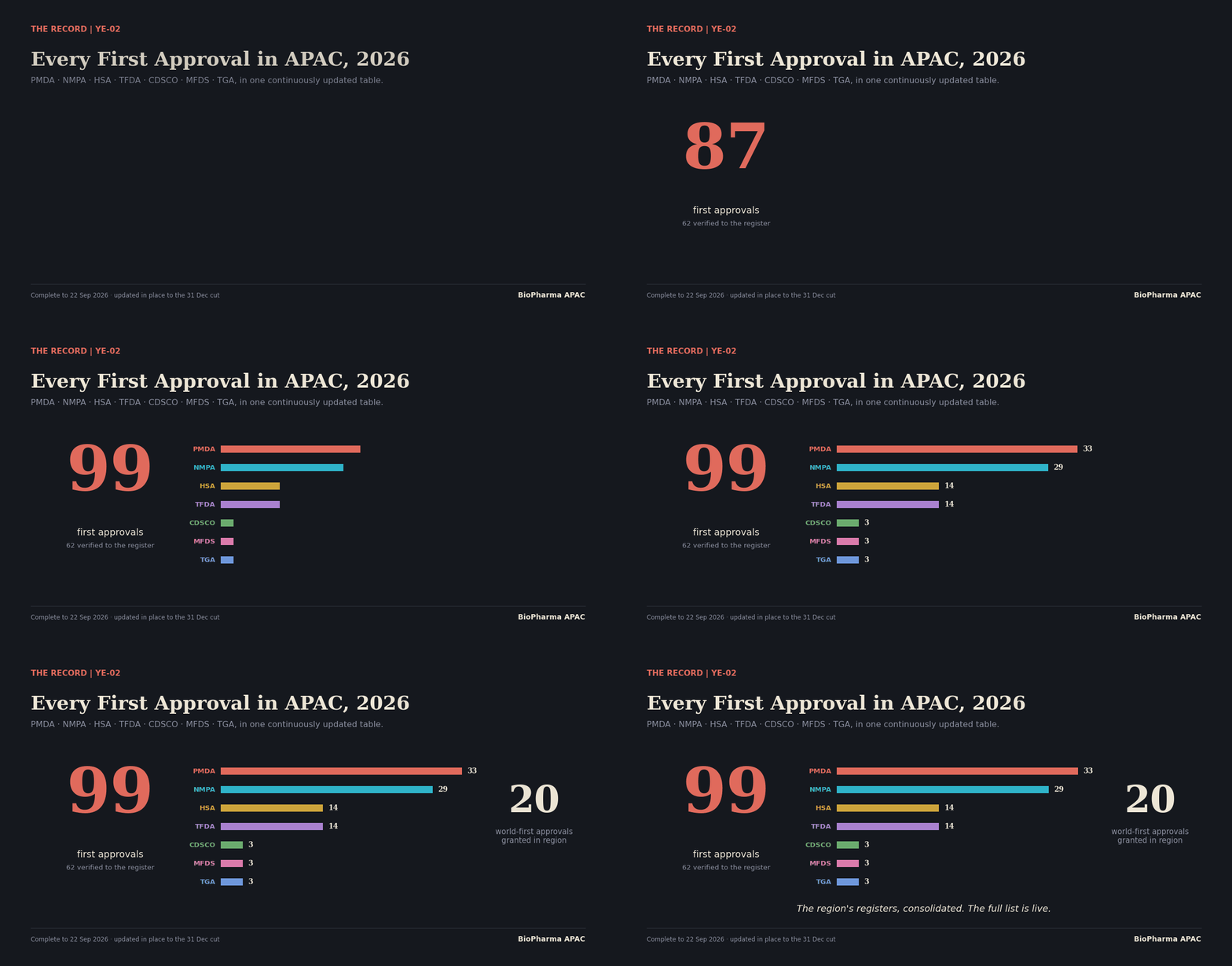
The score, complete to 22 September 2026: 99 new active substances documented, of which 62 are verified against the issuing authority's own register and 37 sit in the pending-verification section below. At least 20 of the 99 were world-first approvals, granted in this region before any regulator elsewhere had acted. Five more are probable world firsts awaiting confirmation. The table runs to the end of this piece; the pending section is dated and updated in place; the list closes at the 31 December cut in the first week of January.
How this list works
An entry here requires the authority's own publication: a register entry, an approval list, or a gazette notice, carrying a document reference and a date. Trade press reports of approval do not qualify on their own. Where a widely reported approval cannot yet be traced to the register, it is listed in the dated pending-verification section rather than the main table, with the reason stated. Approval dates are the dates on the register document, not the announcement.
New active substance means a molecule not previously approved by that authority in any product: new indications, new formulations, biosimilars and generics are excluded. One borderline case is flagged rather than silently resolved: PMDA classed MSD's Keyject, the subcutaneous pembrolizumab co-formulated with berahyaluronidase alfa, as a new active substance on the strength of the novel enzyme; it appears in the table carrying that flag.
Three registers resist automated consolidation, and the pending section is where that shows. NMPA's site refuses external access outright, MFDS's register blocks retrieval, and TGA's new-registrations list could not be machine-read at the cut. Entries from those authorities are held at pending until each is confirmed against the register by hand, a process that continues between this publication and the year-end close. The list is published complete to a stated cut date and updated in place, with a dated revision note for every addition. Nothing is added or changed silently.
One boundary, stated once: this is a record, not a forecast. What changes in APAC regulation in 2027 belongs to the 12 Regulatory Changes calendar, not here.
Five readings of the table
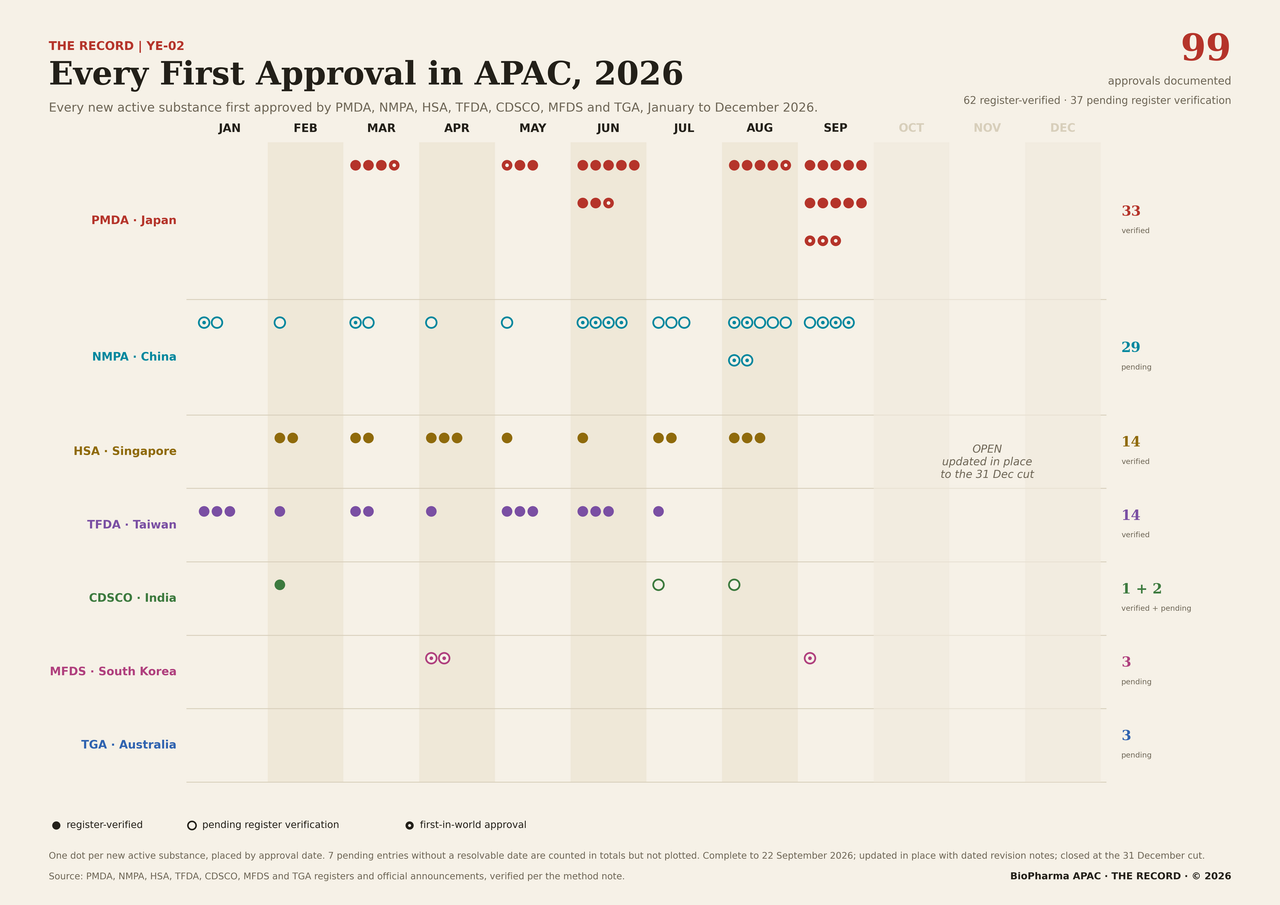
The volume sits in two registers. Ninety-nine documented first approvals by late September puts the region on course for a year comfortably north of 120 once the fourth quarter and the unresolved China tail are counted, against a Chinese full-year baseline of 76 innovative approvals in 2025 and a Japanese register that had never before cleared thirteen substances in a day. Japan and China account for 62 of the 99 entries between them, and they get there in opposite ways. PMDA's 33 arrived in five tightly choreographed batches: four molecules on 23 March, three in May, eight on 19 June, five on 24 August, and then the extraordinary 16 September batch of thirteen, the largest single approval day any regulator in this region has produced this year. NMPA's flow never stops: approvals landed in every month of the year so far, and the official tally, 38 Class 1 innovative drugs in the first half alone, implies the true China number is well above the 29 this list has so far documented. The other five authorities together produced 37 entries, and none of them more than 14.
The world-first ledger has moved east. Twenty of the 99 approvals were the first anywhere on earth for that molecule: eleven in China, six in Japan, three in South Korea. A decade ago a list like this would have carried one or two, usually a local vaccine. This year's world firsts include the first CAR-T therapy approved anywhere for a solid tumour, CARsgen's satri-cel for gastric cancer; the first bispecific antibody-drug conjugate approved anywhere, SystImmune's iza-bren; the first functional cure labelled for chronic hepatitis B, GSK's bepirovirsen, cleared in Tokyo under Sakigake before any Western regulator moved; and Korea's first domestically developed CAR-T, Curocell's anbal-cel. What was once the closing act of a global rollout is now, with growing frequency, the opening night. And the traffic runs both ways: AstraZeneca, GSK, Alexion and Bayer all chose, or accepted, that a 2026 molecule's first approval anywhere would happen in Japan. Takeda's oveporexton missed joining them by nineteen days, when the FDA cleared the narcolepsy drug on 5 August and PMDA followed on 24 August.
Two registers originate; five import. Origin, not just approval, is where the table divides. Of China's 29 documented entries, 25 are domestically developed molecules. Korea's three are all homegrown, numbered 42, 43 and 44 in the country's official count of home-developed new drugs. Then the share collapses: two of Japan's 33 entries are Japanese-origin molecules, one of Taiwan's 14 is Taiwanese, none of Singapore's 14 is Singaporean, and India's entries are domestic manufacturing of foreign-origin molecules. The region's approval map now has two origination engines and five import windows, and the import windows are importing from the engines as well as from the West: Japan's June batch carried cenobamate, a Korean molecule arriving via Ono, and its March batch carried risovalisib, a Shanghai-developed PI3K-alpha inhibitor that may itself be a world first.
The special pathways carried the year. Fifteen of Japan's 33 approvals ran as orphan designations, two under Sakigake and one under conditional early approval; barely half the register is standard-pathway. China's engine runs visibly on conditional approvals and priority review, which is how a solid-tumour CAR-T and a bispecific ADC reached market on single-arm data. Taiwan cleared three of its fourteen through accelerated or conditional routes. Korea's three all drew on expedited machinery, including the GIFT designation, and landed in the first full year of a reform that cut statutory review from 420 days to 240. The ordinary full-dossier, standard-review approval is no longer how most new molecules reach this region first.
The lag is collapsing, unevenly. The old shorthand for this region was the drug lag: years between a Western approval and its Asian echo. The 2026 table shows that lag splitting into two populations. At the fast end, the gap has compressed to weeks. Icotrokinra took its FDA approval in July 2026 and was approved in China on 27 August and in Japan on 16 September, three major approvals inside one summer. Rilzabrutinib, cleared by the FDA in August 2025, reached Japan in June and China in September. Brensocatib, dordaviprone and nerandomilast all reached Japan within roughly a year of their American approvals. At the slow end, the tail has never been longer: the same Japanese register that cleared bepirovirsen before the FDA also spent 2026 admitting anakinra 25 years after its US approval, pitolisant a decade after its European one, and isotretinoin 44 years after its American debut. The average lag is becoming a meaningless number; the split is the story.
One more pattern only a consolidated table can show: nine molecules crossed at least two of the seven registers within the year. Moderna's next-generation COVID vaccine cleared Tokyo on 18 May and Taipei on 20 May, two days apart. Clesrovimab reached Singapore in February, four months before Japan. Belantamab mafodotin's relaunch wave is legible as a regional sequence, Taiwan in March, Singapore in July. Tapinarof appears twice in a single month at opposite ends of the value chain, an Indian-manufactured version reported approved in August and Shionogi's licensed original cleared in Japan in September. Sequencing decisions that used to be invisible, buried in seven registers and five languages, are now a single sortable column.
The timeline strip that accompanies this piece plots all 92 dateable entries as one dot each, month by month, lane by lane, solid where the register confirms the entry and hollow where verification is pending. Read left to right it shows the year's real shape: a quiet January and February everywhere except Taipei and Beijing, the March fiscal-year surge in Tokyo, China's midsummer run, and the September wall.
Japan: the deepest register
PMDA's 33 verified entries make Japan the largest fully verified block in the table, and the batch rhythm tells its own story. The year started slowly: no new active substances in January or February, then four on 23 March to close fiscal 2025, among them gadoquatrane, Bayer's low-dose gadolinium contrast agent, which Japan approved roughly three months before the FDA. May brought Daiichi Sankyo's Mimurit, Japan's first domestically produced MMR vaccine, a world first with the caveat that it combines established strains.
The 19 June batch of eight was the year's most international, spanning Biogen's diroximel fumarate, Sanofi's rilzabrutinib, Novartis's remibrutinib and AstraZeneca's camizestrant, which Japan cleared two and a half months before the FDA acted, making a breast cancer molecule from a British company a Japanese world first. The same batch carried anakinra, arriving 25 years after its 2001 FDA approval, and isotretinoin, arriving 44 years after its American debut, two reminders that the famous drug lag still runs in both directions and both extremes.
August belonged to bepirovirsen. GSK's antisense oligonucleotide for chronic hepatitis B took its first approval anywhere in Tokyo on 24 August under Sakigake, the pathway built precisely to make Japan a first-launch market, carrying a functional-cure label no other regulator has yet granted. In a franchise dominated for a decade by suppression, a regulator writing the word cure onto a label is the single most consequential line in this year's table, and it happened in Japanese first.
Then came 16 September: thirteen approvals in one day, the biggest single approval date in the region this year and, on this list's records, the biggest in PMDA's modern history. The batch carried two more world firsts from Alexion, the C5 nanobody gefurulimab, notable as a self-injected challenger in a myasthenia gravis market built on infusions, and the AL amyloidosis antibody anselamimab. It carried Lilly's once-weekly insulin efsitora, approved in Japan while the FDA's decision was still pending, an apparent world first awaiting confirmation and a pointed one, since Japan is the market where weekly basal insulin's convenience case is strongest. And it carried the table's one definitional headache, Keyject, along with a run of oncology and rare-disease imports, tovorafenib, mirvetuximab, dordaviprone and emapalumab, that cleared most of Japan's backlog of 2022 to 2025 American approvals in a single sitting.
China: the biggest engine, behind a wall
Everything about China's 2026 is large except its verifiability. Officials confirmed 38 Class 1 innovative approvals in the first half alone, 31 of them domestic. This list documents 29 named molecules for the year to 22 September, every one of them held at pending because nmpa.gov.cn refuses external access and the register cannot yet be cited row by row. The desk check against the innovative-drug directory is underway; entries will move from the pending section to the main table with dated revision notes as each is confirmed.
What is already beyond doubt is the character of the year. China's eleven firm world firsts are not me-too chemistry: satri-cel is the first CAR-T anywhere for a solid tumour, iza-bren the first bispecific ADC anywhere, ecnoglutide the first cAMP-biased GLP-1 agonist, HH-003 the first hepatitis D antibody, felzartamab a German-originated molecule whose first approval anywhere came via its Chinese development partner, and mprosevir the first approved small molecule to come out of DNA-encoded library discovery. The engine also imports: tarlatamab, rilzabrutinib and icotrokinra all took Chinese approvals this year within months of their Western ones, a cadence that would have taken half a decade in the last cycle.
The domestic tail matters as much as the marquee names. July's reported approvals included adamgammadex, a homegrown reversal agent challenging sugammadex, and octohydroaminoacridine, an Alzheimer's small molecule from Tonghua Jinma, the kind of unglamorous Class 1 chemistry that never makes English-language news and is precisely what a register-verified list exists to capture. The September window is a story in itself: two competing domestic RSV antibodies, culevibart and retavibart, cleared on the same reported day, 3 September, setting up a winter launch fight in a market nirsevimab had to itself.
The documented list also has a known shadow. Official statements confirm approvals this list has not yet resolved to named molecules: an imported MET inhibitor, an EGFR exon-20 lung cancer drug, a myelofibrosis therapy and China's first independently developed diagnostic radiopharmaceuticals all appear in regulator and ministry summaries of the first half. They are counted in no total here. When the register check lands, the China block will grow, and the gap between 29 documented and whatever the register finally shows will be stated, not smoothed over.
South Korea: three approvals, all of them firsts
MFDS contributed the table's smallest verified-or-pending block and its highest concentration of novelty: three approvals, three world firsts, three homegrown molecules. Curocell's anbal-cel, homegrown new drug number 42, made Korea the first country to approve a domestically developed CAR-T, a cell therapy built on the company's own PD-1 and TIGIT dual-downregulation platform rather than a licensed construct. FutureChem's florastamin, number 43, is a PSMA PET imaging agent approved at home while its US phase 3 continues, the theranostic half of a strategy that treats the home register as the launchpad rather than the afterthought. GL Pharmtech's recoflafone eye drops, number 44, cleared on 8 September as the first approval to run through the fully reformed review clock, the June reform that cut Korea's statutory new-drug review from 420 days to 240.
Three homegrown approvals in a single year is a first for Korea; the country took two decades to reach its first fourteen. The register itself blocks automated retrieval, so all three sit at pending on press sourcing that reproduces MFDS's own announcements, and the imported-molecule side of Korea's ledger, historically fifteen to thirty new substances a year, is a known gap this list will fill by the close rather than an absence to be read as zero. The near-term watch is Hanmi's efpeglenatide, filed in December 2025 under GIFT designation and targeted for approval within 2026; if it lands before the cut, Korea's homegrown count goes to four and the year gets its first domestic GLP-1.
Taiwan and Singapore: the import windows
TFDA's fourteen verified entries map almost perfectly onto the previous eighteen months of FDA and EMA approvals: sotatercept, dostarlimab, tucatinib, atrasentan, imlunestrant and their cohort, arriving in Taipei on a lag of one to three years. Two entries break the pattern. Aumolertinib opened the year on 8 January as a China-originated EGFR inhibitor carried by a Taiwanese licence-holder, TTY Biopharm, the engines-to-windows trade in a single row. And ibalizumab came home: developed by TaiMed Biologics, approved by the FDA in 2018, and only on 25 June 2026 licensed in Taiwan itself, eight years after its own molecule conquered a foreign market.
Taiwan also supplied the year's best illustration of this list's boundary line. PharmaEssentia's Besremi took what the company rightly called the first approval anywhere in the world for essential thrombocythaemia in June, a genuine Taiwanese world first, and it is not in this table, because ropeginterferon has been licensed in Taiwan since 2021 and a new indication is not a new active substance. The scope rule cuts against a good story here, which is exactly when a scope rule proves it exists.
HSA's fourteen are the cleanest demonstration of what a reliance-model regulator looks like in table form: not one world first, a steady one-or-two-a-month cadence from February through August, and a register updated frequently enough that every entry here is verified, complete with SIN licence numbers. The mix skews sharply to rare disease and oncology, teprotumumab, vosoritide, motixafortide, pirtobrutinib, which is what an abridged route optimised for already-approved molecules delivers. Singapore also quietly beat Japan on a shared molecule, registering clesrovimab in February against PMDA's June, a reminder that a reliance model can be fast precisely because someone else did the primary review.
India: a register that stopped in March
CDSCO presents the table's strangest picture: a register of record, the List of New Drugs Approved, that has not been updated since 12 March 2026 and currently carries a single 2026 new active substance, brexpiprazole, approved in February. Everything since is press-verifiable only. Two entries wait in the pending section: Takeda's Qdenga, reported cleared on 20 July as India's first dengue vaccine of any kind, approved for ages four to sixty with no pre-vaccination screening, and Optimus Pharma's tapinarof cream, reported in August as the first Indian permission for the molecule on the strength of a 213-patient domestic phase 3.
Neither the engine nor the pipeline looks idle. Subject Expert Committee recommendation records run through at least May, and the localisation pattern in both verified and pending entries, foreign-origin molecules approved on Indian manufacturing and Indian trial data, is consistent with a busy year. In a normal year the Indian register would carry a dozen or more entries by September; the 2025 list implies exactly that. Either India's approval engine slowed sharply in 2026, or its register did. The distinction matters, not least because CDSCO's list is the only one of the seven that is free, official and in English when it is current, and the year-end close will state which it was.
Australia: the machine-unreadable register
TGA publishes exactly the register this list needs, a new-registrations list with dates, sponsors and pathway flags. It also blocks every automated route to it. Three candidates surfaced through AusPAR publications, ublituximab, repotrectinib and avacincaptad pegol, and all three sit at pending with dates unconfirmed, because an AusPAR publication date is not a registration date; toripalimab's AusPAR appeared in July 2026 for a registration granted in January 2025, and that trap is exactly why this list's method refuses to print an approval date it cannot trace. The Australian block will be completed by hand before the close, and its absence from the verified count today is the method working, not failing.
Between now and the close
Three things will change this table by January. The pending section will drain as the NMPA, MFDS and TGA desk checks complete, and the China count in particular should rise well past its documented 29. October, November and December will add their own approvals, with Japan due at least one more batch on its established cadence, China's fourth quarter historically its heaviest, and Korea's efpeglenatide decision live. And the first-in-world column will settle as the handful of apparent and probable firsts, led by insulin efsitora, risovalisib and tinengotinib, are confirmed or reassigned.
Every change lands as a dated revision note; nothing is edited silently; and the closed 2026 table becomes the baseline the 2027 edition measures itself against, on the same fixed columns. The registers will keep publishing in seven places and five languages. The list will keep being one table. The 2026 list closes in the first week of January; the 2027 edition opens the same week.
The full entry tables follow: Table 1, the 62 register-verified entries; Table 2, the 37 entries pending register verification, each with its reason and source.
Table 1. Register-verified first approvals, 1 January to 22 September 2026 (62 entries)
|
Authority |
Date |
Molecule (INN) |
Brand |
Sponsor / applicant |
Indication |
Pathway / designation |
First-in-world |
Register reference |
|
PMDA |
2026-03-23 |
leniolisib |
Joenja |
OrphanPacific |
Activated PI3K-delta syndrome (APDS) |
Orphan |
no |
PMDA FY2025 list, 000277965.pdf |
|
PMDA |
2026-03-23 |
triheptanoin |
Dojolvi |
Ultragenyx Japan |
Long-chain fatty acid oxidation disorders |
Orphan |
no |
PMDA FY2025 list, 000277965.pdf |
|
PMDA |
2026-03-23 |
gadoquatrane |
Ambelvist |
Bayer Yakuhin |
Low-dose gadolinium MRI contrast agent |
Standard |
yes |
PMDA FY2025 list, 000277965.pdf |
|
PMDA |
2026-03-23 |
risovalisib |
Hytzexin |
Haihe Pharmaceutical |
PIK3CA-mutated ovarian clear cell carcinoma |
Standard |
unclear |
PMDA FY2025 list, 000277965.pdf |
|
PMDA |
2026-05-11 |
measles-mumps-rubella vaccine (live attenuated) |
Mimurit |
Daiichi Sankyo |
MMR prophylaxis; Japan's first domestic MMR |
Standard |
yes |
PMDA FY2026 list, 000281577.pdf |
|
PMDA |
2026-05-18 |
nerandomilast |
Jascayd |
Nippon Boehringer Ingelheim |
Idiopathic pulmonary fibrosis / progressive pulmonary fibrosis |
Orphan |
no |
PMDA FY2026 list, 000281577.pdf |
|
PMDA |
2026-05-18 |
SARS-CoV-2 mRNA vaccine (next-generation) |
mNEXSPIKE |
Moderna Japan |
COVID-19 prophylaxis |
Standard |
no |
PMDA FY2026 list, 000281577.pdf |
|
PMDA |
2026-06-19 |
diroximel fumarate |
Vumerity |
Biogen Japan |
Relapsing-remitting multiple sclerosis |
Standard |
no |
PMDA FY2026 list, 000281577.pdf |
|
PMDA |
2026-06-19 |
netarsudil |
Rhopressa |
Santen |
Glaucoma / ocular hypertension, second line |
Standard |
no |
PMDA FY2026 list, 000281577.pdf |
|
PMDA |
2026-06-19 |
rilzabrutinib |
Wayrilz |
Sanofi |
Persistent/chronic immune thrombocytopenia |
Orphan |
no |
PMDA FY2026 list, 000281577.pdf |
|
PMDA |
2026-06-19 |
remibrutinib |
Rhapsido |
Novartis Pharma |
Chronic spontaneous urticaria, refractory |
Standard |
no |
PMDA FY2026 list, 000281577.pdf |
|
PMDA |
2026-06-19 |
anakinra |
Kineret |
Swedish Orphan Biovitrum Japan |
Systemic JIA / adult-onset Still's disease |
Orphan |
no |
PMDA FY2026 list, 000281577.pdf |
|
PMDA |
2026-06-19 |
clesrovimab |
Enflonsia |
MSD |
RSV lower respiratory tract disease prevention, infants |
Standard |
no |
PMDA FY2026 list, 000281577.pdf |
|
PMDA |
2026-06-19 |
camizestrant |
Etcamah |
AstraZeneca |
HR-positive HER2-negative breast cancer with emergent ESR1 mutation |
Standard |
yes |
PMDA FY2026 list, 000281577.pdf |
|
PMDA |
2026-06-19 |
isotretinoin |
Isotrex |
Sun Pharma Japan |
Neuroblastoma after high-dose chemotherapy |
Orphan |
no |
PMDA FY2026 list, 000281577.pdf |
|
PMDA |
2026-08-24 |
bepirovirsen |
Hibsago |
GlaxoSmithKline |
Chronic hepatitis B, functional cure |
Sakigake |
yes |
PMDA FY2026 list, 000281577.pdf |
|
PMDA |
2026-08-24 |
brensocatib |
Brinsupri |
Insmed |
Non-cystic fibrosis bronchiectasis |
Standard |
no |
PMDA FY2026 list, 000281577.pdf |
|
PMDA |
2026-08-24 |
sevabertinib |
Hyrnuo |
Bayer Yakuhin |
HER2-mutant unresectable advanced/recurrent NSCLC |
Orphan |
no |
PMDA FY2026 list, 000281577.pdf |
|
PMDA |
2026-08-24 |
oveporexton |
Orzeyful |
Takeda |
Narcolepsy type 1 (orexin OX2R agonist) |
Sakigake + orphan |
no |
PMDA FY2026 list, 000281577.pdf |
|
PMDA |
2026-08-24 |
setmelanotide |
Imcivree |
Rhythm Pharmaceuticals Japan |
Acquired hypothalamic obesity |
Orphan |
no |
PMDA FY2026 list, 000281577.pdf |
|
PMDA |
2026-09-16 |
cenobamate |
Xcopri |
Ono Pharmaceutical |
Partial-onset seizures in epilepsy |
Standard |
no |
PMDA FY2026 list, 000281577.pdf |
|
PMDA |
2026-09-16 |
pitolisant |
Wakix |
Viatris |
Narcolepsy; EDS in obstructive sleep apnoea |
Orphan (narcolepsy) |
no |
PMDA FY2026 list, 000281577.pdf |
|
PMDA |
2026-09-16 |
gefurulimab |
Qlaijefa (JP brand, katakana) |
Alexion Pharma |
Generalised myasthenia gravis (C5 nanobody, self-injection) |
Standard |
yes |
PMDA FY2026 list, 000281577.pdf |
|
PMDA |
2026-09-16 |
eptinezumab |
Vyepti |
Lundbeck Japan |
Migraine prophylaxis |
Standard |
no |
PMDA FY2026 list, 000281577.pdf |
|
PMDA |
2026-09-16 |
anselamimab |
Amylopave (JP brand, katakana) |
Alexion Pharma |
Systemic AL amyloidosis |
Orphan |
yes |
PMDA FY2026 list, 000281577.pdf |
|
PMDA |
2026-09-16 |
insulin efsitora alfa |
Onsuik (JP brand, katakana) |
Eli Lilly Japan |
Type 2 diabetes, once-weekly basal insulin |
Standard |
yes (apparent) |
PMDA FY2026 list, 000281577.pdf |
|
PMDA |
2026-09-16 |
icotrokinra |
Icotide (JP brand, katakana) |
Janssen Pharma |
Plaque/pustular/erythrodermic psoriasis (oral IL-23R peptide) |
Standard |
no |
PMDA FY2026 list, 000281577.pdf |
|
PMDA |
2026-09-16 |
emapalumab |
Gamifant |
Swedish Orphan Biovitrum Japan |
Macrophage activation syndrome / HLH |
Orphan |
no |
PMDA FY2026 list, 000281577.pdf |
|
PMDA |
2026-09-16 |
berahyaluronidase alfa (with pembrolizumab) |
Keyject |
MSD |
Pembrolizumab subcutaneous formulation, multiple tumour indications |
Standard |
no |
PMDA FY2026 list, 000281577.pdf |
|
PMDA |
2026-09-16 |
tovorafenib |
Ojemda |
Ipsen |
Paediatric low-grade glioma |
Conditional early approval + orphan |
no |
PMDA FY2026 list, 000281577.pdf |
|
PMDA |
2026-09-16 |
mirvetuximab soravtansine |
Elahere |
Takeda |
FR-alpha positive ovarian cancer |
Orphan |
no |
PMDA FY2026 list, 000281577.pdf |
|
PMDA |
2026-09-16 |
dordaviprone |
Modeyso |
Ohara Pharmaceutical |
Diffuse midline glioma (H3 K27M) |
Orphan |
no |
PMDA FY2026 list, 000281577.pdf |
|
PMDA |
2026-09-16 |
tapinarof |
Vtama |
Shionogi |
Psoriasis (topical AhR agonist) |
Standard |
no |
PMDA FY2026 list, 000281577.pdf |
|
HSA |
2026-02-12 |
clesrovimab |
Enflonsia |
MSD Pharma (Singapore) |
RSV lower respiratory tract disease prevention, infants |
NDA-1 (route not stated in register) |
no |
HSA register; SIN17467P |
|
HSA |
2026-02-20 |
pneumococcal 21-valent conjugate vaccine |
Capvaxive |
MSD Pharma (Singapore) |
Invasive pneumococcal disease prevention, adults |
NDA-1 (route not stated in register) |
no |
HSA register; SIN17471P |
|
HSA |
2026-03-06 |
RSV mRNA vaccine (mRNA-1345) |
mResvia |
Moderna Biotech Singapore |
RSV disease prevention, older adults |
NDA-1 (route not stated in register) |
no |
HSA register; SIN17482P |
|
HSA |
2026-03-16 |
ivosidenib |
Tibsovo |
Servier (S) |
IDH1-mutated AML / cholangiocarcinoma |
NDA-1 (route not stated in register) |
no |
HSA register; SIN17485P |
|
HSA |
2026-04-01 |
lanadelumab |
Takhzyro |
Takeda Pharmaceuticals (Asia Pacific) |
Hereditary angioedema prophylaxis |
NDA-1 (route not stated in register) |
no |
HSA register; SIN17511P |
|
HSA |
2026-04-15 |
icatibant |
Firazyr |
Takeda Pharmaceuticals (Asia Pacific) |
Acute hereditary angioedema attacks |
NDA-1 (route not stated in register) |
no |
HSA register; SIN17516P |
|
HSA |
2026-04-27 |
indocyanine green |
Verdye |
Transmedic |
Diagnostic / surgical visualisation agent |
NDA-1 (route not stated in register) |
no |
HSA register; SIN17525P |
|
HSA |
2026-05-15 |
teprotumumab |
Tepezza |
Amgen Biotechnology Singapore |
Thyroid eye disease |
NDA-1 (route not stated in register) |
no |
HSA register; SIN17539P |
|
HSA |
2026-06-08 |
motixafortide |
Aphexda |
DCH Auriga Singapore |
Stem cell mobilisation in multiple myeloma |
NDA-1 (route not stated in register) |
no |
HSA register; SIN17555P |
|
HSA |
2026-07-06 |
mirogabalin |
Tarlige |
A. Menarini Singapore |
Peripheral neuropathic pain |
NDA-1 (route not stated in register) |
no |
HSA register; SIN17575P |
|
HSA |
2026-07-21 |
belantamab mafodotin |
Blenrep |
GlaxoSmithKline |
Relapsed/refractory multiple myeloma |
NDA-1 (route not stated in register) |
no |
HSA register; SIN17590P |
|
HSA |
2026-08-19 |
vosoritide |
Voxzogo |
Novem Healthcare |
Achondroplasia in children |
NDA-1 (route not stated in register) |
no |
HSA register; SIN17615P |
|
HSA |
2026-08-20 |
insulin icodec |
Awiqli FlexTouch |
Novo Nordisk Pharma (Singapore) |
Once-weekly basal insulin, diabetes |
NDA-1 (route not stated in register) |
no |
HSA register; SIN17619P |
|
HSA |
2026-08-27 |
pirtobrutinib |
Jaypirca |
DKSH Singapore |
Relapsed/refractory MCL / CLL |
NDA-1 (route not stated in register) |
no |
HSA register; SIN17627P |
|
TFDA |
2026-01-08 |
aumolertinib |
Pulmivex |
TTY Biopharm (in-licensed from Hansoh Pharma) |
EGFR-mutant NSCLC first line; T790M-positive NSCLC |
Accelerated (T790M indication conditional) |
no |
TFDA NAS review register, sid 2712 |
|
TFDA |
2026-01-12 |
sotatercept |
Winrevair |
MSD Taiwan |
Pulmonary arterial hypertension (WHO Group 1) |
Standard |
no |
TFDA NAS review register, sid 2712 |
|
TFDA |
2026-01-22 |
dostarlimab |
Jemperli |
GSK Taiwan |
Primary advanced/recurrent endometrial cancer |
Standard |
no |
TFDA NAS review register, sid 2712 |
|
TFDA |
2026-02-12 |
rozanolixizumab |
Rystiggo |
UCB Taiwan |
Generalised myasthenia gravis, add-on |
Standard |
no |
TFDA NAS review register, sid 2712 |
|
TFDA |
2026-03-02 |
tucatinib |
Tukysa |
Pfizer Taiwan |
HER2-positive advanced breast cancer |
Standard |
no |
TFDA NAS review register, sid 2712 |
|
TFDA |
2026-03-11 |
belantamab mafodotin |
Blenrep |
GSK Taiwan |
Relapsed/refractory multiple myeloma |
Standard |
no |
TFDA NAS review register, sid 2712 |
|
TFDA |
2026-04-23 |
pneumococcal 21-valent conjugate vaccine |
Capvaxive |
MSD Taiwan |
Invasive pneumococcal disease prevention, adults 18+ |
Accelerated |
no |
TFDA NAS review register, sid 2712 |
|
TFDA |
2026-05-07 |
mirvetuximab soravtansine |
Elahere |
AbbVie Taiwan |
FR-alpha positive platinum-resistant ovarian cancer |
Standard |
no |
TFDA NAS review register, sid 2712 |
|
TFDA |
2026-05-15 |
imlunestrant |
Inluriyo |
Eli Lilly Taiwan |
ER-positive HER2-negative advanced breast cancer with ESR1 mutation |
Standard |
no |
TFDA NAS review register, sid 2712 |
|
TFDA |
2026-05-20 |
SARS-CoV-2 mRNA vaccine (mRNA-1283) |
mNEXSPIKE |
Moderna Taiwan |
COVID-19 immunisation, ages 12+ |
Standard |
no |
TFDA NAS review register, sid 2712 |
|
TFDA |
2026-06-08 |
netarsudil (fixed-dose with latanoprost) |
Rocklatan |
Santen Taiwan |
Elevated IOP in open-angle glaucoma |
Standard |
no |
TFDA NAS review register, sid 2712 |
|
TFDA |
2026-06-22 |
atrasentan |
Vanrafia |
Novartis Taiwan |
Proteinuria reduction in primary IgA nephropathy |
Accelerated/conditional |
no |
TFDA NAS review register, sid 2712 |
|
TFDA |
2026-06-25 |
ibalizumab |
Trogarzo |
Excelsior Biopharma (developer TaiMed Biologics) |
Multidrug-resistant HIV-1 |
Standard |
no |
TFDA NAS review register, sid 2712 |
|
TFDA |
2026-07-07 |
tildrakizumab |
Ilumetri |
Kang Lian Da (agent for Almirall) |
Moderate-to-severe plaque psoriasis |
Standard |
no |
TFDA NAS review register, sid 2712 |
|
CDSCO |
2026-02-16 |
brexpiprazole |
not stated in register |
not stated in register |
Schizophrenia |
Standard |
no |
CDSCO List of New Drugs approved in 2026 (register PDF, last updated 12 Mar 2026) |
Notes: entries sorted by authority, then date. Japanese trade names for four 16 September approvals await confirmed romanisation and are marked accordingly in the tracking sheet. The Keyject entry carries the definitional flag described in the method note. Full source URLs, origin markets and per-entry notes are in the accompanying tracking sheet.
Table 2. Pending register verification at the 22 September cut (37 entries)
|
Authority |
Reported date |
Molecule (INN) |
Sponsor / applicant |
Indication |
First-in-world |
Why pending |
Best available source |
|
NMPA |
2026-01-06 (reported) |
sonrotoclax |
BeOne Medicines (BeiGene) |
R/R CLL/SLL and R/R MCL after BTK inhibitor |
yes |
nmpa.gov.cn blocks external access (HTTP 412/403); to be checked against the innovative-drug directory |
link.springer.com |
|
NMPA |
2026-01-16 (reported) |
ologliflozin |
HEC / Sunshine Lake Pharma |
Type 2 diabetes |
no |
nmpa.gov.cn blocks external access (HTTP 412/403); to be checked against the innovative-drug directory |
zyzhan.com |
|
NMPA |
2026-02-13 (reported) |
anmu (SSGJ-608, anti-IL-17A mAb) |
Sunshine Guojian |
Moderate-to-severe plaque psoriasis |
no |
nmpa.gov.cn blocks external access (HTTP 412/403); to be checked against the innovative-drug directory |
phirda.com |
|
NMPA |
2026-03 (reported) |
ecnoglutide |
Sciwind Biosciences |
Weight management / type 2 diabetes |
yes |
nmpa.gov.cn blocks external access (HTTP 412/403); to be checked against the innovative-drug directory |
phirda.com |
|
NMPA |
2026-03-19 (reported) |
long-acting erythropoiesis-stimulating agent (INN to confirm) |
3SBio |
Anaemia of CKD on dialysis |
unclear |
nmpa.gov.cn blocks external access (HTTP 412/403); to be checked against the innovative-drug directory |
zyzhan.com |
|
NMPA |
2026-04-10 (reported) |
tarlatamab |
Amgen (with BeOne Medicines) |
Small-cell lung cancer |
no |
nmpa.gov.cn blocks external access (HTTP 412/403); to be checked against the innovative-drug directory |
yicaiglobal.com |
|
NMPA |
2026-05-28 (reported) |
ruzinurad |
Jiangsu Hengrui |
Gout with hyperuricaemia (URAT1 inhibitor) |
no |
nmpa.gov.cn blocks external access (HTTP 412/403); to be checked against the innovative-drug directory |
tipranks.com |
|
NMPA |
2026-06 (reported) |
pelegenan (PL-5 antimicrobial peptide) |
Prime Medical |
Multidrug-resistant bacterial wound infection |
yes |
nmpa.gov.cn blocks external access (HTTP 412/403); to be checked against the innovative-drug directory |
finance.sina.com.cn |
|
NMPA |
2026-06-20 (announced 22 Jun) |
satricabtagene autoleucel (satri-cel) |
CARsgen |
CLDN18.2-positive advanced gastric / GEJ adenocarcinoma |
yes |
nmpa.gov.cn blocks external access (HTTP 412/403); to be checked against the innovative-drug directory |
carsgen.com |
|
NMPA |
2026-06-22 (announced) |
izalontamab brengitecan (iza-bren, BL-B01D1) |
Baili Tianheng / SystImmune |
3L+ recurrent/metastatic nasopharyngeal carcinoma |
yes |
nmpa.gov.cn blocks external access (HTTP 412/403); to be checked against the innovative-drug directory |
prnewswire.com |
|
NMPA |
2026-06-22 (reported) |
rabies bispecific antibody (silewei mAb) |
Genrix Bio |
Rabies post-exposure passive immunisation |
yes |
nmpa.gov.cn blocks external access (HTTP 412/403); to be checked against the innovative-drug directory |
cq.cnr.cn |
|
NMPA |
2026-07-14 (reported) |
adamgammadex sodium |
Hangzhou Adamerck |
Reversal of rocuronium neuromuscular blockade |
unclear |
nmpa.gov.cn blocks external access (HTTP 412/403); to be checked against the innovative-drug directory |
163.com |
|
NMPA |
2026-07-14 (reported) |
octohydroaminoacridine succinate |
Tonghua Jinma |
Mild-to-moderate Alzheimer's disease |
unclear |
nmpa.gov.cn blocks external access (HTTP 412/403); to be checked against the innovative-drug directory |
163.com |
|
NMPA |
2026-07-29 (reported) |
anti-IL-36R mAb (likely HB0034) |
Shanghai Huaota-linked sponsor |
Generalised pustular psoriasis flares |
no |
nmpa.gov.cn blocks external access (HTTP 412/403); to be checked against the innovative-drug directory |
ipharmacenter.com |
|
NMPA |
2026-08-11 (reported) |
tinengotinib |
TransThera |
FGFR2-fusion cholangiocarcinoma, previously treated |
yes (likely) |
nmpa.gov.cn blocks external access (HTTP 412/403); to be checked against the innovative-drug directory |
ipharmacenter.com |
|
NMPA |
2026-08-13 (reported) |
felzartamab |
I-Mab / TJ Biopharma with Biogen |
R/R multiple myeloma (with len/dex) |
yes |
nmpa.gov.cn blocks external access (HTTP 412/403); to be checked against the innovative-drug directory |
prnasia.com |
|
NMPA |
2026-08-27 (reported) |
fanregratinib (HMPL-453) |
HUTCHMED |
FGFR2 fusion/rearranged intrahepatic cholangiocarcinoma |
yes |
nmpa.gov.cn blocks external access (HTTP 412/403); to be checked against the innovative-drug directory |
hutch-med.com |
|
NMPA |
2026-08-27 (reported) |
TY-9591 (deuterated osimertinib analogue) |
TYK Medicines |
EGFR-mutant NSCLC with CNS metastases |
yes (molecule-first) |
nmpa.gov.cn blocks external access (HTTP 412/403); to be checked against the innovative-drug directory |
news.qq.com |
|
NMPA |
2026-08-27 (reported) |
anti-IL-17A/F mAb (LZM012-type) |
Livzon |
Moderate-to-severe plaque psoriasis |
unclear |
nmpa.gov.cn blocks external access (HTTP 412/403); to be checked against the innovative-drug directory |
news.qq.com |
|
NMPA |
2026-08-27 (reported) |
BCMA-directed biologic (GR1803-type) |
Genrix Bio |
R/R multiple myeloma |
unclear |
nmpa.gov.cn blocks external access (HTTP 412/403); to be checked against the innovative-drug directory |
news.qq.com |
|
NMPA |
2026-08-27 (reported) |
icotrokinra |
Xian Janssen |
Plaque psoriasis (oral IL-23R peptide) |
no |
nmpa.gov.cn blocks external access (HTTP 412/403); to be checked against the innovative-drug directory |
news.qq.com |
|
NMPA |
2026-09-03 (reported) |
mprosevir |
Westlake Pharmaceuticals |
Mild-to-moderate COVID-19 |
yes |
nmpa.gov.cn blocks external access (HTTP 412/403); to be checked against the innovative-drug directory |
globaltimes.cn |
|
NMPA |
2026-09-03 (reported) |
rilzabrutinib |
Sanofi |
Persistent/chronic primary immune thrombocytopenia |
no |
nmpa.gov.cn blocks external access (HTTP 412/403); to be checked against the innovative-drug directory |
ipharmacenter.com |
|
NMPA |
2026-09-03 (reported) |
culevibart |
Reyoung Biopharma / Simcere |
RSV LRTI prevention, neonates and infants |
yes (molecule-first) |
nmpa.gov.cn blocks external access (HTTP 412/403); to be checked against the innovative-drug directory |
allsci.com |
|
NMPA |
2026-09-03 (reported) |
retavibart (TNM001) |
Trinomab |
RSV LRTI prevention, infants entering first RSV season |
yes (molecule-first) |
nmpa.gov.cn blocks external access (HTTP 412/403); to be checked against the innovative-drug directory |
allsci.com |
|
NMPA |
2026-H1 (month untraced) |
retlirafusp alfa |
Jiangsu Hengrui |
Gastric / GEJ adenocarcinoma |
yes |
nmpa.gov.cn blocks external access (HTTP 412/403); to be checked against the innovative-drug directory |
phirda.com |
|
NMPA |
2026-H1 (month untraced) |
anti-PreS1 hepatitis D mAb (HH-003) |
Huahui Anjian |
Hepatitis D |
yes |
nmpa.gov.cn blocks external access (HTTP 412/403); to be checked against the innovative-drug directory |
chinanews.com.cn |
|
NMPA |
2026-H1 (month untraced) |
plozasiran sodium |
Arrowhead / Visirna (Greater China) |
Severe hypertriglyceridaemia |
unclear |
nmpa.gov.cn blocks external access (HTTP 412/403); to be checked against the innovative-drug directory |
phirda.com |
|
NMPA |
2026-Q1 (reported) |
higenamine hydrochloride |
domestic sponsor (to confirm) |
Pharmacologic stress agent for myocardial perfusion imaging |
unclear |
nmpa.gov.cn blocks external access (HTTP 412/403); to be checked against the innovative-drug directory |
zyzhan.com |
|
CDSCO |
2026-07-20 (reported) |
dengue tetravalent vaccine, live attenuated (TAK-003) |
Takeda Biopharmaceuticals India |
Dengue prevention, ages 4 to 60; India's first dengue vaccine |
no |
Not yet on CDSCO register (stale since 12 Mar 2026) |
business-standard.com |
|
CDSCO |
2026-08-17 (reported) |
tapinarof (cream 1%) |
Optimus Pharma |
Plaque psoriasis, adults |
no |
Not yet on CDSCO register |
pharmabiz.com |
|
MFDS |
2026-04-29 |
anbalcabtagene autoleucel (anbal-cel) |
Curocell |
Relapsed/refractory DLBCL and PMBCL |
yes |
MFDS announcement 29 Apr 2026 (register robots-blocked; press-verified) |
en.sedaily.com |
|
MFDS |
2026-04-30 |
florastamin (18F) |
FutureChem |
PSMA-targeted PET-CT imaging of prostate cancer |
yes |
MFDS announcement (register robots-blocked; press-verified) |
asiae.co.kr |
|
MFDS |
2026-09-08 |
recoflafone |
GL Pharmtech with Aju Pharm |
Adult dry eye disease |
yes |
MFDS announcement 8 Sep 2026 (register robots-blocked; press-verified) |
newspim.com |
|
TGA |
2026 (date unconfirmed) |
ublituximab |
sponsor to confirm |
Relapsing multiple sclerosis |
no |
AusPAR published Apr 2026; ARTG date unverified |
tga.gov.au |
|
TGA |
2026 (date unconfirmed) |
repotrectinib |
Bristol Myers Squibb Australia (to confirm) |
ROS1-positive NSCLC / NTRK-positive solid tumours |
no |
AusPAR published Jan/Feb 2026; ARTG date unverified |
tga.gov.au |
|
TGA |
2026 (date unconfirmed) |
avacincaptad pegol |
Astellas Pharma Australia |
Geographic atrophy secondary to AMD |
no |
TGA register entry page exists; fetch blocked |
tga.gov.au |
**Each entry moves to Table 1 with a dated revision note once confirmed against the issuing authority's register, or is removed with a dated note if the register does not support it. Reported dates come from sponsor announcements, state media reproducing regulator statements, or trade press, and may differ from the certificate date by one to two days.
Sources and method. Entries verified against: PMDA new drug approval lists FY2025 and FY2026 (pmda.go.jp, documents 000277965 and 000281577); HSA Listing of Approvals (register update of 15 September 2026, SIN licence numbers cited per entry); TFDA new active substance review report summaries (fda.gov.tw, register sid 2712, licence dates as stated in each review PDF); CDSCO List of New Drugs Approved in 2026 (register PDF last updated 12 March 2026). Pending entries cite the best available official-adjacent source per row: sponsor announcements, state media reproducing regulator statements, and specialist trade press. Official aggregate figures for China (38 Class 1 approvals in H1 2026, 31 domestic) are from NMPA and MIIT statements reproduced by state media. Verification cut: 22 September 2026. Known limitations at the cut: NMPA, MFDS and TGA registers inaccessible to automated retrieval; CDSCO register stale since March; PMDA row-level designation fields for the 23 March batch pending manual re-verification; Japanese trade-name romanisations for four September approvals pending confirmation; the Keyject entry carries a definitional flag. This piece will be updated in place; each addition or correction carries a dated revision note.
Disclaimer. This article is a record of regulatory actions compiled from the cited public sources and is provided for general information only. It is not medical, clinical, investment or regulatory advice, and no entry implies endorsement, availability, reimbursement or comparative merit of any product. Approval scope and labels differ by jurisdiction; readers should consult the issuing authority's register before relying on any entry. Errors identified against primary registers will be corrected in place with a dated note.
Colophon. THE RECORD is BioPharma APAC's year-end franchise: the APAC biopharma year, closed and counted. YE-02, Every First Approval in APAC, is the series flagship and an annual publication; the 2026, 2027 and 2028 editions will interlink, and the tracking sheet behind this table carries fixed columns so that next year's edition is assembly, not archaeology.
© 2026 BioPharma APAC. All rights reserved.
Most Read
- Can APAC Biomanufacturing Decarbonise Without Pricing Itself Out?
- The Algorithm on the GMP Floor: AI Promises a Smarter Plant. Regulators Demand the Audit Trail.
- APAC's Peptide-Capacity Gamble
- After the Rush: APAC's mRNA and Vaccine Capacity Hangover
- The Biosimilar Race: Factory to the World — or Stuck in the Copycat Economy?
- The Vein-to-Vein Problem: Can APAC's Cold Chain Carry Advanced Therapies?
- Vectors, Plasmids and the CGT Trap: APAC's Cell and Gene Therapy Ambitions Face an Upstream Bottleneck
- Can APAC Build Radioligand Therapy Before the Atoms Decay?
- The Great Biopharma Reset: 50 Developments That Changed Everything in H1 2026
- Beyond the Trial: Can Real-World Evidence Earn Regulatory Trust in APAC?
- Beyond the Obvious Giant: Where APAC's Clinical Trials Go Next
- The Frontier That Won’t Quite Arrive
Bio Jobs
- Sanofi Turns The Page As Belén Garijo Steps In And Paul Hudson Steps Out
- Global Survey Reveals Nearly 40% of Employees Facing Fertility Challenges Consider Leaving Their Jobs
- BioMed X and AbbVie Begin Global Search for Bold Neuroscience Talent To Decode the Biology of Anhedonia
- Thermo Fisher Expands Bengaluru R&D Centre to Advance Antibody Innovation and Strengthen India’s Life Sciences Ecosystem
- Accord Plasma (Intas Group) Acquires Prothya Biosolutions to Expand Global Plasma Capabilities
- ACG Announces $200 Million Investment to Establish First U.S. Capsule Manufacturing Facility in Atlanta
- AstraZeneca Invests $4.5 Billion to Build Advanced Manufacturing Facility in Virginia, Expanding U.S. Medicine Production
News